
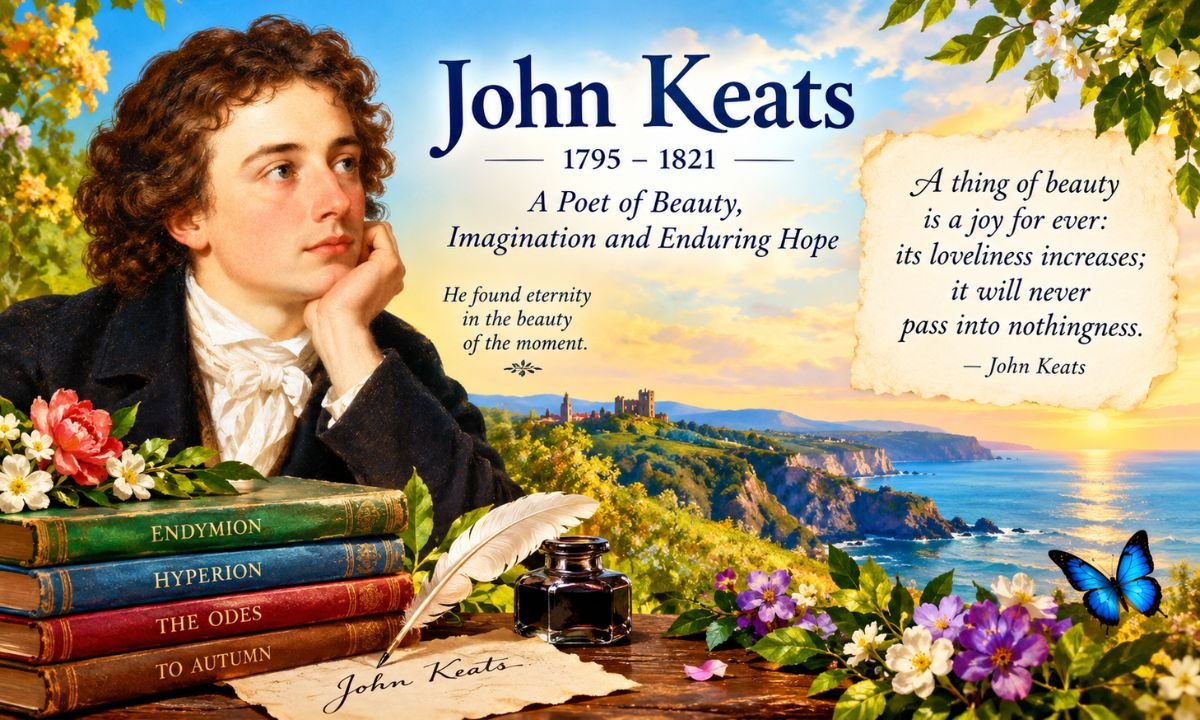
John Keats Poetry is inspirable for every human being. He lived only twenty-five years, yet he changed the shape of English poetry forever. He wrote about love, beauty, mortality, and the fleeting nature of human experience with a richness of language that still moves readers two centuries later. If you have ever wondered why Keats is considered one of the greatest Romantic poets, or you are studying his work for class, this guide breaks down everything you need to know — his biography, his writing style, his major themes, and the ideas that made him unforgettable.
This is not a list of his poems reprinted word for word. Instead, it is a clear, well-researched explanation of what makes Keats’s poetry work, why it still resonates, and how to think about it critically.
Who Was John Keats? A Short Biography
John Keats was born in London on October 31, 1795, into a working-class family. His father managed a livery stable and died in an accident when Keats was only eight years old. His mother passed away from tuberculosis six years later, leaving Keats and his siblings orphaned in their teens. These early losses shaped him profoundly, giving him an acute awareness of mortality that would surface again and again in his later work.
Keats trained as a surgeon-apothecary before abandoning medicine to pursue poetry full time — a bold and financially risky decision for a young man with no inheritance. He published his first collection in 1817, followed by “Endymion” in 1818, a long narrative poem that critics mocked harshly at the time but which revealed his growing ambition.
The year 1819 became the turning point of his short career. In a burst of creative energy that lasted only a few months, Keats composed his most celebrated odes, including “Ode on a Grecian Urn,” “Ode to a Nightingale,” “Ode on Melancholy,” “To Autumn,” and “Ode to Psyche.” These poems remain some of the most studied works in English literature.
Keats died of tuberculosis in Rome on February 23, 1821, at just twenty-five years old. He is buried in the Protestant Cemetery in Rome, and his gravestone — at his own request — does not carry his name, only the words describing him as a poet whose name was “writ in water.”
My heart aches, and a drowsy numbness pains
My sense, as though of hemlock I had drunk,
Or emptied some dull opiate to the drains
One minute past, and Lethe-wards had sunk:
’Tis not through envy of thy happy lot,
But being too happy in thine happiness,—
That thou, light-winged Dryad of the trees,
In some melodious plot
Of beechen green, and shadows numberless,
Singest of summer in full-throated ease.
O, for a draught of vintage! that hath been
Cool’d a long age in the deep-delved earth,
Tasting of Flora and the country green,
Dance, and Provençal song, and sunburnt mirth!
O for a beaker full of the warm South,
Full of the true, the blushful Hippocrene,
With beaded bubbles winking at the brim,
And purple-stained mouth;
That I might drink, and leave the world unseen,
And with thee fade away into the forest dim:
Fade far away, dissolve, and quite forget
What thou among the leaves hast never known,
The weariness, the fever, and the fret
Here, where men sit and hear each other groan;
Where palsy shakes a few, sad, last gray hairs,
Where youth grows pale, and spectre-thin, and dies;
Where but to think is to be full of sorrow
And leaden-eyed despairs,
Where Beauty cannot keep her lustrous eyes,
Or new Love pine at them beyond to-morrow.
Away! away! for I will fly to thee,
Not charioted by Bacchus and his pards,
But on the viewless wings of Poesy,
Though the dull brain perplexes and retards:
Already with thee! tender is the night,
And haply the Queen-Moon is on her throne,
Cluster’d around by all her starry Fays;
But here there is no light,
Save what from heaven is with the breezes blown
Through verdurous glooms and winding mossy ways.
I cannot see what flowers are at my feet,
Nor what soft incense hangs upon the boughs,
But, in embalmed darkness, guess each sweet
Wherewith the seasonable month endows
The grass, the thicket, and the fruit-tree wild;
White hawthorn, and the pastoral eglantine;
Fast fading violets cover’d up in leaves;
And mid-May’s eldest child,
The coming musk-rose, full of dewy wine,
The murmurous haunt of flies on summer eves.
Darkling I listen; and, for many a time
I have been half in love with easeful Death,
Call’d him soft names in many a mused rhyme,
To take into the air my quiet breath;
Now more than ever seems it rich to die,
To cease upon the midnight with no pain,
While thou art pouring forth thy soul abroad
In such an ecstasy!
Still wouldst thou sing, and I have ears in vain—
To thy high requiem become a sod.
Thou wast not born for death, immortal Bird!
No hungry generations tread thee down;
The voice I hear this passing night was heard
In ancient days by emperor and clown:
Perhaps the self-same song that found a path
Through the sad heart of Ruth, when, sick for home,
She stood in tears amid the alien corn;
The same that oft-times hath
Charm’d magic casements, opening on the foam
Of perilous seas, in faery lands forlorn.
Forlorn! the very word is like a bell
To toll me back from thee to my sole self!
Adieu! the fancy cannot cheat so well
As she is famed to do, deceiving elf.
Adieu! adieu! thy plaintive anthem fades
Past the near meadows, over the still stream,
Up the hill-side; and now ’tis buried deep
In the next valley-glades:
Was it a vision, or a waking dream?
Fled is that music:—Do I wake or sleep?
Quick Facts Table Of John Keats Poetry
| Detail | Information |
| Full Name | John Keats |
| Born | October 31, 1795, London, England |
| Died | February 23, 1821, Rome, Italy (aged 25) |
| Literary Movement | English Romanticism |
| Training | Studied medicine before turning to poetry |
| Most Productive Year | 1819 (“The Great Year”) |
| Famous Odes | “Ode to a Nightingale,” “Ode on a Grecian Urn,” “To Autumn,” “Ode on Melancholy” |
| Cause of Death | Tuberculosis |
Style of John Keats Poetry
John Keats Poetry style is often described as sensuous, musical, and richly imagistic. He did not simply describe a scene — he made readers feel, taste, hear, and touch it. A few defining stylistic traits set him apart from his Romantic contemporaries like Wordsworth, Byron, and Shelley.
- Sensory richness: Keats layered sight, sound, touch, taste, and smell into single stanzas, creating an almost physical experience for the reader.
- Classical influence: His deep interest in Greek mythology and art gave his poetry a timeless, sculptural quality.
- Odes as his signature form: Keats is best remembered for perfecting the English ode, a lyrical form dedicated to contemplating a single object, feeling, or idea.
- Melancholic beauty: Joy and sorrow are rarely separate in his work; beauty is often tinged with an awareness that it cannot last.
- Musical language: John Keats Poetry used careful rhythm, assonance, and vowel sounds gives his lines a singing quality when read aloud.
Because he trained in medicine, Keats also brought a naturalist’s precision to his imagery — his descriptions of plants, birds, and the human body are exact, not vague or decorative.
Read Also This Blog: Inspirational Poetry
How Does John Keats Poetry Work in the Reader’s Mind?
John Keats Poetry is beautiful. John Keats Poetry is built to slow readers down. Rather than rushing toward a conclusion or moral, his poems ask you to sit inside a single moment — a bird’s song, an ancient urn, a autumn afternoon — and experience it fully before moving on.
John Keats Poetry works on the mind in a few specific ways:
- John Keats Poetry engages multiple senses at once, which psychologically makes the imagined scene feel more “real” and immersive than plain description would.
- John Keats Poetry creates emotional tension between pleasure and loss, so the reader feels both the beauty of a moment and the sadness of its passing at the same time.
- John Keats Poetry invites reflection rather than resolution, leaving readers with questions about beauty, truth, and mortality instead of neat answers.
- John Keats Poetry uses rhythm and sound to mirror meaning — slow, drawn-out vowels for stillness; quicker patterns for urgency or change.
This is why Keats’s odes are often used in mindfulness and literature therapy contexts today: they train the reader’s attention on a single sensory experience, much like a meditation exercise.
Bright star, would I were stedfast as thou art—
Not in lone splendour hung aloft the night
And watching, with eternal lids apart,
Like nature’s patient, sleepless Eremite,
The moving waters at their priestlike task
Of pure ablution round earth’s human shores,
Or gazing on the new soft-fallen mask
Of snow upon the mountains and the moors—
No—yet still stedfast, still unchangeable,
Pillow’d upon my fair love’s ripening breast,
To feel for ever its soft fall and swell,
Awake for ever in a sweet unrest,
Still, still to hear her tender-taken breath,
And so live ever—or else swoon to death.
John Keats as a Romantic Poet
Keats is one of the six major poets of English Romanticism, alongside William Wordsworth, Samuel Taylor Coleridge, Lord Byron, Percy Bysshe Shelley, and William Blake. John Keats Poetry is awesome. Romanticism, as a movement, rejected the rigid rules of eighteenth-century Neoclassicism in favor of imagination, emotion, individuality, and a fascination with nature and the sublime.
Keats fits this mold closely, but with his own emphasis:
- He believed in “art for art’s sake” — that beauty itself was a worthy subject, not merely a vehicle for moral or political messages.
- He rejected what he called Coleridge’s “irritable reaching after fact and reason,” preferring instead to dwell in uncertainty and sensation.
- He used nature as a doorway to deeper feeling rather than writing about landscapes for their own sake.
- John Keats Poetry carries strong emotional intensity — joy, longing, grief, and awe are expressed openly rather than restrained.
Where Wordsworth found meaning in memory and rural life, and Byron built a persona of rebellious individualism, Keats turned inward toward sensation, beauty, and the tension between mortality and art.
Beneath the moon, your gentle beauty softly gleams,
A rose of love awakened from my sweetest dreams.
The nightingale sings where silver shadows lie,
And tender stars bloom brightly in the velvet sky.
Your eyes hold spring, where every flower grows,
My heart finds endless summer in the warmth of your rose.
Though fleeting hours may carry youth away,
Love leaves its golden fragrance where forever stays.
Major Themes in John Keats Poetry
Beauty and Truth In John Keats Poetry
Keats treated beauty as something close to a philosophical principle. For him, encountering true beauty — in art, nature, or love — offered a kind of truth that reasoning alone could never reach.
Mortality and the Passage of Time In John Keats Poetry
Having lost his parents young and watched his brother Tom die of tuberculosis before his own diagnosis, Keats wrote constantly about the shortness of life and the fear of dying before achieving lasting work.
Love and Longing In John Keats Poetry
John Keats Poetry often presents love as intense, consuming, and bittersweet — a force that brings deep joy but is shadowed by loss, distance, or the awareness that it cannot last forever.
Nature as Emotional Mirror In John Keats Poetry
Rather than simply describing landscapes, Keats used natural imagery — birdsong, ripening fruit, falling leaves — to reflect inner emotional states.
Art and Permanence In John Keats Poetry
Several of his best-known odes explore how art can “freeze” a moment in time, offering a kind of immortality that living beings can never have.
Escapism In John Keats Poetry
John Keats Poetry frequently used imagination as a refuge from suffering, illness, and the harsh realities of his life, creating vivid alternate worlds within his poems.
Key Characteristics and Features of John Keats Poetry
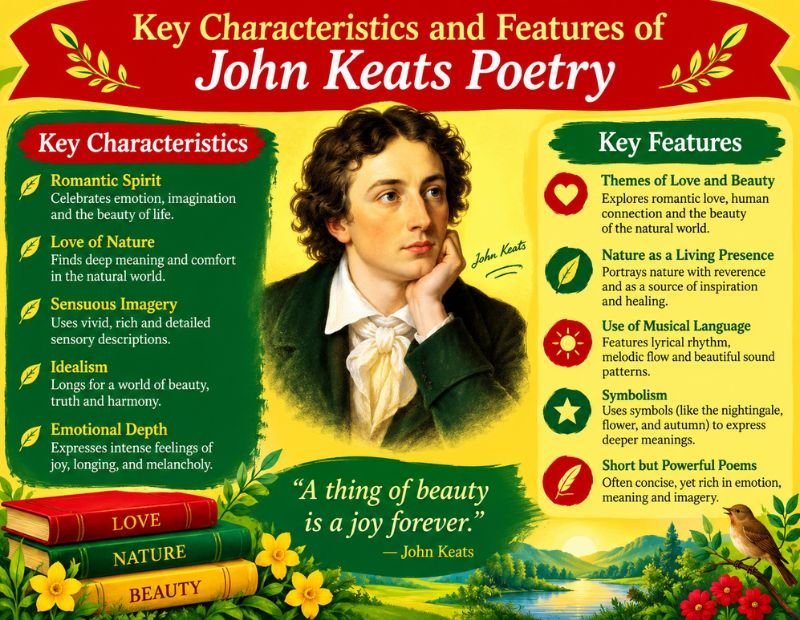
| Characteristic Of John Keats Poetry | What It Means |
| Sensuousness | Heavy use of the five senses to build vivid, physical imagery |
| Hellenism | Frequent references to Greek mythology, art, and ideals of beauty |
| Melancholic tone | Joy paired with an undertone of sadness or impermanence |
| Odes as primary form | Structured lyrical meditations on a single subject |
| Rich, musical language | Careful attention to sound, rhythm, and word choice |
| Philosophical depth | Poems that explore beauty, truth, and mortality rather than simple narrative |
| Escapist imagination | Creation of idealized worlds as relief from real-life suffering |
Synaesthesia in John Keats Poetry
John Keats Poetry most distinctive techniques is synaesthesia — blending one sensory experience with another, such as describing a sound as if it had a texture, or a color as if it had a taste. This technique makes his imagery feel unusually vivid and immersive, because it forces the brain to process sensations in an unexpected, layered way. Scholars often point to this as one of the clearest markers of his mature style, especially in the great odes of 1819.
Golden light sings softly through the trees,
While honeyed shadows dance upon the breeze.
Sweet colors bloom beneath the moonlit sky,
Their silken whispers drift and gently fly.
The crimson sunset tastes of summer wine,
As fragrant music makes the stars divine.
Hellenism in John Keats Poetry
Hellenism refers to John Keats Poetry deep admiration for ancient Greek art, mythology, and ideals of beauty and proportion. He never traveled to Greece, but his imagination was shaped by Greek sculpture, myth, and philosophy, which he encountered through books, translations, and museum visits — most famously the Elgin Marbles at the British Museum. This influence shows up in his use of mythological figures, his structured, sculptural imagery, and his belief that beauty and truth were intertwined, an idea rooted in classical aesthetics.
Marble gods awaken where the golden temples gleam,
And mortal hearts are lifted into beauty’s timeless dream.
Greek winds whisper softly through the olive-covered hills,
While ancient myths awaken where the moonlit silence thrills.
In sculpted forms, eternal beauty finds its graceful flight,
And Hellenic dreams transform the mortal world with light.
Escapism in John Keats Poetry
Escapism in John Keats Poetry is not simple denial of reality — it is a deliberate imaginative strategy. Facing poverty, illness, and the deaths of loved ones, Keats often used poetry to construct alternate worlds of beauty, myth, and sensation. This escapism typically has two layers: the initial pull toward an idealized, imagined realm, followed by a return to reality that is more painful because of the contrast. This push and pull is part of what gives his poetry its emotional complexity.
Through fields of dreams, my weary spirit flies,
Where beauty blooms beneath eternal skies.
I leave the world where grief and shadows stay,
And lose my troubled heart in song and May.
O gentle night, carry my soul away,
To realms where sorrow fades in silvered day.
Negative Capability In John Keats Poetry
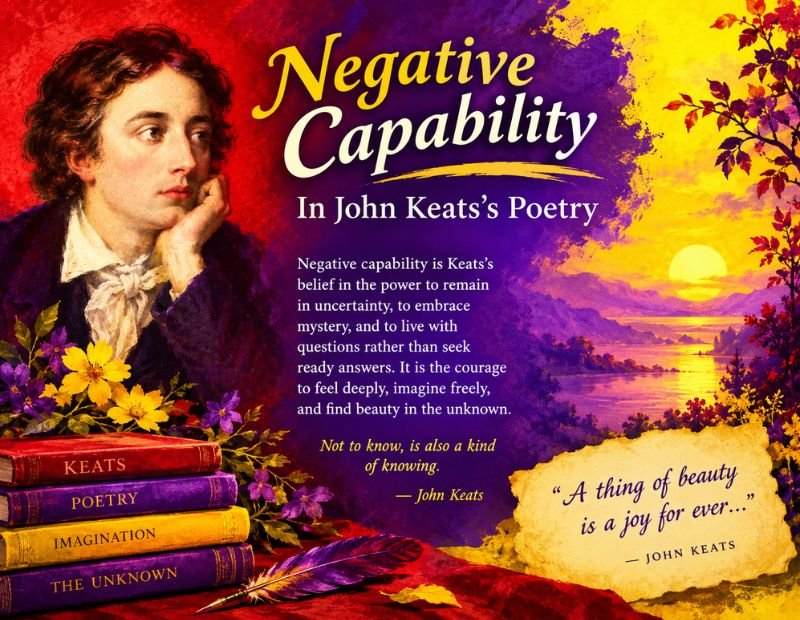
Negative capability is a term Keats coined in an 1817 letter to his brothers. He described it as the capacity to remain in uncertainties, mysteries, and doubts “without any irritable reaching after fact and reason.” In simple terms, it is the ability to accept ambiguity and mystery without forcing a definitive answer or explanation.
Keats believed this quality — which he associated most strongly with Shakespeare — was essential to great literature. A poet with negative capability could inhabit different perspectives, tolerate uncertainty, and let beauty override the need for logical resolution. This concept has influenced not just poetry but psychology, philosophy, and creative writing theory well beyond the Romantic era.
In doubt I wander where no answers bloom,
Yet mystery turns darkness into room.
I hold the silence where the truths remain,
And find a strange delight within the unknown’s domain.
When reason fades beneath the moonlit sky,
I trust the mystery and let questions fly.
Five Words That Describe John Keats Poetry
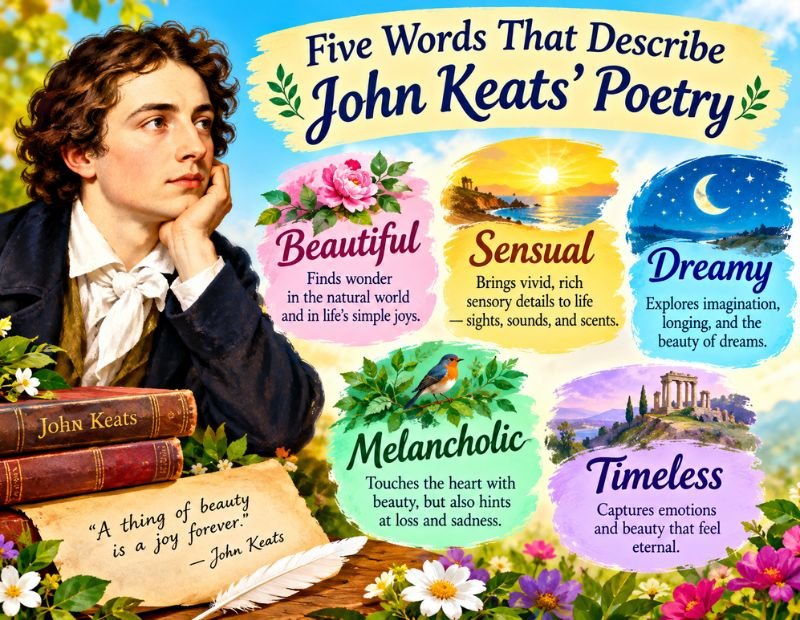
- Sensuous — rich in physical, sensory detail
- Melancholic — tinged with sadness and awareness of loss
- Mythic — steeped in classical Greek imagery and legend
- Reflective — contemplative rather than narrative-driven
- Transient — preoccupied with beauty and life’s fleeting nature
Best Books and Collections of John Keats Poetry
For readers wanting to explore his work in depth, these collections are widely recommended by scholars and literary critics:
| Collection Of John Keats poetry | Why It Matters |
| Poems (1817) | Keats’s debut collection, showing his early style and influences |
| Endymion (1818) | His first major long narrative poem |
| Lamia, Isabella, The Eve of St. Agnes, and Other Poems (1820) | Contains his mature masterpieces, including the great odes |
| The Complete Poems of John Keats | A comprehensive modern edition gathering his full body of work |
| Selected Letters of John Keats | Not poetry, but essential for understanding his ideas, including negative capability |
Thou still unravish’d bride of quietness,
Thou foster-child of silence and slow time,
Sylvan historian, who canst thus express
A flowery tale more sweetly than our rhyme:
What leaf-fring’d legend haunts about thy shape
Of deities or mortals, or of both,
In Tempe or the dales of Arcady?
What men or gods are these? What maidens loth?
What mad pursuit? What struggle to escape?
What pipes and timbrels? What wild ecstasy?
Heard melodies are sweet, but those unheard
Are sweeter; therefore, ye soft pipes, play on;
Not to the sensual ear, but, more endear’d,
Pipe to the spirit ditties of no tone:
Fair youth, beneath the trees, thou canst not leave
Thy song, nor ever can those trees be bare;
Bold Lover, never, never canst thou kiss,
Though winning near the goal—yet, do not grieve;
She cannot fade, though thou hast not thy bliss,
For ever wilt thou love, and she be fair!
Ah, happy, happy boughs! that cannot shed
Your leaves, nor ever bid the Spring adieu;
And, happy melodist, unwearied,
For ever piping songs for ever new;
More happy love! more happy, happy love!
For ever warm and still to be enjoy’d,
For ever panting, and for ever young;
All breathing human passion far above,
That leaves a heart high-sorrowful and cloy’d,
A burning forehead, and a parching tongue.
Who are these coming to the sacrifice?
To what green altar, O mysterious priest,
Lead’st thou that heifer lowing at the skies,
And all her silken flanks with garlands drest?
What little town by river or sea shore,
Or mountain-built with peaceful citadel,
Is emptied of this folk, this pious morn?
And, little town, thy streets for evermore
Will silent be; and not a soul to tell
Why thou art desolate, can e’er return.
O Attic shape! Fair attitude! with brede
Of marble men and maidens overwrought,
With forest branches and the trodden weed;
Thou, silent form, dost tease us out of thought
As doth eternity: Cold Pastoral!
When old age shall this generation waste,
Thou shalt remain, in midst of other woe
Than ours, a friend to man, to whom thou say’st,
“Beauty is truth, truth beauty,—that is all
Ye know on earth, and all ye need to know.”
Love & Short Poetry, Last Work Of John Keats Poetry
John Keats Poetry of love is known for combining desire with vulnerability — love is rarely presented as simple happiness, but as something intertwined with longing, distance, or fear of loss. His shorter poems, including several sonnets, distill these same themes into tighter, more concentrated forms, making them popular choices for readers new to his work.
Toward the end of his life, as his illness worsened, Keats’s final poems grew increasingly focused on mortality, farewell, and the fear of dying with his artistic potential unfulfilled. These last works carry a raw emotional honesty that many readers find especially moving, knowing they were written by a poet keenly aware his time was running out.
Thy gentle love, like moonlight, warms my heart,
And makes the stars of lonely nights depart.
In beauty’s garden, I shall seek thy hand,
Where love blooms softly like a rose in spring.
If time should fade the flowers of the day,
Our love shall linger, beautiful and bright always.
“This Living Hand” (1819)
This is one of the eeriest, most unsettling short poems in the English language, and possibly the last poem Keats wrote.
Mood: Unlike the lush, sensuous tone of his odes, this poem is stark, urgent, and almost accusatory. It doesn’t linger in beauty — it confronts the reader directly.
Structure: It’s just eight lines of blank verse, written as a single unbroken thought. There’s no stanza break, no formal ode structure — the lines tumble forward the way a panicked or feverish thought might, which mirrors its content.
Themes:
- Mortality made physical — rather than talking about death abstractly, Keats imagines his own hand, now warm and alive, one day cold and in the grave.
- Guilt and haunting — the poem suggests that the memory of his death would burden whoever reads it, almost like a curse reaching from beyond the grave.
- The power of imagination over death — some scholars read it as Keats asserting that poetry itself can keep him “present,” even after he’s gone, disturbing the reader as if he were still there.
It’s debated whether this was written for a poem, a play he was drafting, or directly to Fanny Brawne — its raw, second-person address makes it feel intensely personal, almost like a threat or a plea.
His Final Sonnet (often called “Bright Star,” though its exact dating is debated)
Mood: Longing and conflict. It’s tender rather than frightening, but shadowed by the same awareness of mortality.
Structure: A traditional Shakespearean sonnet — three quatrains and a closing couplet, following the ABAB rhyme pattern Keats often used for his more intimate, personal poems.
Themes:
- Permanence vs. impermanence — the poem contrasts something fixed and eternal (a star) with human love, which is intense but fleeting.
- The wish to stop time — Keats imagines wanting to be unchanging like the star, but only so he could remain forever in a tender human moment, not in cold isolation.
- Love shadowed by death — written while he was separated from Fanny Brawne and dying, the poem reads as both a love letter and a meditation on wanting more time than he had.
Frequently Asked Questions About John Keats’s Poetry
Who is John Keats?
John Keats (1795–1821) was an English Romantic poet best known for his odes and for dying young after a brief but brilliant career.
What makes John Keats Poetry unique?
His poetry stands out for its sensory richness, classical influences, and its constant meditation on beauty, truth, and mortality.
What is Keats’s most famous poem?
“Ode to a Nightingale” and “Ode on a Grecian Urn” are widely regarded as his most famous and most studied works.
What is negative capability in simple terms?
It is the ability to sit with uncertainty and mystery without forcing a logical explanation, a quality Keats admired in Shakespeare.
Why did Keats write so much about death?
He lost both parents and a brother to illness and was later diagnosed with tuberculosis himself, giving him a lifelong awareness of mortality.
Is Keats considered a Romantic poet?
Yes, he is one of the six major English Romantic poets, known especially for prioritizing beauty and imagination over strict reason.
What themes appear most often in his poetry?
Beauty, truth, mortality, love, nature, and escapism are the most recurring themes across his body of work.
How long was Keats’s writing career?
Remarkably short — roughly five to six years, with his best work concentrated in 1819 alone.
Final Thoughts
John Keats packed an extraordinary literary legacy into a life that ended far too soon. John Keats Poetry continues to be studied, quoted, and loved because it captures something universal: the ache of loving something beautiful while knowing it cannot last. Whether you are drawn to his odes, his sonnets, or his ideas about negative capability and imagination, Keats offers a way of looking at the world that remains as powerful today as it was two centuries ago.
If you are studying his work for the first time, start with his major odes from 1819, then explore his letters — they reveal the mind behind the poetry and make his verse even richer to read.