
A couplet is one of poetry’s most powerful tools packed into just two lines. From Shakespeare’s sonnets to modern song lyrics, couplets create rhythm, deliver punchlines, and wrap up ideas with striking clarity. This complete guide breaks down everything you need to know about couplets in poetry, including their meaning, types, structure, famous examples, and the literary effects that make them so effective.
Couplet in Poetry Meanings
A couplet is a pair of successive lines in a poem that usually rhyme and share the same meter. Together, these two lines form a complete thought or unit of meaning, almost like a mini poem within a larger poem.
The word couplet comes from the idea of “coupling,” meaning to join two things together. In poetry, that joining happens through rhyme, rhythm, and shared meaning between two consecutive lines.
Key defining features of a couplet include:
- Two consecutive lines of poetry 2️⃣
- Usually rhyming at the end of each line 🔗
- Often written in the same meter 🎵
- Frequently expresses a complete thought or idea 💭
- Can stand alone or appear within a larger poem 📖
Couplets are one of the oldest and most versatile structural devices in poetry, appearing everywhere from ancient epics to modern greeting cards.
Read Also This Blog: Meter in Poetry
Couplet vs Stanza vs Verse
Since these terms often get mixed up, here is a quick breakdown of how a couplet fits into the bigger picture of poetic structure.
| Term | Definition |
|---|---|
| Verse | A single line, or sometimes an entire poem |
| Couplet | Two consecutive lines that rhyme and share meaning |
| Stanza | A grouped set of lines, which can include one or more couplets |
A couplet is technically a specific type of stanza made up of exactly two lines.
What Is a Rhyming Couplet in Poetry?
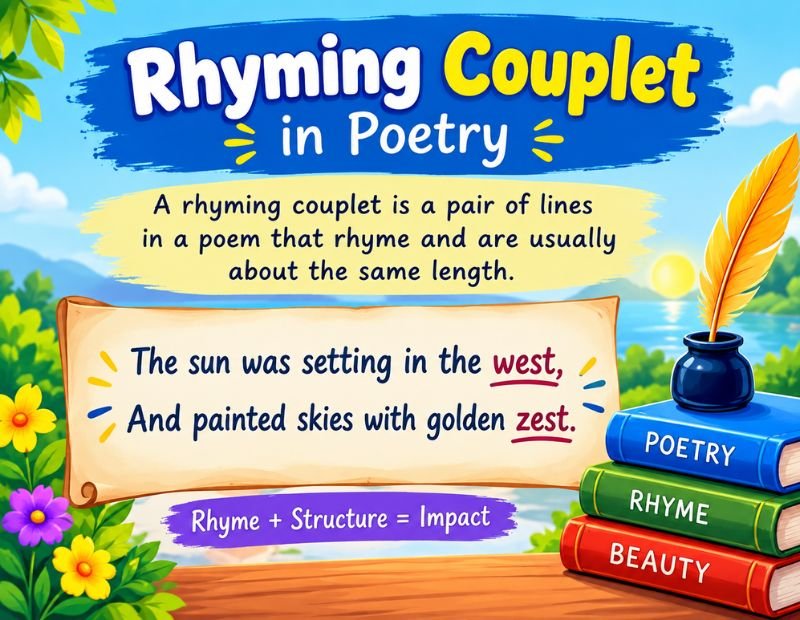
A rhyming couplet is the most common and recognizable type of couplet. It consists of two lines that end with matching or similar sounding words, creating a satisfying auditory connection between them.
Original rhyming couplet example:
The stars above shine soft and bright,
Guiding travelers through the night.
Rhyming couplets are popular because they are:
- Easy to remember and recite 🧠
- Musical and pleasant to read aloud 🎶
- Useful for emphasizing key ideas 💡
- Common in children’s poetry and nursery rhymes 🧸
Not every couplet rhymes perfectly. Some poets use slant rhyme, where the ending sounds are similar but not identical, to create a subtler effect.
Characteristics of Couplet in Poetry
Every effective couplet tends to share a few defining characteristics that separate it from a random pair of lines.
- Rhyme, most couplets use end rhyme, though not always required 🔗
- Meter, both lines typically share the same rhythmic pattern 📐
- Unity, the two lines usually work together to express one complete idea 🧩
- Brevity, couplets deliver meaning in a compact, efficient form ✂️
- Placement, couplets can stand alone, end a stanza, or close an entire poem 📍
- Punch, couplets often carry a strong emotional or intellectual payoff 💥
These characteristics make couplets extremely flexible, since poets can use them as small standalone poems or as structural building blocks within longer works.
Types of Couplet in Poetry
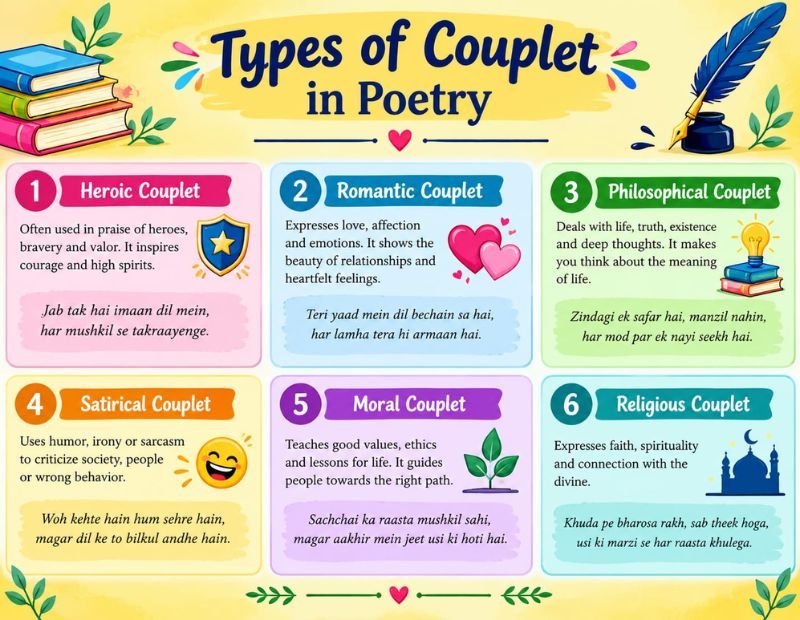
Couplets come in several distinct types, each defined by structure, meter, or historical use. Understanding these types helps readers recognize how poets use couplets for different effects.
1. Closed Couplet
A closed couplet contains a complete grammatical thought within its two lines, without spilling over into the next line or stanza. The sentence begins and ends within the couplet itself.
2. Open Couplet
An open couplet uses enjambment, meaning the sentence or thought continues beyond the two lines into the next line of the poem. This creates a flowing, less contained rhythm.
3. Heroic Couplet
A heroic couplet is written in iambic pentameter, meaning each line contains ten syllables arranged in five stressed and unstressed pairs. This form is closely associated with epic and narrative poetry.
4. Elegiac Couplet
An elegiac couplet alternates between two different line lengths, traditionally used in classical Greek and Latin poetry, often for mourning or reflective themes.
5. Split Couplet
A split couplet occurs when the two rhyming lines are separated by other lines within a stanza, rather than appearing directly next to each other.
| Couplet Type | Meter Required | Complete Thought | Common Use |
|---|---|---|---|
| Closed Couplet | No | Yes | General poetry 📗 |
| Open Couplet | No | No, continues on | Narrative poetry 📖 |
| Heroic Couplet | Yes, iambic pentameter | Usually yes | Epic poetry ⚔️ |
| Elegiac Couplet | Yes, alternating lines | Yes | Classical poetry 🏛️ |
| Split Couplet | No | Yes | Complex stanza forms 🧵 |
Heroic Couplet in Poetry
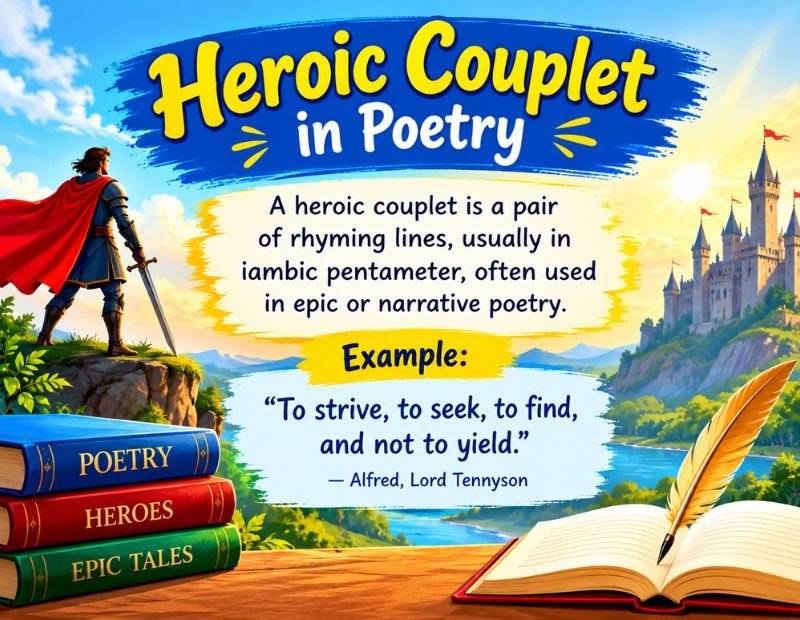
The heroic couplet deserves special attention because it is one of the most historically significant couplet forms in English literature. It consists of two rhyming lines written in strict iambic pentameter, giving it a formal, elevated tone.
This form earned the name “heroic” because it was traditionally used in epic poetry describing heroic deeds and grand narratives. Over time, poets like Geoffrey Chaucer pioneered its use in English poetry, and later writers such as John Dryden and Alexander Pope perfected the form during the Restoration and early eighteenth century.
Key features of heroic couplets include:
- Written in iambic pentameter, ten syllables per line 🔟
- Two lines rhyme with each other 🔗
- Often used in epics, satire, and philosophical poetry 📜
- Frequently closed, meaning each couplet completes a full thought ✅
- Associated with wit, formality, and reasoned argument 🎩
Original heroic couplet example:
The wise man speaks with measured, gentle grace,
While fools rush forward, blind to time and place.
Heroic couplets were especially popular for satire because their tight structure and rhyme created a natural setup and punchline effect, perfect for delivering sharp, witty observations.
Examples of Couplet in Poetry
Below are more than 30 original examples of couplets, organized by type and style, to help students and writers understand how couplets function across different contexts.
Simple rhyming couplets:
- The moon shines bright upon the lake, its silver path for love to make 🌙
- A single rose beside the gate, blooms quietly and learns to wait 🌹
- The children laughed and ran with glee, beneath the old and shady tree 🌳
- Soft rain falls gently on the ground, a peaceful, steady, whispering sound 🌧️
- The candle flickers, warm and low, a golden glow through winter’s snow ❄️
Closed couplets:
- He worked all day beneath the sun, and rested only when day was done ☀️
- She wrote her thoughts upon the page, then closed the book and turned the stage 📖
- The river winds through fields of gold, a story ancient, calm, and old 🌾
Open couplets with enjambment:
- The wind that moves across the hill
carries secrets no one can still 🍃 - Beneath the waves where sunlight fades
a hidden world forever stays 🌊
Heroic style couplets:
- The soldier marched with courage in his eyes, prepared to face whatever fate applies ⚔️
- True wisdom comes not loud, but quiet, slow, it teaches patience those who seek to grow 🧠
Short and simple couplets for children:
- The cat sat down upon the mat, and purred so softly, warm and fat 🐱
- The sun comes up, the day begins, a bright new morning always wins ☀️
- Little birds sing sweet and clear, welcoming spring, the time of year 🐦
Couplets expressing emotion:
- My heart still holds the words unsaid, the quiet love that time has fed 💗
- Through every storm and every fall, I found the strength to stand up tall 🌪️
- Grief comes softly, then moves on, but memory lingers even gone 🕊️
Couplets with a twist or punchline:
- He claimed he never told a lie, yet every word was one more sly 🎭
- She said she’d change, and so she did, but not the way that we all bid 🃏
Nature themed couplets:
- The mountains stand so tall and proud, above the mist, above the cloud ⛰️
- The ocean waves crash on the shore, a rhythm heard forevermore 🌊
- Autumn leaves in red and gold, fall gently as the year grows old 🍁
Reflective and philosophical couplets:
- Time moves on, it does not wait, it shapes our lives, it shapes our fate ⏳
- We build our dreams from hopes and fears, then watch them grow through passing years 🌟
These examples highlight how flexible couplets are, working equally well for simple children’s poetry, emotional reflection, nature imagery, and formal literary structure.
Famous Couplet in Poetry

Throughout literary history, several poets became especially known for their masterful use of couplet in poetry. While this guide avoids reproducing copyrighted text directly, understanding which poets shaped the couplet form helps contextualize its importance.
- Geoffrey Chaucer pioneered the heroic couplet in English poetry through his narrative storytelling works 📜
- William Shakespeare frequently closed his sonnets with a rhyming couplet to deliver a final, powerful thought 🎭
- Alexander Pope perfected the heroic couplet, using it extensively for wit, satire, and philosophical commentary 🖋️
- John Dryden was known for elevating the heroic couplet into a dominant poetic form during the Restoration era 👑
- Robert Frost used couplets within more modern, reflective poetry to create quiet, rhythmic closure 🌲
These poets demonstrate how the couplet has evolved across centuries while remaining a consistently powerful structural tool.
Purpose of Couplet in Poetry
Couplet in poetry serve several important purposes within a poem, whether used as a standalone form or as part of a larger structure.
- Deliver a complete thought in a compact, memorable format 💭
- Provide rhythmic and structural closure to a stanza or poem 🔚
- Create emphasis, often through a final punchline or twist 🎯
- Reinforce musicality through rhyme and consistent meter 🎵
- Break longer poems into smaller, digestible thematic units 🧩
- Highlight contrast or comparison between two connected ideas ⚖️
Because couplets are short and rhythmically satisfying, poets often use them at pivotal or concluding moments to leave a lasting impression on the reader.
Effects of Couplet in Poetry
The couplet’s tight structure creates several distinct literary effects that influence how readers experience a poem.
Sense of Closure
Couplets often create a strong feeling of completion, especially when used at the end of a poem or stanza, giving readers a satisfying sense that an idea has been fully resolved.
Emphasis and Punch
Because couplets are short, the final rhyme often lands with extra weight, making couplets ideal for delivering sharp, memorable conclusions or witty observations.
Musical Rhythm
The combination of rhyme and matching meter gives couplets a strong musical quality, making them pleasant and easy to read aloud.
Contrast and Comparison
Poets often use couplets to place two contrasting or complementary ideas side by side, using the rhyme to reinforce their connection.
| Effect | Description | Common Use |
|---|---|---|
| Closure | Signals the end of a thought or poem | Sonnet endings 🔚 |
| Emphasis | Adds weight to a final idea | Satire, wit 🎯 |
| Musicality | Creates rhythmic, pleasant sound | Children’s poetry 🎵 |
| Contrast | Highlights differences between ideas | Philosophical poetry ⚖️ |
Couplet in poetry vs Other Poetic Forms
To fully understand where couplets fit within poetry, it helps to compare them against other common structural forms.
| Form | Number of Lines | Rhyme Required | Common Use |
|---|---|---|---|
| Couplet | 2 | Usually yes | Closure, wit, emphasis 🔗 |
| Tercet | 3 | Often | Haiku, villanelles 🌸 |
| Quatrain | 4 | Often | Ballads, hymns 🎻 |
| Sonnet | 14 | Yes, structured | Formal love or reflective poetry 💗 |
This comparison shows that while a couplet is the shortest structural form, it remains one of the most impactful due to its compact rhyme and rhythm.
How to Write an Effective Couplet in Poetry?
Writing a strong couplet in poetry takes practice, but a few simple guidelines can help both students and aspiring poets.
- Choose two words that rhyme naturally, without forcing the sentence 🎯
- Keep both lines similar in length and rhythm for balance ⚖️
- Make sure the two lines connect through a clear, complete thought 💭
- Read the couplet aloud to check that it flows smoothly 🗣️
- Avoid overly complicated vocabulary that disrupts natural rhythm 🔤
- Use the couplet to deliver emphasis, contrast, or a memorable conclusion 💥
Practicing with simple themes, such as nature or emotions, is a great way to build confidence before attempting more complex heroic couplets.
Why Couplets Remain Popular Today?
Even outside of classical and formal poetry, couplets remain widely used in modern writing. They appear in:
- Song lyrics and rap verses, where rhyme and rhythm carry emotional weight 🎤
- Advertising slogans, since short rhyming phrases are easy to remember 📢
- Greeting cards and celebratory poems, thanks to their warm, musical tone 💌
- Children’s books, where simple rhyme helps with language learning 📚
This continued relevance shows that the couplet, despite being centuries old, remains one of the most practical and enduring tools in both poetry and everyday language.
Conclusion
The couplet in poetry may be one of poetry’s smallest structures, but its impact is anything but small. From the formal elegance of heroic couplets used by Pope and Dryden to the simple, rhythmic charm of a children’s rhyme, couplets prove that powerful meaning does not require length. By understanding the different types, from closed and open couplets to elegiac and heroic forms, you gain a much deeper appreciation for how poets use just two lines to create closure, emphasis, and lasting emotional impact. Whether you are analyzing classic literature or writing your own verses, mastering the couplet gives you one of the most versatile tools in the entire poetic toolkit.
FAQs
What is a couplet in poetry?
A couplet in poetry is a pair of consecutive lines in a poem that usually rhyme and share the same meter, forming a complete thought.
What is a heroic couplet in poetry?
A heroic couplet in poetry is a pair of rhyming lines written in iambic pentameter, often used in epic and narrative poetry.
What is the difference between a closed and open couplet in poetry?
A closed couplet in poetry completes its thought within the two lines, while an open couplet in poetry continues its sentence into the next line.
Do all couplets have to rhyme?
Most couplets rhyme, but some use slant rhyme or no rhyme at all while still functioning as a paired structural unit.
Why do poets use couplets at the end of poems?
Couplets create a strong sense of closure and emphasis, making them ideal for delivering a poem’s final, memorable idea.
What is an example of a simple couplet in poetry?
A basic example includes two rhyming lines describing the same image or idea, such as nature, emotion, or daily life.
What is the difference between a couplet in poetry and a stanza?
A couplet is always exactly two lines, while a stanza can contain any number of grouped lines, including multiple couplets.
Who is famous for using heroic couplet in poetry?
Alexander Pope and John Dryden are among the most famous poets known for mastering the heroic couplet form.