
Haiku is one of the most recognizable forms of poetry in the world, admired for saying so much in so few words. In just three short lines, a well written haiku can capture a fleeting moment, a season, or a feeling that lingers long after you finish reading it.
This guide covers everything you need to know about haiku in poetry, including its meaning, history, structure, syllable rules, characteristics, and purpose. You will also find original example haiku, a breakdown of how haiku fits into lyric poetry, and answers to the most common questions people ask about this timeless Japanese form.
What Is Haiku in Poetry?
Haiku is a short, unrhymed form of poetry that originated in Japan, traditionally built around a 5-7-5 syllable pattern across three lines. Rather than telling a full story, haiku captures a single moment, image, or feeling, often drawn from nature or everyday life.
The word itself refers to a poem that is:
- Extremely brief, usually just seventeen syllables total ✂️
- Focused on one clear image or emotion 🌸
- Free of forced rhyme, relying instead on rhythm and imagery 🎋
- Rooted in direct observation rather than abstract explanation 👁️
- Open ended, leaving space for the reader to feel the rest 🌙
Because haiku says so much with so little, it is often described as the distilled essence of poetry rather than a full narrative form.
Read Also This Blog: Poetry
Haiku in Poetry Meaning
At its core, haiku in poetry means capturing a single, concentrated moment of awareness. Traditional Japanese haiku often present two contrasting images placed side by side, letting the reader connect them rather than explaining the connection outright.
This structure gives haiku its emotional power. Instead of telling readers how to feel, a haiku shows a small, vivid scene and trusts the reader’s imagination to fill in the rest.
History of Haiku in Japanese Poetry
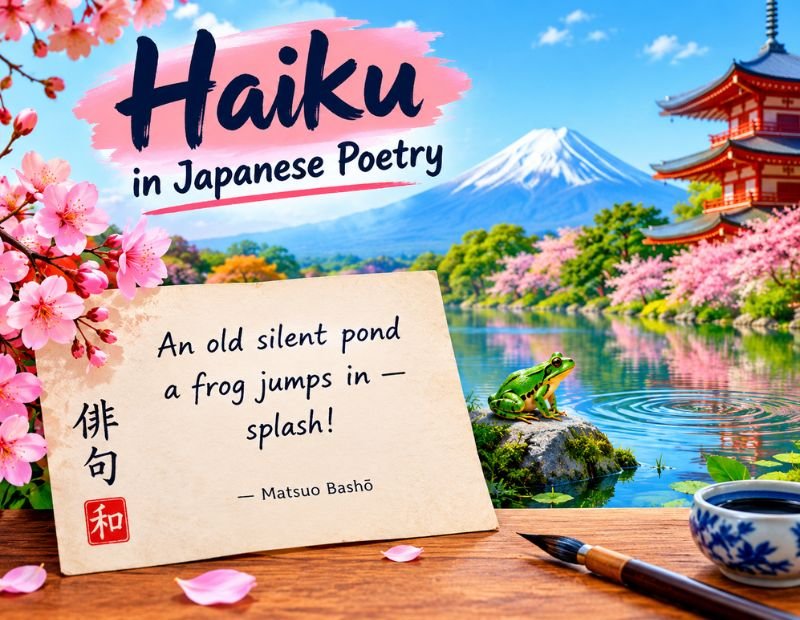
Haiku evolved from a longer collaborative poetry form called renga, where poets took turns adding linked verses. Over time, the opening verse of renga, known as hokku, developed into its own independent poem, eventually becoming what we now call haiku.
Key milestones in haiku’s history include:
- Its emergence as a distinct form during the sixteenth century in Japan 🏯
- Its refinement by Matsuo Basho in the seventeenth century, who elevated haiku into a serious literary art centered on simplicity and Zen inspired mindfulness 🍃
- Further development by poets like Yosa Buson, who brought a painter’s eye to imagery, and Kobayashi Issa, known for warmth and everyday village life 🎨
- Its spread to the West in the early twentieth century, where it directly influenced the Imagist poetry movement led by writers like Ezra Pound 🌍
- Its continued global popularity today, with haiku now written in dozens of languages beyond Japanese 📖
Basho remains the most celebrated haiku poet in history, famous for turning ordinary observations, like a frog jumping into a pond, into lasting works of art.
Purpose of Haiku in Poetry
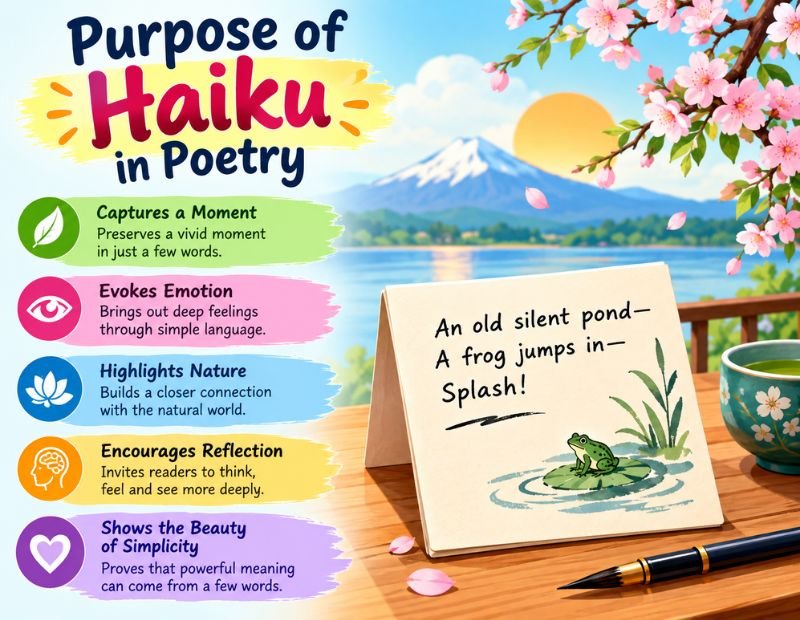
Haiku exists to capture a fleeting moment with total clarity and economy. Its purpose goes beyond simple description, since a well crafted haiku aims to create a small spark of recognition or insight in the reader.
The main purposes of haiku include:
- Preserving a single moment in time before it disappears ⏳
- Encouraging mindfulness and close attention to the present ⛩️
- Connecting human emotion to the natural world and changing seasons 🍁
- Creating meaning through juxtaposition rather than direct explanation 🔗
- Offering a meditative pause within a busy, fast moving world 🧘
Effects of Haiku in Poetry

Because haiku is so compact, it tends to affect readers differently than longer poetic forms. The brevity forces both the poet and the reader to slow down and notice small details that might otherwise be overlooked.
Common effects of reading or writing haiku include:
- A heightened sense of presence, since haiku rewards close observation 🌿
- Emotional resonance created through implication rather than explanation 💫
- A meditative, calming effect similar to mindfulness practice 🌾
- Increased appreciation for nature, seasons, and small daily moments 🌤️
- A feeling of open endedness, since the reader completes the meaning 🕊️
Characteristics of Haiku in Poetry
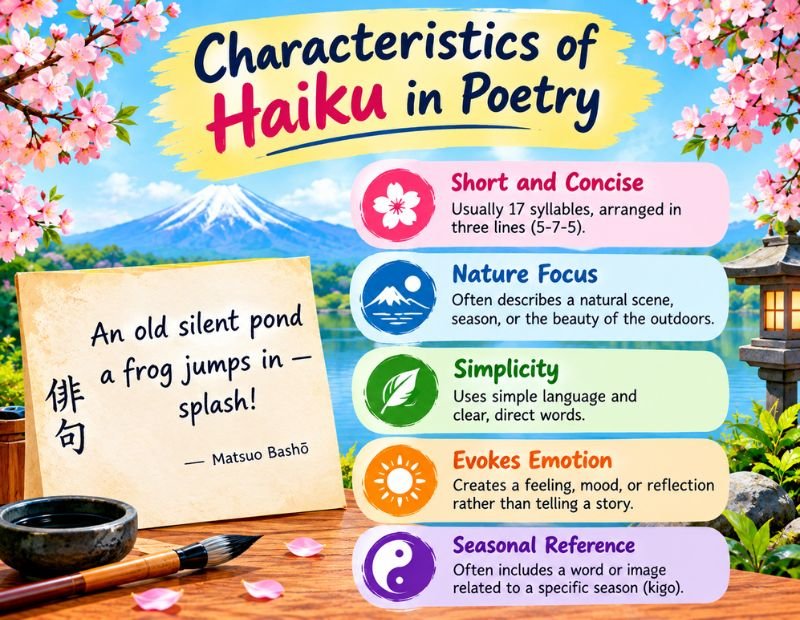
Traditional haiku follows a recognizable set of characteristics, even though modern poets sometimes bend these rules for creative effect.
| Characteristic of haiku in poetry | Description |
|---|---|
| Syllable structure | Usually 5-7-5 across three lines |
| Kigo | A seasonal word or phrase anchoring the poem in a specific time of year |
| Kireji | A cutting word that creates a pause and separates two images |
| Imagery | Concrete, sensory details rather than abstract ideas |
| Juxtaposition | Two images placed together to create meaning |
| No rhyme | Haiku typically avoids end rhyme entirely |
| Present tense | Most haiku are written in the present, capturing an immediate moment |
Syllables in Haiku In Poetry
The 5-7-5 Rule Explained
The most widely known rule of haiku in poetry is its syllable count, structured as follows:
| Line | Syllable Count |
|---|---|
| First line | 5 syllables |
| Second line | 7 syllables |
| Third line | 5 syllables |
This adds up to seventeen syllables total, traditionally written across three lines in English, though Japanese haiku are often written in a single vertical line.
Soft rain taps the roof
Green leaves dance beneath the clouds
Spring wakes up again
Moonlight fills the lake
Silver ripples gently glow
Night whispers so softly
A small bird takes flight
Wings rise above golden fields
Morning fills the sky
Snow falls on the trees
Quiet footsteps fade away
Winter dreams softly
Warm sunlight on flowers
Bees hum around the garden
Summer smiles brightly
Why Syllable Counts Can Vary?
Japanese haiku are actually measured in units called on, sometimes translated as morae, rather than syllables exactly as English speakers understand them. Because on and English syllables do not align perfectly, translated haiku do not always land neatly on 5-7-5, and many modern English language poets intentionally break the strict syllable count while still honoring haiku’s spirit of brevity and imagery.
Haiku in a Sentence
If you need a quick, simple explanation, here is haiku defined in a single sentence: haiku in poetry is a short, three line Japanese poem, traditionally following a 5-7-5 syllable pattern, that captures one clear image or moment, usually connected to nature or the seasons.
What Is Haiku in Lyric Poetry?
Haiku in poetry is often classified as a form of lyric poetry, since lyric poetry generally expresses personal emotion or a single moment of reflection rather than telling an extended story. Where narrative or epic poetry follows characters and plot over many lines, haiku compresses lyric poetry’s emotional focus into its smallest possible form, using just seventeen syllables to create a complete emotional experience.
This is part of why haiku pairs so naturally with themes common across lyric poetry, such as longing, seasonal change, solitude, and quiet observation.
give me 5 examples of Haiku in Lyric Poetry. haiku in poetic form without caption and numbers . add any beautifel indication mark
❀
Morning mist rises
Birdsong wakes the sleeping trees
Sunlight fills the sky
✦
Moonlight on still waves
Silver whispers touch the shore
Night breathes soft and slow
❧
Autumn leaves are gold
Gentle winds carry them far
Earth dreams beneath rain
☾
Snow falls without sound
White petals cover the fields
Winter holds its breath
❁
Spring flowers awaken
Warm breezes dance through green meadows
Hope blooms in my heart
Haiku In Japanese Versus English
| Feature | Japanese Haiku | English Haiku |
|---|---|---|
| Line format | Usually written in one vertical line | Usually written across three lines |
| Counting unit | On, or sound units | Syllables |
| Kireji | A formal cutting word | Often replaced with punctuation like a dash or line break |
| Syllable flexibility | Traditionally fixed at 17 on | Often flexible, especially in modern haiku |
| Seasonal reference | Frequently required, drawn from a seasonal word list called saijiki | Common, but not always strictly required |
How to Write a Haiku In Poetry?
Writing your own haiku is simpler than it might seem once you understand the basic building blocks.
- Choose a single moment, image, or feeling to focus on 🌙
- Include a seasonal reference if you want a traditional feel 🍂
- Use concrete, sensory language instead of abstract ideas 👂
- Follow or gently bend the 5-7-5 syllable structure 📏
- Read it aloud to check the rhythm and flow 🔊
- Let the final line create a small shift, surprise, or pause 🌊
10 Original Example Of Haiku In Poetry
Below are ten original haiku written to illustrate the form’s structure, imagery, and seasonal focus.
- Morning fog lifting, hills emerge from silver mist, a heron takes flight 🌫️
- Autumn leaf spirals, silent dance upon cold wind, resting on the path 🍁
- Summer rain begins, children laughing in the street, puddles catch the sky 🌧️
- Winter breath in clouds, footprints vanish in fresh snow, stars watch from above ❄️
- Cherry blossoms fall, petals drifting on the breeze, spring says its goodbye 🌸
- Old wooden bridge creaks, river carries autumn gold, fish rise then are gone 🍂
- Quiet garden dusk, fireflies blink one by one, night begins to breathe ✨
- Mountain peak in mist, one small bird calls through the clouds, silence answers back 🏔️
- Candle flame flickers, shadows dance across the wall, midnight holds its breath 🕯️
- First snowfall arrives, the world forgets all its noise, footsteps write the page ⛄
These examples show how haiku uses nature, seasonal imagery, and a quiet emotional turn to create meaning within a tight structural frame.
Frequently Asked Questions
What is a haiku in simple terms?
A haiku in poetry is a short three line poem, usually following a 5-7-5 syllable pattern, that captures a single moment or image, often connected to nature.
Who is considered the master of haiku in poetry ?
Matsuo Basho is widely regarded as the greatest haiku poet in history, known for elevating the form into a serious literary art.
Does a haiku in poetry always need to follow 5-7-5?
Not always, since many modern haiku poets, especially in English, intentionally vary the syllable count while keeping the form’s brevity and imagery.
What is kigo in haiku in poetry?
Kigo is a seasonal word or phrase that anchors a haiku to a specific time of year, adding depth and context to the poem.
What is kireji in haiku in poetry?
Kireji is a Japanese cutting word used to create a pause or break between two images, often replaced by punctuation in English translations.
Is haiku considered lyric poetry?
Yes, haiku is generally classified as lyric poetry, since it expresses a personal moment or emotion rather than following a narrative plot.
Can haiku be about topics other than nature?
Yes, while nature remains the traditional focus, modern haiku also explore urban life, emotions, and everyday human experience.
Conclusion
Haiku proves that powerful poetry does not need length to leave a lasting impression. With its roots in Japanese tradition, its refinement by masters like Basho, and its lasting influence on modern poetry worldwide, haiku continues to teach readers and writers alike the value of noticing small, fleeting moments.
Whether you are drawn to its strict 5-7-5 structure, its seasonal imagery, or its meditative simplicity, haiku remains one of the most accessible and rewarding forms of poetry to explore, read, and write for yourself.