
Have you ever read a line like “the wind whispered through the trees” and instantly pictured the wind leaning in to tell you a secret? 🍃 That little spark of imagination is personification at work — one of poetry’s oldest and most enchanting tricks.
Personification is the literary device that gives human thoughts, feelings, or actions to something that isn’t human — an object, an animal, an emotion, or even an entire season. It’s like handing a costume to the wind, the moon, or a broken-down bicycle and letting it walk, talk, and feel just like we do.
In this guide, you’ll learn exactly what personification means, why poets reach for it so often, its different types, and 15+ real examples — including simple ones perfect for students, kids, and KS2 classrooms. Grab a cup of tea ☕ and let’s bring some non-human things to life.
Meaning of Personification in Poetry
Personification in poetry means giving human qualities — actions, emotions, or characteristics — to something non-human, such as an object, animal, natural force, or abstract idea.
Think of it like putting a human mask 🎭 on something that has no face at all. When Carl Sandburg writes that fog comes “on little cat feet,” the fog isn’t literally padding around on paws — but suddenly it feels alive, quiet, and sneaky, exactly like a cat.
It’s a specific branch of figurative language and, more precisely, a type of metaphor — because it compares a non-human thing to a person without using “like” or “as.” That’s the key difference from a simile.
Quick definition table:
| Term | Meaning |
|---|---|
| Personification | Giving human traits to non-human things (figurative) |
| Anthropomorphism | Giving literal human traits — speech, clothes, walking — to animals/objects (often in fiction) |
| Simile | Comparing two things using “like” or “as” |
| Metaphor | Saying one thing IS another, without “like/as” |
Why Is Personification in Poetry used?
Poets use personification in poetry because it turns flat description into a living, breathing scene — like switching a black-and-white photo to full color. 🎨
Here’s why personification in poetry works so well:
- It builds emotional connection. Readers relate more easily to something that “feels” than to something that just “exists.”
- It creates vivid imagery. “The waves danced” paints a far clearer picture than “the waves moved.”
- It simplifies abstract ideas. Giving Death a carriage to drive (as Emily Dickinson does) makes an enormous, invisible concept easier to imagine.
- It adds rhythm and musicality. Personified lines often read more smoothly, almost like a story being told rather than a fact being stated.
- It reflects universal human instinct. We naturally see faces in clouds and hear “voices” in the wind — personification simply puts that instinct into words.
Read Also This Blog: Rhythm in Poetry
Purpose of Personification in Poetry
The core purpose of personification is to help readers feel a poem rather than just read it. It’s the difference between hearing about a storm and hearing the storm “roar in anger.”
Poets typically use personification in poetry to:
- Deepen meaning — turning a simple image into a symbol (a wilting rose “sighing” can represent lost youth).
- Set the mood — a “cruel” winter feels harsher than a “cold” one.
- Create relatable characters out of ideas — hope, fear, and time often “act” like people in poems.
- Strengthen a theme — nature personified as caring or hostile can mirror a poem’s larger message about humanity.
- Make the abstract concrete — it’s hard to picture “time,” but easy to picture time “creeping” or “flying.”
Effects of Personification in Poetry
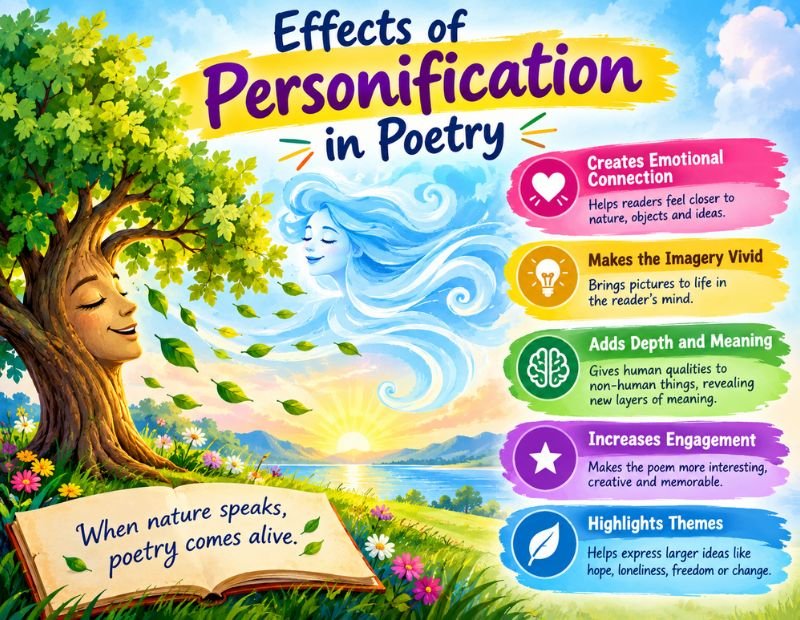
The effect of Personification In Poetry is a bit like adding sound and color to a silent film — suddenly, everything feels more alive and emotionally charged.
Common effects include:
- Emotional resonance 💓 — readers empathize with non-human subjects as if they were characters.
- Heightened imagery 🖼️ — abstract or ordinary things become vivid and memorable.
- Tone-setting — a “gentle” breeze feels calm; a “hungry” fire feels dangerous.
- Symbolic depth — a personified object can represent a bigger idea (a ticking clock personified as “impatient” can symbolize mortality).
- Musical flow — personification often pairs naturally with rhythm and alliteration, making lines more pleasant to read aloud.
Function of Personification in Poetry
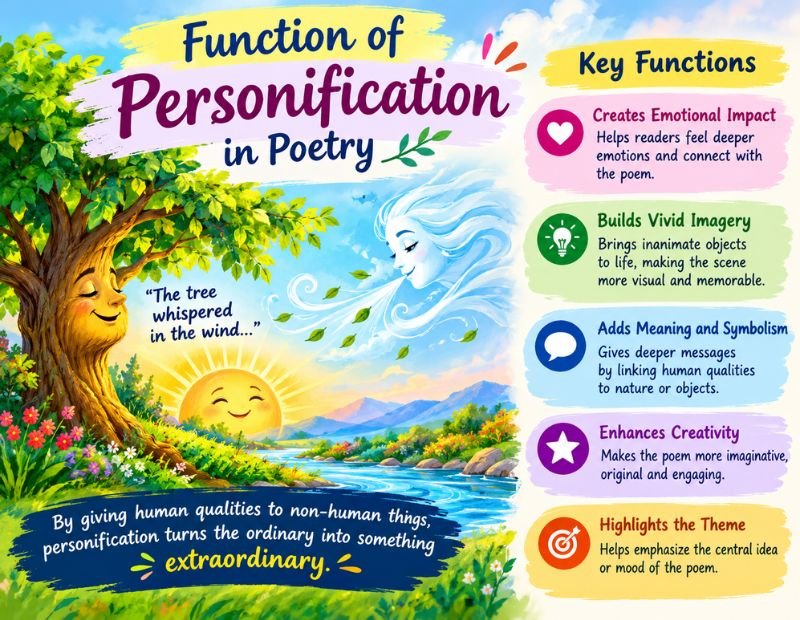
Functionally, personification acts like a bridge 🌉 — connecting the reader’s human experience to something they’d otherwise find distant or lifeless.
Its main functions in a poem are to:
- Narrate — letting a non-human “voice” tell part of the story (like Sylvia Plath’s poem written from a mirror’s point of view).
- Characterize — turning forces like Death, Time, or Nature into active characters with motives.
- Contrast — placing a joyful personified image (dancing daffodils) against a sad human mood, as Wordsworth does.
- Foreshadow or warn — a personified Earth “groaning” under pollution can hint at consequences to come.
Types of Personification in Poetry
Not all personification works the same way. Here are the main types poets use, each with a quick example.
1. Personifying Nature
Giving human behavior to natural elements like wind, rain, sun, or mountains — as natural and common as sunlight itself.
Example: “The sun smiled down on the valley.”
2. Personifying Animals
Giving animals human emotions or reasoning beyond their natural behavior, like a cat “plotting” mischief.
Example: “The old dog sighed with regret as he watched the ball roll away.”
3. Personifying Objects
Giving inanimate objects human actions or feelings, turning a lifeless item into something almost like a companion.
Example: “The old clock groaned with every passing hour.”
4. Personifying Abstract Ideas/Emotions
Giving human form to feelings or concepts like love, death, fear, or hope — much like a puppet given strings to move.
Example: “Death kindly stopped for me.” — Emily Dickinson
5. Personifying Time and Seasons
Treating time, days, or seasons as living beings with moods and motives.
Example: “Winter crept in on silent feet.”
6. Personifying Places or Cities
Giving a location human character, almost like the setting becomes its own personality in the poem.
Example: “The city never sleeps, always whispering its restless secrets.”
Examples of Personification in Poetry (15+ Famous Lines)
Here are 15+ powerful examples pulled from celebrated poems, showing personification in action across different eras and styles.
| # | Line/Example | Poet | What’s Personified |
|---|---|---|---|
| 1 | “The fog comes on little cat feet” | Carl Sandburg | Fog |
| 2 | “Because I could not stop for Death – He kindly stopped for me” | Emily Dickinson | Death |
| 3 | “Fluttering and dancing in the breeze” (daffodils) | William Wordsworth | Daffodils |
| 4 | “O Rose, thou art sick!” | William Blake | Rose |
| 5 | “Death, be not proud” | John Donne | Death |
| 6 | “Earth felt the wound; and Nature from her seat, sighing…” | John Milton | Earth/Nature |
| 7 | “The night was creeping on the ground! She crept and did not make a sound” | James Stephens | Night |
| 8 | “The moon walks the night in her silver shoon” | Walter de la Mare | Moon |
| 9 | “And the dish ran away with the spoon” | Mother Goose | Dish |
| 10 | “The little dog laughed to see such sport” | Mother Goose | Dog |
| 11 | “There’s no one to talk with — I’ll talk with my shoe” | Shel Silverstein | Shoe |
| 12 | “Hope is the thing with feathers” | Emily Dickinson | Hope |
| 13 | “The wind howled in the night” | Common poetic phrase | Wind |
| 14 | “Ah, William, we’re weary of weather,” said the sunflowers | William Blake | Sunflowers |
| 15 | “The waves chased each other up the shore” | Common poetic phrase | Waves |
| 16 | “The stars danced playfully in the moonlit sky” | Common poetic phrase | Stars |
Each of these examples proves the same point: personification turns scenery into character, like handing every object in a poem its own tiny heartbeat. 💫
Examples of Personification in Poetry for Students
For students studying figurative language, it helps to see personification broken down clearly, almost like solving a small puzzle. 🧩
- “The leaves danced in the autumn wind.” — Leaves given the human ability to dance.
- “Opportunity knocked at his door.” — An abstract concept given a hand to knock with.
- “The old house groaned as the storm hit.” — A house given the human sound of groaning.
- “The alarm clock screamed at me to wake up.” — A clock given the human act of screaming.
Study tip: Ask yourself, “Can this thing actually do this action in real life?” If the answer is no, but the sentence still makes sense emotionally, you’ve found personification.
Examples of Personification in Poetry for Kids
Kids often meet personification for the first time in nursery rhymes, where objects behave like playful cartoon characters. 🧸
- “Hey Diddle Diddle” — the cow jumps over the moon, the dog laughs, and the dish runs away with the spoon.
- “The wind whistled a happy tune.”
- “The sun woke up and stretched its golden arms across the sky.”
- “My teddy bear waited patiently for me by the door.”
These lines work like a magic trick for young readers — suddenly a spoon can run, and a cow can jump over the moon, making the world feel like one big, friendly storybook.
15 Examples of Personification in Poetry (Quick-Reference List)
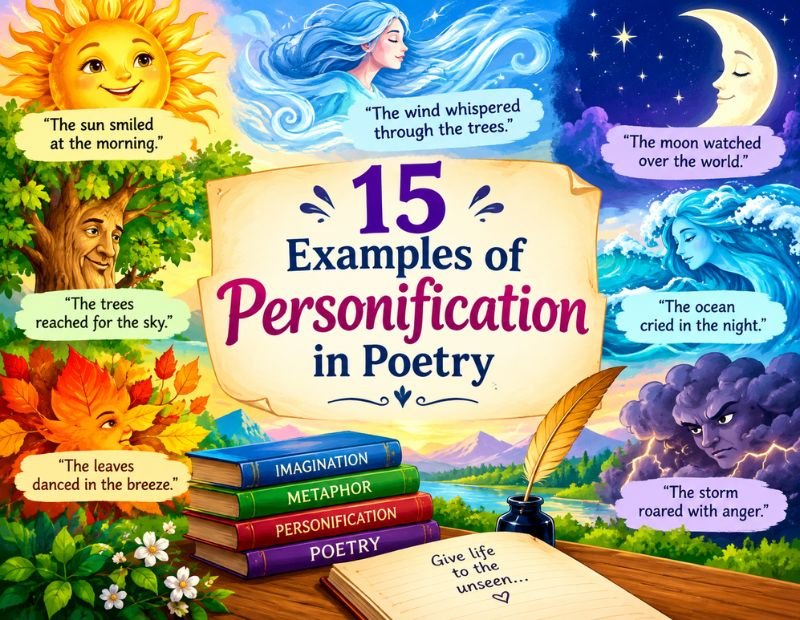
For a fast recap, here are 15 short, standalone personification examples you can use for study or inspiration:
- The wind whispered secrets through the trees. 🍃
- The stars winked at the sleeping town. ⭐
- Time flew by during the holidays. ⏰
- The flowers nodded their heads in the breeze. 🌸
- The thunder grumbled angrily overhead. ⛈️
- The old car coughed and sputtered to life. 🚗
- The candle flame danced on the table. 🕯️
- The sea reached out and pulled the boat closer. 🌊
- Fear gripped his heart tightly. 😨
- The morning sun kissed the hilltops. 🌅
- The books on the shelf begged to be read. 📚
- The rain tapped gently on the window. 🌧️
- The moon smiled down on the quiet village. 🌙
- The shadows crept across the floor. 👣
- Hope knocked softly on her door. 🚪
- The trees waved goodbye as autumn arrived. 🍂
Personification in Poetry KS2
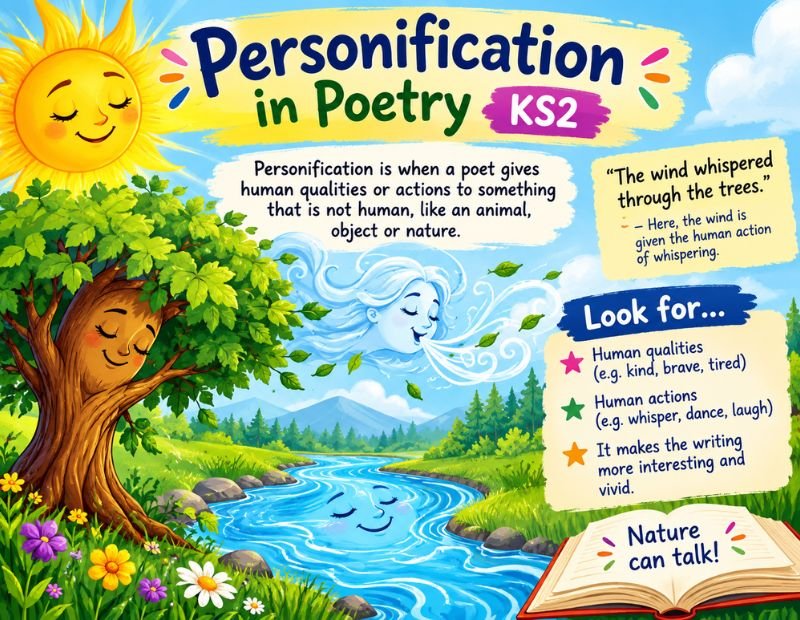
For KS2 (UK primary school, ages 7–11) learners, personification is usually taught as a simple, fun rule: give a non-living thing a human action or feeling.
Teachers often use it to help children:
- ✨ Build descriptive, imaginative vocabulary
- 🧠 Understand figurative language alongside similes and metaphors
- 🎭 Perform poems aloud with expression and voice
- 🌍 Connect English writing skills to Geography, Science, or Art topics
Simple KS2 example poem line: “The football sighed as it rolled slowly into the goal, tired from the long match.” ⚽
A popular classroom exercise is writing “Here Lies…” poems, where pupils personify a river, forest, or planet as if it had feelings, a voice, and even a life story — a gentle way to blend creativity with real-world topics like the environment.
Personification vs. Other Figurative Language
Since personification is often confused with related devices, here’s a simple comparison table:
| Device | Definition | Example |
|---|---|---|
| Personification | Human traits given to non-human things | “The wind howled.” |
| Simile | Comparison using “like” or “as” | “The wind was loud, like a scream.” |
| Metaphor | Direct comparison without “like/as” | “The wind was a scream in the night.” |
| Anthropomorphism | Literal human behavior (speech, clothes) in fiction | A wolf that talks and wears a suit |
Conclusion
Personification is one of poetry’s simplest yet most powerful tools — like a magic wand 🪄 that turns silent, lifeless things into characters with feelings, voices, and motives. Whether it’s fog creeping in on cat feet, Death politely stopping his carriage, or a shoe becoming someone’s only friend, personification helps readers feel a poem instead of just reading it. Once you start noticing it, you’ll see it everywhere — in classic poems, nursery rhymes, and even in the way you casually say, “my phone is dying.” 📱
Frequently Asked Questions
What is personification in poetry in simple words?
Personification is giving human actions, feelings, or traits to something that isn’t human, like an object, animal, or idea.
Why is personification used in poetry?
It’s used to create vivid imagery, build emotional connection, and make abstract ideas easier to picture and feel.
What is an easy example of personification in poetry for kids?
“The sun smiled down on us” is an easy example, since the sun is given the human ability to smile.
What’s the difference between personification in poetry and a simile?
Personification gives human traits directly, while a simile compares two things using “like” or “as.”
What’s the difference between personification in poetry and anthropomorphism?
Personification is figurative and poetic, while anthropomorphism gives literal human behavior, like speech, to animals or objects, usually in stories.
What is the purpose of personification in poetry?
Its purpose is to make writing more relatable, vivid, and emotionally powerful by giving life to non-human things.
Can emotions be personified in poetry?
Yes — emotions like hope, fear, and love are commonly personified, such as “Hope is the thing with feathers” by Emily Dickinson.
What are some famous poems that use personification in poetry?
Famous examples include Carl Sandburg’s “Fog,” Emily Dickinson’s “Because I could not stop for Death,” and Wordsworth’s “I Wandered Lonely as a Cloud.”