
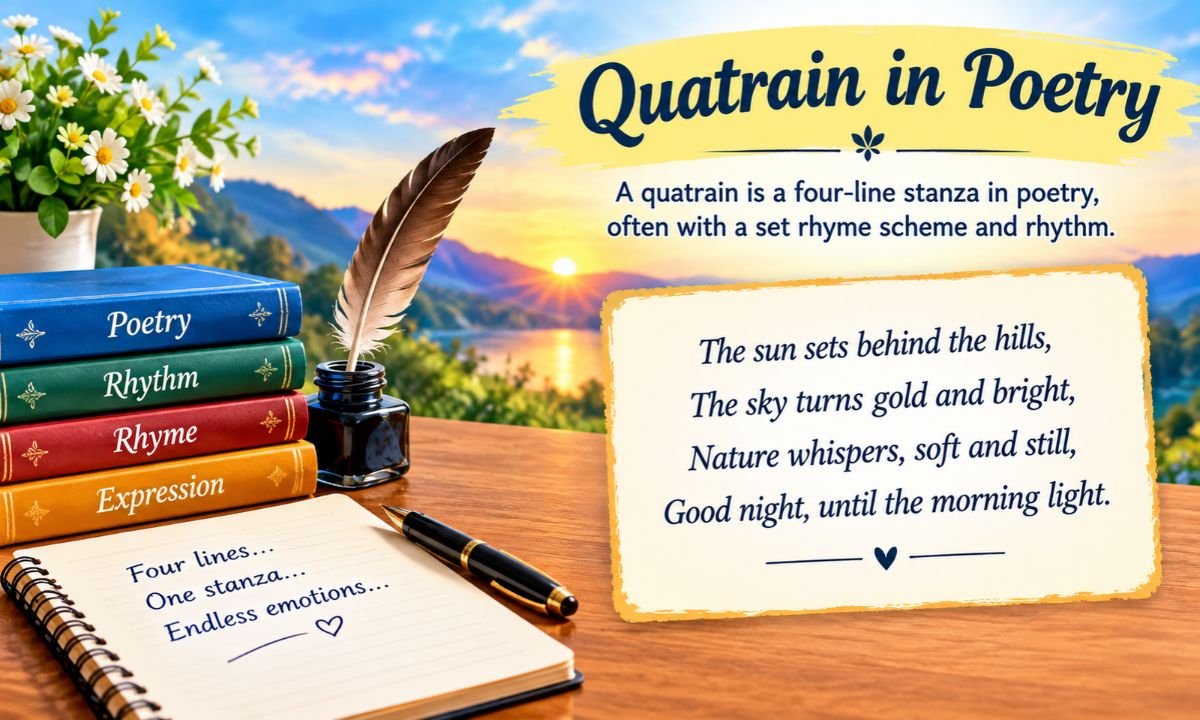
If you’ve ever read a nursery rhyme, a Shakespearean sonnet, or a folk ballad, you’ve already met the quatrain even if nobody told you its name. It is, without exaggeration, the most widely used stanza form in the history of poetry.
A quatrain in poetry is a four-line stanza, and it shows up everywhere: in sonnets, hymns, ballads, elegies, pop songs, and even Persian philosophy written a thousand years ago. Its popularity isn’t an accident. Four lines are just long enough to develop an idea and just short enough to feel tight, musical, and memorable.
In this guide, you’ll learn what a quatrain in poetry is, why poets keep returning to it, the major types you’ll encounter in literature class, and more than 25 examples that show the form in action plus a dedicated look at how quatrains function in Philippine secular poetry.
What Is a Quatrain in Poetry? (Meaning)
The word quatrain comes from the French word quatre, meaning “four,” which itself traces back to the Latin quattuor. In literary terms, a quatrain is a stanza made up of exactly four lines, and it can exist in two ways:
- As a complete, standalone poem of just four lines.
- As a four-line unit within a longer poem, repeated stanza after stanza.
Quatrains usually but not always follow a set rhyme scheme and metrical pattern. They can be rhymed or unrhymed, formal or free verse, and range from playful greeting-card verse to some of the most serious poetry ever written.
Quick definition: A quatrain in poetry is a poetic stanza of four lines, typically connected by a rhyme scheme, meter, or a shared idea, used to build rhythm and structure across a poem.
Read Also This Blog: Ballad in Poetry
Characteristics of a Quatrain in Poetry
Before diving into types and examples, it helps to know what actually makes a stanza a quatrain in poetry. Here are the defining features poets and students look for:
- Four lines exactly. This is the one non-negotiable rule no more, no fewer.
- A rhyme scheme (usually). Common patterns include ABAB, AABB, ABBA, and AABA, though unrhymed quatrains do exist.
- A consistent meter. Many quatrains are written in iambic pentameter, tetrameter, or trimeter, giving the lines a musical, chantable quality.
- A complete thought. Unlike a couplet, which often needs a partner stanza to finish an idea, a quatrain can carry a full thought on its own.
- Flexibility. Quatrains appear in formal verse, free verse, and occasionally blank verse, making them one of the most adaptable stanza forms in poetry.
| Feature | Typical Pattern |
|---|---|
| Line count | 4 lines |
| Common rhyme schemes | ABAB, AABB, ABBA, AABA |
| Common meters | Iambic tetrameter, iambic pentameter, iambic trimeter |
| Can stand alone? | Yes |
| Can repeat as stanzas? | Yes |
Purpose of a Quatrain in Poetry
Why do poets reach for the quatrain in poetry so often instead of tercets (three lines) or longer stanzas? A few reasons stand out:
- Quatrain in poetry balances structure with freedom. Four lines give enough room to develop imagery or an argument without sprawling.
- Quatrain in poetry creates rhythm, poets and readers can predict. Repeated quatrains give a poem a steady, song-like pulse.
- Quatrain in poetry suits for storytelling. Ballads and narrative poems use quatrains to move a story forward stanza by stanza.
- It’s rhyme-efficient. In languages where rhyming words are limited, an alternating quatrain (ABAB) makes rhyme easier to sustain across a long poem.
- Quatrain in poetry supports contrast and balance. A quatrain in poetry can be split into two rhymed pairs, allowing poets to set up an idea in the first half and resolve or contrast it in the second.
Effects of a Quatrain in Poetry
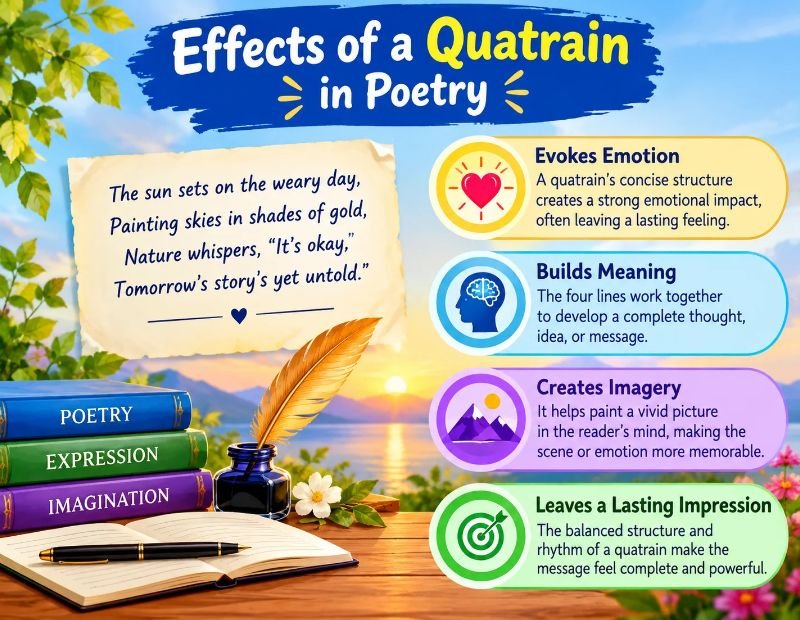
The quatrain in poetry isn’t just a container, it actively shapes how a poem feels. Some of its most common effects include:
- Musicality: Rhyme and meter give quatrains a song-like quality, which is why so many hymns, ballads, and nursery rhymes use them.
- Memorability: The compact, repeating structure makes quatrains easy to memorize and recite — think of how easily proverbs or short verses stick in your head.
- Emotional pacing: Because each stanza delivers a complete unit of thought, quatrains let poets control the emotional rhythm of a poem, pausing briefly at the end of every four lines.
- A sense of order: Even poems dealing with chaotic or intense emotions often feel controlled and deliberate when structured into quatrains.
- Narrative momentum: In ballads, each quatrain can act like a “beat” in a story, pushing the plot forward.
Types of Quatrain in Poetry
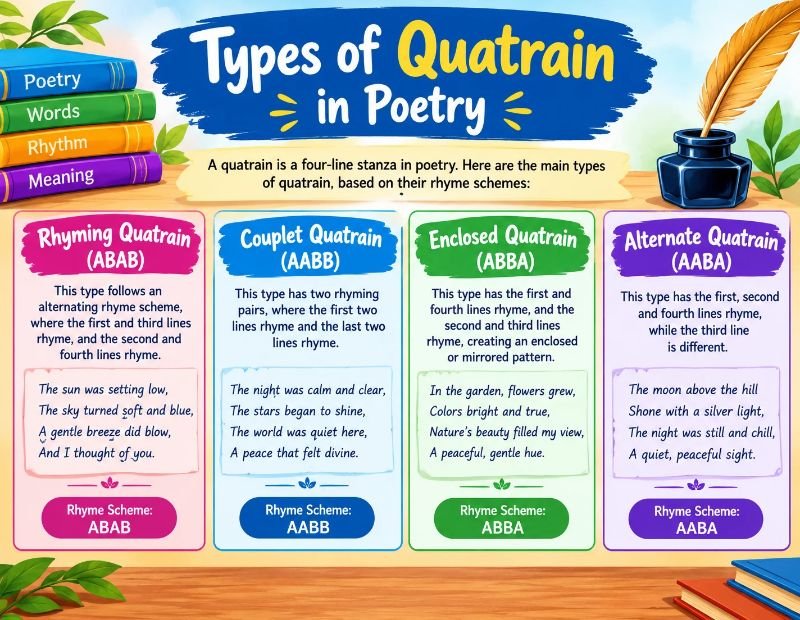
Not all quatrains are the same. Poets have developed several recognizable types over centuries, mostly distinguished by rhyme scheme and meter.
| Type of Quatrain in poetry | Rhyme Scheme | Typical Meter | Known For |
|---|---|---|---|
| Ballad stanza | ABAB (or ABCB) | Alternating tetrameter and trimeter | Folk ballads, hymns |
| Heroic (Elegiac) stanza | ABAB | Iambic pentameter | Formal, elegiac poems |
| Rubaiyat (Ruba’i) | AABA | Varies | Persian quatrains, Omar Khayyám |
| Envelope stanza | ABBA | Varies, often iambic tetrameter | “Wrapped” or mirrored ideas |
| In Memoriam stanza | ABBA | Iambic tetrameter | Tennyson’s elegies |
| Double couplet | AABB | Varies | Simple, song-like verse |
| Unrhymed quatrain (tetrastich) | None | Often blank verse | Free verse, modern poetry |
Ballad Stanza
The most common quatrain in English poetry, the ballad stanza alternates iambic tetrameter and iambic trimeter lines, usually rhyming ABAB or ABCB. It grew out of church hymns and folk storytelling, which is why it still feels musical and narrative today.
Heroic or Elegiac Stanza
Written in iambic pentameter with an ABAB or AABB rhyme scheme, the heroic stanza gives poems a formal, weighty tone. Thomas Gray’s “Elegy Written in a Country Churchyard” is the classic example.
Rubaiyat (Ruba’i)
A Persian form with an AABA rhyme scheme, made famous in English through Edward FitzGerald’s translation of Omar Khayyám’s Rubáiyát. The unrhymed third line creates a small, satisfying twist before the final rhyme lands.
Envelope Stanza
Using an ABBA rhyme scheme, this quatrain “wraps” the middle two lines inside the outer two, often used to mirror or contrast an idea. Tennyson’s “In Memoriam A.H.H.” popularized this pattern in English elegy.
Double Couplet (AABB)
Essentially two rhyming couplets placed back-to-back, this is the simplest and most sing song of the quatrain types common in children’s poetry and light verse.
Unrhymed Quatrain (Tetrastich)
A four-line stanza with no fixed rhyme scheme, often built purely on meter or thought structure. Walt Whitman used this style in free-verse quatrains within “Song of Myself.”
What Is a Quatrain in a Sonnet?
A traditional Shakespearean (English) sonnet is built almost entirely out of quatrains. It contains 14 lines divided into:
- Three quatrains (4 lines each), usually rhyming ABAB CDCD EFEF
- One closing couplet (2 lines), rhyming GG
Each quatrain typically develops a new stage of the poem’s argument or emotion, the first sets up a problem or image, the second complicates it, the third intensifies it, and the final couplet delivers a twist or resolution. This is why understanding quatrains is essential to understanding how a sonnet actually works.
Famous Quatrain in Poetry
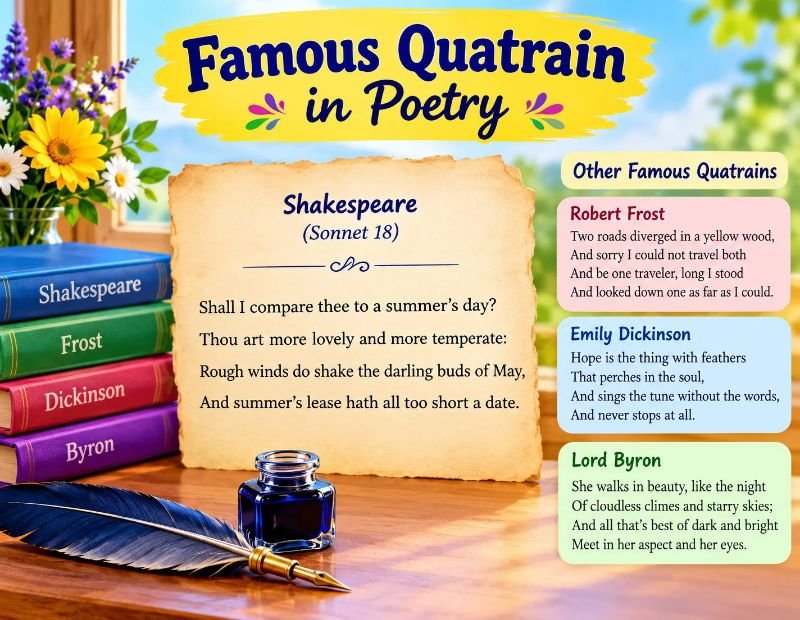
Quatrain in poetry appear across centuries and cultures. Some of the poets and works most associated with the form include:
- William Shakespeare: Used quatrains to build the structure of his sonnets and dialogue in plays like Romeo and Juliet.
- Thomas Gray: “Elegy Written in a Country Churchyard” is written entirely in heroic quatrains.
- Omar Khayyám (trans. Edward FitzGerald) : The Rubáiyát of Omar Khayyám popularized the AABA ruba’i form in English.
- Alfred, Lord Tennyson: “In Memoriam A.H.H.” uses the envelope (ABBA) quatrain throughout.
- Robert Frost : “Stopping by Woods on a Snowy Evening” uses interlocking quatrains to build its hypnotic, snowbound mood.
- Emily Dickinson: Frequently wrote in ballad-like quatrains, often using slant rhyme.
- William Blake: “The Tyger” and Songs of Innocence and Experience rely heavily on quatrain structure.
- Walt Whitman: Experimented with unrhymed, free-verse quatrains in “Song of Myself.”
25+ Examples of Quatrain in Poetry
To see the range of the form, here are examples spanning classic literature, folk tradition, and original illustrative verses.
Classic and Traditional Examples
- Ballad stanza (traditional folk pattern): A wandering hero sets off at dawn, / His cloak pulled tight against the rain; / He leaves behind the fields he’s known, / To walk the road and not complain.
- AABB double couplet (nursery rhyme style): Roses are red, violets are blue, / Sugar is sweet, and so are you.
- Elegiac / heroic quatrain (original, in the style of Gray): The evening bell tolls slow across the lea, / The weary plowman turns his homeward way; / The world grows still beneath the darkening tree, / And light gives way to soft and fading gray.
- Rubaiyat-style quatrain (AABA, original): A cup of wine beneath the bough, / A loaf of bread, a verse, and now / The wilderness feels paradise enough — / If you are near, none other cares I vow.
- Envelope quatrain (ABBA, original): I called your name into the dark, / The dark gave back no word at all; / And silence pressed against the wall / Until I lost the smallest spark.
Themed Original Quatrain in poetry for Students
- Nature theme (ABAB): The river bends beneath the hill, The willows lean to touch the stream; / The world at dusk grows soft and still, As if it walked inside a dream.
- Friendship theme (ABAB): We met by chance on ordinary days, / And somehow chance became a lasting thread; / Through storms and calm and shifting, changing ways, / Your steady friendship carried me ahead.
- Hope theme (AABB): When darkness falls and days feel long, / Hold to the echo of a song; / For morning always finds its way, / And night must yield to newborn day.
- Loss theme (ABAB): The chair stands empty by the door, / The silence louder than before; / I set two cups out, still, from habit, / Though one will not be filled anymore.
- Courage theme (ABAB): She stood where fear had told her not, / And let her trembling hands be still; / The storm she faced, she had not sought, / But faced it fully, by her will.
- Childhood theme (AABB): Barefoot summers, sunlit days, / Chasing fireflies through the haze; / Time moved slow in golden light, / Before the coming of the night.
- Time theme (ABAB): The clock does not slow down for grief, / Nor pause for joy, nor wait for fear; / It moves as steady as a leaf / Let loose upon the turning year.
- Love theme (ABAB): Your name sits quiet on my tongue, / A word I keep but rarely say; / A song that once I might have sung / Now hums beneath the ordinary day.
- Seasons theme (AABB): The autumn leaves let go their hold, / Painting the ground in rust and gold; / While winter waits with patient breath, / To hush the world in quiet death.
- Resilience theme (ABAB): The tree that bends does not break down, / The wind that howls will someday cease; / What now feels heavy as a crown / Will, given time, dissolve to peace.
Short Free-Verse and Unrhymed Quatrain in poetry Examples
- The kettle sings its small complaint, / steam curling up like a question mark; / outside, the evening loses light, / and something in the house grows still.
- She folded laundry, thought of nothing, / let the quiet do its ordinary work; / the day had asked too much already, / and this, at least, asked nothing back.
- A train moves through the sleeping town, / its sound a rumor more than noise; / somewhere, someone is arriving, / somewhere, someone has just left.
Quatrains Illustrating Different Metrical Patterns
- Iambic tetrameter (ABAB): The morning light breaks soft and slow, / Across the fields of silver dew; / The birds begin their songs to grow, / As day repeats what night once knew.
- Iambic trimeter/tetrameter mix (ballad meter, ABCB): The wind blew cold that night, / Across the empty square; / A single lamp burned bright, / As if it did not care.
- Trochaic quatrain: Softly falling, gently calling, / Rain upon the windowpane; / Evening shadows slowly crawling, / Whisper of a quiet rain.
Playful and Light-Verse Examples
- My coffee’s cold, my toast is burnt, / My socks don’t match, I’ve clearly learnt; / That mornings rarely go as planned — / I’ll try again, cup still in hand.
- The cat ignores me, as she should, / Queen of the house, as cats are sworn; / I offer treats, as cats think good, / And she pretends she wasn’t born.
Quatrain in poetry for Reflection and Meditation
- What is a life but scattered days, / Strung loosely on a single thread? / We walk in fog, in shifting haze, / And call it living till we’re dead.
- Not every question needs an answer, / Not every silence needs a name; / Some things are simply meant to wander, / Unfinished, and without a frame.
- The candle does not fear the dark, / It only knows the light it gives; / So let your small and steady spark / Be proof enough of how you lived.
8+ Examples of Quatrain in Poetry for Students
Students learning to identify quatrains often benefit from short, simple, easy-to-scan examples. Here are eight beginner-friendly quatrains with their rhyme schemes labeled:
| # | Quatrain (first words) | Rhyme Scheme |
|---|---|---|
| 1 | “Roses are red, violets are blue…” | AABB |
| 2 | “The wind blew cold that night…” | ABCB |
| 3 | “A cup of wine beneath the bough…” | AABA |
| 4 | “I called your name into the dark…” | ABBA |
| 5 | “The river bends beneath the hill…” | ABAB |
| 6 | “When darkness falls and days feel long…” | AABB |
| 7 | “The morning light breaks soft and slow…” | ABAB |
| 8 | “My coffee’s cold, my toast is burnt…” | AABB |
For classroom use, students can practice by identifying the rhyme scheme first, then the meter, and finally the “complete thought” each quatrain expresses — a simple three-step method that builds confidence quickly.
How to Write a Quatrain in Poetry?
Writing your own quatrain in poetry is easier than it looks. Follow these steps:
- Choose your theme. Decide what single idea, image, or emotion your four lines will capture.
- Pick a rhyme scheme. ABAB and AABB are the easiest starting points for beginners.
- Choose a meter (optional). Iambic tetrameter (eight syllables, alternating stress) is a good default rhythm.
- Write your first line. Set the tone, image, or subject clearly.
- Write your second line so it either rhymes with the first (AABB) or sets up an alternating pattern (ABAB).
- Write your third and fourth lines, completing the rhyme scheme and resolving the thought.
- Read it aloud. Quatrains are meant to be musical if it doesn’t flow when spoken, revise the rhythm.
- Revise for meaning, not just rhyme. Never sacrifice clarity or imagery just to force a rhyme; a slightly imperfect (slant) rhyme is better than a nonsensical line.
Beginner tip: Start with AABB, since it’s the most forgiving pattern, you only need to match two rhyming pairs instead of alternating across the whole stanza.
Quatrains in Philippine Secular Poetry

Quatrains hold a special place in Philippine literary history, particularly in secular poetry written during the Spanish colonial period. Two forms stand out: the awit and the korido, both metrical romances that told colorful tales of chivalry, love, and adventure, often adapted from European sources.
What Are Philippine Secular Poetry in Octosyllabic Quatrains?
The korido is a form of Philippine secular narrative poetry written in octosyllabic quatrains four-line stanzas where each line has eight syllables. It was used for lively, fast-paced metrical romances meant to be chanted or sung, with Jose de la Cruz’s “Ibong Adarna” (Adarna Bird) as its most famous example.
What Are Philippine Secular Poetry in Dodecasyllabic Quatrains?
The awit is a form of Philippine secular narrative poetry written in dodecasyllabic quatrains four-line stanzas where each line has twelve syllables. Its most celebrated example is Francisco Balagtas’s “Florante at Laura,” considered the finest metrical romance in Philippine literature.
| Form | Syllables per Line | Stanza Type | Famous Example |
|---|---|---|---|
| Korido | 8 (octosyllabic) | Quatrain | Ibong Adarna |
| Awit | 12 (dodecasyllabic) | Quatrain | Florante at Laura |
Both forms used quatrains because the structure suited oral performance — the regular syllable count and stanza length made the poems easy to chant, memorize, and pass down through generations.
Why Are Quatrains Used in Poetry?
Pulling everything together, quatrain in poetry remain popular across languages and centuries because they offer:
- A balance of structure and flexibility: enough room to develop an idea, but tight enough to stay focused.
- Natural musicality: rhyme and meter make quatrains pleasant to read aloud and easy to remember.
- Adaptability across genres: from sonnets to ballads to modern free verse, the four-line stanza fits almost anywhere.
- Efficient storytelling: narrative poems and metrical romances (like the awit and korido) use quatrains to move a story forward stanza by stanza.
- A long, trusted literary tradition: from Omar Khayyám to Shakespeare to Balagtas, generations of poets have proven the form works.
Conclusion
The quatrain in poetry has survived for thousands of years because it does something few stanza forms manage: it gives poets just enough room to say something meaningful, while keeping the language tight, musical, and memorable. Whether it’s Shakespeare building toward a sonnet’s final couplet, Omar Khayyám musing on wine and mortality, or Balagtas chanting the dodecasyllabic verses of Florante at Laura, the four-line stanza keeps proving its staying power.
Whether you’re a student learning to identify rhyme schemes, a teacher building a lesson plan, or a writer hoping to compose your own verses, understanding the quatrain, its types, purpose, and structure gives you one of the most versatile tools in all of poetry.
Frequently Asked Questions
What is a quatrain in poetry?
A quatrain in poetry is a four-line stanza in poetry, usually connected by a rhyme scheme and meter, that can stand alone as a complete poem or repeat as part of a longer work.
What is a quatrain in a sonnet?
In a Shakespearean sonnet, a quatrain is one of the three four-line sections (each developing the poem’s idea) that come before the final rhyming couplet.
What are the main types of quatrain in poetry?
The most common types are the ballad stanza, heroic (elegiac) stanza, Rubaiyat (ruba’i), envelope stanza, and the unrhymed tetrastich.
What rhyme scheme do quatrain in poetry use?
Quatrains commonly use ABAB, AABB, ABBA, or AABA rhyme schemes, though unrhymed quatrains exist too.
Why are quatrains used in poetry?
Poets use quatrains because they balance structure with flexibility, create natural rhythm, and suit both short standalone poems and long narrative works.
How do you write a quatrain?
Pick a theme, choose a rhyme scheme like ABAB or AABB, write four lines that complete one clear thought, and read them aloud to check the rhythm.
What is an awit in Philippine poetry?
The awit is a Philippine secular metrical romance written in dodecasyllabic (12-syllable) quatrains, with Balagtas’s Florante at Laura as its most famous example.
What is a korido in Philippine poetry?
The korido is a Philippine secular metrical romance written in octosyllabic (8-syllable) quatrains, best known through Jose de la Cruz’s Ibong Adarna.
Can a quatrain be unrhymed?
Yes, unrhymed quatrains (sometimes called tetrastichs) exist and rely on meter or thought structure instead of rhyme.
What’s the difference between a quatrain and a couplet?
A couplet is a two-line stanza, usually rhymed, while a quatrain is a four-line stanza that can carry a fuller, more developed idea.