
Every poem has a voice. Before you can talk about theme, tone or imagery, you need to know who is talking. That voice is called the speaker of the poem, and spotting it correctly changes how you read every line.
Students often assume the speaker is the poet. Sometimes that is true. Often it is not. A poem can be spoken by a duke, a mirror, a monster, a child or a whole town.
This guide explains the meaning of the speaker, shows you how to find the voice in any poem, compares speaker types, and walks through the speakers in 15 well known poems.
Speaker of the Poem Meaning
The speaker of a poem is the voice that delivers the words on the page. It is the imagined person, character, object or group that “says” the poem to the reader.
Think of it like a film. The poet is the writer and director. The speaker is the actor on screen. The actor may resemble the writer, or may be someone completely different.
Key points to remember:
- The speaker is created by the poem, not automatically the same as the poet.
- The speaker may be human, animal, object, spirit or an abstract idea.
- The speaker has a point of view, a mood and a purpose for speaking.
- The speaker may talk to a listener, to nature, to God or to nobody at all.
This is why teachers ask “who is the speaker?” so often. The answer unlocks tone, attitude and meaning together.
Read Also This Blog: Poetry Project
Why the Speaker Matters in Poetry?
Knowing the speaker helps you read with more accuracy. The same event described by two different voices becomes two different poems.
A war poem spoken by a soldier feels very different from one spoken by a mother waiting at home. The facts may match, but the emotion does not.
Understanding the speaker helps you:
- Decide whether the tone is sincere, bitter, ironic or playful
- Spot bias and unreliable narration
- Connect word choice to character
- Write stronger exam answers and essays
- Avoid wrongly mixing the poet’s life with the poem’s voice
How to Identify the Speaker of the Poem?
Finding the speaker is a skill you can learn in a few steps. Use the process below on any poem, from a school textbook to a classic anthology.
Step by Step Method
- Read the title. Titles like “Windigo” or “Mirror” often name the speaker directly.
- Count the pronouns. “I” and “my” point to a first person speaker. “We” suggests a group. “He” or “she” suggests an outside observer.
- Look for an addressee. Is the speaker talking to a lover, a king, a child or a bird? The listener shapes the speaker’s words.
- Study the diction. Formal language, slang, archaic words or childlike phrases all reveal personality.
- Find the setting and time. A castle, a beach, a garden or a shed gives clues about who is speaking and why.
- Notice tone shifts. A sudden change in mood often marks a change in the speaker’s thinking.
- Ask about reliability. Does the speaker tell the full truth, or does the poem quietly expose them?
Quick Clue Checklist
- Direct self description, such as age, job or social position
- Mentions of family, friends or rivals
- Emotional state in the first stanza
- Gaps between what the speaker says and what the reader senses
If you can answer “who, to whom, where, when and why,” you have found your speaker.
Speaker vs Poet vs Narrator vs Persona
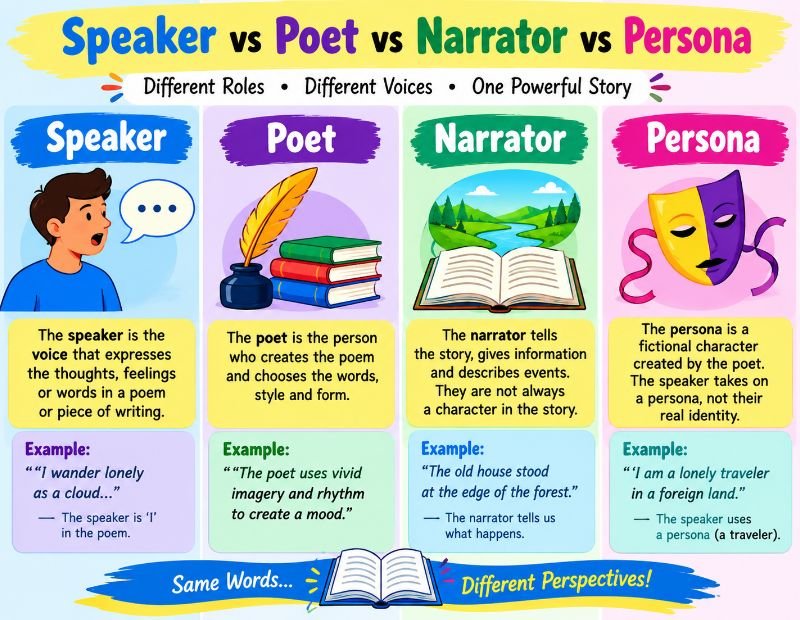
These four terms are often mixed up. The table below separates them in plain language.
| Term | Meaning | Example |
|---|---|---|
| Poet | The real writer who created the poem | Robert Browning |
| Speaker | The voice that speaks inside the poem | The Duke of Ferrara |
| Narrator | A voice that tells a story or sequence of events | The traveler’s reporter in Ozymandias |
| Persona | A deliberate mask or character adopted by the poet | Ulysses in Tennyson’s poem |
Speaker vs Narrator of the Poem
The speaker and narrator overlap, but they are not identical. A speaker may simply express feelings, reflect on an idea or address someone. A narrator mainly tells a story, often describing events from a distance.
In a lyric poem, the speaker usually shares a thought or emotion. In a ballad or narrative poem, the narrator moves the plot forward. Many poems contain both at once, which is why teachers often use the words loosely.
Types of Speaker of the Poem
Poets choose different kinds of voices to create different effects. These are the main types you will meet.
| Type | Description | Typical Example |
|---|---|---|
| First person speaker | Uses “I” and shares personal thoughts | The Road Not Taken |
| Collective speaker | Uses “we” to speak for a group | We Wear the Mask |
| Third person speaker | Watches and describes others | Baudelaire’s observer in The Albatross |
| Dramatic monologue speaker | A character speaks to a silent listener | My Last Duchess |
| Persona speaker | A mask or invented character | Ulysses |
| Inanimate or animal speaker | An object, animal or spirit speaks | Mirror, Windigo |
| Unreliable speaker | Voice that distorts or hides the truth | The Duke in My Last Duchess |
| Multiple speakers | Several voices share the poem | Dialogue poems and ballads |
First Person Speaker
This is the most common type. The speaker says “I,” which creates closeness and emotion. Readers feel they are hearing a private thought. Remember, the “I” is still a constructed voice, even when it sounds personal.
Dramatic Monologue Speaker
In a dramatic monologue, one character speaks to a silent listener at a specific moment. The speech reveals the character’s personality, often more than they intend. Browning made this form famous.
Unreliable Speaker
Some speakers are biased, self deceived or dishonest. The reader sees the gap between what they say and what is true. That gap creates irony and drama.
Inanimate and Animal Speakers
Poets sometimes hand the voice to a mirror, a tree, a bird or a monster. This surprises the reader and offers a fresh view of human life.
Classical Speaker of the Poem
Classical poetry, rooted in ancient Greek and Roman tradition, often uses a bard or epic voice. The speaker may call on a Muse for inspiration and tell stories of gods and heroes.
Typical features:
- Formal, elevated language
- An impersonal or authoritative storyteller
- Large themes such as honor, fate, war and the gods
- Invocations and epic similes
The classical speaker is less about private feeling and more about preserving a heroic story for a community.
Traditional Speaker of the Poem
Traditional poetry covers folk ballads, sonnets and the Romantic lyric. Speakers here tend to be recognizable types.
- The ballad voice: a simple, often anonymous storyteller
- The sonnet lover: a speaker wrestling with desire, loss or faith
- The Romantic reflector: a thoughtful “I” meditating on nature and memory
Rhyme, meter and fixed forms keep the voice controlled and musical. The emotion is strong, but it is shaped by form.
Modern Speaker of the Poem
Modern and contemporary poets often break the rules. The speaker may be fragmented, uncertain or openly flawed. Confessional poets blur the line between poet and speaker, while others invent personas to explore identity, race, gender or trauma.
Common modern traits:
- Fractured or shifting identity
- Conversational, plain language
- Social and political awareness
- Unusual speakers such as objects, animals or myth figures
Poems such as “Mirror” and “Windigo” show how modern writers give voice to the unexpected.
Famous Speakers in Poems: Examples and Analysis
Below are 15 poems, each with a clear look at who speaks and why it matters.
Speaker of the Poem The Shed
“The Shed” by Frank Flynn is spoken by a young child. The child lives near an old shed at the bottom of the garden and feels both fear and curiosity. A brother tells ghost stories to keep the shed for himself, but the speaker suspects the lie. The repeated plan to go inside “one day” shows a child slowly building courage. This is a first person speaker with a very believable childlike voice.
Speaker of the Poem Ozymandias
In Shelley’s “Ozymandias,” the voice reports what a traveler once said. The poem is layered. A narrator passes along the traveler’s account, which in turn describes a broken statue and the words of a proud king. The speaker is calm and observant, which lets the ruined monument deliver the irony. The message is that even great power fades.
Speaker of the Poem Ulysses
Tennyson’s “Ulysses” is a dramatic monologue spoken by the aged hero Ulysses, also known as Odysseus. He is back in Ithaca but restless. He rejects a quiet domestic life, hands rule to his son Telemachus and calls his old crew to seek new adventures. His voice is bold and heroic, though some readers sense avoidance of duty beneath it.
Speaker of the Poem My Last Duchess
Browning’s Duke of Ferrara speaks to an envoy who has come to arrange his next marriage. He shows a portrait of his late wife and explains, with chilling calm, why her behavior displeased him. The Duke is a classic unreliable speaker. He thinks he is displaying taste and authority, but he exposes jealousy and cruelty.
Speaker of the Poem The Last Bargain
Tagore’s “The Last Bargain” is spoken by a wandering seeker who offers to be hired. A king offers power, a rich man offers wealth and a young woman offers a smile, yet none of these work. Only a child playing by the sea offers nothing, and that is the deal that frees the speaker. The speaker is a spiritual first person voice, searching for true freedom outside power, money and charm.
Speaker of the Poem The Road Not Taken
Frost’s speaker is an unnamed traveler standing at a fork in a wood. He chooses one path and imagines telling the story years later. Many readers treat it as a poem about bold individuality, but the speaker admits the two roads were nearly the same. The voice is thoughtful, slightly teasing and aware of how people rewrite their own past.
Speaker of the Poem Tintern Abbey
In Wordsworth’s “Lines Composed a Few Miles above Tintern Abbey,” the speaker returns to a landscape after five years. He reflects on how nature has comforted him in the city and how his view of the land has matured. Near the end he speaks directly to his companion, usually read as his sister. The tone is meditative and grateful, a classic Romantic reflector.
Speaker of the Poem Dover Beach
Arnold’s speaker stands at a window above the English Channel at night, watching the sea. He turns to a loved one beside him and speaks about fading faith and a troubled world. The calm opening sets up a sadder, more anxious mood. His appeal for loyalty between two people feels like a refuge in a confusing age.
Speaker of the Poem Albatross
Baudelaire’s “L’Albatros” is often called “The Albatross.” The speaker watches sailors mock a great sea bird after catching it. Once graceful in flight, the bird looks clumsy on the ship’s deck. The speaker then compares the bird to the poet, who is noble in the sky of imagination and awkward in everyday society. Do not confuse it with Coleridge’s “Rime of the Ancient Mariner,” where the mariner himself tells the tale of a shot albatross.
Speaker of the Poem We Wear the Mask
Paul Laurence Dunbar speaks as “we,” a collective voice for African Americans who hide pain behind a smile. The plural pronoun turns a private feeling into a shared struggle. The tone is restrained, almost whispered, which fits the idea of hiding truth from a hostile world.
Speaker of the Poem Richard Cory
Edwin Arlington Robinson uses another collective speaker, the townspeople. They watch Richard Cory from the pavement and admire his wealth, manners and appearance. Their envy and ignorance set up a sharp, tragic twist. The poem teaches that outward success does not reveal inner life, and the plain “we” voice makes the shock hit harder.
Speaker of the Poem I, Too
Langston Hughes writes in the first person, but “I” represents a whole people. The speaker is a Black American told to eat in the kitchen when company comes. He laughs, grows strong and promises to sit at the table tomorrow. The voice is calm, confident and hopeful, answering a famous celebration of America with a quiet claim to belonging.
Speaker of the Poem Mirror
Sylvia Plath gives the voice to a mirror, which describes itself as silver, exact and without opinions. In the second part, the speaker becomes a lake that a woman searches for her real self. The inanimate speaker lets Plath explore aging, honesty and fear of change from an unusual angle. It is a strong example of a persona poem.
Speaker of the Poem Windigo
Louise Erdrich’s “Windigo” is spoken by the Windigo itself, a cold, flesh eating spirit from Anishinaabe tradition. It speaks to a child in the second person, turning the usual monster story inside out. The creature sounds menacing but also strangely longing, which makes readers unsure whether to fear it or pity it. The voice is both frightening and tender.
Quick Reference: Speaker of Each Poem
| Poem | Poet | Speaker | Type |
|---|---|---|---|
| The Shed | Frank Flynn | A young child | First person |
| Ozymandias | Percy Bysshe Shelley | Narrator reporting a traveler | Layered narrator |
| Ulysses | Alfred Lord Tennyson | Ulysses | Dramatic monologue |
| My Last Duchess | Robert Browning | Duke of Ferrara | Unreliable, dramatic monologue |
| The Last Bargain | Rabindranath Tagore | A wandering seeker | First person, spiritual |
| The Road Not Taken | Robert Frost | An unnamed traveler | First person |
| Tintern Abbey | William Wordsworth | A reflective returning visitor | Romantic lyric |
| Dover Beach | Matthew Arnold | A thoughtful observer by the sea | First person, addresses a listener |
| The Albatross | Charles Baudelaire | Observer comparing bird and poet | Observer voice |
| We Wear the Mask | Paul Laurence Dunbar | A collective “we” | Collective |
| Richard Cory | Edwin Arlington Robinson | The townspeople | Collective |
| I, Too | Langston Hughes | A Black American voice | First person, representative |
| Mirror | Sylvia Plath | A mirror, then a lake | Inanimate persona |
| Windigo | Louise Erdrich | The Windigo spirit | Mythic persona |
Speaker, Tone and Mood: How They Connect?
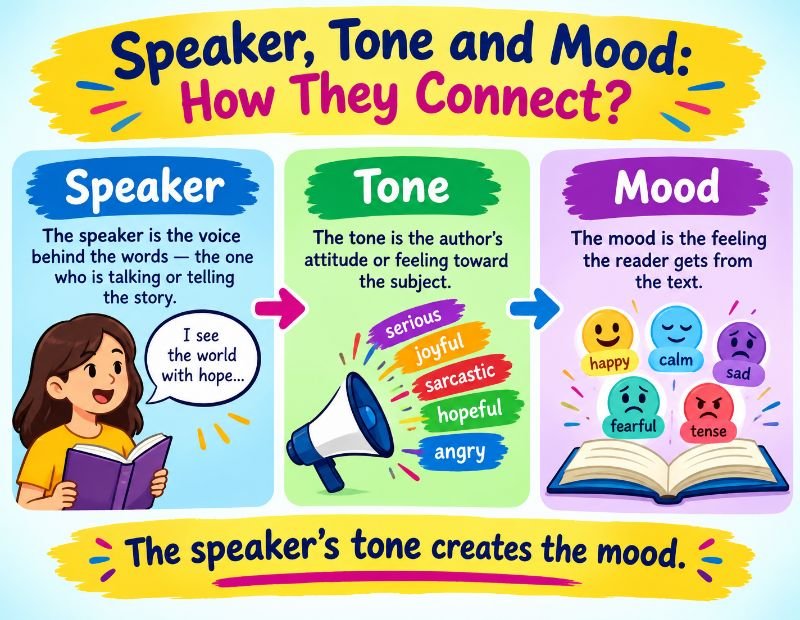
Readers often mix up speaker, tone and mood. They work as a chain.
- The speaker is who talks.
- The tone is the speaker’s attitude toward the subject.
- The mood is the feeling the reader gets.
For example, in “My Last Duchess” the Duke’s polite, controlled tone creates a mood of unease. Understanding the speaker first makes tone and mood easier to name.
Poetic Devices That Reveal the Speaker of the poem
Poets use several tools to shape and expose the voice.
- Diction: word choice that signals class, age and education
- Syntax: sentence rhythm that shows calm, anger or panic
- Imagery: what the speaker notices reflects what they value
- Apostrophe: speaking directly to an absent person, object or idea
- Irony: the gap between what the speaker says and what is true
- Repetition: returning to a phrase to show obsession or hesitation
Notice which devices appear most often. They usually point straight to the speaker’s personality.
Common Mistakes When Identifying the Speaker of the poem
Avoid these frequent errors.
- Assuming every “I” is the poet
- Ignoring the listener or addressee
- Missing irony and taking everything literally
- Naming the speaker without textual proof
- Forgetting that some speakers are objects, animals or groups
Always back up your answer with a line or phrase from the poem.
How to Write About the Speaker in an Exam or Essay?
A strong answer names the speaker, explains the situation and links voice to meaning. Try this structure:
- Identify: Say who is speaking and to whom.
- Support: Use short evidence from the text.
- Explain: Describe tone, attitude and any shifts.
- Connect: Show how the speaker shapes the theme.
Helpful sentence starters:
- “The speaker appears to be…”
- “The use of the first person plural suggests…”
- “The speaker’s calm tone contrasts with…”
- “This detail reveals that the speaker is unreliable because…”
Keep your claims tied to the poem and avoid guessing about the poet’s private life unless the question asks for context.
Tips for Writing Your Own Poem Speaker
If you write poetry, building a clear speaker makes your work stronger.
- Decide who is speaking before you write the first line
- Give the speaker a want, a fear or a secret
- Choose a listener, even if the poem never names them
- Let diction match the character’s age and background
- Try an unusual voice, such as an object or a place
- Read your poem aloud to check that the voice stays consistent
Conclusion
The speaker of the poem is the heart of the reading experience. Speaker of the poem tells you who is talking, how they feel and why the poem exists. Once you can name the speaker, themes, tone and symbols fall into place more easily.
From a frightened child in “The Shed” to a monster in “Windigo,” poets use speakers to widen our view of human life. Use the steps and tables in this guide the next time you open a poem, and always ask: who is speaking, to whom, and why?
Frequently Asked Questions About the Speaker of the Poem
What is the speaker of the poem?
The speaker of the poem is the voice that delivers the poem. It may be a person, character, object or group, and it is not always the poet.
Is the speaker of the poem the same as the poet?
Not always. The poet writes the poem, while the speaker is the voice the poet creates to say it.
How do you identify the speaker of the poem?
Check the title, pronouns, tone, setting, listener and word choice. These clues reveal who is talking and why.
What is the difference between a speaker of the poem and a narrator in poetry?
A speaker of the poem expresses thoughts or feelings, while a narrator mainly tells a story or events. The two often overlap in one poem.
What are the main types of speaker of the poetry?
Common types include first person, collective, third person, dramatic monologue, persona, unreliable and inanimate speakers.
What is a dramatic monologue speaker?
It is a character who speaks to a silent listener at a particular moment. Their words reveal their true personality.
Who is the speaker in “The Shed”?
The speaker is a young child who is both afraid and curious about an old garden shed.
Who is the speaker in “My Last Duchess”?
The Duke of Ferrara is the speaker. He talks to an envoy about his late wife and unintentionally reveals his cruelty.
Who is the speaker in “Ozymandias”?
A narrator who repeats the story told by a traveler about a ruined statue of a once powerful king.
Who is the speaker in “Mirror” by Sylvia Plath?
The first speaker is a mirror, and in the second part it becomes a lake reflecting a woman’s face.
Who is the speaker in “Windigo”?
The speaker is the Windigo, a mythic winter spirit that addresses a child directly.
What does “unreliable speaker” mean?
It means the speaker’s account is biased, mistaken or dishonest, so readers must question what they say.