
Poetry used to live on bookshelves, in school anthologies and at open mic nights. Today, it also lives on screens. A poetry site gives readers, writers, teachers and students a place to find verse, share it and learn from it, often for free.
If you have ever searched for a favorite ghazal at midnight, posted a first poem for feedback or looked for a classroom activity, you have already used one. This guide explains what a poetry site is, how it works, the main types, and the best examples for every language and audience.
Poetry Site Definition
A poetry site is a website or online platform built around poems. It may store poems, publish new work, host a writing community, teach poetry skills or do all of these together.
In simple terms, it is a digital home for verse. Some sites work like libraries, some like workshops and some like magazines.
Quick snapshot:
- Main content: poems, poet biographies, audio readings, essays and prompts
- Main users: readers, writers, students, teachers and researchers
- Main goal: make poetry easy to find, share and understand
Read Also this Blog: Speaker of the Poem
5+ Powerful Meanings of a Poetry Site
The phrase “poetry site” means different things to different people. Here are the six most common meanings.
- A digital library. A large archive of classic and modern poems you can search by poet, theme or form.
- A writing community. A place where poets post work and give feedback to each other.
- A publishing outlet. A journal or magazine website that accepts submissions and prints selected poems.
- A learning hub. A resource with lesson plans, guides and analysis for classrooms.
- An audio and video archive. A platform that hosts recordings of poets reading their own work.
- A personal portfolio. A poet’s own website showing their books, events and new poems.
Many modern platforms combine two or three of these roles, which is why the term is so broad.
History of the Poetry Site
Online poetry began with early digital libraries that turned old books into plain text files for anyone to read. As the web grew in the 1990s, organizations and poetry lovers launched sites to share verse beyond the printed page.
Several milestones shaped the space:
- Mid 1990s: Poetry organizations and enthusiasts started the first dedicated poetry websites.
- Late 1990s: Daily poem services and scholarly projects appeared, including the Modern American Poetry Site, created at the University of Illinois as a companion to a poetry anthology.
- 2000s: Community platforms let ordinary writers post, comment and build audiences.
- 2010s: Blogs, Instagram and mobile apps made short form poetry popular.
- Today: Spoken word clips, audio archives and social platforms sit alongside traditional poetry websites.
The trend is clear. Poetry has moved from a closed literary world to an open, global conversation.
Purpose of a Poetry Site
Why do these platforms exist? Most share a handful of goals.
- Access: give free or low cost reading material to everyone
- Preservation: keep rare and older poems from disappearing
- Education: support teaching, studying and exam preparation
- Expression: give new voices a safe place to write
- Discovery: help readers find poets they would never meet in a bookstore
- Connection: build communities around shared love of language
A good poetry site balances all six without feeling crowded.
Types of Poetry Sites
Different needs call for different platforms. The table below shows the main categories.
| Type | What It Offers | Best For |
|---|---|---|
| Archive or library site | Large searchable collection of poems | Readers and researchers |
| Poetry writing site | Prompts, tools, writing guides | Beginners and practicing poets |
| Poetry posting site | Free space to publish and get comments | Amateur and emerging poets |
| Publishing site | Journal or magazine with submissions | Poets seeking recognition |
| Educational site | Lessons, analysis, teacher guides | Classrooms |
| Audio or video site | Recorded readings and performances | Listeners and learners |
| Regional language site | Urdu, Hindi, Persian or other poetry | Language lovers |
Key Features of a Great Poetry Site
Not every site is equally helpful. Look for these features before you commit your time.
- Clean layout. Poems need white space, readable fonts and mobile friendly design.
- Smart search. Filters for poet, theme, form, era and language save time.
- Poet biographies. Context makes a poem easier to understand.
- Audio recordings. Hearing a poem read aloud reveals rhythm and tone.
- Word meanings. Glossaries are especially useful for Urdu, Persian and classical English verse.
- Community tools. Comments, likes, follows and groups encourage writers.
- Writing resources. Prompts, forms and craft essays help growth.
- Fair use and copyright respect. A trustworthy site credits poets and follows permission rules.
Free Poetry Site Options
Many excellent platforms cost nothing to read. Free sites usually earn support through donations, institutions or light advertising.
Benefits of free platforms:
- No subscription barrier for students
- Large public domain collections
- Daily poem emails and newsletters
- Open access to audio and essays
A small number of sites keep extra tools, such as advanced portfolios or ad free browsing, behind a paid plan. For reading and basic posting, free versions are usually enough.
Poetry Writing Site
A poetry writing site helps you practice the craft, not only post the result. These platforms often include:
- Daily or weekly prompts
- Lessons on meter, rhyme and free verse
- Form guides for sonnets, haiku, ghazals and villanelles
- Challenges and contests
- Peer review groups
If you are new to writing, pick a site with prompts and feedback. Regular practice matters more than perfect drafts.
Poetry Posting Site
A poetry posting site lets you publish poems quickly. Writers upload text, add tags and wait for readers to respond.
Popular posting spaces include dedicated community platforms such as AllPoetry and Hello Poetry, along with blogging and social media channels. Tags and categories help readers discover your work by theme.
Posting tips:
- Add a clear title and 3 to 5 tags.
- Keep lines short and easy to scan on mobile.
- Comment on other poets before expecting comments yourself.
- Keep a private copy of every poem you post.
- Remember that some magazines treat online posts as published work, so check their rules before submitting.
Poetry Site for Teachers
Teachers need reliable, classroom ready material. The best teacher resources include lesson plans, discussion questions, printable poems and National Poetry Month ideas.
Useful picks:
- Poets.org offers lesson ideas, poem collections and teaching tools from the Academy of American Poets.
- Poetry Foundation provides a learning section with classroom resources.
- Poetry Archive hosts recordings of poets reading, which help students hear rhythm.
Poetry Site for Students
Students need clear explanations, summaries and context. Look for sites with analysis, poet biographies and critical essays.
- Poetry Foundation supports study with a large archive and poet profiles.
- Modern American Poetry Site (MAPS) offers criticism and background on individual poems and poets.
- Poets.org has glossaries of poetic terms and thematic collections.
Always cite your sources in assignments, and use summaries as a starting point rather than a replacement for reading the poem.
Poetry Site for Kids
Young readers love humor, rhythm and bright design. Child friendly sites avoid heavy language and use short, playful poems.
- Poetry4Kids by Kenn Nesbitt offers funny poems and writing tips for children.
- Giggle Poetry shares silly verse and rhyming games.
- Poetry Foundation’s children’s section lists age appropriate poems and read aloud choices.
Parents should check privacy settings and avoid open comment spaces for younger children.
Poetry Site for Adults
Adults often want depth, new releases and thoughtful essays. Journals, daily poem services and critical archives work well here.
- Poetry Daily features a new poem every day from recent books and journals.
- Poetry Foundation publishes Poetry magazine and wide ranging commentary.
- Allpoetry and Hello Poetry let adult writers share personal work with a community.
8 Famous Poetry Sites
These platforms appear again and again in teacher lists and reader guides.
| # | Site | Best For | Highlight |
|---|---|---|---|
| 1 | Poetry Foundation | Readers and students | Huge archive plus Poetry magazine |
| 2 | Poets.org | Teachers and learners | Lesson plans and National Poetry Month |
| 3 | Poetry Daily | Contemporary poetry fans | Daily featured poem |
| 4 | Allpoetry | Writers seeking community | Posting, contests and feedback |
| 5 | Hello Poetry | New poets | Simple, clean sharing space |
| 6 | Poetry Archive | Listeners | Recordings of poets reading |
| 7 | Famous Poets and Poems | Quick lookup | Large collection sorted by poet |
| 8 | Modern American Poetry Site | Scholars and students | Criticism and context on American poets |
Poetry Collection Online
An online poetry collection is a curated group of poems arranged by theme, poet, era or form. Think of it as an anthology you can search.
What to expect in a good collection:
- Poems grouped by themes such as love, nature, loss and justice
- Notes on historical background
- Links to related poets
- Options to save favorites
- Sections for audio and translation
Online collections beat printed ones for speed, though printed anthologies still give a calmer reading experience.
Poetry Site Packages
“Packages” can mean two things. Some platforms sell premium membership plans, while poets and organizations buy website packages to build their own poetry site.
| Package Type | Typical Inclusions | Who Needs It |
|---|---|---|
| Free membership | Basic posting, reading, commenting | Beginners |
| Premium membership | Extra tools, fewer ads, advanced profile | Active writers |
| Website builder plan | Template, domain, hosting, blog | Poets with a portfolio |
| Custom development | Unique design, search, member accounts | Publishers and institutions |
| Educational license | Multiple student accounts, resources | Schools |
Compare cost, storage, mobile support and support quality before paying.
5 Best Urdu Poetry Sites
Urdu poetry has a rich online home. These sites help readers explore ghazals, nazms and couplets, often in several scripts.
- Rekhta. A free platform dedicated to Urdu literature. It offers ghazals and nazms in Urdu, Hindi (Devanagari) and Roman scripts, with word meanings and audio recordings.
- Allama Iqbal Poetry website. A searchable collection of Iqbal’s Urdu and Persian books, including translations and explanations.
- Iqbal Cyber Library. A digital library linked with Iqbal studies and Urdu literature.
- UrduPoint. A general portal with a large shayari section.
- Hamariweb. A popular Pakistani portal with poetry categories.
Site features change over time, so check each platform for current content.
5 Best English Poetry Sites
- Poetry Foundation. A trusted archive with poet profiles and the Poetry magazine.
- Poets.org. Great for learning, teaching and daily poems.
- Poetry Archive. Ideal for hearing poets read aloud.
- Poetry Daily. A fresh poem every day from contemporary work.
- PoemHunter. A giant, easy to browse collection for quick lookup.
5 Best Hindi Poetry Sites
- Hindwi. Created by the Rekhta Foundation, it focuses on Hindi poetry and literature.
- Kavita Kosh. A large volunteer built collection of Hindi poems.
- Hindi Samay. A literature portal with poetry and prose.
- Bharat Darshan. A cultural magazine site with a Hindi poetry section.
- Sahitya Kunj. A literary magazine platform for contemporary Hindi writers.
Persian Poetry Site
For Persian lovers, Ganjoor is the go to name. It is an open access collection of classical and modern Persian literature, built through collective effort. Visitors can browse poets, read random lines of poetry, explore a music index of poems used in songs and listen to recitations. Its interface is in Persian, so some language knowledge helps.
Blackout Poetry Site
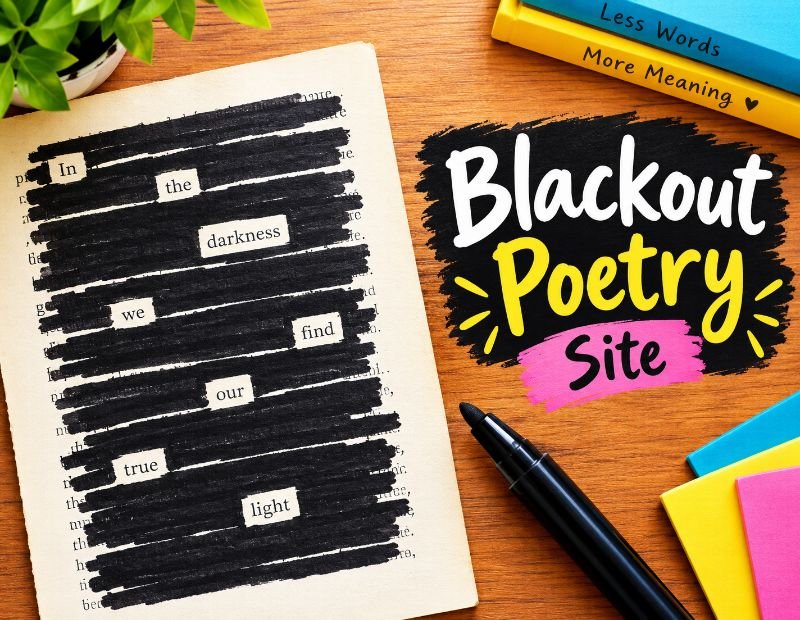
Blackout poetry creates a new poem by covering most words on a printed page and leaving a few visible. Artist and writer Austin Kleon helped popularize the newspaper version, and his site offers examples and ideas.
You do not need a special site to try it. A printed page, a marker and a bit of patience are enough. Digital tools and design apps can also help you black out text on screen.
Quick method:
- Choose a page with interesting vocabulary.
- Underline words that form a thought.
- Black out everything else.
- Add small drawings or patterns if you like.
Anonymous Poetry Site
Some poets want to share without attaching their name. Anonymous or pen name spaces can feel safer for personal or sensitive themes.
Ways to post privately:
- Use a pen name on a poetry community
- Create a separate email and profile for writing
- Join forums that allow throwaway accounts
Remember that complete anonymity is rarely guaranteed. Read privacy policies, avoid sharing identifying details and think about long term consequences before posting.
3 Traditional Poetry Sites
Traditional poetry sites focus on established verse such as sonnets, ballads and Romantic lyrics.
- Representative Poetry Online. A scholarly collection from the University of Toronto.
- Bartleby. An older but still useful reference source for classic English verse.
- Poetry Foundation archive. Mixes older and modern poems with biographies.
3 Classical Poetry Sites
Classical sites highlight ancient Greek and Latin literature and translations.
- Perseus Digital Library. Texts and tools for classical Greek and Latin works.
- Poetry in Translation. Offers translations of poems from many languages and eras.
- Project Gutenberg. Free public domain books, including many classical translations.
Modern American Poetry Site
The Modern American Poetry Site (MAPS) began in 1999 at the University of Illinois as a companion to an Oxford anthology. It grew into a collaborative learning space with essays, biographies, timelines and sample syllabi. Its special strength is focused criticism on individual poems, not only on poets’ careers.
Other helpful sites for modern American verse include Poets.org, Poetry Foundation and Poetry Daily.
Poetry Publishing Site
A poetry publishing site accepts submissions and selects work for print or online issues. Being chosen often brings credibility and a wider audience.
Steps to submit your poems:
- Read the journal’s recent issues to understand its taste.
- Follow formatting and word limit rules.
- Send a short, polite cover note.
- Submit simultaneously only if allowed.
- Track your submissions in a spreadsheet.
- Expect long waits and many rejections, which are normal.
Platforms such as Submittable and directories like Duotrope or Poets & Writers help you find open calls. Always verify fees and rights before submitting.
How to Choose the Right Poetry Site?
Use this quick checklist.
- Do you want to read, learn, write or publish?
- Is the site easy to use on your phone?
- Does it respect copyright and credit poets?
- Is the community kind and active?
- Are there tools that fit your language?
- Does it protect your privacy?
Try two or three sites for a week and keep the one that feels natural.
Extra SEO Tips for Running Your Own Poetry Site
If you plan to launch a poetry website, search friendly basics will help readers find you.
- Target clear keywords such as “love poems,” “Urdu ghazal” or “poetry for kids.”
- Write helpful descriptions for each poem or collection, not only the text.
- Use clean URLs like /poems/autumn-poem.
- Add alt text to every image.
- Link between related poems and poets to keep readers browsing.
- Improve speed with compressed images and light design.
- Use structured data where possible so search engines understand your content.
- Publish original analysis because many sites repeat the same poems.
- Credit sources and respect copyright at all times.
Safety, Copyright and Etiquette
Poetry sites are friendly spaces, but a few habits keep them that way.
- Post only your own work or public domain poems.
- Give credit when quoting or sharing a poem.
- Give honest feedback with kindness.
- Never copy someone else’s poem and call it yours.
- Protect personal data in poems and profiles.
Conclusion
A poetry site can be a library, classroom, workshop, stage or magazine, all in one place. The right one depends on what you want to do. Readers will love archives like Poetry Foundation and Rekhta, learners will gain from Poets.org and MAPS, and new writers can find a friendly start on community platforms.
Pick a site, bookmark a few favorites and make poetry a small daily habit. Over time, you will find voices that stay with you.
Frequently Asked Questions About Poetry Sites
What is a poetry site?
A poetry site is a website where people read, write, share, teach or publish poems. It may work as a library, community, school resource or magazine.
What is the best free poetry site?
Poetry Foundation and Poets.org are strong free choices for English readers. Rekhta is excellent for free Urdu poetry.
Which poetry site is best for beginners?
Hello Poetry and Allpoetry are friendly for new writers. For learning, Poets.org is easy to follow.
Can I post my poems online for free?
Yes, many community sites let you post for free. Keep a private copy and check magazine rules, since some treat online posts as already published.
Which poetry site is best for teachers?
Poets.org and the Poetry Foundation learning section offer lesson ideas and classroom resources.
Which poetry site is best for kids?
Poetry4Kids and Giggle Poetry provide funny, simple poems suited to children.
What is the best Urdu poetry site?
Rekhta is widely used for ghazals and nazms, with word meanings and multiple scripts.
What is the best Hindi poetry site?
Hindwi and Kavita Kosh are two of the most useful for Hindi poems.
Where can I read Persian poetry online?
Ganjoor is a major free online collection of Persian poetry, though its interface is in Persian.
What is blackout poetry?
It is a poem made by hiding most words on a page and leaving a few visible to form a new message.
Can I post poetry anonymously?
Many platforms allow pen names, but full anonymity is never guaranteed. Avoid sharing personal details.
What is the Modern American Poetry Site?
MAPS is a University of Illinois project with essays, biographies and criticism on American poems and poets.
How do I get my poems published?
Read a journal’s past issues, follow its guidelines and submit through its listed system or a platform like Submittable.