
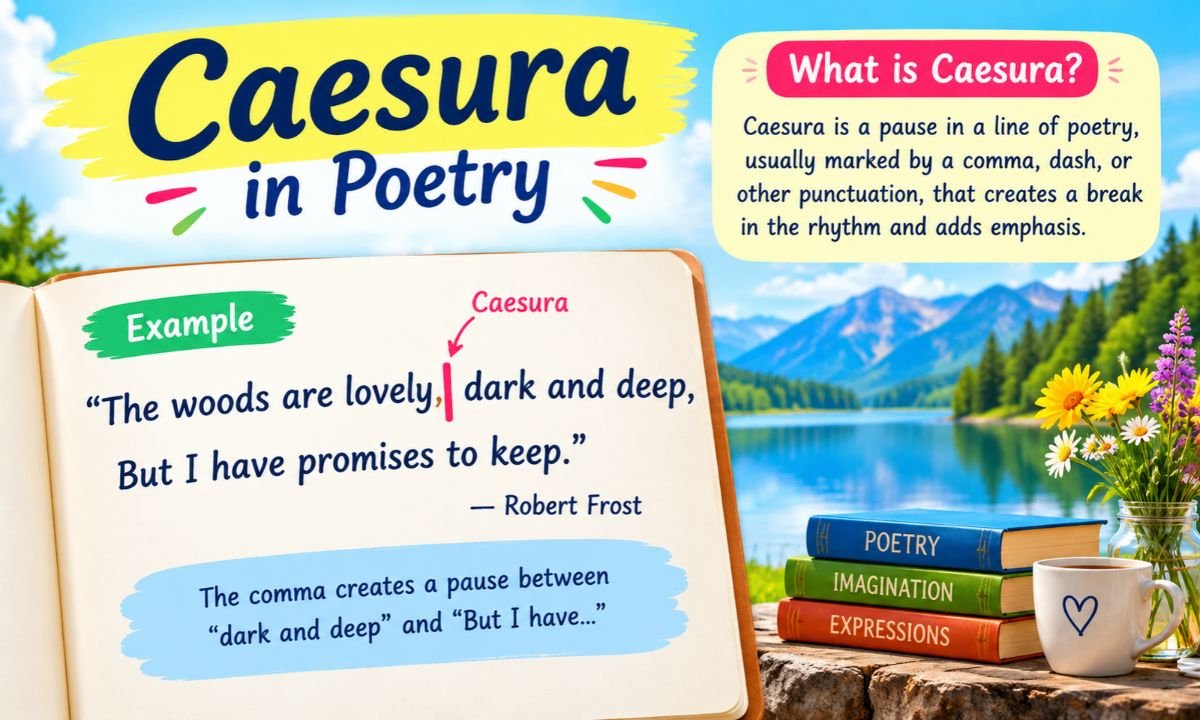
Poetry isn’t just about words. It’s about rhythm, pauses, and breath. One of the most powerful tools poets use to control that rhythm is called caesura. If you’ve ever read a poem and felt a natural pause in the middle of a line, you’ve already experienced caesura in action.
This guide breaks down everything you need to know about caesura in poetry, its meaning, types, purpose, and real examples so you can identify and use it like a skilled poet or literature student.
What Is Caesura in Poetry?
A caesura (pronounced si-ZHOOR-uh) is a natural pause or break within a line of poetry, usually created by punctuation, grammar, or meaning rather than the end of the line itself.
Key characteristics of caesura:
- Occurs within a line, not at the end.
- Often marked by punctuation like a comma, period, dash, or colon.
- Creates a pause when the poem is read aloud.
- Can shift emphasis, tone, or emotional weight.
The word “caesura” comes from the Latin word caedere, meaning “to cut.” True to its origin, a caesura literally “cuts” a line of poetry into two rhythmic parts.
Read Also This Blog: Quatrain in Poetry
How to Use Caesura in Poetry?
Poets use caesura deliberately to control pacing, emotion, and emphasis. Here’s how to use it effectively in your own writing:
- Identify the natural pause point in your sentence or thought.
- Use punctuation (comma, period, semicolon, dash) to mark the break.
- Place it strategically: early, middle, or late in the line for different effects.
- Read the line aloud to test whether the pause feels natural.
- Balance it with flow so the poem doesn’t feel choppy or forced.
A well-placed caesura can turn a flat line into one filled with tension, drama, or reflection.
How to Identify Caesura in Poetry?
Spotting caesura becomes easier once you know what to look for.
Look for these signals:
- Punctuation marks in the middle of a line (commas, periods, colons, dashes).
- A natural breath pause when reading aloud.
- A shift in thought or subject within the same line.
- Symbols used by scholars: || or / to mark the pause in analysis.
Quick Tip: If you can comfortably pause mid-line while reading the poem aloud without breaking meaning, you’ve likely found a caesura.
Function of Caesura in Poetry
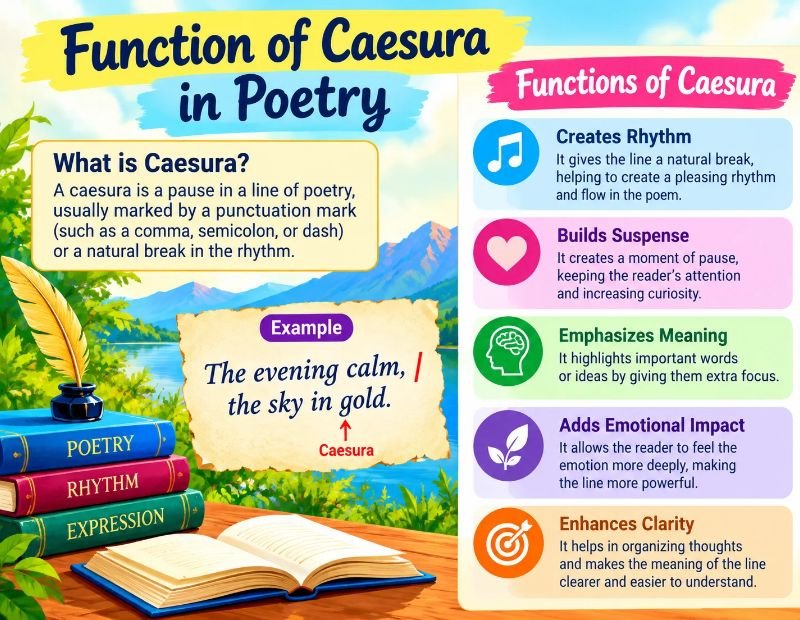
Caesura serves several important literary functions beyond simply creating a pause.
| Function | Explanation |
|---|---|
| Rhythm control | Breaks up monotonous meter |
| Emotional emphasis | Highlights key words or ideas |
| Dramatic tension | Creates suspense before a reveal |
| Natural speech pattern | Mimics how people actually talk |
| Structural balance | Splits a line into two meaningful halves |
Without caesura, poetry can feel mechanical. With it, poems gain a more human, conversational rhythm.
Types of Caesura in Poetry
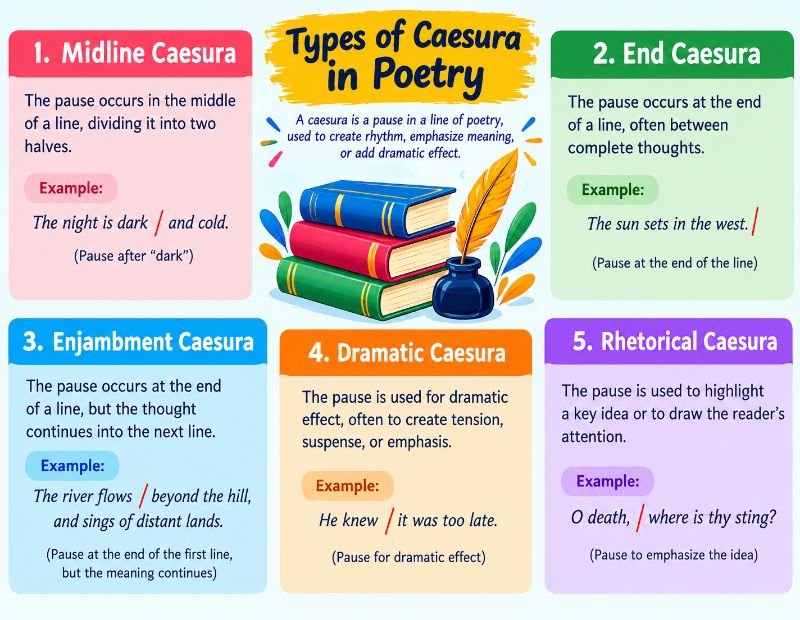
Caesura isn’t one size fits all. Scholars classify it based on position and strength within a line.
Masculine Caesura
Occurs after a stressed syllable, creating a strong, abrupt pause.
- Feels firm and decisive.
- Common in dramatic or formal poetry.
Feminine Caesura
Occurs after an unstressed syllable, creating a softer, smoother pause.
- Feels gentle and flowing.
- Common in lyrical or emotional poetry.
Initial Caesura
The pause happens near the beginning of the line.
Medial Caesura
The pause happens in the middle of the line: the most common type.
Terminal Caesura
The pause happens near the end of the line, just before it concludes.
| Type | Position in Line | Effect |
|---|---|---|
| Masculine | After stressed syllable | Strong, abrupt |
| Feminine | After unstressed syllable | Soft, flowing |
| Initial | Near the start | Sudden emphasis early |
| Medial | Middle of line | Balanced rhythm |
| Terminal | Near the end | Delayed pause, lingering effect |
Characteristics of Caesura in Poetry
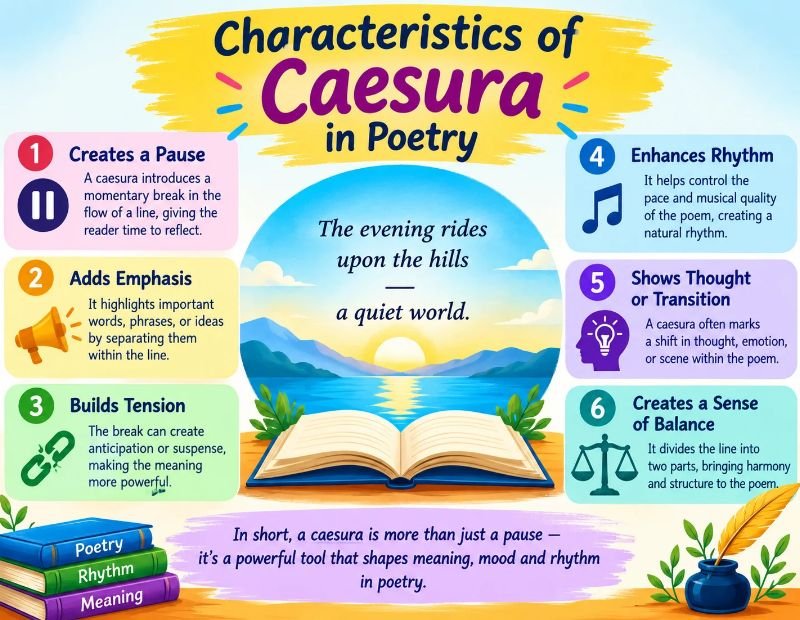
Here are the defining characteristics that help identify true caesura:
- Creates a natural breathing point for the reader.
- Typically marked by punctuation, though not always required.
- Can appear anywhere within a line (not fixed to one position).
- Found in both formal, metered poetry and free verse.
- Often used to mirror natural speech patterns.
Not every pause counts as caesura, it must occur mid line and create a genuine rhythmic or grammatical break, not just a line ending.
Effects of Caesura in Poetry
The impact of caesura goes far beyond rhythm. It shapes how readers feel while reading.
Common effects include:
- Building suspense before an important word or reveal.
- Slowing down the pace to emphasize emotion.
- Mimicking hesitation, doubt, or shock in the speaker’s voice.
- Creating contrast between two ideas within a single line.
- Adding realism by mirroring natural human speech patterns.
A single well-placed pause can completely change how a line is interpreted emotionally.
Purpose of Caesura in Poetry
At its core, caesura exists to give poetry control over time and emotion. Its main purposes include:
- Guiding the reader’s breathing and pacing.
- Emphasizing specific words or phrases.
- Creating dramatic or emotional tension.
- Breaking predictable rhythm to avoid monotony.
- Reflecting the natural flow of human thought and speech.
Without caesura, even well-written poetry can feel flat or robotic when read aloud.
10 Examples of Caesura in Poetry
Caesura has been used by legendary poets for centuries. Below are classic examples showing where the pause naturally occurs (marked with ||).
| # | Poet/Work | Example Line Structure |
|---|---|---|
| 1 | Shakespeare, Hamlet | To be, |
| 2 | Alexander Pope | A little learning |
| 3 | Alfred, Lord Tennyson | Theirs not to reason why, |
| 4 | John Milton | Of Man’s first disobedience, |
| 5 | William Wordsworth | The child is father |
| 6 | Homer (translated) | Sing, O goddess, |
| 7 | Old English epic style | Beowulf spoke, |
| 8 | Emily Dickinson style | Because I could not stop, |
| 9 | Robert Frost style | Two roads diverged, |
| 10 | Modern free verse | She whispered softly, |
These examples show how caesura appears across different eras — from ancient epics to modern free verse — always serving the same purpose: controlling rhythm and emotional weight.
Caesura in Poetry and Enjambment
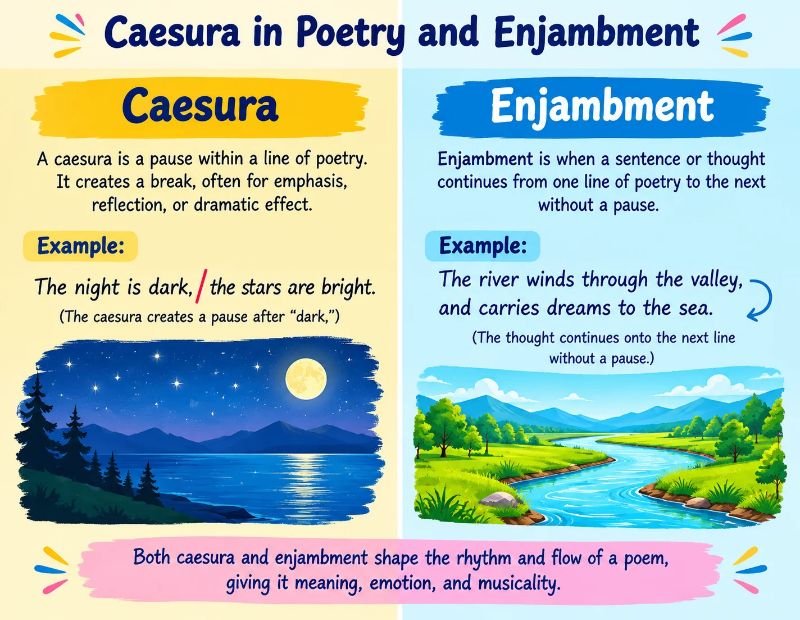
Caesura and enjambment are often confused, but they work in opposite ways.
| Feature | Caesura | Enjambment |
|---|---|---|
| Location | Within a line | At the end of a line |
| Effect | Creates a pause | Creates flow/continuation |
| Punctuation | Usually present | Usually absent |
| Purpose | Slows rhythm, adds emphasis | Speeds up rhythm, builds momentum |
| Reading style | Natural stop | Continues into next line without pause |
Simple way to remember:
- Caesura: pause within a line
- Enjambment: continuation across lines
Poets often use both techniques together to create dynamic, layered rhythm throughout a poem.
Is Caesura Only Used in Poetry?
No. While caesura is most associated with poetry, it also appears in:
- Music: Pauses in lyrics or instrumental phrasing.
- Prose writing: Dramatic pauses in literary fiction.
- Public speaking: Strategic pauses for emphasis.
- Screenwriting: Dialogue pacing and dramatic timing.
Essentially, any form of expression that relies on rhythm and timing can use caesura-like techniques, even outside traditional poetry.
Caesura vs Other Poetic Pauses
To avoid confusion with similar poetic terms, here’s a quick comparison:
| Term | Definition | Location |
|---|---|---|
| Caesura | Pause within a line | Mid-line |
| Enjambment | Continuation without pause | End of line |
| End-stopped line | Line ends with punctuation/pause | End of line |
| Stanza break | Pause between groups of lines | Between stanzas |
Understanding these distinctions helps readers and writers analyze poetic structure more accurately.
How Poets Use Caesura for Emotional Impact?
Great poets don’t use caesura randomly, they use it with intention.
Common creative strategies include:
- Placing caesura right before a shocking word to increase impact.
- Using multiple caesuras in one line to slow down intense emotional moments.
- Combining caesura with short, blunt words for dramatic effect.
- Using soft caesura (feminine) for reflective or peaceful tones.
- Using hard caesura (masculine) for conflict, urgency, or finality.
This level of control is what separates technically correct poetry from emotionally powerful poetry.
Conclusion
Caesura is one of the most powerful yet subtle tools in a poet’s toolkit. By creating natural pauses within a line, it shapes rhythm, builds emotional tension, and mirrors the way humans actually think and speak. From Shakespeare to modern free verse, caesura continues to influence how poetry is written, read, and felt.
Whether you’re analyzing classic literature or writing your own poems, understanding caesura, its types, functions, and effects gives you a deeper appreciation for the craftsmanship behind every carefully placed pause.
FAQs
What is caesura in simple terms?
Caesura is a natural pause or break that occurs in the middle of a line of poetry, often marked by punctuation.
How do you mark caesura in poetry analysis?
Caesura in poetry is typically marked using two vertical lines (||) or a single slash (/) at the pause point.
What’s the difference between caesura in poetry and enjambment?
Caesura is a pause within a line, while enjambment is when a sentence continues without pause into the next line.
Is caesura in poetry always marked by punctuation?
Not always, but punctuation like commas, periods, or dashes commonly signals where a caesura occurs.
Can caesura in poetry appear more than once in a single line?
Yes, longer lines can contain multiple caesuras to create extended pauses or heightened emotional effect.
Is caesura in poetry used only in traditional, metered poetry?
No, caesura also appears in free verse, prose, music, and even public speaking for dramatic pacing.