
Every strong poem starts with a plan, even when it looks effortless on the page. A poetry outline gives your ideas a shape before you worry about perfect words. It saves time, reduces writer’s block and helps you finish more poems.
This guide explains what a poetry outline is, how to build one, and how to use it for different poem types, essays, books and courses. You will also find templates, tables and quick answers to common questions.
What Is a Poetry Outline?
A poetry outline is a short, structured plan that maps out the idea, form, emotion and flow of a poem before you write it. It can be a rough list of stanzas, a diagram, or a filled-in template.
Think of it as a blueprint. A builder does not lay bricks without a drawing, and a poet can work the same way. The outline does not lock you in. It simply keeps your main idea clear while you play with language.
A basic poetry outline usually covers:
- The topic or central image
- The purpose and mood
- The form (free verse, sonnet, haiku and so on)
- The number of stanzas and lines
- The key images and literary devices
- The ending or final turn
Read Also This Blog: Poetry About Healing
Characteristics of a Poetry Outline
A good poetry outline shares a few traits, no matter the style.
- Brief: It uses keywords and short phrases, not full paragraphs.
- Flexible: You can change it as the poem grows.
- Focused: It stays tied to one main idea or emotion.
- Organized: Ideas appear in a clear order, from opening image to closing thought.
- Form-aware: It notes rhyme, rhythm, line length and stanza pattern.
- Sensory: It lists images, sounds and feelings you plan to use.
Effects of a Poetry Outline
Using an outline changes how you write. Poets often notice these effects:
- Clearer thinking. You know what the poem is about before you start.
- Faster drafting. Less time is lost staring at a blank page.
- Stronger flow. Stanzas connect naturally, one to the next.
- Better editing. You can compare the draft with the plan and spot weak lines.
- More confidence. Beginners feel less overwhelmed because the task is broken into small parts.
Purpose of a Poetry Outline
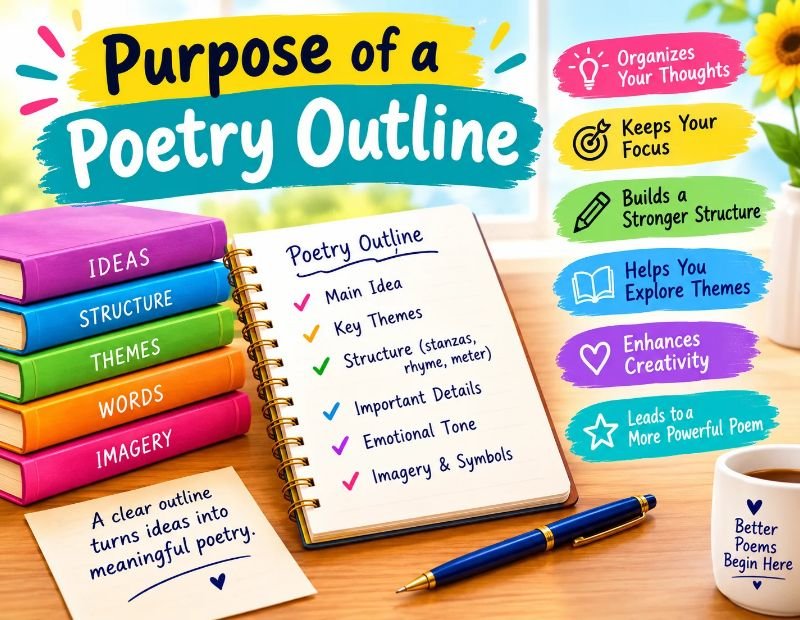
The main purpose is to organize your thoughts so the poem has direction. Beyond that, an outline can:
- Help you choose the right form for your message
- Keep rhyme and rhythm consistent
- Prevent rambling or repeated ideas
- Make group projects and classroom tasks easier to manage
- Turn a vague feeling into a concrete piece of writing
For students, it also works as proof of planning, which many teachers ask for in creative writing assignments.
10+ Powerful Steps to Create a Poetry Outline
Follow these steps in order, or skip around if you already have a strong idea.
Step 1: Pick a Clear Subject
Choose one subject you care about. A place, a memory, an object or a season all work well. Specific beats general. “My grandmother’s kitchen at dawn” is stronger than “family.”
Step 2: Decide the Purpose
Ask what you want the reader to feel or understand. You might want to comfort, celebrate, protest, describe or question. Write the purpose in one sentence.
Step 3: Brainstorm Words and Images
Set a timer for five minutes. List every word, sound, smell, color and memory linked to your subject. Do not edit. This list becomes your word bank.
Step 4: Choose Your Form
Pick a form that suits the mood. A haiku suits a quiet moment. A sonnet suits an argument or a turning thought. Free verse suits an emotion that needs room.
Step 5: Set the Structure
Decide how many stanzas and lines you will use. Note the rhyme scheme or the line length if the form needs it. Even free verse benefits from a simple plan, such as three stanzas of four lines.
Step 6: Map the Flow
Write a one-line summary for each stanza. A common flow looks like this:
- Opening: Introduce the image or situation
- Middle: Deepen, complicate or compare
- Closing: Land on a twist, a question or a quiet resolution
Step 7: Plan Your Literary Devices
Choose two or three tools, such as metaphor, simile, alliteration, personification or imagery. Too many devices crowd a poem, so pick only those that serve your message.
Step 8: Decide the Tone and Voice
Will the speaker sound tender, angry, playful or distant? Choose the point of view (first, second or third person) and keep it steady unless you have a reason to shift.
Step 9: Draft Without Judging
Use the outline as a guide and write the first version quickly. Do not stop to fix every line. Poems improve in revision, not in the first pass.
Step 10: Read Aloud and Revise
Poetry is built for the ear. Read the draft aloud and mark places that sound clumsy. Cut filler words, sharpen images and check that each stanza matches the plan.
Step 11: Polish and Title
Finish with a title that adds meaning instead of repeating the first line. Check punctuation, line breaks and spacing, then share the poem with a trusted reader.
Basic Poetry Outline Structure
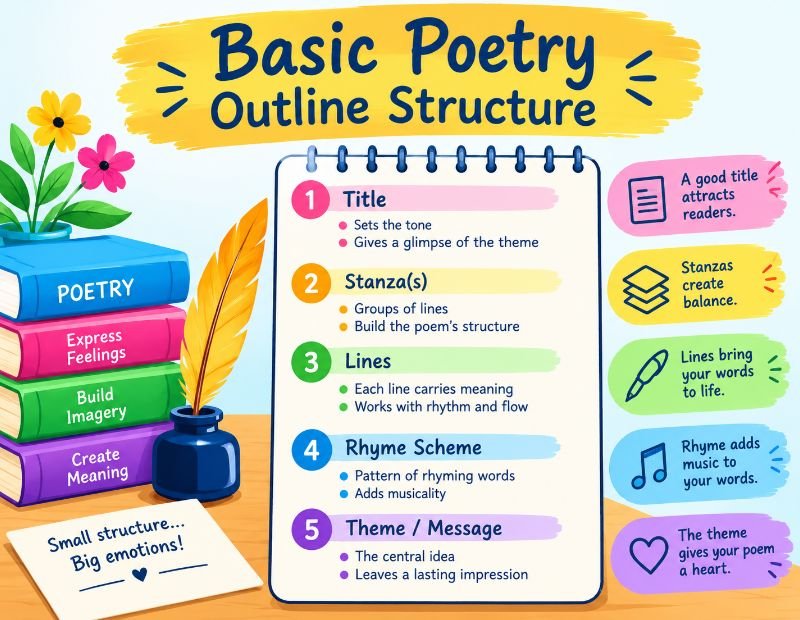
Here is a simple structure that works for most poems.
| Part | What to Include | Example Note |
|---|---|---|
| Title idea | Working title | “Morning Tea” |
| Theme | Central message | Comfort in small routines |
| Form | Style and length | Free verse, 3 stanzas |
| Stanza 1 | Opening image | Steam rising from a cup |
| Stanza 2 | Development | Memory of a parent’s voice |
| Stanza 3 | Closing turn | Quiet gratitude |
| Devices | Tools to use | Imagery, simile |
| Tone | Mood and voice | Warm, calm, personal |
12 Types of Poetry Outline
Different goals call for different outlines. These 12 types cover most needs.
| No. | Type | Best For | Key Focus |
|---|---|---|---|
| 1 | Short poetry outline | Quick poems, haiku, couplets | One image, few lines |
| 2 | Famous poetry outline | Studying well-known works | Structure and themes |
| 3 | Poetry outline for students | Class assignments | Simple steps |
| 4 | Poetry outline template | Repeated use | Fill-in sections |
| 5 | Classical poetry outline | Ancient and epic forms | Meter, invocation, narrative |
| 6 | Traditional poetry outline | Sonnets, ballads, odes | Rhyme and stanza rules |
| 7 | Modern poetry outline | Contemporary free verse | Voice and imagery |
| 8 | Spoken poetry outline | Performance | Rhythm, pauses, delivery |
| 9 | Slam poetry outline | Competitions | Timing, hook, impact |
| 10 | Romantic and Victorian outline | Period study or imitation | Nature, emotion, morality |
| 11 | Poetry book outline | Collections | Sections and sequence |
| 12 | Poetry analysis or explication outline | Essays | Thesis and evidence |
Poetry course outlines are covered separately below because they serve teachers more than writers.
Short Poetry Outline
Short poems need tight planning because every word counts. Use this quick format:
- Single image: What one thing will the reader see?
- Feeling: What emotion sits behind it?
- Line count: Often 3 to 8 lines
- Final beat: A surprise, a contrast or a quiet close
Sample outline (haiku style):
- Line 1: Season or setting (5 syllables)
- Line 2: Action or detail (7 syllables)
- Line 3: Shift or feeling (5 syllables)
Famous Poetry Outline
Studying how well-known poems are built is one of the best ways to learn. To create an outline of a famous poem, break it into parts instead of copying it.
Ask these questions:
- What is the central theme?
- How many stanzas are there, and how long are they?
- Where does the mood or argument change?
- Which images repeat?
- How does the final stanza answer the first?
Many sonnets, for example, set up a problem in the first section and turn toward a response in the second. Noticing that pattern helps you borrow the idea of structure without borrowing the words.
Poetry Outline for Students
Students need a clear, repeatable method. A friendly classroom outline looks like this:
- Write the topic in one sentence.
- List five senses words (see, hear, smell, taste, touch).
- Choose a form your teacher approves.
- Write one idea per stanza.
- Add one simile and one metaphor.
- Draft, read aloud, and revise twice.
This keeps the process simple and gives teachers an easy way to check progress.
Poetry Outline Template
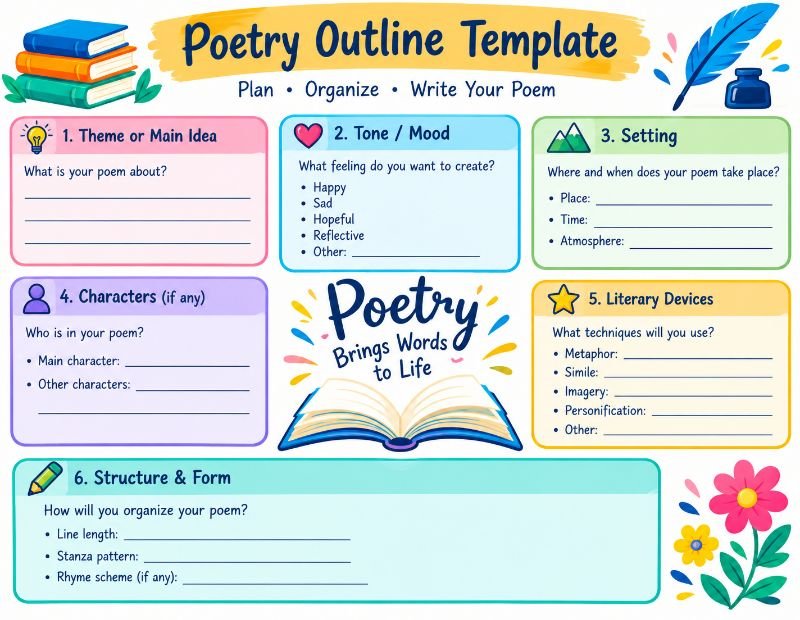
Copy this template into a notebook or document and fill it in for any poem.
Poem Planning Template
- Working title:
- Main subject:
- Purpose (inform, move, question, celebrate):
- Mood and tone:
- Form and length:
- Rhyme or rhythm plan:
- Point of view:
- Key images and sensory details:
- Stanza 1 idea:
- Stanza 2 idea:
- Stanza 3 idea:
- Ending or twist:
- Devices to use:
- Revision notes:
Templates like this help you reuse the same reliable process again and again.
Classical Poetry Outline
Classical poetry draws from ancient Greek and Roman traditions. Epics, odes and elegies often follow set patterns. When you outline a classical-style poem, plan for:
- Invocation: A call to a muse or higher power
- Setting the scene: Place, time and characters
- Narrative or argument: The main journey or claim
- Elevated language: Formal diction and rich imagery
- Closure: A resolution or moral
Classical forms value balance and order, so a detailed outline is especially useful.
Traditional Poetry Outline
Traditional poetry follows established rules for rhyme, meter and stanza shape. Common forms include sonnets, ballads, villanelles and odes.
Your outline should record:
- The form’s required line count
- The rhyme scheme (for example, ABAB CDCD)
- The meter, such as iambic pentameter
- Any repeated lines, as in a villanelle
- The place where the argument or mood turns
Writing these rules down first prevents mistakes halfway through the poem.
Modern Poetry Outline
Modern and contemporary poetry often breaks old rules. Free verse, prose poems and experimental forms are common. Even so, an outline helps.
Focus on:
- Voice: Who is speaking, and why now?
- Image chain: Which images connect from start to finish?
- Line breaks: Where will you pause for emphasis?
- White space: How will spacing shape meaning?
- Theme: Identity, memory, technology, nature or society
A modern outline is usually looser, but it still needs a clear center.
Spoken Poetry Outline
Spoken word poetry is written for the voice. Your outline must plan the sound as well as the meaning.
Include:
- A strong opening line that grabs attention
- Rhythm and repetition for flow
- Planned pauses and emphasis marks
- A build in energy toward the middle
- A memorable closing line
Practice reading your outline aloud. If a section feels flat when spoken, rework it before writing the final version.
Slam Poetry Outline
Slam poetry is performed in timed rounds, usually about three minutes. A slam outline should be tighter and more strategic.
| Section | Time | Goal |
|---|---|---|
| Hook | 0:00 to 0:20 | Seize attention immediately |
| Setup | 0:20 to 1:00 | Introduce the issue or story |
| Build | 1:00 to 2:15 | Raise emotion and stakes |
| Climax | 2:15 to 2:45 | Deliver the most powerful lines |
| Close | 2:45 to 3:00 | Leave a lasting final image |
Plan your timing carefully, because going over the limit can cost points.
Romantic and Victorian Poetry Outline
Romantic poetry (late 1700s to mid 1800s) celebrates emotion, imagination and nature. Victorian poetry (roughly 1837 to 1901) often explores faith, doubt, duty and social change.
When outlining a poem in either style, or studying one, consider:
- Romantic focus: Nature, personal feeling, the sublime, individual freedom
- Victorian focus: Morality, progress, loss of certainty, social issues
- Common forms: Odes, sonnets, dramatic monologues, narrative poems
- Structure: Look at how the speaker moves from observation to reflection
A period-based outline keeps your poem or essay tied to the right historical mood.
Poetry Book Outline
Planning a full collection takes more than gathering your best poems. A strong poetry book outline gives readers a journey.
Steps to outline a poetry book:
- Choose a unifying theme, voice or story arc.
- Group poems into sections, such as “Roots,” “Storms” and “Light.”
- Place a strong poem first and a memorable one last.
- Vary length and mood so the pacing never feels flat.
- Add front matter (title page, dedication) and back matter (notes, about the author).
- Review the order again after editing, because sequence shapes meaning.
A simple layout might be: introduction, three to five themed sections, and a closing poem.
Poetry Analysis Essay Outline
A poetry analysis essay explains how a poem works and what it means. Start by reading the poem several times, noting the speaker, structure, imagery and tone.
Standard analysis outline:
- Introduction
- Name the poem and poet
- Give brief context
- State your thesis
- Body paragraph 1: Theme and meaning, with evidence
- Body paragraph 2: Imagery and figurative language
- Body paragraph 3: Structure, rhyme and sound
- Conclusion
- Restate your thesis in fresh words
- Explain why the poem matters
Keep quotations short and always explain why each one supports your claim.
Poetry Explication Outline
An explication is a close reading that examines small units of meaning, such as word choice, rhythm and symbols, to show how each part supports the whole. It is more detailed than a general analysis.
Explication outline:
| Section | What to Do |
|---|---|
| Introduction | Briefly summarize the poem and state a thesis |
| Line by line or stanza by stanza | Examine diction, imagery, syntax and sound |
| Form and structure | Explain rhyme, meter and stanza choices |
| Connections | Show how details support the main theme |
| Conclusion | Sum up findings and the poem’s final effect |
Moving in order through the poem keeps your essay logical and easy to follow.
Poetry Course Outline
Teachers and workshop leaders use a poetry course outline to organize lessons across a term. A clear course plan helps students know what to expect.
Sample 8-week poetry course outline:
| Week | Topic |
|---|---|
| 1 | What is poetry? Voice, tone and imagery |
| 2 | Sound devices: rhyme, rhythm and alliteration |
| 3 | Figurative language: metaphor, simile, symbol |
| 4 | Traditional forms: sonnet, ballad, haiku |
| 5 | Free verse and modern poetry |
| 6 | Spoken word and slam performance |
| 7 | Poetry analysis and explication writing |
| 8 | Revision, portfolio and final reading |
Add learning goals, reading lists, assignments and grading details to make the outline complete.
Poetry Outline Example
Here is a short sample plan for a free verse poem about rain.
- Title idea: After the Storm
- Theme: Renewal after hardship
- Form: Free verse, 3 stanzas, 4 lines each
- Stanza 1: Dark clouds and heavy air (tension)
- Stanza 2: First drops, the smell of wet earth (release)
- Stanza 3: Clear sky, quiet street (peace)
- Devices: Imagery, personification, one simile
- Tone: Reflective and hopeful
From this plan, a poet can write the full poem in one sitting.
Common Mistakes to Avoid
Even a good outline can fail if you fall into these traps:
- Making the outline too detailed and stiff
- Choosing a topic that is too broad
- Forcing rhymes that weaken meaning
- Ignoring the poem’s ending
- Skipping revision
- Overloading the poem with devices
Quick Tips to Improve Your Poetry Outline
- Start with a feeling, not a rule.
- Use specific nouns and strong verbs in your notes.
- Keep a running list of images you spot every day.
- Revisit your outline after the first draft and update it.
- Read your plan aloud to test its flow.
- Study one poem a day to learn how others structure ideas.
Conclusion
A poetry outline turns scattered inspiration into a clear path. It helps you choose a subject, set a form, plan stanzas and shape a satisfying ending. Whether you are writing a short verse, a slam piece, a book of poems or an analysis essay, the same principle applies: plan lightly, write freely and revise with care.
Start with one template from this guide and test it on your next poem. With practice, outlining becomes second nature, and your poems will feel more focused, more musical and more your own.
Frequently Asked Questions
What is a poetry outline?
A poetry outline is a short plan that organizes a poem’s theme, form, stanzas, images and ending before you write it.
Why is a poetry outline important?
It keeps your ideas focused, speeds up drafting and makes revision easier.
How do I write a poetry outline step by step?
Choose a subject, set your purpose, brainstorm images, pick a form, plan each stanza, then draft and revise.
Do all poems need an outline?
No, but even a quick list of ideas and stanza notes helps most poets, especially beginners.
What should a poetry outline include?
It should include the theme, form, tone, stanza plan, key images, literary devices and the ending.
How long should a poetry outline be?
Usually one page or less. Short poems may need only a few lines of notes.
What is the difference between a poetry outline and a poetry explication outline?
A poetry outline plans a poem you will write. An explication outline plans an essay that closely analyzes an existing poem.
How do I outline a poetry analysis essay?
Write an introduction with a thesis, then body paragraphs on theme, imagery and structure, followed by a conclusion.
What is a poetry outline template?
It is a fill-in-the-blank sheet with sections for theme, form, stanzas, tone and revision notes.
Can I use a poetry outline for slam poetry?
Yes. Plan your hook, build, climax and closing line with timing in mind.
How do I outline a poetry book?
Pick a unifying theme, group poems into sections, order them for pacing, and open and close with strong pieces.
What is the best structure for a short poem?
Use one clear image, a small number of lines and a final line that surprises or resolves the feeling.