
Meta title: Poetry Project: 25+ Ideas, Examples & Creative Writing Tips
Meta description: Explore every meaning of “poetry project”: classroom ideas, the NYC Poetry Project, Pongo, AVBOB, blackout poetry, Python Poetry commands and a full how-to guide.
URL slug: /poetry-project
Search for “poetry project” and you will see very different results. One person wants a school assignment. Another wants the famous arts organization in New York. A developer wants to know how to start a new Poetry project in Python.
This guide covers all of those meanings in one place. You will learn what a poetry project is, how to plan one, which well-known programs to know about, and 25+ ideas you can use right away. A short section at the end covers the Python tool for developers.
What Is a Poetry Project?
A poetry project is any planned activity built around writing, sharing, studying or performing poems. It can be a one-week class assignment, a community program, a published collection or a long-running arts organization.
The term also names real programs, such as The Poetry Project at St. Mark’s Church in New York, the Pongo Poetry Project in Seattle and the AVBOB Poetry Project in South Africa. In tech, “Poetry” is a separate Python dependency tool, so “poetry project” can mean a coding project too.
| Meaning | Who Searches For It | Example |
|---|---|---|
| Classroom or creative project | Students, teachers, parents | Blackout poetry, poster, multimedia project |
| Arts organization | Poets, event goers | The Poetry Project, NYC |
| Community or healing program | Volunteers, donors, mentors | Pongo, Alzheimer’s poetry work |
| Competition or library | South African poets | AVBOB Poetry Project |
| Software project | Python developers | poetry init, poetry new |
Read Also This Blog: Poetry Outline
Purpose of a Poetry Project
Every poetry project exists to turn words into something shared. The goal changes with the setting.
- Learning: Students practice imagery, rhythm, figurative language and revision.
- Expression: Writers process feelings that are hard to say in plain speech.
- Community: Poets meet, read aloud and support one another.
- Healing: Some programs use writing to help people cope with trauma or loss.
- Preservation: Collections, libraries and newsletters keep voices on record.
- Fundraising and culture: Events bring audiences together and pay for more programming.
Structure of a Poetry Project
A good project has a clear shape, whether it runs for a week or a year. Most successful ones follow the same five stages.
- Define the goal. Decide what the project should produce, such as ten finished poems, a class anthology or a public reading.
- Choose a theme and form. A tight theme (memory, home, climate, identity) keeps the work focused.
- Plan the schedule. Set dates for brainstorming, drafting, feedback and revision.
- Create and workshop. Write, share drafts and revise using peer comments.
- Present or publish. Hold a reading, print a booklet, build a website or post the poems online.
A simple weekly plan for a classroom looks like this:
| Week | Task |
|---|---|
| 1 | Pick a theme, read sample poems, brainstorm images |
| 2 | Write first drafts |
| 3 | Peer review and revision |
| 4 | Final copy, design and presentation |
The Poetry Project in NYC (St. Mark’s Church)
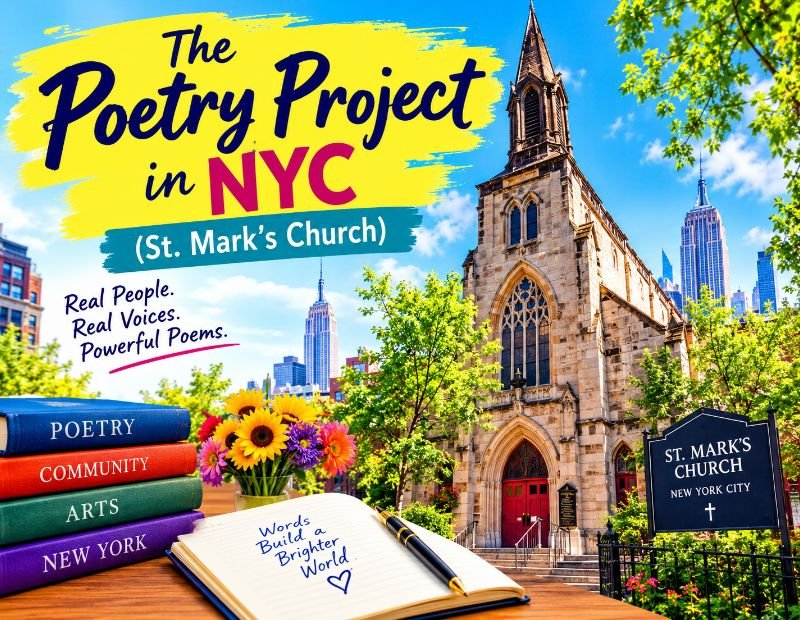
The best-known organization with this name is The Poetry Project at St. Mark’s Church in the East Village of Manhattan. It was founded in 1966 at St. Mark’s Church in-the-Bowery, and its work includes regular readings, writing workshops and an annual New Year’s Day Marathon. Wikipedia
Its roots are interesting. In May 1966, the church rector accepted a federal grant of almost $200,000 from the Office of Juvenile Delinquency and Youth Development, and the Poetry Project was established with that money. Since then it has become a landmark of experimental and avant-garde poetry in American culture. Wikipedia
If you are a poet, the organization is worth knowing for three reasons: its live events, its workshops and its publications.
Poetry Project Events and the New Year’s Day Marathon
The Marathon is the signature event. Anne Waldman organized the first one in 1974, and another source notes it began with 31 poets. Over the decades, well-known figures have read there, including Yoko Ono, Amiri Baraka, Allen Ginsberg and Patti Smith. Poetry Project +2
The event runs for most of January 1. For the 50th edition, the Marathon began at 11 AM and went to about midnight. It is also the organization’s biggest fundraiser. poetryprojectpoetryproject
Poetry Project Marathon: What to Expect
- Dozens or hundreds of readers across many styles
- Music, dance and performance mixed with poetry
- Part one and part two sessions, with tickets sold for each
- In some years, a livestream for people who cannot attend in person
Check the official Poetry Project website for current dates, ticket details and format, because these change each year.
Poetry Project Newsletter
The Poetry Project Newsletter is a long-running publication. It is currently the Poetry Project’s main publishing output, and an earlier literary magazine called The World ran from 1966 until 2002. WikipediaWikipedia
The newsletter usually carries event listings, poems, reviews and essays. For a working poet, it is a quick way to see what the community is reading and where to submit work.
American Poetry Project
“American Poetry Project” is not one single organization. People use the phrase for several things: school units on American poets, anthology series, university research projects and arts nonprofits that focus on poetry in the United States.
If you are researching it, read the page carefully to confirm which program you have found. A classroom unit may ask students to study poets across periods, while a nonprofit may run readings and workshops.
Poetry Project Controversy
Searchers sometimes add “controversy” to the keyword. I did not find a single settled controversy that applies to every poetry project. Any long-running arts group can face public debate over funding, programming choices, inclusion or leadership.
If you want facts on a specific dispute, search for the exact organization plus the year and rely on reputable news coverage. Avoid forum rumors, and treat any claim you cannot trace to a credible source with caution.
Pongo Poetry Project
The lesson for any poetry project leader is simple: listening matters as much as teaching. Pongo’s approach centers the young person’s own voice and treats their words with respect.
AVBOB Poetry Project
The project also grows its offerings over time. Starting in 2025, a new AVBOB Prize for Best Published Collection of Poetry offers R10,000, and the project supports poets through online workshops, articles and interviews. A strong takeaway is the focus on mother tongues. Editors noted that 65% of poems entered in one year were written in vernacular languages.
Alzheimer’s Poetry Project

The Alzheimer’s Poetry Project is a program model that uses poems and group activities to connect with people living with memory loss. Facilitators read a familiar poem aloud, invite responses and then help the group create new lines together.
Why it works: rhythm, rhyme and repeated phrases can stay accessible to the mind even when other memories fade. If you want to run something similar, partner with a care facility, keep sessions short and let participants lead.
Other Named Poetry Projects (Tiny, Tango, Salem, Victoria, World)
Many local and themed projects use the same label. Names such as Tiny Poetry Project, Tango Poetry Project, Salem Poetry Project, Victoria Poetry Project and World Poetry Project usually point to community groups, festivals, publications or school programs in a particular place or style. Details vary widely, so confirm each one on its own website before sharing dates or claims.
You can borrow their core ideas for your own work:
- Tiny: Very short poems, such as haiku or six-word poems
- Tango: Poetry paired with dance, music or movement
- Salem and Victoria: City-based readings, walks and anthologies
- World: Poems from many countries, translated or read in original languages
Poetry Project Ideas: 25+ Powerful Ideas
Here are more than 25 ideas, grouped by type. Pick one that fits your time, skill level and audience.
Classroom and Student Ideas
- Blackout poetry: Black out most words on a page, leaving a hidden poem.
- Poetry poster: Combine a short poem with illustration and color.
- Found poem: Build a poem from words in newspapers or labels.
- I Am poem: Describe yourself using a repeating line pattern.
- Where I’m From poem: Write about your home, family and memories.
- Acrostic name poem: Use each letter of a word to start a line.
- Poetry anthology: Collect class poems in one printed or digital booklet.
- Poetry scavenger hunt: Find examples of metaphor, simile and alliteration.
Creative and Multimedia Ideas
- Multimedia poetry project: Pair a poem with images, music and voice recording.
- Poetry video: Film a reading with visuals that match the mood.
- Podcast episode: Record readings and short discussions.
- Concrete or shape poem: Arrange words into the shape of the subject.
- Photo poetry: Write a short poem for each photograph.
- Digital slideshow: Show one stanza per slide with art.
- Illustrated zine: Make a handmade folded booklet.
Community and Performance Ideas
- Walking poetry project: Walk a route and write a poem at each stop.
- Open mic night: Invite friends and neighbors to read.
- Slam night: Hold a timed performance contest.
- Poetry marathon: Host a long reading with many voices.
- Poems on public walls: Display short poems in windows, cafes or libraries.
- Poetry exchange: Swap poems with a pen pal or another school.
- Local history poems: Interview elders and write poems from their stories.
Long-Term and Writing Ideas
- Thirty poems in thirty days: Write one poem daily for a month.
- Chapbook project: Plan, edit and publish a small collection.
- Translation project: Translate a poem and compare versions.
- Poem in response to art: Write after visiting a gallery or museum.
- World poetry project: Study and share poems from many countries.
- Tiny poetry project: Write and share very short poems on cards.
Blackout Poetry Project
Blackout poetry is one of the easiest and most popular options. It works well for beginners because you do not start from a blank page.
How to do it:
- Choose a page of text, such as an old book or newspaper article.
- Read the page and circle words that catch your eye.
- Look for a path of words that forms a short poem.
- Black out everything else with a marker.
- Add small drawings or patterns if you like.
Use pages you own or that are copyright free, and do not mark library books.
Poetry Poster Project
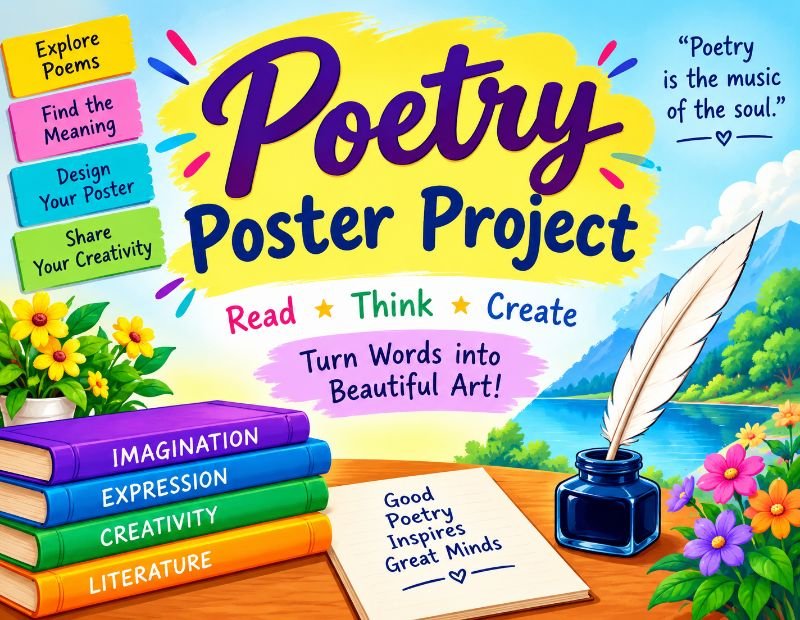
A poetry poster combines text and design. Students choose a short poem, pick a theme color and add images that echo the poem’s meaning.
Checklist for a strong poster:
- Poem is easy to read from a distance
- Title and poet are clearly shown
- Colors match the mood
- Images support, not overpower, the words
- Original work or properly credited sources
Multimedia Poetry Project
A multimedia project uses more than text. You might record the poem aloud, add background sound, include photos and place everything in a short video or slideshow.
Plan it in three parts: script (the poem), visuals (images or footage) and sound (voice and music). Keep the poem the star. Visuals should add meaning, not distract from it.
Walking Poetry Project
A walking project ties poetry to place. Choose a route, such as a park, a street or a campus. Stop at five or six points and write a few lines at each one using what you see, hear and smell.
Later, combine the lines into one poem or a series. You can even turn the route into a map with QR codes linking to recordings.
How to Run a Poetry Project?
Running a project, whether in a classroom, library or online group, takes planning. Follow these steps.
Step 1: Set a Clear Purpose
Write one sentence that explains why the project exists and who it serves.
Step 2: Know Your Audience
Match difficulty and tone to the group. Children need short prompts. Adults may want longer workshops.
Step 3: Pick a Format
Decide between a workshop series, a challenge, an event or a publication.
Step 4: Build a Simple Schedule
Share dates early so everyone can plan. Include time for revision.
Step 5: Gather Materials and Space
Collect paper, markers, books, microphones or digital tools. Choose a calm, welcoming space.
Step 6: Create Safe Feedback Rules
Ask readers to comment kindly and specifically. Start with what works before suggesting changes.
Step 7: Share the Work
Hold a reading, publish an anthology, post online or display poems around your community.
Step 8: Review and Improve
Ask participants what they enjoyed. Use their answers to improve the next round, or the next “instance” of the project.
Creative Writing Tips for Any Poetry Project
- Start small. One strong image beats ten vague ones.
- Show, do not tell. Replace “I was sad” with a detail the reader can see or feel.
- Use sensory language. Include sound, smell, taste and touch.
- Read aloud. Your ear will catch clumsy lines your eye misses.
- Cut ruthlessly. Remove words that do not earn their place.
- Rhyme with care. A non-rhyming poem often beats a forced rhyme.
- Revise in layers. Fix meaning first, then sound, then punctuation.
- Ask for feedback. A fresh reader sees what you cannot.
- Keep a notebook. Capture lines, overheard phrases and images daily.
Poetry Project Python: A Quick Guide for Developers
If you landed here looking for the Python tool, this section is for you. Poetry is a tool for dependency management and packaging in Python. One of its strengths is that it uses a single configuration file for dependency management, packaging and publishing, namely pyproject.toml. readthedocsfedoramagazine
How to Create a New Poetry Project
Use poetry new when you want Poetry to build a fresh folder structure:
Poetry Init Project (Existing Folder)
If you already have a folder, run the init command inside it: fedoramagazine
Poetry asks a few questions about name, version and dependencies, then creates the config file.
Poetry Venv in Project and Virtualenvs in Project
By default, Poetry creates the virtual environment in a cache folder. To keep it inside your project folder, change the virtualenvs.in-project setting.
New environments will then appear in a .venv folder next to your code. This helps editors find the interpreter and keeps projects self-contained.
Common Poetry Commands
| Task | Command |
|---|---|
| Add a package | poetry add requests |
| Install all dependencies | poetry install |
| Run a script in the environment | poetry run python app.py |
| List environments | poetry env list |
| Remove an environment | poetry env remove python |
| Build the package | poetry build |
How to Delete a Poetry Project?
Poetry has no single “delete project” command. To remove a project:
- Remove its virtual environment with
poetry env remove. - Delete the
.venvfolder if you used in-project environments. - Delete the project folder itself.
Always back up anything you may need first, and check the official Poetry documentation for the command syntax that matches your installed version.
Common Mistakes to Avoid
- Picking a theme that is too broad
- Skipping the planning stage
- Leaving no time for revision
- Ignoring the audience’s age or comfort level
- Forcing rhyme or “poetic” language
- Not crediting sources, quotes or borrowed lines
- Publishing someone’s poem without permission
Conclusion
A poetry project can be as small as a blackout poem on a single page or as large as a nationwide competition. What links every example here, from the New Year’s Day Marathon in New York to Pongo’s healing work in Seattle and the multilingual AVBOB library in South Africa, is a shared belief that poems matter.
Start with one idea from the list above, set a simple plan and give yourself a finish line. Share the result with at least one reader. If you are a developer, use the Python section as your quick reference and keep your environments tidy.
Frequently Asked Questions
What is a poetry project?
A poetry project is a planned activity or program focused on writing, studying, performing or sharing poems.
What is the Poetry Project NYC?
It is a nonprofit arts organization at St. Mark’s Church in Manhattan, known for readings, workshops and its New Year’s Day Marathon.
When did the Poetry Project at St. Mark’s begin?
It was founded in 1966.
What is the Poetry Project Marathon?
It is an annual New Year’s Day reading marathon featuring many poets and performers, and it serves as the group’s biggest fundraiser.
What is the Poetry Project Newsletter?
It is the organization’s main publication, featuring poems, reviews and event news.
What is the Pongo Poetry Project?
It is a Seattle nonprofit that uses trauma-informed poetry mentoring to help young people heal and grow.
What is the AVBOB Poetry Project?
It is a South African competition and poetry library that welcomes poems in all 11 official languages.
What is the Alzheimer’s Poetry Project?
It is a program model that uses poem reading and group writing to connect with people living with memory loss.
What are some easy poetry project ideas?
Try blackout poetry, an I Am poem, a poster, a found poem or a short anthology.
What is a blackout poetry project?
You black out most words on a printed page so the remaining words form a poem.
What is a multimedia poetry project?
It combines a poem with images, video, music or voice recording.
What is a walking poetry project?
You walk a route and write lines at each stop, then combine them into a poem or series.
How do I run a poetry project?
Set a goal, choose a theme, plan a schedule, hold workshops, give kind feedback and share the final work.
How do I create a new Poetry project in Python?
Run poetry new project-name for a fresh structure, or poetry init inside an existing folder.
How do I keep the Poetry virtual environment inside my project?
Run poetry config virtualenvs.in-project true before creating the environment.
How do I delete a Poetry project?
Remove the environment with poetry env remove, then delete the .venv folder and project directory.
What does “Poetry Project instance” mean?
It usually means one running version or round of a project, such as a single class, cohort or software environment.