
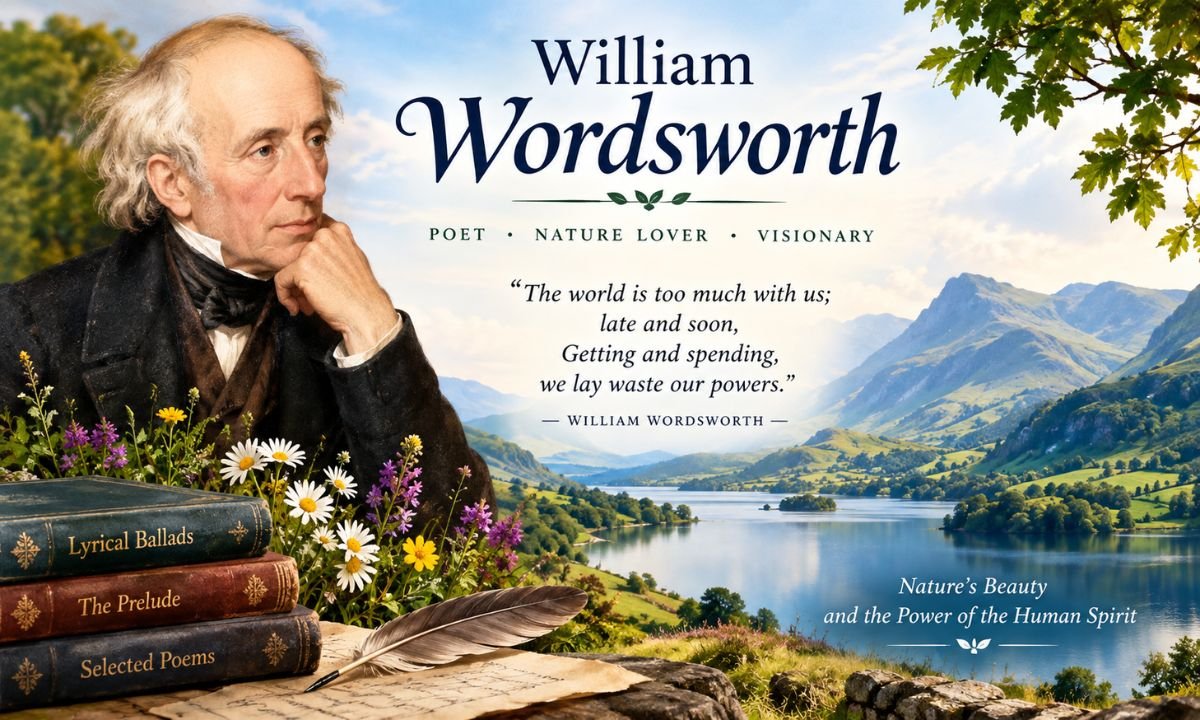
William Wordsworth Poetry is beautiful. He spent a long life writing about short, ordinary moments — a field of daffodils, a solitary reaper singing in the hills, a walk along a riverbank — and turned them into some of the most enduring poetry in the English language. As a founder of English Romanticism, he changed what poetry was allowed to sound like, trading formal, ornate language for the “real language of men.”
This guide covers everything you need to understand Wordsworth’s poetry: his life, his writing style, his major themes, and why his work still shapes how we think about nature, memory, and emotion today. Every section here is written fresh, based on research into how his poetry is discussed and taught, without reproducing his actual verses.
Who Was William Wordsworth? A Short Biography
William Wordsworth was born on April 7, 1770, in Cockermouth, in England’s Lake District, to John Wordsworth, a legal agent, and Ann Cookson. His childhood was marked by early loss — his mother died when he was seven, and his father passed away six years later, leaving William and his four siblings, including his beloved sister Dorothy, separated among relatives.
Despite this instability, the Lake District’s mountains, lakes, and valleys left a permanent mark on him, becoming both his emotional refuge and his greatest poetic subject. He studied at Cambridge, traveled through France and Switzerland during the early years of the French Revolution, and eventually settled back in the Lake District, where he lived for most of his life.
In 1798, Wordsworth and his close friend Samuel Taylor Coleridge published “Lyrical Ballads,” a collection now widely credited with launching the English Romantic movement. The book’s preface, expanded in 1800, laid out Wordsworth’s revolutionary belief that poetry should use everyday language and focus on ordinary people and experiences rather than elevated, formal subjects.
Wordsworth’s most productive period, often called his “great decade,” ran from roughly 1797 to 1808. During these years, he wrote “Tintern Abbey,” “I Wandered Lonely as a Cloud,” “The Solitary Reaper,” “Ode: Intimations of Immortality,” and much of “The Prelude,” his long autobiographical poem tracing the growth of his own mind. “The Prelude” was published only after his death.
In 1843, Wordsworth was named Poet Laureate of the United Kingdom. He died on April 23, 1850, at his home, Rydal Mount, in the Lake District.
Read Also This Blog: John Keats Poetry
Quick Facts Table
| Detail | Information |
| Full Name | William Wordsworth |
| Born | April 7, 1770, Cockermouth, England |
| Died | April 23, 1850, Rydal Mount, England (aged 80) |
| Literary Movement | English Romanticism |
| Key Collaboration | Samuel Taylor Coleridge, “Lyrical Ballads” (1798) |
| Most Productive Period | 1797–1808 (“The Great Decade”) |
| Major Work | “The Prelude” (published posthumously, 1850) |
| Honor | Poet Laureate of the UK, 1843–1850 |
Style of William Wordsworth Poetry
Wordsworth’s style broke sharply from the elevated, decorative language common in 18th-century poetry. He argued, in the preface to “Lyrical Ballads,” that poetry should be written in the language ordinary people actually used, and should capture “the spontaneous overflow of powerful feelings” recalled later in a state of calm reflection.
Key stylistic traits include:
- Plain, accessible language: Wordsworth avoided elaborate poetic diction in favor of clear, direct wording anyone could understand.
- Focus on common life: His subjects were often farmers, shepherds, children, and rural laborers rather than aristocrats or mythological figures.
- Emotion recollected in tranquility: He believed the strongest poetry came not from raw emotion in the moment, but from that emotion remembered and reflected upon later.
- Blank verse and traditional forms: Despite his radical ideas about language, Wordsworth often worked within established forms like the sonnet and blank verse.
- Autobiographical depth: Much of his major work, especially “The Prelude,” draws directly on his own memories and psychological development.
This combination of simple language and deep emotional or philosophical weight is part of what makes his poetry still feel approachable today, even though it’s over two centuries old.
Nature’s Quiet Voice in William Wordsworth Poetry
The morning hills awaken in the light,
While dancing leaves whisper through the air,
A river carries dreams beyond my sight,
And peace is blooming everywhere.
The Lonely Wanderer in William Wordsworth Poetry
I walk where golden meadows softly gleam,
And listen to the skylark’s gentle song,
The quiet fields become a living dream,
Where wandering thoughts can rest for long.
Memories of Childhood in William Wordsworth Poetry
The fields I knew still live within my heart,
Their simple beauty follows where I roam,
Though years have passed and kept us far apart,
Those tender memories still feel like home.
The Gift of Nature in William Wordsworth Poetry
A little flower shining by the way,
Can teach the heart to cherish what is small,
The sun may turn an ordinary day
Into a joyful wonder for us all.
How Does William Wordsworth Poetry Work in the Reader’s Mind?
Wordsworth’s poetry is built around the idea that ordinary moments, properly remembered and reflected upon, can reveal profound truths. This has a specific effect on how readers process his work.
- William Wordsworth Poetry triggers recognition, not distance. Because his language is plain and his subjects are everyday, readers see themselves in the poem rather than admiring it from afar.
- William Wordsworth Poetry slows the reader down through memory. Many poems move from a present moment into recollection, prompting readers to do the same with their own memories.
- William Wordsworth Poetry connects nature to inner feeling. A landscape in a Wordsworth poem is rarely just scenery — it becomes a mirror for grief, joy, or spiritual insight, encouraging readers to find the same connection in their own surroundings.
- William Wordsworth Poetry builds meaning gradually. Rather than delivering a message upfront, his poems often arrive at insight only after sustained reflection, training readers toward patience and attentiveness.
This is why William Wordsworth Poetry is often described as meditative — it doesn’t just describe an experience, it recreates the mental process of finding meaning in it.
Romance in William Wordsworth Poetry
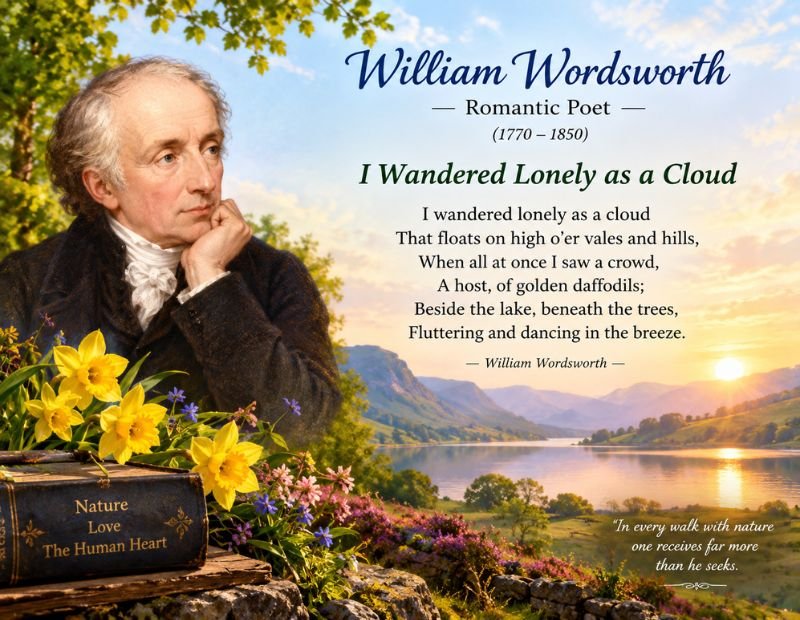
Wordsworth is considered the founding figure of English Romanticism, alongside Samuel Taylor Coleridge. Romanticism, as a movement, reacted against the rigid rules and formal language of Neoclassical poetry, favoring imagination, individual emotion, and a reverence for nature instead.
Wordsworth’s specific contributions to the movement include:
- Championing “common life” as a valid subject for serious poetry, rather than only kings, myths, or classical heroes.
- Elevating nature to near-spiritual status, treating the natural world as a source of moral and emotional guidance.
- Prioritizing the individual mind — how a person’s perception, memory, and imagination shape their understanding of the world.
- Writing in accessible language, rejecting the elaborate diction of earlier poetic traditions.
Where Keats leaned into sensuous beauty and classical myth, and Byron cultivated a rebellious, larger-than-life persona, Wordsworth grounded Romanticism in quiet reflection, rural life, and the workings of memory.
The quiet hills awaken with the dawn,
While golden light rests softly on the trees;
My wandering heart follows the gentle morn,
And finds its peace within the whispering breeze.
A lonely stream moves slowly through the land,
Reflecting clouds that wander through the sky;
I pause beside it, feeling nature’s hand,
And watch the peaceful hours go drifting by.
The flowers bloom beside the woodland way,
Their simple beauty fills my heart with grace;
They teach my soul to welcome every day,
And find deep joy in nature’s warm embrace.
When evening falls upon the silent hill,
The fading sun paints clouds with tender gold;
The world grows calm, the restless winds grow still,
And cherished memories quietly unfold.
Major Themes in William Wordsworth Poetry
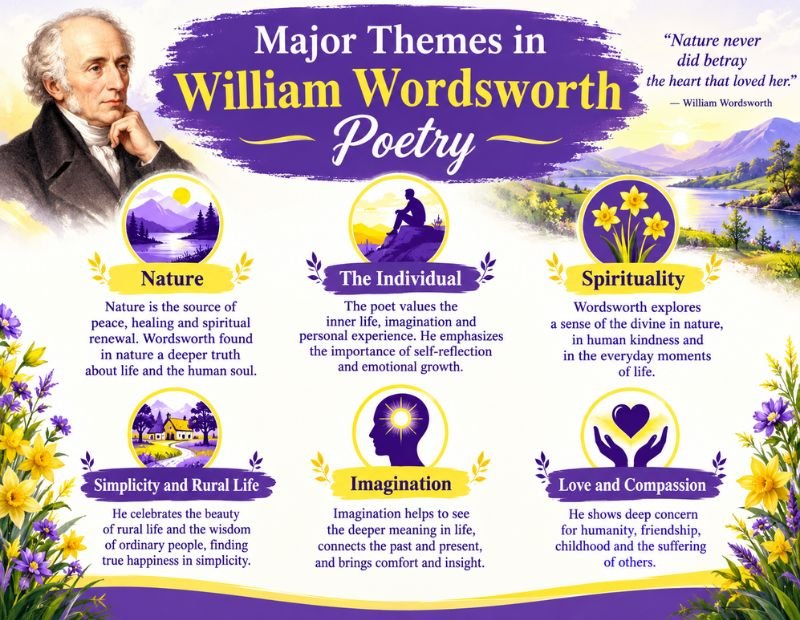
Nature as a Moral and Spiritual Guide in William Wordsworth Poetry
For Wordsworth, nature was not just a backdrop — it was a living presence capable of teaching, healing, and elevating the human spirit. He believed regular contact with the natural world made people more compassionate and spiritually grounded.
Memory and the Passage of Time in William Wordsworth Poetry
Many of his poems revisit past experiences, especially from childhood, showing how memory shapes present identity and emotional life.
Childhood and Innocence in William Wordsworth Poetry
Wordsworth viewed childhood as a time of unmatched purity and imaginative connection to the world, a state adults spend their lives trying to recover glimpses of.
The Individual Mind and Imagination in William Wordsworth Poetry
Much of his major work, particularly “The Prelude,” is concerned with tracing how a poet’s mind develops — how perception, feeling, and imagination combine to create understanding.
Simplicity and Common Life in William Wordsworth Poetry
Wordsworth consistently found deep meaning in modest, everyday subjects: a solitary worker, a small flower, a rural walk, rejecting the idea that poetry needed grand or elevated subject matter.
Solitude and Loneliness in William Wordsworth Poetry
Isolation appears frequently in his work, often framed positively — solitude, especially in nature, was where Wordsworth believed people could best access wisdom and emotional clarity.
Key Characteristics and Features of William Wordsworth Poetry
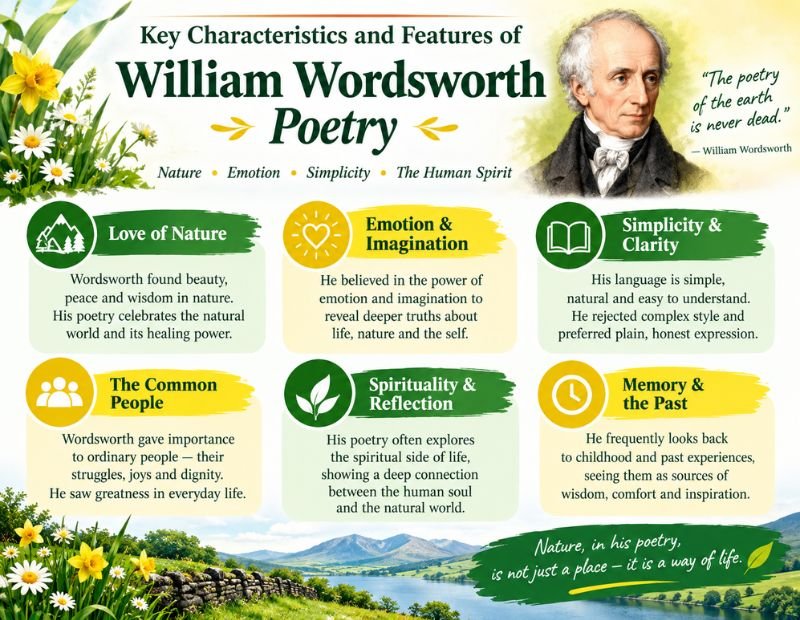
| Characteristic of William Wordsworth Poetry | What It Means |
| Plain diction | Everyday language instead of formal, ornate poetic style |
| Nature worship | Nature treated as a spiritual and moral teacher |
| Autobiographical focus | Poems rooted in personal memory and lived experience |
| Emotional recollection | Feelings revisited and processed through calm reflection |
| Rural subject matter | Farmers, children, and common people as central figures |
| Philosophical depth | Poems that explore perception, memory, and the growth of the mind |
| Traditional forms | Use of sonnets and blank verse despite simple language |
Five Words That Describe William Wordsworth Poetry
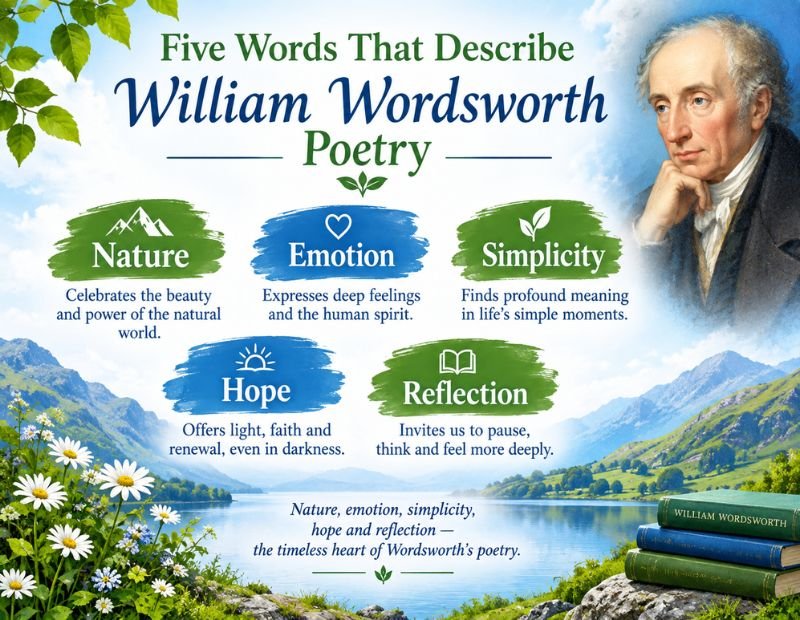
- Reflective — built around memory and quiet contemplation
- Pastoral — rooted in rural life and natural landscapes
- Sincere — emotionally direct rather than ornamental
- Meditative — slow-moving, thoughtful, and introspective
- Accessible — written in clear, everyday language
Best Poetry Books and Collections of William Wordsworth Poetry
| Collection Of William Wordsworth Poetry | Why It Matters |
| Lyrical Ballads (1798, with Coleridge) | The collection that launched English Romanticism |
| Poems, in Two Volumes (1807) | Includes some of his most famous shorter poems |
| The Excursion (1814) | A long philosophical poem, intended as part of a larger work |
| The Prelude (published 1850) | His autobiographical masterpiece, tracing his development as a poet |
| The Complete Poetical Works | A comprehensive modern edition for readers wanting his full body of work |
Love Poetry, Short Poetry
Love in William Wordsworth Poetry, including his poems about “Lucy,” a mysterious and possibly fictional figure, is quieter and more restrained than the passionate declarations found in some of his Romantic peers. Loss and tender memory dominate these poems more than romantic longing itself.
His shorter poems, including many sonnets, distill his core ideas — nature, memory, simplicity — into tightly controlled forms, making them a popular entry point for new readers.
In his later years, Wordsworth’s output slowed considerably, and by the time he accepted the role of Poet Laureate in 1843, he had largely stopped writing new verse. His final works reflect a more conservative, settled outlook compared to the emotional intensity of his earlier “great decade,” though “The Prelude,” revised throughout his life, remained his most significant and deeply personal achievement.
Where quiet hills embrace the morning light,
I find thy gentle memory in the air,
The fields grow golden, soft and warm and bright,
As though thy loving spirit lingered there.
Beneath the moon, beside the silver stream,
I hear thy voice within the whispering trees,
Thy love returns like some forgotten dream,
And fills my lonely heart with tender peace.
The wandering clouds may cross the summer sky,
And autumn leaves may fall upon the ground,
Yet love shall bloom whenever thou art nigh,
Like springtime flowers where joy is found.
When evening rests upon the quiet land,
I think of thee beneath the fading sun,
My heart still reaches for thy gentle hand,
For in thy love, two wandering souls are one.
Last Work Of William Wordsworth
By the 1840s, Wordsworth had largely stopped writing new poetry, though he continued revising earlier work — especially The Prelude, his long autobiographical poem, which he kept editing privately for decades. It was never published in his lifetime; his wife, Mary, released it a few months after his death in 1850, and it’s now considered his masterpiece.
In 1843, Wordsworth accepted the role of Poet Laureate, largely as an honorary title rather than an active writing post — he reportedly agreed only after being told he wouldn’t be required to compose new verse for the role. His final original poems from this late period are quieter and more reflective than his earlier work, often revisiting themes of memory, faith, and mortality, with less of the emotional intensity that marked his “great decade” (1797–1808).
Where quiet hills embrace the fading day,
The wandering heart finds peace along the way;
Old memories bloom like flowers in spring,
And nature teaches joy in everything.
The evening river whispers soft and slow,
While golden fields beneath the sunset glow;
A lifetime rests within the mountain air,
And gentle thoughts dissolve each earthly care.
Though youth has vanished like a morning mist,
The soul still treasures moments once it kissed;
In every leaf, a cherished vision stays,
A quiet light from long-remembered days.
When weary footsteps reach the twilight shore,
The heart looks back at all it loved before;
Yet nature’s voice, serene and ever true,
Still leads the spirit toward the dawn anew.
Frequently Asked Questions About William Wordsworth Poetry
Who is William Wordsworth?
William Wordsworth (1770–1850) was an English Romantic poet best known for co-writing “Lyrical Ballads” and for his autobiographical poem “The Prelude.”
What makes Wordsworth’s poetry unique?
His poetry stands out for its plain, accessible language and its deep focus on nature, memory, and ordinary human experience.
What is Wordsworth’s most famous poem?
“I Wandered Lonely as a Cloud” (often called “Daffodils”) is his most widely recognized poem, along with “Tintern Abbey.”
What is Wordsworth’s poetic philosophy?
He believed poetry should be “the spontaneous overflow of powerful feelings,” written in the natural language people actually speak.
Why is nature so important in his poetry?
Wordsworth saw nature as a spiritual and moral guide capable of healing and elevating the human mind.
Is Wordsworth considered a Romantic poet?
Yes, he is widely regarded as a founding figure of English Romanticism alongside Samuel Taylor Coleridge.
What themes appear most often in his poetry?
Nature, memory, childhood, solitude, and the workings of the imagination are his most recurring themes.
How long was Wordsworth’s writing career?
He wrote for several decades, though his most celebrated work came during his “great decade” between 1797 and 1808.
Final Thoughts
William Wordsworth taught readers to find meaning in the ordinary — a solitary walk, a remembered childhood, a field of flowers seen years ago. His plain, sincere language and deep reverence for nature reshaped what English poetry could be, and his influence still echoes through how poets write about memory, landscape, and emotion today.
If you’re new to his work, start with his shorter, more accessible poems from the “great decade,” then move on to “The Prelude” for a fuller picture of how his mind, and his poetry, grew over a lifetime.