
Read a good poem aloud and something changes. The words stop being marks on a page and start behaving like music. That change is the work of sound devices in poetry. Poets have relied on these tools for thousands of years, from oral epics chanted around fires to spoken word nights in modern cafes.
This guide explains sound devices in poetry in simple language. You will learn what they are, why poets use them, how each technique works, and how to spot them in real verse. You will also find short four line poems, a quick reference table, a section for KS2 learners, and clear answers to common questions. By the end, you will hear poems in a new way.
What Are Sound Devices in Poetry?
Sound devices in poetry are techniques that poets use to control how language sounds, so the music of the words supports the meaning. They are also called literary sound devices, musical devices or sonic devices.
Quick definition: Sound devices in poetry are literary techniques such as rhyme, alliteration, assonance and onomatopoeia that use the sounds of words to create rhythm, mood and meaning.
Think of a poem as a song without instruments. The words are the notes. The sound devices are the arrangement that turns those notes into a tune. Prose writers use these tools too, but poetry leans on them far more. That is a big reason a poem feels different from a paragraph.
Read Also this Blog: Poetry School
Purpose of Sound Devices in Poetry
The purpose of sound devices in poetry goes well beyond decoration. Poets use them to:
- Create music, flow and a pleasing rhythm
- Stress important words and ideas
- Set the mood and tone of a poem
- Build vivid imagery that the ear can “see”
- Make lines memorable and easy to recall
- Link ideas and hold stanzas together
- Echo the meaning of the words through sound
Before printing existed, rhyme and rhythm helped people memorise long poems. That memory function is still one of the quiet strengths of sound devices in poetry.
Effects of Sound Devices in Poetry
The effects of sound devices in poetry fall into three main areas.
Emotional Effects
Soft sounds like l, m and s tend to feel calm and gentle. Hard sounds like k, t and g feel sharp, tense or angry. Poets choose sounds to push the reader toward a particular feeling without ever naming it.
Musical and Structural Effects
Repeated sounds create a beat the listener can follow. Rhyme schemes and refrains also give a poem a shape. You know where a stanza ends because the sound tells you.
Effects on Meaning
When a poet uses sound devices in poetry to mirror an idea, the reader feels the meaning in the ear before the mind explains it. A line about a slow river can drag its vowels out. A line about a battle can clatter with hard consonants.
Elements of Sound Devices in Poetry
Several building blocks sit behind every one of the sound devices in poetry. Knowing them makes analysis much easier.
- Phonemes: the smallest units of sound, divided into vowels and consonants.
- Syllables and stress: the strong and weak beats inside words.
- Rhythm and meter: the pattern of stressed and unstressed syllables across a line.
- Repetition: sounds, words or phrases that return on purpose.
- Position: where the sound appears, such as the start of a word, the middle, the end of a line or inside a line.
- Tone: the emotional colour that the sounds create together.
Literary Sound Devices in Poetry: Quick Reference Table
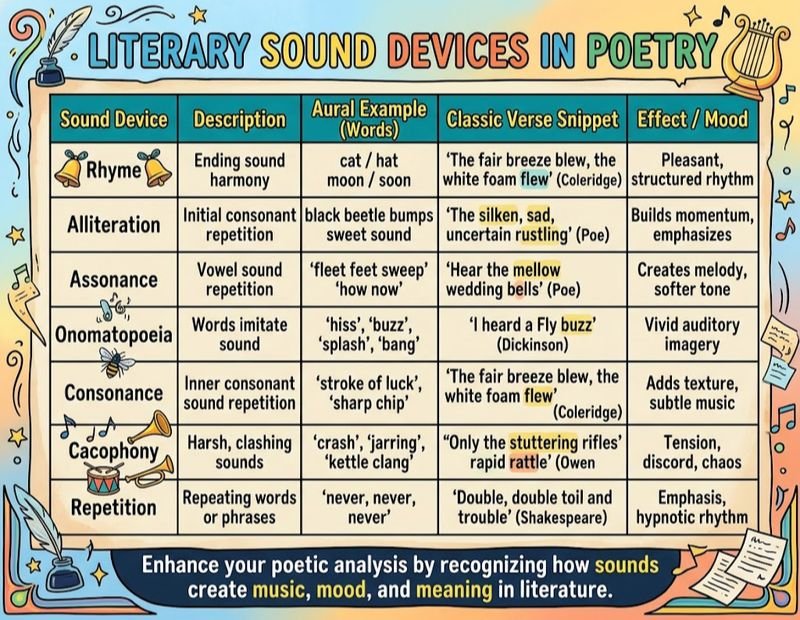
Use this table for fast revision. It covers the most common literary sound devices in poetry and what each one repeats.
| Sound Device | What It Does | Short Example |
|---|---|---|
| Rhyme | Repeats ending sounds | cat / hat |
| Alliteration | Repeats starting consonant sounds | black beetle bumps |
| Assonance | Repeats vowel sounds | the moon rose too soon |
| Consonance | Repeats consonant sounds anywhere | the stack of black chalk |
| Onomatopoeia | Words that imitate sounds | buzz, splash, hiss |
| Repetition | Repeats words or phrases | never, never, never |
| Anaphora | Repeats words at line starts | We will rise, we will rise |
| Refrain | Repeats a line at intervals | “Nevermore” |
| Rhythm | Pattern of beats | da DUM da DUM |
| Meter | Measured rhythm per line | iambic pentameter |
| Euphony | Pleasant, smooth sounds | lull, mellow, hum |
| Cacophony | Harsh, jarring sounds | crash, clatter, grit |
| Sibilance | Repeats hissing s sounds | the silken, sad rustle |
| Internal rhyme | Rhyme inside one line | dreary / weary |
| Slant rhyme | Near rhyme with similar sounds | stone / stunned |
| Caesura | A pause inside a line | To err is human; to forgive, divine |
Sound Devices in Poetry With Examples
Here is each technique explained with an example. The quotes come from classic poems in the public domain, and they are kept short.
1. Rhyme
Rhyme repeats the ending sounds of words, usually at the ends of lines. A pattern of rhymes is called a rhyme scheme and is labelled with letters, such as AABB or ABAB. The nursery favourite “Twinkle, twinkle, little star / How I wonder what you are” is a clear AABB couplet. Rhyme gives a poem order and makes lines stick in the memory.
2. Alliteration
Alliteration repeats the same starting consonant sound in nearby words. It is one of the most recognisable sound devices in poetry. Coleridge wrote, “The fair breeze blew, the white foam flew.” The repeated f and w sounds push the line forward like the wind itself.
3. Assonance
Assonance repeats vowel sounds inside words that sit close together. The consonants can differ. In Poe’s “The Bells,” the line “Hear the mellow wedding bells” repeats a soft e sound and creates a gentle ring.
4. Consonance
Consonance repeats consonant sounds anywhere in a word, often at the end. Think of “pitter patter” or “the stack of black chalk.” It adds texture without needing a full rhyme. It also differs from alliteration because the repeated sound does not have to open the word.
5. Onomatopoeia
Onomatopoeia uses words that sound like the thing they describe. Buzz, hiss, splash, clang and murmur all work this way. Emily Dickinson opens a famous poem with “I heard a Fly buzz,” and the word buzz does half the work. Among the sound devices in poetry, this one is the most direct bridge between sound and meaning.
6. Repetition
Repetition brings back a word or phrase for emphasis. Shakespeare’s witches chant “Double, double toil and trouble,” and the echo gives the spell its eerie rhythm. Repetition can build tension, show obsession or simply add music.
7. Anaphora
Anaphora repeats the same word or phrase at the start of successive lines. It creates a rolling, speech like power. Walt Whitman used it again and again in Leaves of Grass to build long, sweeping lists.
8. Refrain
A refrain is a line or phrase that returns at set points, like a chorus in a song. In “The Raven,” Poe ends stanza after stanza with the word “Nevermore.” Each return deepens the sense of grief.
9. Rhythm
Rhythm is the pattern of strong and weak beats in a line. It works like a heartbeat under the words. Fast rhythm can feel excited or anxious. Slow rhythm can feel peaceful or sad.
10. Meter
Meter is rhythm that follows a measured pattern. The most famous English meter is iambic pentameter, which has five beats per line in a da DUM pattern. “Shall I compare thee to a summer’s day?” is a classic example. Meter is often called the backbone of traditional verse.
11. Euphony
Euphony means pleasing, smooth sound. Poets create it with soft consonants and long vowels. Pope’s “Soft is the strain when Zephyr gently blows” glides across the tongue, which is exactly the point.
12. Cacophony
Cacophony is the opposite. It packs in harsh, clashing sounds to create discomfort. Wilfred Owen captured the noise of war with “Only the stuttering rifles’ rapid rattle.” The hard t and r sounds sound like gunfire.
13. Sibilance
Sibilance repeats hissing sounds such as s, sh and z. Poe’s line about “the silken, sad, uncertain rustling of each purple curtain” whispers on the page. Sibilance can feel soothing or sinister depending on the scene.
14. Internal Rhyme
Internal rhyme places rhyming words inside the same line, or in the middle of lines. Poe’s “Once upon a midnight dreary, while I pondered, weak and weary” shows it perfectly. It adds speed and a hypnotic pull.
15. Slant Rhyme
Slant rhyme, also called near rhyme or half rhyme, uses words that sound similar but do not match exactly. Examples include “stone” and “stunned.” Modern poets love it because it avoids the sing song feel of perfect rhyme.
16. Caesura
Caesura is a deliberate pause inside a line, often shown by a comma, full stop or semicolon. Pope’s “To err is human; to forgive, divine” splits neatly in the middle. The pause gives the reader time to think.
17. Euphony and Cacophony Together
Many poets mix smooth and harsh sounds in one poem to show conflict or change. A calm opening that breaks into jagged noise can mirror a storm arriving. Skilled use of sound devices in poetry often depends on this kind of contrast.
Sound Devices in Poetry KS2
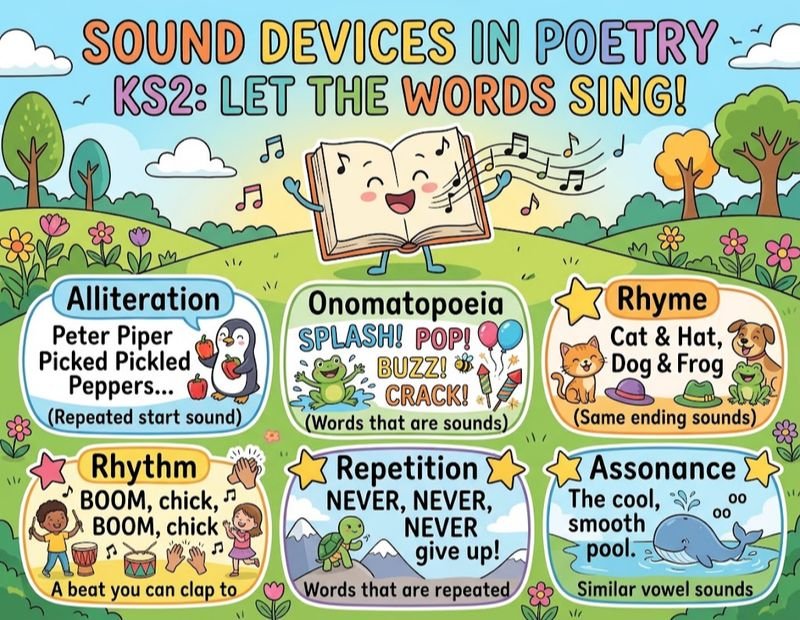
KS2 pupils, aged seven to eleven, meet sound devices in poetry as part of the English curriculum. At this stage, the focus is on spotting and enjoying them rather than using technical language.
The most useful devices for KS2 are:
- Rhyme: matching ending sounds
- Alliteration: repeated first sounds, like “Peter picked pickled peppers”
- Onomatopoeia: words like pop, crackle and whoosh
- Repetition: repeated words or lines
- Rhythm: the beat when a poem is clapped or chanted
Simple classroom activities work best. Ask children to clap the beat of a poem. Let them hunt for rhyming pairs with highlighters. Give them a noisy topic, such as a thunderstorm or a busy playground, and ask them to write four lines using at least two sound devices in poetry. Reading aloud is the golden rule.
8 Short Poems of 4 Lines With Sound Devices
These original poems are short enough to read in seconds. Each one shows a single technique. They also work well as models if you want to practise sound devices in poetry yourself.
1. Alliteration and Sibilance
Silver snowflakes softly spin,
Sliding down the sky,
Sleepy streets are sleeping in
While winter whispers by.
2. Rhyme (AABB)
The moon came out to say hello,
It painted all the hills with snow,
The owl woke up and gave a call,
Then silence settled over all.
3. Assonance
Deep in the sleepy evening breeze,
Green leaves heave and sigh with ease,
We dream beneath the beechen trees,
Where seas of silence seem to freeze.
4. Consonance
The clock ticked slowly, tick by tick,
A cricket clicked, a cat crept quick,
Each creak and crackle, crumb and brick
Made midnight feel too still and thick.
5. Onomatopoeia
Splash! The puddle starts to gurgle,
Drip and drop and pitter patter,
Thunder rumbles, rain goes sizzle,
Wellies squelch and children chatter.
6. Anaphora and Repetition
We will rise when the morning calls,
We will rise when the shadows fall,
We will rise through the broken walls,
We will rise, and we will stand tall.
7. Euphony
Soft waves hum a lullaby,
Moonlight melts on silver seas,
Lazy breezes lightly sigh,
Lulling all the world to ease.
8. Cacophony
Crashing crates and clattering cans,
Gritty gravel grinds and jars,
Kettles clang and car horns bang,
Chaos clatters through the bars.
Try reading poems seven and eight one after the other. The difference in feeling comes entirely from sound.
How Do Sound Devices Contribute in Poetry?
Sound devices contribute to poetry by turning plain statements into experiences. They work on three levels at once.
They create music. Rhyme, rhythm and repetition give lines a tune, which makes a poem pleasant to read aloud.
They strengthen meaning. Onomatopoeia, cacophony and sibilance let sound act out the idea. A reader does not just read about a storm. They hear it.
They guide emotion and memory. A calming vowel or a sharp consonant nudges mood. A refrain or rhyme helps a line stay in the mind long after the page is closed.
In short, sound devices in poetry connect the ear, the emotions and the mind. Remove them and a poem often collapses into ordinary prose.
Famous Poets and Sound Devices in Poetry
Great poets treat sound as seriously as vocabulary.
- Edgar Allan Poe built whole poems on internal rhyme, refrains and sibilance. “The Raven” is a masterclass in sound devices in poetry.
- Alfred, Lord Tennyson was famous for smooth, musical lines. His phrase “the moan of doves in immemorial elms, and murmuring of innumerable bees” uses repeated m and n sounds to make the sound of a summer afternoon.
- Wilfred Owen used harsh consonants and slant rhyme to show the ugliness of war.
- Emily Dickinson favoured slant rhyme and sudden pauses that unsettle the reader.
- Walt Whitman used anaphora and free verse rhythm to create a spoken, democratic voice.
Reading these poets aloud is one of the best ways to train your ear.
Sound Devices in Poetry vs Sound Imagery
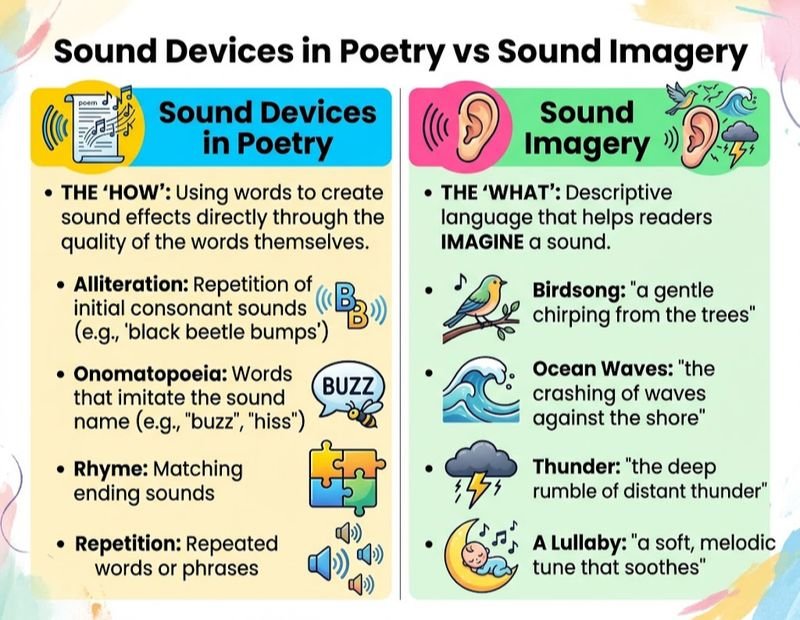
Learners often confuse these two ideas. Sound imagery describes a sound using words, such as “the church bells rang.” A sound device uses the actual sound of the words to create an effect. The table below makes the difference clear.
| Feature | Sound Devices | Sound Imagery |
|---|---|---|
| Focus | How words sound | What sounds are described |
| Example | “stuttering rifles’ rapid rattle” | “I heard the guns in the distance” |
| Works through | Repetition of sounds | Descriptive detail |
| Main effect | Music, mood, emphasis | Sensory picture |
The two often work together, but they are not the same thing. Sound devices in poetry shape how a line is heard, while sound imagery shapes what the reader imagines.
Tips for Using Sound Devices in Poetry
Want to use these techniques in your own writing? Follow these steps.
- Read every draft aloud. Your ear will catch clumsy sounds that your eye misses.
- Start with one device. Practise alliteration or rhyme first, then add others.
- Match sound to subject. Use soft sounds for peaceful scenes and hard sounds for tension.
- Vary your patterns. Mix devices so the poem does not feel mechanical.
- Choose strong verbs. Verbs like whisper, crash and simmer carry sound inside them.
- Edit for meaning first. Sound should support the idea, never replace it.
- Experiment with position. Try sound devices in poetry at the start, middle and end of lines.
Common Mistakes to Avoid with Sound Devices in Poetry
Even strong writers slip up. Watch out for these problems.
- Overloading lines. Too much alliteration or rhyme can make a poem sound like a tongue twister.
- Forcing rhymes. Twisting grammar just to land a rhyme weakens the line.
- Ignoring meaning. Pretty sounds mean little if they do not fit the subject.
- Using one device only. Variety keeps the ear interested.
- Skipping the read aloud test. Silent editing hides sound problems.
Good sound devices in poetry feel natural. If the reader notices the trick instead of the feeling, ease off.
Conclusion
Sound is the heartbeat of verse. From rhyme and rhythm to alliteration, assonance and onomatopoeia, sound devices in poetry give words their music, their mood and their lasting power. They help a poem live in the ear and stay in the memory.
The best way to master sound devices in poetry is simple. Read widely, read aloud and practise writing short pieces that test one technique at a time. Soon you will hear patterns everywhere, and your own poems will sing with more confidence.
Frequently Asked Questions About Sound Devices in Poetry
What are sound devices in poetry?
They are techniques like rhyme, alliteration, assonance and onomatopoeia that use the sounds of words to create music, mood and meaning.
What are the main types of sound devices in poetry?
The main types are rhyme, alliteration, assonance, consonance, onomatopoeia, repetition, rhythm, meter, euphony and cacophony.
What is the purpose of sound devices in poetry?
Their purpose is to add musicality, stress key ideas, set the mood and make lines easier to remember.
How do sound devices contribute in poetry?
They give poems rhythm and emotion, and they let the sound of the words reinforce the meaning.
What are the effects of sound devices in poetry?
They create emotional atmosphere, build structure and flow, and deepen the reader’s connection to the poem.
What is the difference between alliteration and assonance?
Alliteration repeats the starting consonant sound of nearby words, while assonance repeats vowel sounds anywhere inside them.
What are sound devices in poetry for KS2?
For KS2, the key devices are rhyme, alliteration, onomatopoeia, repetition and rhythm, usually taught through reading aloud and clapping beats.
What is the difference between euphony and cacophony?
Euphony uses smooth, pleasant sounds, while cacophony uses harsh, clashing sounds to create tension.
Do sound devices only appear in poetry?
No. Prose, speeches, advertising and song lyrics use them too, but poetry relies on them most heavily.
How can I identify sound devices in a poem?
Read the poem aloud, listen for repeated sounds or patterns, and then match them to the technique names.