
Global poetry is the shared voice of people who write across borders, languages and cultures. It connects a farmer in Punjab, a student in Durban, a teacher in Lisbon and a dreamer in Karachi through the same quiet act: putting feeling into words. This guide explains what global poetry is, why it matters, how to join competitions and festivals, and gives you original verses to read, share and enjoy.
Whether you want to understand the idea, find a platform to publish, or simply read a few lines that move you, you are in the right place.
What Is Global Poetry?
Global poetry is poetry that crosses national, linguistic and cultural lines. It includes work written in many languages, work translated for new readers, and work shared on worldwide platforms, festivals and contests.
The idea is not new, but its name carries a specific story. The Global Poetry project began around the year 2000, started by Indian poet Sumeet Grover. Its goal was to bring poets together so that verse could inspire change at a personal level and support peace between communities. It later joined the Transcend Art and Peace Network.
Scholars use a wider lens. Writers such as Jahan Ramazani and Walt Hunter study how poems carry local experience and global forces at the same time. In simple words, a poem about a village well can also speak about water, climate and shared survival everywhere.
A quick definition for search and snippets:
Global poetry is poetry created, translated or shared across countries and cultures to express common human experiences such as love, loss, hope, nature and justice.
Read Also this Blog: Children’s Poetry
Global Poetry vs World Poetry vs Local Poetry
| Feature | Local Poetry | World Poetry | Global Poetry |
|---|---|---|---|
| Audience | One community or region | Readers of many nations | Worldwide, often online |
| Language | Mostly one language | Many languages, often translated | Many languages plus English bridges |
| Main aim | Preserve culture | Share literary heritage | Connect voices and spark dialogue |
| Platforms | Local readings, magazines | Anthologies, journals | Festivals, contests, social media |
| Themes | Place, tradition | Universal literary themes | Shared issues like peace, climate, identity |
Purpose of Global Poetry
Poetry has always been more than decoration. Global poetry has a clear job in the modern world.
Why Does Global Poetry Exist?
- Build understanding. A poem lets you step inside another life in sixty seconds.
- Support peace. The original Global Poetry mission used verse to open dialogue between people of different countries and civilisations.
- Give voice to the unheard. Many poets write about migration, poverty, gender and justice when few other platforms listen.
- Preserve language and memory. Translation keeps small languages alive and carries them to new readers.
- Inspire action. Verses shape how people feel about climate, war, freedom and community.
- Create belonging. Writers who feel isolated find a global circle of readers.
Characteristics of Global Poetry
Good global poetry shares a handful of traits. You will notice them across eras and regions.
Key Features at a Glance
- Universal emotion. Love, grief, hope and fear read the same in every language.
- Local detail. Specific images, such as a monsoon sky, a market street or a snowy road, make the poem believable.
- Cultural blending. Poets borrow forms, from the ghazal to the haiku to the sonnet, and remix them.
- Accessible language. Short lines and clear imagery travel better across translation.
- Social awareness. Many poems touch on migration, identity, war, inequality or the environment.
- Musical rhythm. Even free verse relies on sound, breath and pause.
- Digital reach. Reels, audio clips, blogs and online contests carry poems to millions.
Common Poetic Forms Used Worldwide
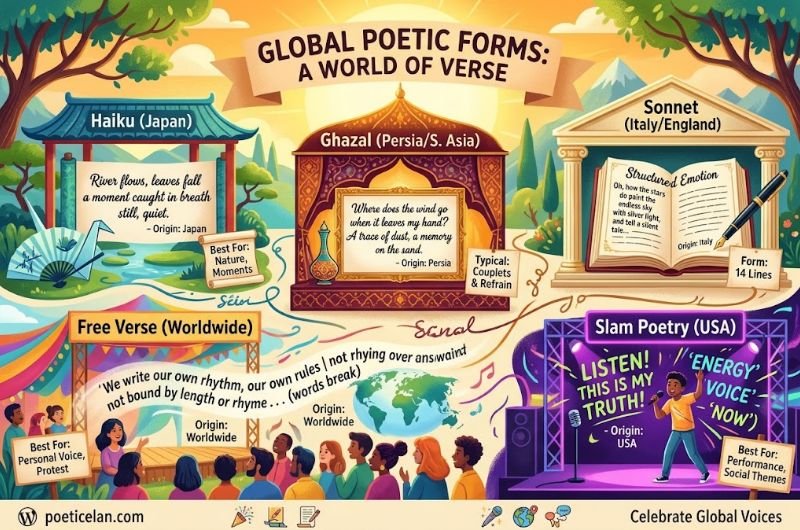
| Form | Origin | Typical Length | Best For |
|---|---|---|---|
| Haiku | Japan | 3 short lines | Nature, a single moment |
| Ghazal | Persia, South Asia | Couplets with a refrain | Longing, love, loss |
| Sonnet | Italy, England | 14 lines | Structured emotion |
| Free verse | Worldwide | Any length | Personal voice, protest |
| Slam poetry | United States, now global | Performed, 2 to 3 minutes | Social themes, live energy |
| Ode | Ancient Greece | Varies | Praise and celebration |
| Quatrain | Many cultures | 4 lines | Short, shareable verse |
Effects of Global Poetry
Poetry does quiet work, but the results are real.
- Emotional healing. Writing and reading verse helps people process grief and stress.
- Empathy. Readers learn to feel what distant strangers feel.
- Confidence. Reciting on stage or posting online builds courage and communication skills.
- Cultural pride. Poets rediscover their own heritage while meeting others.
- Social change. Hashtag poetry and slam events have carried movements for justice into public view.
- Career doors. Competition wins, publications and showcases can open paths to editors, galleries and festivals.
Global Poetry Quotes
These original lines are written to be shared. Use them on cards, captions and classroom walls.
❖ Poetry is the only passport that needs no visa.
❖ A poem begins in one heart and finishes in a thousand.
❖ When borders fall silent, verses keep walking.
❖ Every language has a way to say hope, and poets find it.
❖ The world is loud, but a single line can still be heard.
❖ We write in different tongues, yet we bleed the same ink.
❖ A stanza is a small home where strangers meet.
❖ Poets do not divide the map; they stitch it.
❖ Words travel farther than ships, and they carry more.
❖ To read a foreign poem is to be welcomed without knocking.
8 Latest 4 Lines Global Poetry
Short verses are the most searched and most shared form of poetry. Here are eight fresh quatrains, written for this article.
✦ The Common Sky
The sky above my window is the same one over yours, It carries all our prayers across the oceans and the shores. No flag is stitched into its blue, no border in its rain, It shelters every sleeping child and every hidden pain.
✦ Mother Tongue
My grandmother sang softly in a language few recall, But every vowel held a field, a river and a wall. I write her song in English now, yet something stays the same, The sound of home survives the shift of every changing name.
✦ Bridge of Words
I do not know your alphabet, you do not know mine, Yet in a single trembling verse, our hearts begin to align. A translator lifts the bridge, and we walk across with care, Two strangers sharing silence and the poem that lives there.
✦ Midnight Train
The midnight train hums lullabies to those who journey far, To workers chasing morning and to dreamers under stars. Each window holds a story that the dark cannot erase, And poetry sits quietly in every weary face.
✦ Rain Prayer
The rain arrives in Karachi like a long-awaited friend, It paints the dust with silver and it teaches dry earth to bend. Somewhere another village sings the same wet melody, The world is one wide listening beneath a rainy sea.
✦ Open Palm
A fist can hold a grievance, but it cannot hold a rose, An open palm receives the light and everything that grows. So let our verses open wide and let our hands be free, For peace is only poetry in human company.
✦ Little Lantern
A lantern in a window says the night will not be long, It hums a tune of courage in a quiet, steady song. If every poet lit a flame and set it on a sill, The darkest city on the earth would glow and soften still.
✦ After the Storm
The storm has torn the roofs away, yet morning finds a way, A child begins to draw the sun upon the broken clay. We rebuild with our fingers and we sing while we repair, Hope is a stubborn poem that the wind cannot impair.
Powerful Themes in Global Poetry
Most poems from around the world circle a few large ideas. Knowing them helps you read better and write better.
| Theme | What Poets Explore | Sample Image |
|---|---|---|
| Love and longing | Distance, devotion, memory | A letter that never arrives |
| Peace and conflict | War, healing, reconciliation | An olive branch on a ruined wall |
| Identity and migration | Home, belonging, exile | A suitcase by a door |
| Nature and climate | Beauty, loss, responsibility | A river running low |
| Justice and freedom | Rights, resistance, dignity | A voice rising in a crowd |
| Hope and resilience | Survival, joy after hardship | A seed in cracked pavement |
Global Warming Poetry
Climate change is now one of the strongest subjects in world verse. Poets turn data into feeling, which is often what moves readers to act.
Global warming poetry usually uses images of melting ice, drying rivers, burning forests and shrinking shorelines. The best pieces avoid lecture and focus on a single human detail.
✦ The Warming
The glacier wrote a farewell in the language of the stream, A slow and silver letter that we mistook for a dream. The forest keeps its ledger of the heat we never mourned, And every ash-grey morning asks what we have learned.
The seasons lose their manners and the monsoon loses time, The farmer reads the weather like a half-forgotten rhyme. We borrowed from tomorrow and we never signed the page, Yet children read the bill in lines of a changing age.
So plant a tree, my neighbour, and write it in the ground, A verse that grows in silence with a green and steady sound. The earth is not a metaphor, it is the only home, And poetry must guard it, wherever we may roam.
Tips to Write Your Own Climate Poem
- Start with one object, such as a dry well or a melting glacier.
- Use sensory words: heat, dust, smoke, silence.
- Show loss and hope together.
- End on a small action instead of a slogan.
More Poems by Region and Mood
Here are a few more original verses, each tuned to a different corner of the poetic map.
✦ Monsoon Letter (South Asia)
The clouds arrive with letters from the sea, They knock on rooftops, asking to come in. We open every window, set tea, And let the thunder tell us where we’ve been.
✦ Desert Lullaby (Middle East)
The dunes are sleeping giants under a pearl-white moon, The wind hums ancient poems, a slow and sandy tune. A traveller lights a fire and the stars come down to hear, In every desert silence, a poet’s voice is near.
✦ Harvest Song (Africa)
The drums begin at sunrise, the fields begin to sway, The women lift their voices like the dawn lifts up the day. The grain is gold, the laughter loud, the songs are passed along, A harvest is a poem that the whole village writes in song.
✦ Cherry Blossom Hour (East Asia)
Petals fall like whispers on the quiet garden stone, A moment, soft and fleeting, that we cannot make our own. We bow to what is passing, and we hold it for a while, The beauty of a petal is the shortness of its smile.
✦ Northern Lights (Europe)
The sky unfurls a ribbon of green and violet fire, A slow and silent symphony that lifts the earth up higher. Beneath the frozen quiet, a thousand hearts agree, That wonder needs no language and no certainty.
✦ City of Dreams (Americas)
The skyline hums with sleepless lights, the subway sings below, A million stories hurry past and never stop to slow. Someone writes a poem on the back of a receipt, And the city turns it gently to a rhythm in the street.
Global Poetry Submissions
If you want to publish your work, treat submissions like a professional step.
How to Submit Your Poem?
- Pick the right venue. Match your style to the journal, platform or contest.
- Read the guidelines. Check line limits, themes, file formats and deadlines.
- Prepare clean copy. Proofread, use a simple font and add a short bio.
- Send original, unpublished work unless the venue accepts previously published poems.
- Track your entries. Note dates, titles and responses in a simple sheet.
- Stay patient. Replies can take weeks or months.
Smart Submission Checklist
- Is the poem polished and within the word or line limit?
- Does the venue clearly state fees, rights and prize details?
- Are the organisers transparent, with a visible history and contact details?
- Have you kept a copy of the entry confirmation?
Global Poetry Competition 2026
Poetry contests give writers deadlines, feedback and visibility. Several competitions open to international entrants run each year, so always confirm current dates on the official website before you enter.
Examples of Notable 2026 Poetry Events
| Event | Type | Key Detail |
|---|---|---|
| National Poetry Competition (The Poetry Society, UK) | Open to poets worldwide aged 18 or over | Unpublished poem up to 40 lines; the 2026 closing date was 31 October 2026 |
| World Slam Poetry Competition and Convention, Durban | Live slam event | Scheduled for 5 to 11 October 2026 with around 40 poets from 40 countries |
| Poetry International social media competition | Online, hashtag based | Poets share work using a campaign hashtag |
| Student poetry festivals | School level | Many countries run recitation and video poetry events |
Because many of these dates have now passed, use this list as a model for what to watch for in 2027. Follow festival pages, subscribe to newsletters and set calendar reminders three months before typical deadlines.
How to Win a Poetry Competition?
- Follow the theme closely without being predictable.
- Open with a striking image.
- Cut every unnecessary word.
- Read your poem aloud before submitting.
- End with a line that lingers.
Global Poetry and Creative Writing Competition
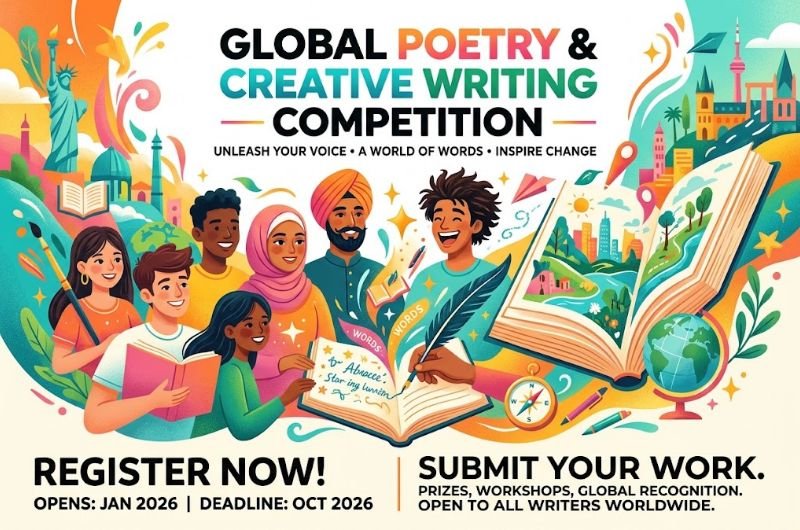
Some contests combine poetry with short stories, essays and flash fiction. These multi-category events suit writers who like to explore more than one form.
What to look for:
- Clear categories and age groups
- Transparent judging criteria
- Published results and winner lists
- Honest information about entry fees and what they cover
Hashtag Kalakar Global Poetry Competition
Hashtag Kalakar runs online creative writing and poetry competitions for emerging artists. Participants and local news outlets have described entries, shortlists and public voting rounds, and several poets list placements from 2023 in their biographies.
Online reviews are mixed. Some writers praise the exposure and transparent results, while at least one reviewer raised concerns about fees for later rounds. This is a useful reminder to read every rule before you pay.
Before you enter any paid contest, check:
- The full fee structure for every round
- The refund policy
- Rights to publish or archive your work
- Independent reviews and past winner stories
Global Poetry Tour
A poetry tour takes poets to multiple cities or countries for readings, workshops and cultural exchange. Some are organised by arts councils and others by independent collectives.
Why join one?
- Meet poets in person
- Perform before new audiences
- Learn how other cultures present verse
- Build friendships that last for years
If you are planning your own tour, begin with libraries, bookshops, universities and cultural centres. They often host readings for little or no cost.
Global Poetry Day
The date most people mean is World Poetry Day, observed every year on 21 March. UNESCO proclaimed it in 1999 to support linguistic diversity and give endangered languages a chance to be heard.
Ways to Celebrate
- Read a poem aloud at school, work or home.
- Share a favourite verse on social media with a tag.
- Translate a short poem into your mother tongue.
- Host an open mic night.
- Write a four line poem and send it to a friend.
Global Poetry Showcase
A showcase is a curated event or online gallery where selected poets present their work. It differs from a contest because there is usually no ranking.
Showcases are ideal for new voices. You gain audience, feedback and a portfolio piece without the pressure of competing.
Euphoria Global Poetry Festival
Several literary and cultural festivals use the words Euphoria and Global Poetry in their programmes, usually around themes of joy, expression and unity. Because names and formats change from year to year, search the festival title together with the year and confirm dates, venues and registration rules on the official page.
Typical festival activities include:
- Open mic sessions
- Poetry slams
- Panel talks on translation and craft
- Book launches
- Youth workshops
Global Poetry Cult
The phrase suggests a devoted community of poetry lovers rather than a formal organisation. In everyday use, online groups and collectives that share verse daily, hold weekly prompts and cheer each other on are often described this way.
Healthy poetry communities share three habits: they give honest feedback, they celebrate small wins, and they welcome beginners. Join one that feels supportive, not competitive for its own sake.
Global Poetry Consortium
A consortium is a group of organisations, universities or poets who collaborate on projects such as anthologies, translation programmes or research. Consortia pool resources, which helps smaller voices reach bigger stages.
If you want to join one, start by contacting local literary societies. They often know which partnerships are accepting new members.
Global Poetry Platform
Online platforms are now the main door into world verse. They let you publish, read, record and discuss in minutes.
What Makes a Good Poetry Platform?
| Feature | Why It Matters |
|---|---|
| Clear submission rules | Saves time and avoids rejection for technical reasons |
| Active readers | Real feedback and engagement |
| Fair rights policy | You keep ownership of your work |
| Moderation | A safe, respectful space |
| Multilingual support | Reaches a wider audience |
| Audio or video options | Lets performance poets shine |
Tip: Cross post carefully. Some journals will not accept poems that have already appeared online.
How to Write Your Own Global Poem?
You do not need a famous name to write a poem the world can feel. Follow this simple method.
- Choose one feeling. Pick a single emotion, such as longing or hope.
- Anchor it in one image. A window, a train, a river.
- Write plain lines. Short sentences translate best.
- Add a shared question. Something every reader can ask: Where is home?
- Read aloud. Listen for rhythm and trim anything that stumbles.
- Share it. Post it, send it to a contest or read it to a friend.
Starter Prompts
- Write about a smell that reminds you of home.
- Describe a stranger you will never meet again.
- Imagine the same sunrise seen from three countries.
- Write a letter to your future grandchild about the climate.
SEO and Reading Tips for Poetry Bloggers
If you run a poetry blog or page, a few habits help readers and search engines find you.
- Use a clear title with your main keyword near the front.
- Add short descriptions and alt text for images of poems.
- Group poems by theme so readers can browse easily.
- Link related posts, for example a quote page and a competition guide.
- Publish consistently, even once a week.
- Include a short author bio to build trust.
- Format poems with line breaks and spacing so they are easy to read on mobile.
Conclusion
Global poetry reminds us that the world is smaller than it looks and kinder than the news suggests. It gives voice to the quiet, carries culture across oceans and lets strangers feel like neighbours.
Start small. Read one poem from another country this week. Write four lines of your own. Look for a competition, a festival or an online community that fits your style, and always check the rules before you enter or pay.
✦ A Closing Verse
So let the poets gather on the roof of every town, And read their small and shining words as evening settles down. For borders are but lines on maps, but verses cross the sea, And every voice that dares to sing helps set the whole world free.
Frequently Asked Questions
What is global poetry?
Global poetry is poetry written, translated or shared across countries and cultures to express common human themes. It also names a project started around 2000 to use verse for peace and dialogue.
What is the purpose of global poetry?
Its purpose is to build understanding, give voice to underrepresented people and promote peace through shared artistic expression.
What are the main characteristics of global poetry?
It features universal emotion, local imagery, cultural blending, simple language and awareness of social issues.
How can I submit my poems to global platforms?
Choose a suitable journal or platform, read the guidelines, prepare a clean unpublished poem with a short bio, and send it before the deadline.
When is Global Poetry Day?
World Poetry Day is celebrated every year on 21 March, as proclaimed by UNESCO in 1999.
Are global poetry competitions free?
Some are free and many charge an entry fee, so always read the fee structure and refund policy before you pay.
Is Hashtag Kalakar a genuine competition?
It is an active online platform with reported participants and shortlists, but reviews are mixed, so verify the fees and rules yourself before entering.
What is a quatrain, and why is it popular?
A quatrain is a four line poem. It is short, memorable and easy to share on social media.
What is global warming poetry?
It is verse that uses imagery of melting ice, drying rivers and changing seasons to express concern about climate change.
Can beginners join a global poetry festival?
Yes, most festivals and open mic events welcome beginners and often run workshops for new writers.
Where can I find global poetry online?
Look at international poetry journals, festival websites, social media hashtags and community platforms that publish verse from many countries.
How do I write a poem that connects with a global audience?
Use one strong image, plain language and a feeling readers everywhere recognise, then read it aloud and trim extra words.