A child hears a rhyme once and can repeat it for years. That small miracle is the magic of children’s poetry. It turns ordinary words into games, songs and tiny pictures that stay in the mind.
This guide covers everything parents, teachers and young writers want to know about children’s poetry. You will find a clear definition, its purpose, the key elements, famous books, contests, free reading sources, and more than 25 original poems to read aloud today. Each poem is marked with a ✦ sign so it is easy to spot.
What Is Children’s Poetry?
Children’s poetry is verse written for, suited to or enjoyed by young readers. It is rooted in oral tradition, folk poetry and nursery rhymes, which means grown ups were reciting it to kids long before printed books were common. Wikipedia
Quick definition: Children’s poetry is short, rhythmic and imaginative verse that uses rhyme, repetition and playful language to help young readers enjoy sound, learn new words and explore feelings.
The history is interesting. Early printed poems for children were almost all educational, often teaching moral lessons. Over time, publishers such as John Newbery brought lighter material to the shelves, and nonsense verse arrived, focused more on sound than sense. Today, children’s poetry covers everything from silly limericks to quiet nature haiku.
Read Also This Blog: Sound Devices in Poetry
Purpose of Children’s Poetry
The real purpose of children’s poetry is to make language fun first and useful second. When a child enjoys a poem, learning happens almost by accident. Librarians often point out that good poetry builds a love of language, supports literacy and gives children a healthy way to express emotions. tcpl
Here is what poems do for young minds:
- Build early reading and spelling skills through rhyme and rhythm
- Grow vocabulary with fresh and unusual words
- Spark imagination and creative thinking
- Help children name and manage big feelings
- Strengthen memory, because short rhymes are easy to recall
- Improve listening and speaking confidence
- Connect children with culture, nature and family traditions
How Do You Write Children’s Poetry?
Writing children’s poetry is easier when you start small. You do not need fancy words. You need a clear idea, a bouncy beat and a bit of play.
- Pick one simple topic. A snail, a puddle or a lost sock is plenty.
- Think in pictures. Ask what the child can see, hear, smell and touch.
- Find a rhythm. Clap the beat before you write the words.
- Add rhyme with care. Let the rhyme feel natural, never forced.
- Use playful sounds. Try buzzing words, silly names and repeated phrases.
- Keep lines short. Short lines are easier for small mouths to say.
- Read it aloud. If you trip over a line, rewrite it.
- Edit for fun. Cut anything that feels like a lecture.
Elements of Children’s Poetry
Most strong children’s poetry blends several building blocks. This table shows the main ones.
| Element | What It Means | Why Kids Enjoy It |
|---|---|---|
| Rhyme | Matching end sounds | Feels like a song |
| Rhythm | A steady beat | Easy to clap and chant |
| Repetition | Repeated words or lines | Simple to remember |
| Imagery | Word pictures | Makes the poem vivid |
| Humour | Silly ideas and twists | Brings giggles |
| Theme | The central idea | Connects to their life |
| Stanza | A group of lines | Gives the poem shape |
| Sound play | Alliteration and noises | Fun to say aloud |
Literary Devices for Children’s Poetry
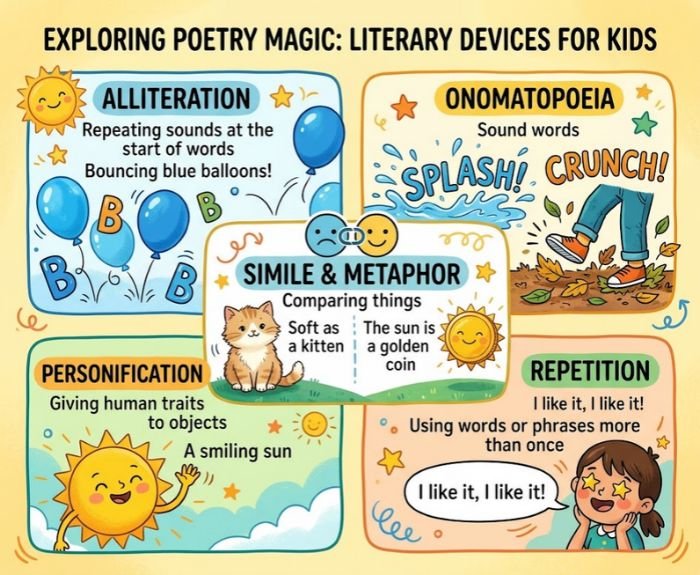
Literary devices sound grown up, but children use them naturally in play. Here are the ones that work best in children’s poetry:
- Alliteration: repeated starting sounds, like “bouncing blue balloons”
- Onomatopoeia: sound words, like splash, zoom and crunch
- Simile: a comparison using “like” or “as”, such as “soft as a kitten”
- Metaphor: saying one thing is another, such as “the moon is a lantern”
- Personification: giving human traits to objects, like a smiling sun
- Hyperbole: playful exaggeration, such as “a million sneezes”
- Repetition: returning to a favourite word or line
- Nonsense words: invented words that make the sound the star
Popular Themes in Children’s Poetry
Themes keep poems close to a child’s world. These are the most loved:
- Animals and insects
- Seasons, weather and nature
- Family, grandparents and home
- School and friendship
- Food and funny habits
- Bedtime and dreams
- Fantasy, dragons and monsters
- Feelings such as joy, fear and pride
- Festivals and celebrations
5 Classic 2 Lines Children’s Poetry
Couplets are the easiest way to introduce children’s poetry to toddlers and early readers. These original verses use the gentle, old fashioned style that parents know well.
✦ The Little Star
A tiny star above the hill
Keeps watch while all the world is still.
✦ Morning
The sun peeps up, the birds all sing,
A brand new day is on the wing.
✦ The Rain
Pitter, patter, on the pane,
Little drops come down again.
✦ My Garden
Seeds in soil, soft and deep,
Wake up slowly from their sleep.
✦ Bedtime
Close your eyes, the day is done,
Sweet dreams wait for everyone.
5 Funny 2 Lines Children’s Poetry
Humour is the fastest way to win over a reluctant reader. Try these silly couplets.
✦ The Sneeze
My grandpa sneezed a thunder sneeze
And sent the cat up in the trees.
✦ Spaghetti Hat
I wore my noodles as a hat,
Now Mum is cross, and so’s the cat.
✦ The Burp
I burped so loud in maths today,
The teacher’s chalk just flew away.
✦ Dog Homework
My dog ate all my homework, true,
Now he knows fractions better than you.
✦ Missing Socks
One sock is missing, who can say?
The washing machine ran away.
8 Short Poems of 4 Lines of Children’s Poetry
Four line verses are perfect for classroom recitals, bedtime reading and first writing attempts. They are short enough to memorise in one sitting, which makes them a favourite format in children’s poetry.
✦ The Friendly Moon
The moon is a lantern hung up in the night,
It follows our car with its soft, silver light,
It peeks through the curtains and watches me yawn,
Then slips off to bed when it’s nearly dawn.
✦ Little Ladybird
Little ladybird, red and round,
Walking on the leaf’s green ground,
Count your spots and spread your wings,
Fly away to see new things.
✦ Rainy Day Boots
My yellow boots go splish and splash,
Through puddles deep with a happy crash,
The rain can pour, I do not mind,
I leave the grumpy clouds behind.
✦ The Bus Ride
The big bus rumbles down the lane,
The wipers swish against the rain,
The windows hum, the seats go bump,
We stop, we start, we jiggle, jump.
✦ My Shadow
My shadow walks along with me,
As tall as any giant tree,
It stretches long, then shrinks at noon,
And vanishes beneath the moon.
✦ Grandma’s Kitchen
Grandma’s kitchen smells of spice,
Warm bread, jam and something nice,
Stirring spoons and flour clouds,
Hugs that make us giggle loud.
✦ The Snail Race
Slowly, slowly, snail by snail,
They slide along the garden trail,
The race began at half past three,
It ends in time for next week’s tea.
✦ Night Owl
The owl is awake when the stars come out,
She swoops and she hoots as she flies about,
She hoots a hush to the sleepy street,
And watches the dreams as they dance on their feet.
8 Best Poetry of 4 Lines on Children’s Day
Children’s Day is marked on different dates around the world, including 14 November in India and 20 November as Universal Children’s Day. Schools often hold recitals, so a short verse is always welcome. These original poems fit any celebration.
✦ Hooray for Us
Today the whole wide world is ours,
With laughing kites and paper flowers,
So jump and sing and chase the sun,
For every child isloved by everyone.
✦ Little Dreamers
Little dreamers, big and bright,
Chase your stars and hold on tight,
Every wish that you have made
Grows in sunshine, grows in shade.
✦ Seeds of Tomorrow
Children are the seeds we sow,
In kindness they will bloom and grow,
Give them love and give them air,
And they will lift the world with care.
✦ Balloon Day
Red balloons float to the sky,
Cheerful voices, flying high,
Cake and games and laughter too,
Children’s Day is made for you.
✦ Hand in Hand
Hand in hand we walk to school,
Learning is the golden rule,
Share your smile and share your toy,
Spread around a little joy.
✦ Be Brave
Be brave enough to ask and try,
Be kind to all who pass you by,
Be curious as the sky is wide,
And keep your dreams right by your side.
✦ A Wish for Every Child
May every child have food and rest,
A school to learn, a home that’s blessed,
A friend to share the games they play,
And hope to greet each brand new day.
✦ Colours of Childhood
Paint the day in red and blue,
Let your giggles shine right through,
Childhood is a splendid ride,
Enjoy it now with joy and pride.
10 Famous Children’s Poetry Books
Great books make children’s poetry a daily habit. This list mixes classics with modern favourites, including titles recommended by libraries and publishers. tcplpanmacmillan
| Book | Poet | Best For |
|---|---|---|
| Where the Sidewalk Ends | Shel Silverstein | Funny, quirky verse |
| A Child’s Garden of Verses | R. L. Stevenson | Classic bedtime reading |
| When We Were Very Young | A. A. Milne | Gentle, playful rhymes |
| Revolting Rhymes | Roald Dahl | Older readers who love twists |
| My Dog May Be a Genius | Jack Prelutsky | Laugh out loud poems |
| Come with Me: Poems for a Journey | Naomi Shihab Nye | Thoughtful, reflective reading |
| Poetry for Young People: Langston Hughes | Edited by Arnold Rampersad | Rhythm and culture |
| This Is Home | Selected by Jackie French | Australian poems |
| The Magic Box | Kit Wright | Imagination games |
| Crazy Mayonnaisy Mum | Julia Donaldson | Read aloud fun |
Children’s Poetry Books Online
You no longer need a big shelf to enjoy children’s poetry. Many reliable sources offer poems online:
- Public libraries: Most offer free ebooks and audiobooks through lending apps.
- Free Kids Books: This site lets readers download or read online collections, including poetry for children and young adults.
- Publisher websites: Many share sample poems and recommended reading lists.
- School platforms: Teachers often upload poem packs and worksheets.
- Audio platforms: Hearing poems performed helps children feel the rhythm.
How to Download Free Children’s Poetry Books PDF
Downloading free children’s poetry books is simple when you stick to legal sources. Follow these steps.
- Search a trusted library such as Project Gutenberg, Open Library or Internet Archive for classic poets whose work is in the public domain.
- Visit Free Kids Books and filter by the poetry subject.
- Check the licence on the page. Look for “public domain” or “free to share”.
- Choose the PDF button and save the file to your device.
- Open the file in a PDF reader and print favourite pages for classroom use.
- Avoid pirate sites. They break copyright and often carry viruses.
Newer books by living poets are usually not free, so borrow them from a library instead.
Gabriel Rosenstock and Children’s Poetry
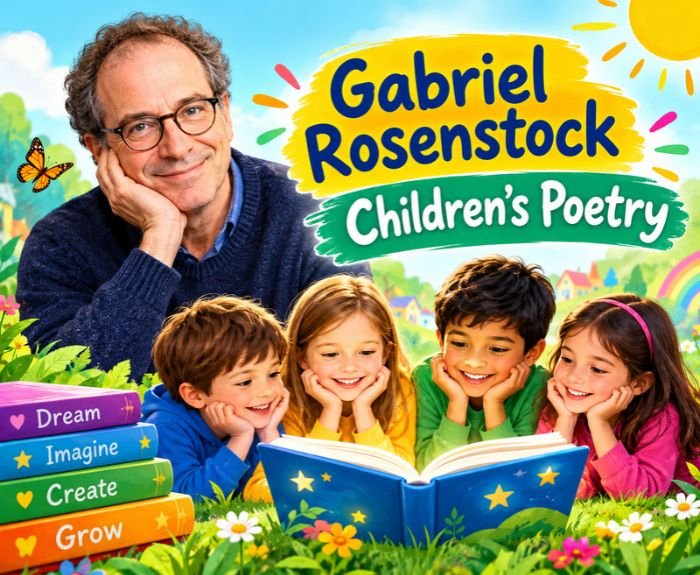
Gabriel Rosenstock is one of Ireland’s best loved poets. He received the 2023 Children’s Books Ireland award for his outstanding contribution, and he writes in both Irish and English. His titles include The Confessions of Henry Hooter the Third, a rhyming collection for owlish children. limerickpost
His work is a fine example of how flexible children’s poetry can be. His Micropoems collection offers very short poems, many only two lines long, inspired by artworks and suited to ages seven to ten and beyond. He has also written haiku for young readers, and several of his books are available free through Free Kids Books. In his own notes, he explains that older children may enjoy a looser, more irregular rhythm than the bouncy rhyme preferred by little ones. nlifreekidsbooks
Australian Children’s Poetry
Australian children’s poetry is full of bush landscapes, wildlife, humour and warm family stories. A good starting point is This Is Home, selected by Jackie French. It gathers poems from Oodgeroo Noonuccal, Henry Lawson, Alison Lester, Andy Griffiths and Shaun Tan. betterreading
Poetry also gets a boost from the national Laureate program. The Australian Children’s Laureate began in 2011 for the 2012 to 2013 term, with Alison Lester and Boori Monty Pryor as the first joint laureates. The role exists to promote reading, and many laureates champion verse in schools. Wikipedia
Children’s Poetry Competition 2025 and 2026
Many readers search for a children’s poetry competition 2025. Those deadlines have now passed, but similar contests return every year. These recent examples show what to expect, so check each official site for current dates and rules.
- BBC and Latitude Festival competition: for children aged 7 to 11, with poems of up to 200 words on the 2026 theme of Generations. latitudefestival
- Whispering Wisdom contest: free to enter, with Under 12 and Under 18 categories and a limit of 12 lines. southbankcentre
- Chiswick Young Poets: open to school Years 3 to 7, with poems up to 25 lines that must be the child’s own work. chiswickbookfestival
- Caterpillar Poetry Prize: awarded for a poem written for children aged 7 to 11, aimed at adult poets. writers-online
- International Poetry Book Awards: added a new Children’s Poetry Book Prize in 2026. welshpoetry
Children’s Poetry Contest: Tips to Win
Every children’s poetry contest has its own rules, but good habits help in all of them.
- Read the guidelines twice and respect the line or word limit.
- Match the theme, but add a personal twist.
- Use one strong image instead of many weak ones.
- Pick fresh rhymes. Avoid “love” and “dove” unless you surprise the reader.
- Read the poem aloud to a friend and listen for clunky lines.
- Keep the title short and memorable.
- Ask an adult to check spelling, but keep every idea your own.
Tips for Parents and Teachers
Sharing children’s poetry at home or in class needs no special training. Try these simple ideas:
- Read one poem aloud each day, ideally at the same time.
- Clap or stomp the rhythm together.
- Act out funny poems with voices and gestures.
- Let children illustrate their favourite lines.
- Make a poetry corner with books and printed poems.
- Invite kids to change one word and create a new version.
Conclusion
Children’s poetry gives young readers a safe, joyful space to play with language. It builds literacy, grows imagination and helps children understand their own feelings. From two line giggles to four line Children’s Day verses, there is a poem for every mood.
Start small, read aloud and let children lead. Whether you are choosing famous books, entering a contest or writing your own verses, children’s poetry rewards curiosity every time.
Frequently Asked Questions About Children’s Poetry
What is children’s poetry?
It is rhythmic, playful verse written for or enjoyed by young readers, often using rhyme and repetition.
What is the purpose of children’s poetry?
It builds literacy, imagination and emotional skills while making language fun.
How do you write children’s poetry?
Choose a simple topic, find a beat, use playful sounds, keep lines short and read the poem aloud.
What are the elements of children’s poetry?
The main elements are rhyme, rhythm, repetition, imagery, humour, theme and sound play.
Which literary devices suit children’s poetry?
Alliteration, onomatopoeia, simile, metaphor, personification and repetition work best.
What are some famous children’s poetry books?
Popular choices include Where the Sidewalk Ends, A Child’s Garden of Verses, Revolting Rhymes and The Magic Box.
Where can I find children’s poetry books online?
Try public library apps, Free Kids Books, Project Gutenberg and Open Library.
How do I download free children’s poetry books PDF?
Use legal sites with public domain or free to share licences, then choose the PDF download option.
Is there a children’s poetry competition every year?
Yes, many schools, festivals and publishers run annual contests, so check official websites for new dates.
Who is Gabriel Rosenstock?
He is an Irish poet who writes for children in Irish and English and has won a major Irish children’s books award.
What is Australian children’s poetry known for?
It is known for bush settings, wildlife, humour and a strong tradition of celebrated poets and laureates.
What age should children start reading poetry?
Right from birth. Babies enjoy the rhythm of nursery rhymes long before they understand the words.