
Read a nursery rhyme out loud and you’ll feel it before you can explain it, that little bounce in your voice, the way certain words seem to land harder than others. That bounce is rhythm, and it’s one of the oldest tools poets have used to make language memorable.
Rhythm is the heartbeat of a poem. Literally many readers compare the steady da-DUM, da-DUM of iambic pentameter to a pulse. It’s the reason a lullaby feels soothing, a war chant feels urgent, and a limerick makes you smile before you’ve even understood the joke.
In this guide, you’ll learn what rhythm in poetry actually means, how it differs from meter, the 15+ types and patterns poets rely on, and dozens of real examples including simple ones for students and kids. By the end, you’ll be able to spot rhythm in any poem, and maybe even hear it in your own writing.
What Is Rhythm in Poetry? (Meaning)
Rhythm in poetry refers to the pattern of stressed and unstressed syllables, pauses, and repeated sounds that create the “beat” of a poem when it’s read aloud. It’s the musical quality of language, the rise and fall you hear even before you understand the words.
Think of rhythm like the waves at a beach. Some waves crash in a steady, predictable pattern (that’s regular rhythm), while others roll in unevenly, one big and one small (that’s irregular or free-verse rhythm). Either way, you can feel the motion.
Rhythm comes from several ingredients working together:
- Stressed and unstressed syllables — the emphasis placed on certain sounds
- Line length and word choice — short, punchy words speed things up; long words slow them down
- Pauses — caused by punctuation, line breaks, or natural breath points
- Repetition — of sounds, words, or phrases
When these elements combine in a consistent, countable pattern, we call that pattern meter. When they combine more loosely, following the natural cadence of speech, we simply call it rhythm.
Read Also This Blog: William Wordsworth Poetry
Importance of Rhythm in Poetry
Rhythm isn’t decoration — it’s structural. It shapes how a poem feels before the reader even processes its meaning, much like a film score sets the mood before a single line of dialogue is spoken.
Here’s why rhythm matters so much to poets:
- It controls mood and pace. A fast, tumbling rhythm can create excitement or panic; a slow, drawn-out rhythm can create calm or sorrow.
- It makes poems memorable. Rhythmic patterns act like musical hooks, which is why nursery rhymes and song lyrics stick in our heads for years.
- It reinforces meaning. A galloping rhythm in a poem about a horse (like a hoofbeat) mirrors the subject matter itself.
- It creates emphasis. Stressed syllables naturally draw the reader’s attention to key words and ideas.
- It distinguishes poetry from prose. While prose has a loose rhythm too, poetry organizes it far more deliberately.
Imagine reading a poem about a train with a slow, meandering rhythm, it would feel wrong, almost like watching a chase scene set to lullaby music. That mismatch is exactly what skilled poets avoid.
Meter vs. Rhythm in Poetry
People often use “meter” and “rhythm” interchangeably, but they aren’t quite the same thing. Think of meter as sheet music and rhythm as the actual performance — a skilled musician might play the notes but add their own swing, pauses, and feeling. That’s the relationship between meter and rhythm in a poem.
| Aspect | Rhythm | Meter |
|---|---|---|
| Definition | The overall flow and beat of a poem’s sound | A specific, countable pattern of stressed/unstressed syllables |
| Regularity | Can be regular or irregular | Follows a fixed, repeating structure |
| Found in | All poetry, including free verse | Mostly formal or traditional poetry |
| How it’s measured | Felt by ear, harder to count | Measured in “feet” (iamb, trochee, etc.) |
| Example | The natural cadence of spoken language | Iambic pentameter, trochaic tetrameter |
Simple way to remember it: meter is the blueprint; rhythm is the finished building. Every building built from the same blueprint still looks and feels slightly different — and every poem in the same meter still has its own unique rhythm.
Types of Rhythm in Poetry (15+ Patterns)
Poetic rhythm is built from small units called feet — each one a specific combination of stressed (/) and unstressed (x) syllables. Combine feet with line length, and you get a huge variety of rhythmic patterns. Below are the major types you’ll encounter.
1. Iamb (Iambic Rhythm)
An unstressed syllable followed by a stressed one (da-DUM), like the word “a–live.” It mimics the natural rhythm of English speech, which is why it’s the most common pattern in the language — almost like the default walking pace of poetry.
Example: “Shall I compare thee to a summer’s day?” — Shakespeare, Sonnet 18
2. Trochee (Trochaic Rhythm)
A stressed syllable followed by an unstressed one (DUM-da), like the word “gar-den.” It creates a falling, almost marching feel — like a drumbeat that starts strong and tapers off.
Example: “Double, double toil and trouble” — Shakespeare, Macbeth
3. Anapest (Anapestic Rhythm)
Two unstressed syllables followed by a stressed one (da-da-DUM), like “in-ter-vene.” This rhythm gallops — think of a horse cantering across a field.
Example: “‘Twas the night before Christmas, when all through the house“
4. Dactyl (Dactylic Rhythm)
A stressed syllable followed by two unstressed ones (DUM-da-da), like “hap-pi-ly.” It has a tumbling, waltz-like quality — one-two-three, one-two-three.
Example: “This is the forest primeval” — Longfellow, Evangeline
5. Spondee (Spondaic Rhythm)
Two stressed syllables in a row (DUM-DUM), like “heart–break.” Spondees interrupt the flow like a sudden stop sign, adding weight and emphasis.
Example: “Break, break, break / On thy cold gray stones, O Sea!” — Tennyson
6. Pyrrhic Rhythm In Poetry
Two unstressed syllables together, with almost no emphasis on either. It’s rare on its own but softens a line, like a quiet breath between louder beats.
Metrical Line Lengths
Once you know the “foot,” you combine it with how many times it repeats per line:
| Line Length | Number of Feet | Example Name |
|---|---|---|
| Monometer | 1 | Iambic monometer |
| Dimeter | 2 | Trochaic dimeter |
| Trimeter | 3 | Iambic trimeter |
| Tetrameter | 4 | Trochaic tetrameter |
| Pentameter | 5 | Iambic pentameter |
| Hexameter | 6 | Dactylic hexameter |
| Heptameter | 7 | Iambic heptameter |
| Octameter | 8 | Trochaic octameter |
7. Regular Rhythm In Poetry
A pattern that repeats consistently throughout a poem, like a metronome ticking at a fixed pace. Formal poems — sonnets, ballads, odes — often use regular rhythm to create a sense of order and control.
8. Irregular Rhythm In Poetry
A pattern that shifts and varies, refusing to settle into one predictable beat — much like jazz music bending and breaking a steady tempo on purpose. This creates surprise and mirrors messy, real emotion.
9. Free Verse Rhythm In Poetry
Poetry with no fixed meter or rhyme scheme at all. It follows the natural rhythm of speech instead, like a conversation rather than a song. Walt Whitman’s “Leaves of Grass” and much of modern poetry use this style.
10. Cadence
The natural rise and fall of language, shaped by word choice and sentence structure rather than a strict metrical count. Cadence is what gives free verse its music even without formal rules — similar to the way a skilled speaker’s voice naturally rises and falls during a speech.
11. Sprung Rhythm In Poetry
A technique pioneered by Gerard Manley Hopkins, where only the stressed syllables are counted, and any number of unstressed syllables can appear between them. It mimics the unpredictable rhythm of natural speech, like someone talking excitedly and skipping over small words.
12. Running (Common) Rhythm In Poetry
A rhythm in which stressed and unstressed syllables alternate consistently — essentially another name for standard duple meter, like iambic or trochaic patterns.
13. Rising Rhythm In Poetry
Rhythm that moves from unstressed to stressed syllables (like iambs and anapests), creating a feeling of building energy — like climbing a staircase toward a high note.
14. Falling Rhythm In Poetry
Rhythm that moves from stressed to unstressed syllables (like trochees and dactyls), creating a feeling of release or descent — like stepping down a staircase.
15. Double Rhythm In Poetry
Rhythm built from two-syllable feet, such as iambs and trochees. It’s the most common rhythmic base in English poetry.
16. Triple Rhythm In Poetry
Rhythm built from three-syllable feet, such as anapests and dactyls, producing a lighter, more musical, sing-song quality — think of a nursery rhyme’s bounce.
Sound and Rhythm in Poetry
Rhythm doesn’t work alone — it’s reinforced by other sound devices that act like backup singers supporting the lead melody:
- Alliteration — repeating consonant sounds (“wild and windy night”) that add punch and pace
- Assonance — repeating vowel sounds that create internal music
- Rhyme — matching end sounds that reinforce the beat and make lines feel connected
- Onomatopoeia — words that sound like what they mean (“buzz,” “clang”), adding texture to the rhythm
- Repetition — repeated words or phrases that act like a recurring drumbeat
Together, sound and rhythm turn a poem into something closer to music than plain speech — which is exactly why so many poems are easy to set to melody.
Examples of Rhythm in Poetry
Here are some well-known examples that showcase different rhythmic patterns in action.
| Poem | Poet | Rhythm/Meter |
|---|---|---|
| Sonnet 18 | William Shakespeare | Iambic pentameter |
| The Charge of the Light Brigade | Alfred, Lord Tennyson | Dactylic dimeter |
| The Raven | Edgar Allan Poe | Trochaic octameter |
| The Tyger | William Blake | Trochaic tetrameter |
| Twas the Night Before Christmas | Clement Clarke Moore | Anapestic tetrameter |
| Leaves of Grass | Walt Whitman | Free verse / cadence |
| The Windhover | Gerard Manley Hopkins | Sprung rhythm |
In Poe’s “The Raven,” the heavy trochaic beat (“Once upon a midnight dreary”) feels like a slow, ominous knock — fitting for a poem about grief and dread. Meanwhile, “Twas the Night Before Christmas” gallops along in anapests, giving it a light, storytelling bounce perfect for children.
Examples of Rhythm in Poetry for Students
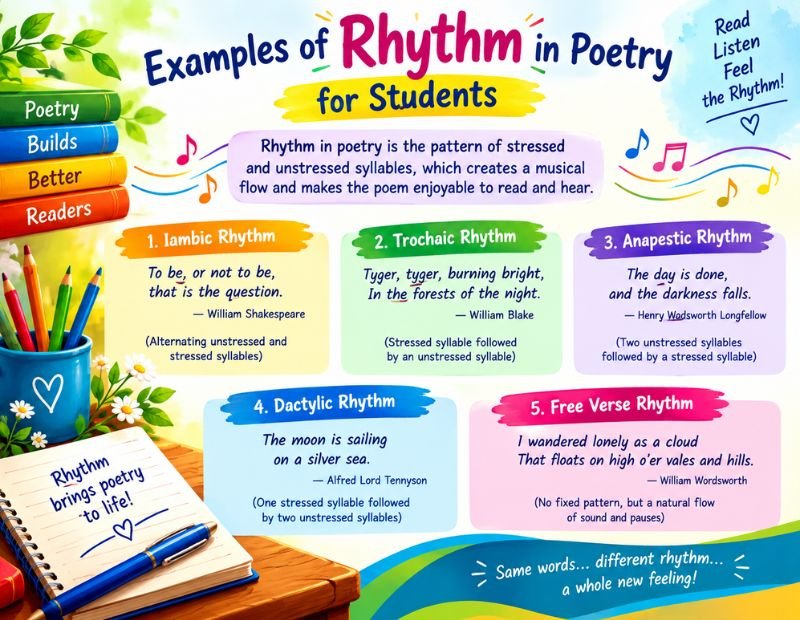
For students learning to identify rhythm, it helps to start with short, clear examples where the beat is easy to tap out.
- “Double, double toil and trouble” — trochaic rhythm, strong and marching.
- “I wandered lonely as a cloud” (Wordsworth) — iambic tetrameter, smooth and flowing like a gentle walk.
- “The sun was shining on the sea” (Lewis Carroll) — iambic rhythm, steady and calm like waves lapping a shore.
- Limericks — almost always anapestic, giving them their signature bouncy, comedic feel.
Classroom tip: Try clapping out the syllables of a line. The claps that land harder are the stressed beats — this is the simplest way to “hear” rhythm before naming it.
Examples of Rhythm in Poetry for Kids
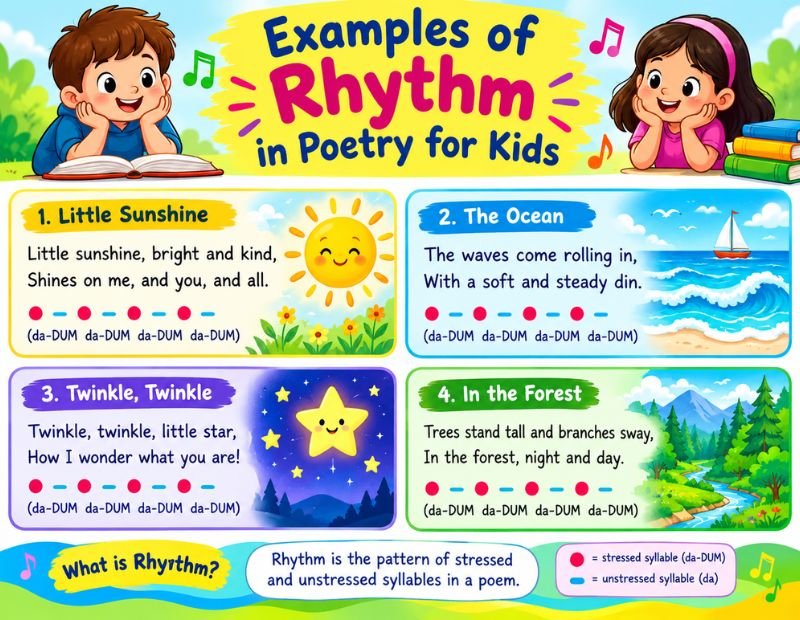
Rhythm is often easiest to spot in nursery rhymes, where the beat is exaggerated almost like a sing-song chant.
- “Twinkle, Twinkle, Little Star” — a steady, rocking trochaic rhythm, like a gentle lullaby swing.
- “Jack and Jill went up the hill” — a bouncy rhythm that mimics actual climbing and tumbling.
- “Hickory Dickory Dock” — a quick, ticking rhythm that mirrors a clock, almost onomatopoeic in feel.
- “Row, Row, Row Your Boat” — a rhythm that rocks back and forth like an actual boat on water.
These poems use rhythm the same way a parent uses a rocking motion to soothe a baby — predictable, repetitive, and comforting.
How to Identify Rhythm in a Poem?
If you’re analyzing a poem for class or for fun, follow these simple steps:
- Read it aloud. Rhythm is meant to be heard, not just seen on the page.
- Mark the stressed syllables. Use a
/for stressed andxfor unstressed sounds. - Group the syllables into feet. Look for repeating two- or three-syllable patterns.
- Count the feet per line. This tells you the meter (tetrameter, pentameter, etc.).
- Notice the pauses. Look for commas, line breaks, and full stops that slow or speed the rhythm.
- Compare rhythm to meaning. Ask why the poet chose a fast or slow, regular or broken pattern for this particular subject.
Rhythm in Poetry Crossword Clue
If you’ve landed here searching for a crossword answer, “rhythm in poetry” clues usually point to words like METER, BEAT, CADENCE, or METRE (British spelling), depending on the number of letters required. Always check the letter count in your puzzle grid, since crosswords often expect the shorter, more common term.
Conclusion
Rhythm is what turns arranged words into music. Whether it’s the disciplined beat of iambic pentameter in a Shakespearean sonnet, the galloping anapests of a holiday poem, or the loose, speech-like cadence of free verse, rhythm shapes how a poem feels in the body as much as the mind. Once you learn to hear stressed and unstressed syllables, feel the pauses, and notice the patterns, you’ll never read a poem the same way again — you’ll feel its pulse.
Frequently Asked Questions
What is rhythm in poetry in simple words?
Rhythm is the beat or flow created by stressed and unstressed syllables when a poem is read aloud.
Rhythm in poetry refers to what exactly?
It refers to the patterned arrangement of sound, stress, and pauses that give a poem its musical quality.
What is the main difference between meter and rhythm?
Meter is a fixed, countable pattern of stresses, while rhythm is the overall flow of sound, which can be regular or free.
What are the 4 most common types of rhythm in poetry?
The four most common are iambic, trochaic, anapestic, and dactylic rhythm, based on stress patterns within each foot.
Does free verse poetry have rhythm?
Yes — free verse lacks a fixed meter but still has rhythm through natural speech cadence, word choice, and pauses.
Why is rhythm important in poetry?
Rhythm sets the mood, makes poems memorable, and reinforces meaning by matching sound to subject matter.
What is an easy example of rhythm in poetry for kids?
Nursery rhymes like “Twinkle, Twinkle, Little Star” use a simple, repeating rhythm that’s easy for children to clap along to.
What does “regular rhythm” mean in poetry?
Regular rhythm means the stressed and unstressed syllable pattern repeats consistently throughout the poem.
What word answers a “rhythm in poetry” crossword clue?
Common crossword answers include METER, BEAT, or CADENCE — check your grid’s letter count to confirm.