
Storytelling is as old as language itself, and long before novels existed, people told their stories through verse. That tradition is called narrative poetry, and it remains one of the richest, most enduring forms of literature today. Whether you are a student, a teacher, or simply a poetry lover, understanding narrative poetry opens the door to some of the greatest works ever written, from Homer’s epics to modern verse novels.
In this guide, you will learn what narrative poetry means, how it developed, its major types, its key elements, and how to write your own. You will also find 20+ examples, a comparison with lyric poetry, book recommendations, and a helpful FAQ section built for quick answers.
What Is Narrative Poetry? Meaning Explained
Narrative poetry is a form of poetry that tells a complete story using poetic devices such as rhyme, rhythm, meter, and figurative language. Unlike a short story or novel written in prose, a narrative poem tells its tale through verse while still including the essential ingredients of storytelling.
A true narrative poem generally includes:
- A clear plot with a beginning, middle, and end 📖
- One or more characters who drive the action 🧍
- A defined setting where events unfold 🌍
- A narrator or speaker who tells the story 🗣️
- Conflict, tension, or a central problem to resolve ⚔️
In simple words, narrative poetry blends the emotional depth and musicality of poetry with the structure and sequence of a story. It stands apart from lyric poetry, which focuses purely on personal feeling rather than plot.
Read Also This Blog: Tone in Poetry
Narrative Poetry History
Narrative poetry is often called the oldest form of literature. Long before writing existed, oral storytellers used rhyme, repetition, and rhythm to make long stories easier to memorize and pass down through generations.
Some historical milestones include:
- Ancient origins: Epics like The Epic of Gilgamesh, Homer’s The Iliad and The Odyssey, and The Mahabharata date back thousands of years and were originally performed aloud.
- Medieval period: Poets such as Geoffrey Chaucer popularized narrative poetry in English through works like The Canterbury Tales, a collection of 24 linked narrative poems.
- Romantic and Victorian eras: Poets like Samuel Taylor Coleridge and Alfred, Lord Tennyson used ballads and idylls to tell dramatic and pastoral stories.
- Modern era: Contemporary poets have moved away from strict rhyme and meter, often writing narrative poems in free verse, including full length novels in verse.
This long history shows how narrative poetry evolved from a memory tool for oral cultures into a flexible literary art form still used by poets today.
How To Write Narrative Poetry?
Writing a narrative poem is easier when you break it into clear steps. Here is a simple process any beginner can follow.
- Choose your story idea – Pick a real or fictional event with enough drama or emotion to sustain a poem 💡
- Decide on your narrator – Choose first person, third person, or an outside observer 🎙️
- Outline plot structure – Map out the beginning, rising action, climax, and resolution 🗺️
- Select a poetic form – Ballad, free verse, blank verse, or another structure that fits your story 🖋️
- Add poetic devices – Use imagery, metaphor, alliteration, and rhythm to enhance the storytelling ✨
- Develop characters briefly – Even short poems benefit from vivid, memorable characters 🎭
- Revise for flow and clarity – Read the poem aloud to check pacing and musicality 🔁
Unlike prose, every word in a narrative poem must carry weight, so revision and word choice matter enormously.
Types Of Narrative Poetry
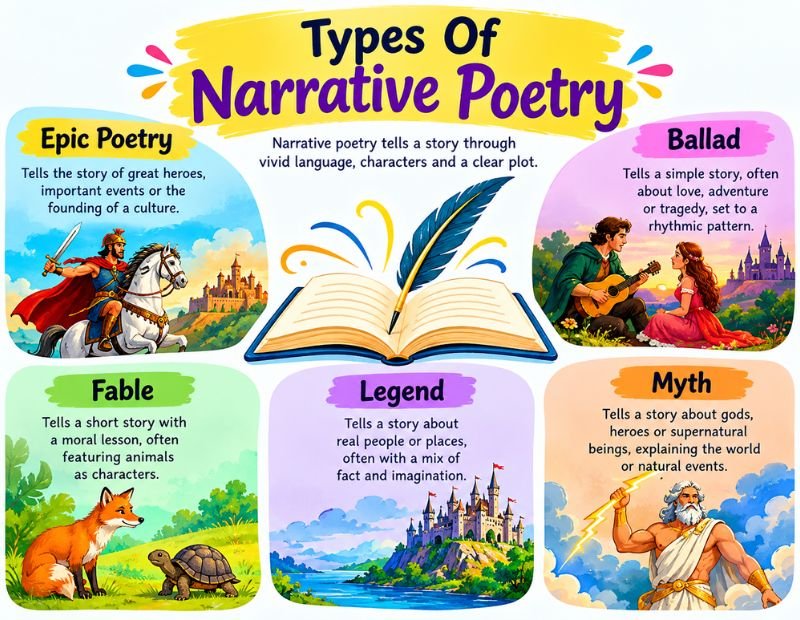
Narrative poetry includes several distinct subtypes, each with its own history and style. Below is a breakdown of the most common types.
| Type | Description | Famous Example |
|---|---|---|
| Epic | Long poem detailing a hero’s journey, war, or nation’s history | The Odyssey by Homer |
| Ballad | Shorter, rhythmic poem, often sung, telling a dramatic tale | “The Rime of the Ancient Mariner” by Coleridge |
| Idyll | Pastoral poem focused on idealized rural or peaceful life | “Idylls of the King” by Tennyson |
| Lay | Short poem about romance, adventure, or chivalry | “The Franklin’s Tale” by Chaucer |
| Verse Novel | Full length novel told entirely in poetic verse | Autobiography of Red by Anne Carson |
| Metrical Romance | Poem involving knights, adventure, and supernatural events | Arthurian legends |
| Dramatic Narrative | Story told through dialogue between characters | “Out, Out—” by Robert Frost |
Each type shares the same storytelling core but differs in length, tone, and structural rules.
20+ Narrative Poetry Examples
Here is a list of well known narrative poems worth reading, spanning centuries and styles.
- “The Iliad” by Homer 🏛️
- “The Odyssey” by Homer 🌊
- “Beowulf” by an anonymous poet ⚔️
- “The Canterbury Tales” by Geoffrey Chaucer 🛤️
- “The Rime of the Ancient Mariner” by Samuel Taylor Coleridge 🚢
- “Idylls of the King” by Alfred, Lord Tennyson 👑
- “The Highwayman” by Alfred Noyes 🐎
- “The Raven” by Edgar Allan Poe 🐦
- “Casey at the Bat” by Ernest Lawrence Thayer ⚾
- “The Eve of St. Agnes” by John Keats 🕯️
- “Paul Revere’s Ride” by Henry Wadsworth Longfellow 🔔
- “The Charge of the Light Brigade” by Alfred, Lord Tennyson 🐴
- “Sohrab and Rustum” by Matthew Arnold 🗡️
- “The Ring and the Book” by Robert Browning 📜
- “Out, Out—” by Robert Frost 🪚
- “A Dream” by William Blake 🌙
- “The Song of Hiawatha” by Henry Wadsworth Longfellow 🪶
- “Enoch Arden” by Alfred, Lord Tennyson ⚓
- “Autobiography of Red” by Anne Carson 🔥
- “Evangeline” by Henry Wadsworth Longfellow 💔
- “The Lady of Shalott” by Alfred, Lord Tennyson 🏰
These poems represent nearly every type discussed above, from ancient epics to modern verse novels.
Characteristics Of Narrative Poetry
Certain traits define narrative poetry across cultures and time periods.
- Strong emphasis on storytelling over abstract emotion 📚
- A clearly identifiable narrator or speaker 🗣️
- Presence of dialogue in many poems 💬
- Use of poetic devices like meter, rhyme, and imagery 🎨
- Often non linear, jumping between time periods or events ⏳
- Frequently rooted in myth, history, or heroic tradition 🏺
Elements Of Narrative Poetry
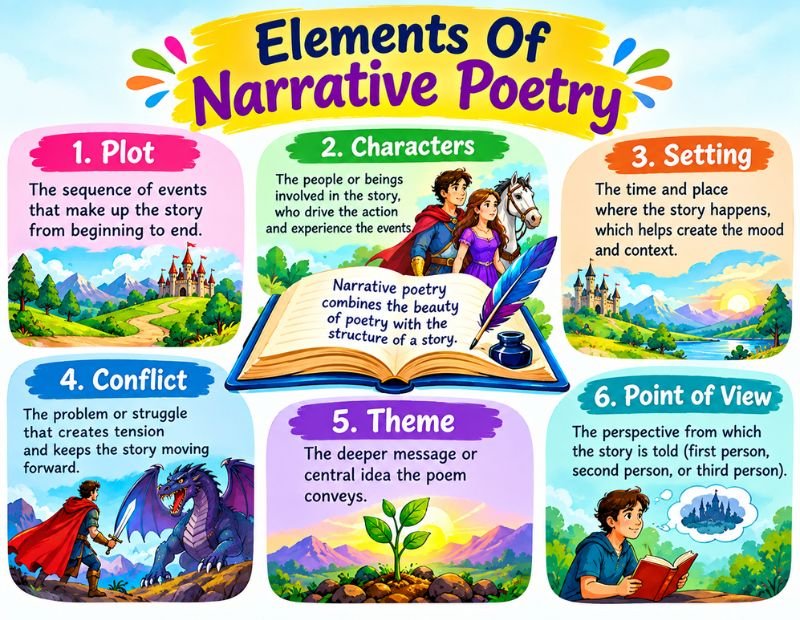
Every narrative poem, regardless of type, tends to include these core building blocks.
| Element | Function in the Poem |
|---|---|
| Narrator | Tells the story, may or may not be the poet |
| Plot | Sequence of events forming the story |
| Setting | Time and place where the story occurs |
| Characters | Individuals who drive the action forward |
| Conflict | The central problem or tension |
| Theme | The underlying message or idea |
| Poetic Devices | Rhyme, meter, imagery, symbolism, alliteration |
Effects Of Narrative Poetry
Narrative poetry does more than entertain. It shapes how readers connect emotionally and culturally with a story.
- Preserves history and cultural memory through verse 🏛️
- Creates emotional impact through rhythm and sound 🎵
- Makes complex stories easier to remember and recite 🧠
- Builds empathy by placing readers inside a character’s journey ❤️
- Bridges the gap between oral tradition and written literature 🌉
Purpose Of Narrative Poetry
The core purpose of narrative poetry is to tell a story in a way that entertains, teaches, and preserves cultural or historical knowledge. In ancient societies, it served as a record of history before written language existed. Today, it continues to explore heroism, morality, love, and human experience through a musical, memorable format that plain prose cannot always achieve.
Lyric Poetry Vs Narrative Poetry
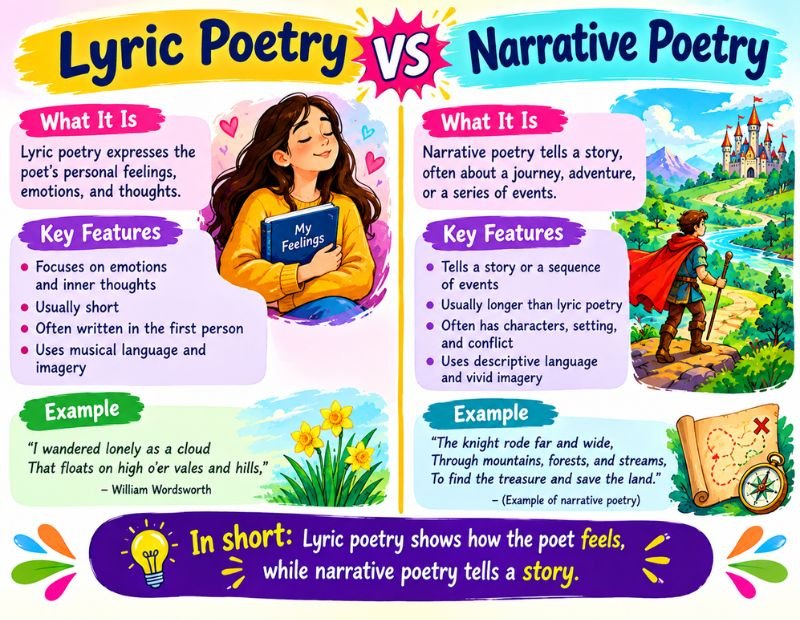
People often confuse these two major poetic traditions, so here is a simple comparison.
| Feature | Narrative Poetry | Lyric Poetry |
|---|---|---|
| Main Focus | Telling a story | Expressing personal emotion |
| Length | Often long | Usually short |
| Plot | Required | Not required |
| Narrator | Storyteller or character | The poet’s own voice |
| Example | “The Odyssey” | Shakespeare’s sonnets |
While these two forms differ, many poems blend elements of both, adding emotional depth to a storyline.
Ballad Narrative Poetry
The ballad is one of the most popular forms of narrative poetry. It typically:
- Uses four line stanzas with an ABAB rhyme scheme 🎶
- Alternates between stressed and unstressed syllables 🥁
- Tells a dramatic, often tragic or heroic story 🌩️
- Was traditionally passed down through song and oral performance 🎤
Famous examples include “The Rime of the Ancient Mariner” and “The Highwayman,” both known for their musical, sing song quality.
Narrative And Dramatic Poetry
Narrative poetry and dramatic poetry often overlap but are not identical. Narrative poetry focuses on a narrator recounting events, while dramatic poetry emphasizes character voice, often through monologue or dialogue, closely resembling theatrical performance. Poems like “Out, Out—” by Robert Frost show how narrative structure and dramatic tension can work together in a single piece.
5 Best Books With Poet Names For Narrative Poetry In English
- The Canterbury Tales by Geoffrey Chaucer 📘
- The Odyssey by Homer 📗
- Idylls of the King by Alfred, Lord Tennyson 📙
- Evangeline by Henry Wadsworth Longfellow 📕
- Autobiography of Red by Anne Carson 📔
5 Best Books With Poet Names For Narrative Poetry In Urdu
- Shahnama-e-Islam by Hafeez Jalandhari 📘
- Bang-e-Dra by Allama Iqbal 📗
- Zarb-e-Kaleem by Allama Iqbal 📙
- Kulliyat-e-Nazeer Akbarabadi by Nazeer Akbarabadi 📕
- Shikwa aur Jawab-e-Shikwa by Allama Iqbal 📔
Narrative Poetry PPT And Classroom Resources
Teachers and students often look for presentation ready material to summarize narrative poetry. A good narrative poetry PPT typically includes slides on definition, history, types, elements, examples, and a short quiz or crossword to reinforce learning. These visual aids work well alongside a narrative poetry crossword, which can test terms like ballad, epic, narrator, and stanza in a fun, interactive format.
Narrative Poetry Contest Ideas
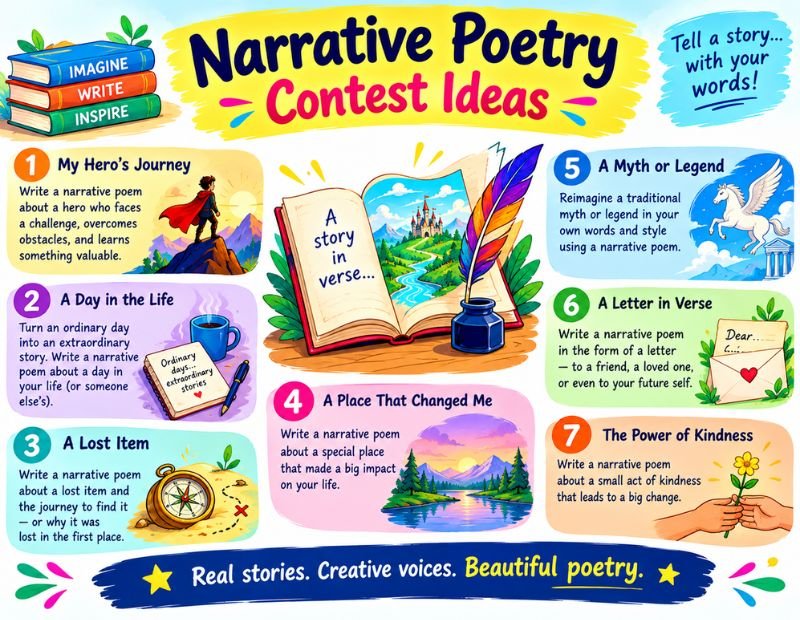
Schools and literary communities often host narrative poetry contests to encourage creative writing. A well structured contest usually includes:
- A clear theme or prompt to guide entries 🎯
- A word or line limit appropriate for the age group 📏
- Judging criteria based on storytelling, imagery, and structure 🏆
- Categories for different age groups or experience levels 🧑🎓
Frequently Asked Questions
What is narrative poetry in simple words?
Narrative poetry is poetry that tells a complete story with characters, setting, and plot, written in verse instead of prose.
What are the 4 main types of narrative poetry?
The four main types are epic, ballad, idyll, and lay, each with a different length, tone, and traditional purpose.
What is the difference between narrative and lyric poetry?
Narrative poetry tells a story with a plot, while lyric poetry expresses personal thoughts and emotions without requiring a storyline.
What are the elements of a narrative poem?
Key elements include a narrator, plot, setting, characters, conflict, theme, and poetic devices like rhyme and meter.
Who is known as the father of narrative poetry?
Homer is often credited as the father of narrative poetry because of his foundational epics, The Iliad and The Odyssey.
Is “The Raven” a narrative poem?
Yes, “The Raven” by Edgar Allan Poe is a classic narrative poem with a clear narrator, setting, and unfolding story.
What makes a good narrative poem?
A good narrative poem balances a compelling story with strong poetic devices, vivid imagery, and a clear narrative voice.
Conclusion
Narrative poetry remains one of the most powerful literary forms because it combines the emotional richness of poetry with the structure of storytelling. From ancient epics like The Odyssey to modern verse novels like Autobiography of Red, this form has continuously evolved while staying true to its core purpose: telling stories that move, teach, and endure. Whether you are studying it for class, writing your own poem, or simply exploring great literature, understanding its types, elements, and history gives you a deeper appreciation for the art of storytelling in verse.