
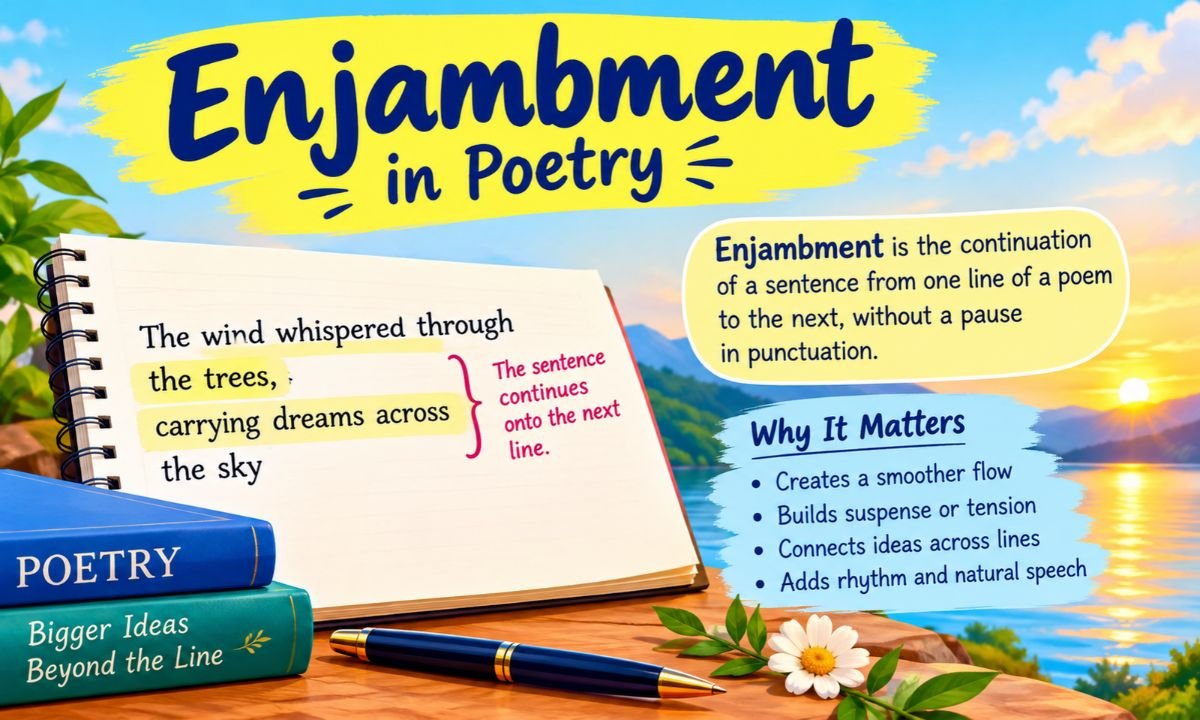
Poetry doesn’t always stop where a line ends. Sometimes a thought spills over, carrying momentum from one line into the next without pause. This technique is called enjambment, and it’s one of the most important tools poets use to create flow, tension, and surprise.
This guide covers everything you need to know about enjambment, its meaning, types, purpose, and real examples so you can spot it, understand it, and use it effectively in your own writing.
What Is Enjambment in Poetry?
Enjambment in poetry is a poetic technique where a sentence or phrase continues beyond the end of a line, without a pause, into the next line.
Key characteristics of enjambment in poetry:
- No punctuation at the end of the line.
- The thought or sentence “runs on” into the next line.
- Creates momentum and forward motion.
- Often used to build suspense or surprise.
The word “enjambment” comes from the French word enjamber, meaning “to straddle” or “to step over.” Just like the word suggests, enjambment “steps over” the line break, connecting two lines into one continuous thought.
Read Also This Blog: Caesura in Poetry
Why Is Enjambment Used in Poetry?
Poets use enjambment for several strategic reasons:
- To create momentum: The reader is pulled forward into the next line.
- To build suspense: Withholding key information until the next line.
- To mimic natural speech: Real thoughts don’t always pause at neat intervals.
- To create surprise: A word at the start of the next line can shift meaning.
- To avoid predictable rhythm: Breaking away from sing-song, end-stopped lines.
Without enjambment, poetry can feel rigid and overly structured. With it, poems gain a natural, flowing, almost conversational quality.
Is Enjambment Only Used in Poetry?
No. While enjambment is most associated with poetry, similar techniques appear in:
- Prose writing: Run-on sentences that carry momentum across paragraphs.
- Song lyrics: Lines that flow into the next without a natural pause.
- Screenwriting and dialogue: Interrupted or continuous speech patterns.
- Spoken word and rap: Lyrical flow that ignores traditional line breaks.
Essentially, any written or spoken form that relies on rhythm and pacing can use enjambment-like techniques, even outside traditional poetry.
How to Use Enjambment in Poetry?
Want to use enjambment effectively in your own writing? Follow these steps:
- Write your sentence naturally first, without worrying about line breaks.
- Choose where to break the line, ideally at a point that creates tension or curiosity.
- Avoid ending on punctuation if you want true enjambment.
- Place emphasis words at the start of the next line for impact.
- Read it aloud to check if the flow feels natural, not forced.
Pro Tip: The word placed right after the line break often carries extra weight, so choose it carefully.
Characteristics of Enjambment in Poetry
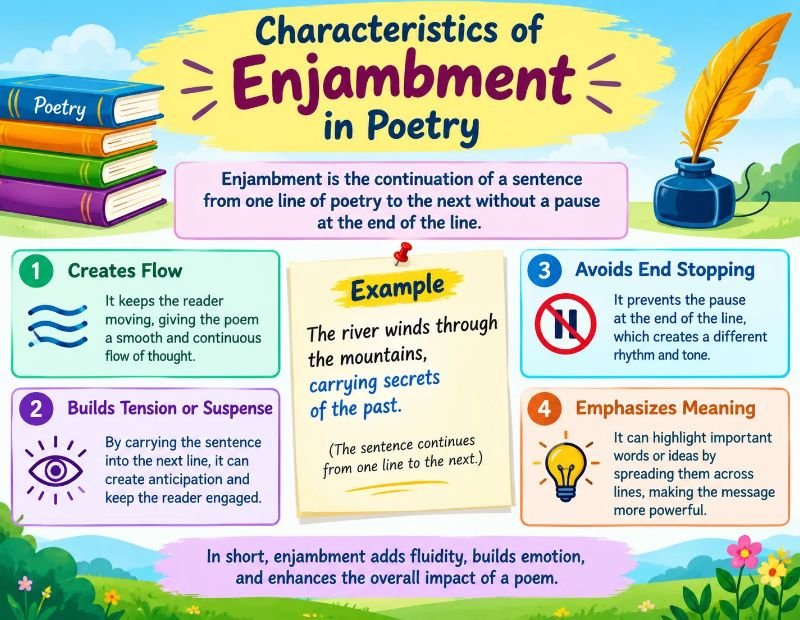
Here’s what defines true enjambment:
- The line ends without terminal punctuation (no period, comma, or semicolon).
- The grammatical sentence continues into the next line.
- Creates a sense of movement rather than a stop.
- Often paired with caesura elsewhere in the poem for rhythmic contrast.
- Common in free verse, but also found in structured, metered poetry.
Not every unfinished-looking line is enjambment, it must be grammatically and logically connected to the next line to count.
Effects of Enjambment in Poetry
Enjambment in poetry shapes how a poem feels, sounds, and is emotionally interpreted.
Common effects include:
- Increased pace: The poem feels faster and more urgent.
- Suspense and anticipation: Readers want to know what comes next.
- Emotional intensity: Mimics rushed or overwhelmed thoughts.
- Ambiguity: A line can carry double meaning before it’s completed.
- Naturalistic tone: Mirrors how people actually think and speak.
A single enjambed line can dramatically shift the emotional weight of a poem compared to a neatly end-stopped one.
Purpose of Enjambment in Poetry
At its core, enjambment exists to give poets control over pacing, tension, and meaning. Its main purposes include:
- Creating forward momentum through a poem.
- Building dramatic tension before a reveal.
- Reflecting stream of consciousness thought patterns.
- Avoiding monotonous, predictable rhythm.
- Allowing double meanings to emerge before the sentence completes.
This purpose driven use is what separates masterful poetry from simple rhyme-and-meter writing.
Types of Enjambment in Poetry
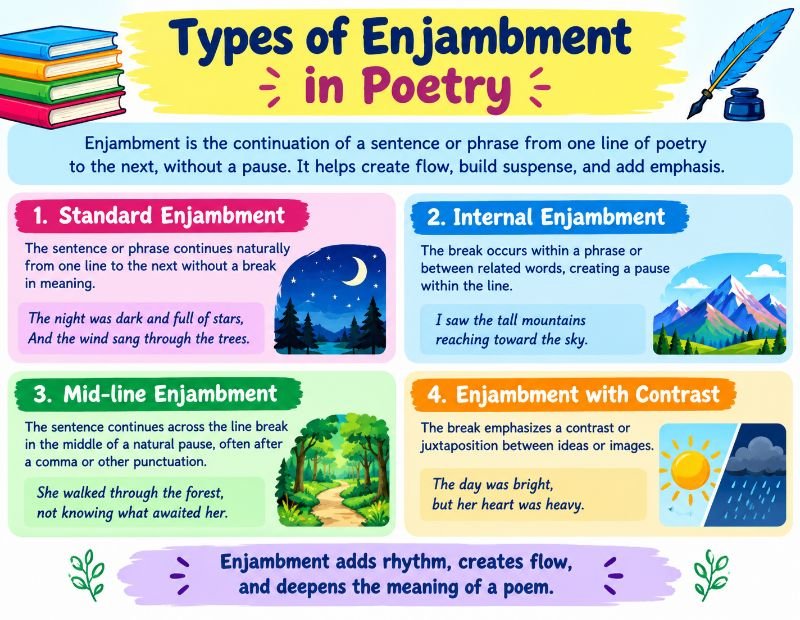
Enjambment isn’t one single technique, it varies based on how strongly the sentence carries over.
Light (Weak) Enjambment
The pause feels almost natural, with minimal grammatical tension.
- Common in narrative or descriptive poetry.
- Creates gentle, flowing movement.
Strong (Radical) Enjambment
The line break interrupts a sentence at an unexpected or jarring point.
- Often splits a phrase mid-thought
- Creates shock, tension, or dramatic effect
Syntactic Enjambment
The line break occurs at a natural grammatical pause, even without punctuation.
Non-Syntactic Enjambment
The line break occurs in the middle of a phrase or grammatical unit, creating maximum tension.
| Type | Description | Effect |
|---|---|---|
| Light Enjambment | Minimal tension, natural flow | Smooth, gentle |
| Strong Enjambment | Breaks mid-phrase unexpectedly | Jarring, intense |
| Syntactic Enjambment | Break at natural grammatical point | Balanced flow |
| Non-Syntactic Enjambment | Break within a phrase | High tension, dramatic |
10 Examples of Enjambment in Poetry
Enjambment has been used by legendary poets across centuries. Below are examples showing how lines flow into the next without pause.
| # | Poet/Work | Example Structure |
|---|---|---|
| 1 | William Carlos Williams | so much depends / upon a red wheel barrow |
| 2 | John Keats | A thing of beauty is a joy forever / Its loveliness increases |
| 3 | William Wordsworth | I wandered lonely as a cloud / That floats on high |
| 4 | Robert Frost | Whose woods these are / I think I know |
| 5 | John Milton | Of Man’s first disobedience, and the fruit / Of that forbidden tree |
| 6 | Emily Dickinson style | I heard a fly buzz / when I died |
| 7 | Walt Whitman | I celebrate myself, and sing myself / And what I assume you shall assume |
| 8 | Sylvia Plath style | I have done it again / One year in every ten |
| 9 | Modern free verse | She reached for the door / but stopped |
| 10 | Contemporary spoken word | The city breathes / in rhythms only strangers understand |
These examples show enjambment’s versatility from classic Romantic poetry to modern free verse, it consistently creates flow and forward motion.
Enjambment in a Sentence
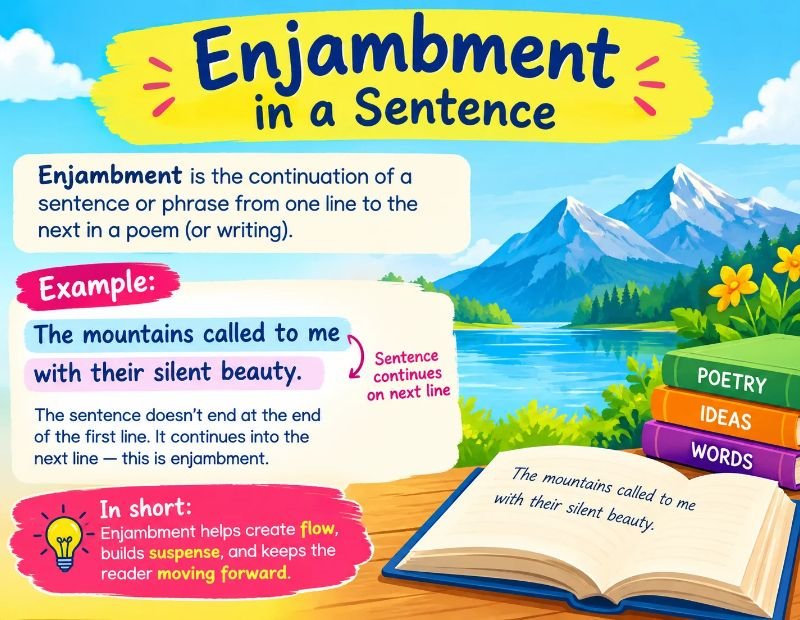
To understand enjambment more simply, here’s how it works using an everyday sentence broken into poetic lines:
Full sentence: “She walked slowly through the empty street, unsure of where she was going.”
Enjambed poetic version:
She walked slowly
through the empty street,
unsure of where
she was going.
Notice how the thought continues naturally across each line without a full stop, creating movement and flow rather than choppy, isolated statements.
Opposite of Enjambment in Poetry
The direct opposite of enjambment in poetry is called an end-stopped line.
| Feature | Enjambment | End-Stopped Line |
|---|---|---|
| Line ending | No punctuation | Punctuation present (period, comma, etc.) |
| Sentence flow | Continues to next line | Completes within the line |
| Reading pace | Faster, flowing | Slower, deliberate |
| Emotional effect | Momentum, tension | Clarity, finality |
| Example | “I saw the bird / fly away” | “I saw the bird fly away.” |
Simple way to remember:
- Enjambment: sentence flows into the next line.
- End-stopped: sentence completes within the line.
Enjambment in Poetry vs Caesura
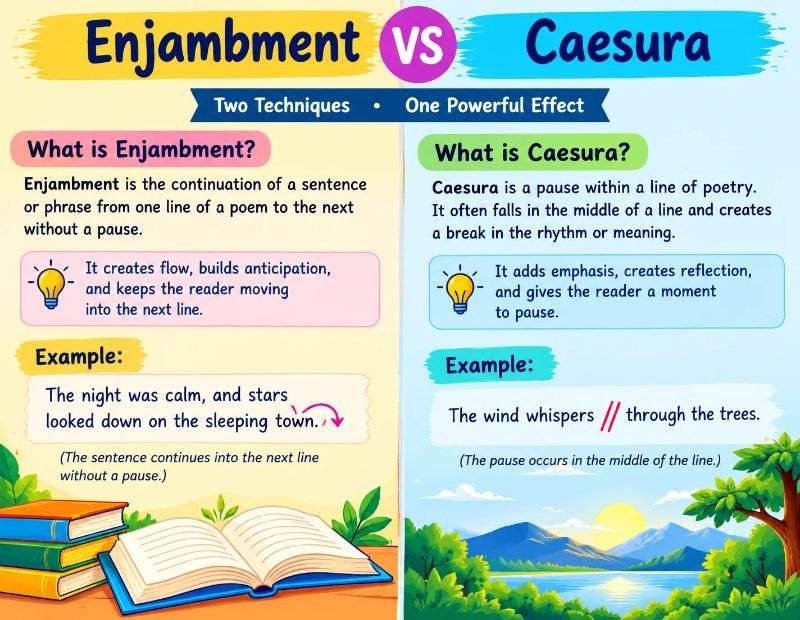
Since both techniques affect poetic rhythm, they’re often confused. Here’s the key difference:
| Feature | Enjambment | Caesura |
|---|---|---|
| Location | End of line | Middle of line |
| Effect | Creates flow/momentum | Creates pause |
| Punctuation | Usually absent | Usually present |
| Purpose | Speeds up rhythm | Slows down rhythm |
Poets often combine both techniques within the same poem to create dynamic, layered rhythm fast moving enjambed lines contrasted with pausing caesuras.
Importance of Enjambment in Poetry
Enjambment in poetry plays a critical role in modern and classical poetry alike because it:
- Breaks predictable rhythm, keeping readers engaged.
- Mirrors natural human thought, which rarely pauses neatly.
- Adds emotional depth by controlling pacing and tension.
- Allows for double meaning, since the first line can be interpreted before the full sentence completes.
- Distinguishes free verse poetry from rigid, traditional forms.
Without enjambment, much of modern poetry would lose its natural, conversational quality.
How Poets Use Enjambment in Poetry for Emotional Impact?
Skilled poets use enjambment in poetry intentionally, not randomly.
Common creative strategies include:
- Ending a line on a surprising or ambiguous word to create double meaning.
- Using strong enjambment to reflect chaos, urgency, or emotional overwhelm.
- Using light enjambment for smooth, reflective, narrative poetry.
- Pairing enjambment with short end-stopped lines for rhythmic contrast..
- Placing important words at the start of the next line for emphasis.
This level of control is what transforms simple line breaks into powerful storytelling tools.
Conclusion
Enjambment is one of the most dynamic techniques in a poet’s toolkit. By allowing sentences to flow beyond the line break, it creates momentum, suspense, and emotional depth that end stopped lines simply can’t achieve. From William Carlos Williams to contemporary spoken word poetry, enjambment continues to shape how poems move, breathe, and connect with readers.
Whether you’re analyzing classic literature or writing your own free verse, understanding enjambment, its types, purpose, and effects gives you a powerful tool to control rhythm and meaning in your writing.
FAQs
What is enjambment in poetry in simple terms?
Enjambment is when a sentence or thought continues from one line of poetry into the next without a pause or punctuation.
How do you identify enjambment in a poem?
Look for lines that end without punctuation, where the sentence’s meaning clearly continues into the next line.
What’s the difference between enjambment in poetry and caesura?
Enjambment in poetry creates flow by continuing a sentence across lines, while caesura creates a pause within a single line.
What is the opposite of enjambment in poetry called?
The opposite is called an end stopped line, where the sentence completes with punctuation at the end of the line.
Why do poets use enjambment in poetry?
Poets use enjambment in poetry to build momentum, create suspense, and mimic natural, flowing human thought.
Is enjambment only found in free verse poetry?
No, enjambment appears in both free verse and traditional metered poetry, though it’s more common in free verse.