
Odes are some of the most emotionally rich poems ever written, built around one simple idea: celebrating something with genuine, heartfelt praise. Whether it’s Keats writing about a Grecian urn or a student today writing about a favorite season, the ode remains one of poetry’s most flexible and enduring forms.
In this guide, we’ll break down everything tied to ode in poetry, its meaning, structure, rules, types, purpose, and plenty of real examples. Whether you’re studying for an exam or trying to write your own ode, this article covers it all in simple, clear language.
What Is An Ode In Poetry?
An ode is a lyric poem written to praise, honor, or deeply reflect on a person, object, idea, or event. Unlike casual poetry, odes are known for their elevated tone, emotional intensity, and often formal structure.
Quick overview:
| Detail | Information |
|---|---|
| Poetic Category | Lyric poetry |
| Main Purpose | To praise or celebrate a subject |
| Common Tone | Elevated, sincere, emotional |
| Origin | Ancient Greece |
| Famous Poet | Pindar |
| Popular Types | Pindaric, Horatian, Irregular |
Odes were originally performed aloud, often accompanied by music and dance, before evolving into the personal, written form most readers recognize today.
Read Also This Blog: Enjambment in Poetry
Ode In Poetry Meaning
At its core, the meaning of an ode centers on admiration. An ode allows a poet to express deep respect, love, or wonder toward a subject, whether that subject is grand, like a hero or a god, or small and personal, like a bird or a piece of pottery.
Key elements behind the meaning of an ode:
- Genuine praise or celebration of the subject
- Emotional, often passionate tone
- A sense of reflection or deep thought
- Formal or semi formal language
- A direct or indirect address to the subject
While early odes focused on public achievements and heroic figures, poets over time expanded the form to include everyday subjects, making the ode far more personal and relatable.
What Is An Ode In Lyric Poetry?
Odes belong to a broader poetic category called lyric poetry, which focuses on personal emotion rather than storytelling or narrative structure.
Here’s how odes fit within lyric poetry as a whole:
| Feature | Lyric Poetry | Ode (Specifically) |
|---|---|---|
| Focus | Personal emotion | Praise and admiration |
| Length | Varies | Often longer, several stanzas |
| Tone | Reflective | Elevated and celebratory |
| Structure | Flexible | Can be formal or irregular |
| Subject | Wide ranging | Often a single dedicated subject |
Because lyric poetry centers on feeling rather than plot, odes are a natural extension of this style, giving poets space to fully explore admiration or emotional connection toward one specific subject.
Types Of Ode In Poetry
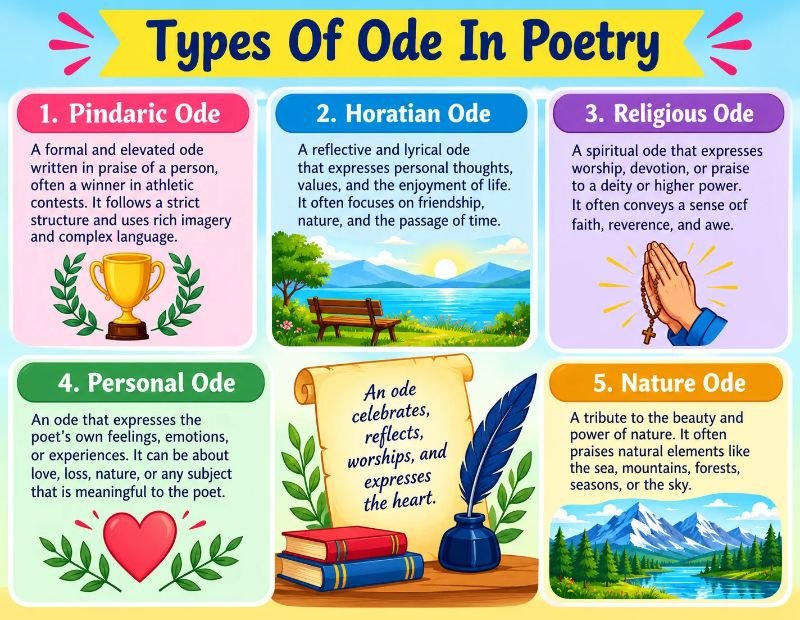
There are three widely recognized types of odes, each with its own structure, tone, and historical background.
| Type | Also Known As | Structure | Tone |
|---|---|---|---|
| Pindaric Ode | Regular or Dorian Ode | Strophe, antistrophe, epode | Formal, ceremonial |
| Horatian Ode | Lesbian Ode | Short, uniform stanzas | Calm, reflective |
| Irregular Ode | Cowleyan Ode | No fixed structure | Flexible, personal |
Pindaric Ode
Named after the ancient Greek poet Pindar, this type follows a strict three part structure and was originally performed publicly with music and dance, often to celebrate athletic or heroic achievements.
Horatian Ode
Named after the Roman poet Horace, this type uses shorter, evenly matched stanzas and leans toward a calmer, more intimate tone, often reflecting on everyday life, friendship, or personal thought.
Irregular Ode
Also called the Cowleyan ode after poet Abraham Cowley, this type abandons strict structural rules entirely. It remains one of the most popular styles in English poetry because of its flexibility.
How To Write An Ode In Poetry?
Writing an ode doesn’t require complicated rules, especially if you choose the irregular style. Here’s a simple step by step approach:
- Choose your subject pick something you genuinely admire or feel strongly about.
- Decide on structure choose Pindaric, Horatian, or irregular based on how much freedom you want.
- Set the tone aim for sincere, elevated language rather than casual phrasing.
- Address the subject directly many odes speak directly to the subject, almost like a heartfelt letter.
- Use vivid imagery describe sensory details that bring the subject to life.
- Build emotional intensity let the praise grow more powerful as the poem progresses.
- End with reflection many odes close with a meaningful insight or realization.
Because there’s no single required format, especially for irregular odes, this makes the form approachable even for beginner poets.
Rules To Write The Ode In Poetry
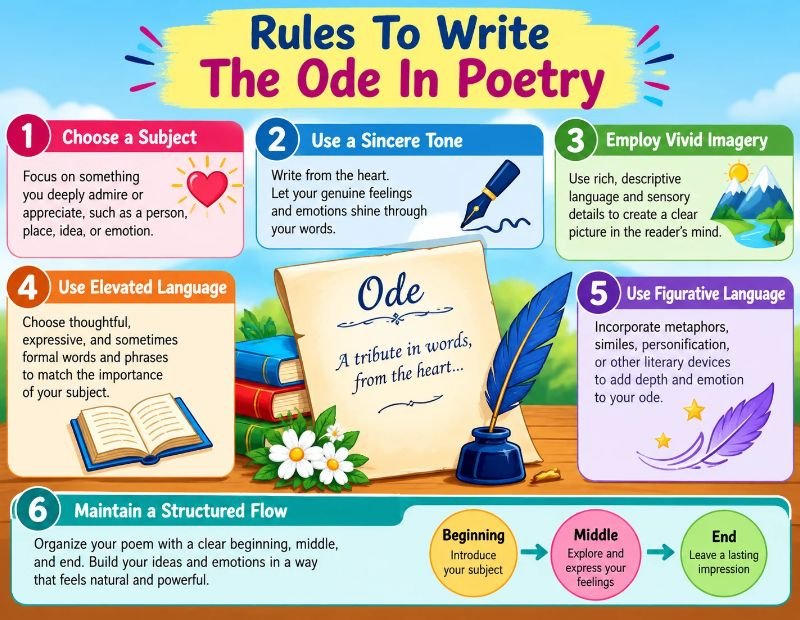
While irregular odes offer creative freedom, traditional odes do follow certain guidelines depending on their type.
General rules across most odes:
- The subject should be treated with respect or admiration.
- The tone should remain elevated, not casual or humorous.
- The poem should maintain a consistent focus on one central subject.
- Emotional sincerity is essential, odes are not meant to feel ironic or sarcastic.
- Formal odes often use quatrain stanzas, meaning four line groupings.
Rules specific to structured odes:
| Type | Structural Rule |
|---|---|
| Pindaric | Follows strophe, antistrophe, and epode pattern |
| Horatian | Uses repeated, uniform stanza length and rhyme |
| Irregular | No fixed rhyme scheme or stanza pattern required |
If you’re writing a Pindaric or Horatian ode, sticking to the traditional structure matters. If you’re writing an irregular ode, the main rule is maintaining tone and sincerity rather than form.
Does An Ode Have To Be A Poem?
Technically, yes, an ode is defined as a poem. However, the spirit of an ode, deep praise and admiration, often appears in other creative formats too, even if they aren’t formally labeled as odes.
Where ode like qualities sometimes appear outside poetry:
- Song lyrics that praise a person or place.
- Speeches that honor an individual’s achievements.
- Tribute essays or dedications.
- Wedding vows or eulogies with celebratory language.
While these formats borrow the emotional spirit of an ode, only a piece specifically written in verse form is technically classified as an ode in the literary sense.
Characteristics Of Ode In Poetry
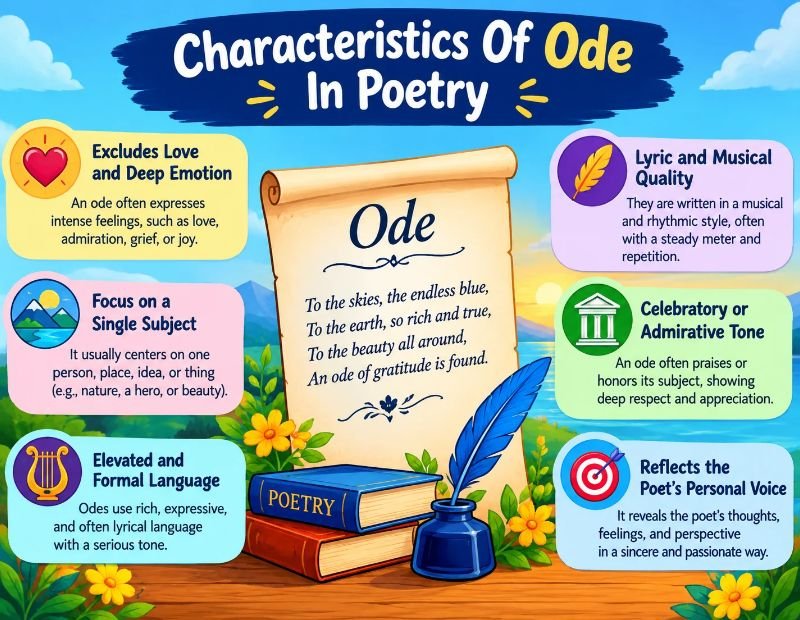
Odes share several defining traits that separate them from other poetic forms.
Key characteristics of an ode:
- Elevated language formal, dignified word choice.
- Emotional intensity deep admiration or reverence.
- Direct address often speaks to the subject as if it can hear the poet.
- Reflective tone explores meaning beyond surface level praise.
- Structured or semi structured form depending on the ode type.
- Singular focus centers on one subject throughout the poem.
- Musicality many odes were originally meant to be sung or performed.
These characteristics work together to give odes their distinct emotional weight compared to more casual poetic forms.
Purpose Of Ode In Poetry
The purpose of an ode goes beyond simple description, it aims to elevate its subject through genuine praise and reflection.
Main purposes behind writing an ode:
- To honor achievements, whether personal, historical, or mythological.
- To express deep admiration for nature, art, or everyday objects.
- To explore complex emotions tied to beauty, loss, or wonder.
- To preserve the significance of a moment or figure through poetic language.
- To connect personal feeling with universal meaning.
Historically, odes served public, ceremonial purposes, but over time, poets shifted toward using them for private emotional exploration instead.
Effects Of Ode In Poetry
A well written ode in poetry creates a specific emotional impact on the reader, often making the subject feel larger, more meaningful, or more beautiful than it might seem in ordinary language.
Common effects created by odes:
- Heightens the emotional importance of the subject.
- Creates a sense of reverence or admiration in the reader.
- Slows the reader down through reflective, descriptive language.
- Builds a personal connection between reader and subject.
- Leaves a lasting impression through elevated imagery and tone.
This emotional effect is part of why odes remain popular in classrooms and literature courses, they demonstrate how language itself can transform an ordinary subject into something deeply meaningful.
Synonym Of Ode In Poetry
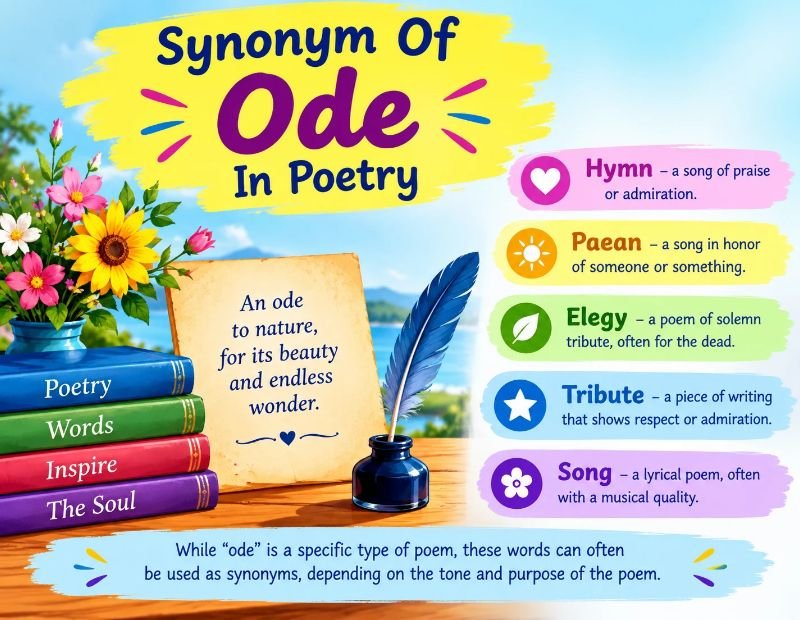
If you’re looking for words similar to “ode” in a poetic or literary context, here are some commonly used alternatives.
| Synonym | Closest Meaning |
|---|---|
| Hymn | A song or poem of praise, often spiritual |
| Panegyric | Formal praise of a person or achievement |
| Eulogy | Tribute, often for someone who has passed |
| Tribute | General term for honoring someone or something |
| Encomium | Formal expression of praise |
While these words share similarities with an ode, none of them carry the exact same poetic structure and tradition tied specifically to the ode form.
15 Examples Of Ode In Poetry
Here are 15 well known odes across different eras and styles, useful for study, reference, or inspiration.
- Ode on a Grecian Urn by John Keats
- Ode to a Nightingale by John Keats
- Ode to Autumn by John Keats
- Ode to the West Wind by Percy Bysshe Shelley
- Ode: Intimations of Immortality by William Wordsworth
- Ode to Psyche by John Keats
- The Progress of Poesy by Thomas Gray
- Ode to the Confederate Dead by Allen Tate
- Ode to Duty by William Wordsworth
- Ode on Solitude by Alexander Pope
- Ode to Joy by Friedrich Schiller
- Ode to a Skylark by Percy Bysshe Shelley
- Ode to Melancholy by John Keats
- The Ship of State by Horace
- To the Immortal Memory by Ben Jonson
These examples span multiple centuries and styles, from the strict Pindaric form to the deeply personal irregular odes popularized during the Romantic era.
What Is An Ode In Hindi Poetry?
In Hindi poetry, an ode is generally referred to as “Ode Kavita” or described using terms like “Prashasti Kavya”, which translates roughly to praise poetry.
Key points about odes in Hindi poetry:
- Focuses on the same core idea, praising a subject with deep emotion.
- Often used to honor nature, deities, historical figures, or abstract virtues.
- Shares similarities with devotional poetry traditions in Hindi literature.
- Maintains an elevated, respectful tone similar to Western odes.
While the structural rules may differ slightly across languages and literary traditions, the emotional purpose, celebrating a subject through heartfelt praise, remains consistent across cultures.
Ode vs Other Poetic Forms
Since odes are often confused with other classical poetic forms, here’s a quick comparison to clarify the differences.
| Form | Main Focus | Typical Length | Tone |
|---|---|---|---|
| Ode | Praise and admiration | Longer, multiple stanzas | Elevated, emotional |
| Sonnet | Love or personal reflection | 14 lines | Intimate, structured |
| Elegy | Mourning or loss | Varies | Somber, reflective |
| Ballad | Storytelling | Varies | Narrative, rhythmic |
Understanding these distinctions helps clarify why odes stand out, they aren’t simply about emotion in general, but specifically about elevating and honoring a chosen subject.
Why Odes Still Matter Today?
Even though odes originated thousands of years ago, they remain relevant because they capture something timeless: the human desire to express deep appreciation. Whether a poet is praising nature, art, love, or memory, the ode gives language enough weight to match that emotion.
This is part of why so many students and writers continue studying, and writing, odes today. The form proves that admiration, when expressed with sincerity and craft, can turn even a simple, everyday subject into something worth remembering.
FAQs About Ode In Poetry
What is an ode in poetry?
An ode is a lyric poem written to praise or deeply reflect on a specific person, object, or idea.
What are the three main types of odes?
The three main types are Pindaric, Horatian, and Irregular odes.
Does an ode have to rhyme?
Not necessarily. While Pindaric and Horatian odes often use structured rhyme, irregular odes may skip rhyme entirely.
What is the purpose of writing an ode?
The purpose is to honor, celebrate, or reflect deeply on a chosen subject through elevated, emotional language.
Who is considered the creator of the ode?
The ancient Greek poet Pindar is widely credited with creating the ode as a poetic form.
What is the easiest type of ode to write?
The irregular ode is generally easiest, since it doesn’t require a fixed rhyme scheme or stanza structure.
Is an ode in poetry always about a person?
No. Ode in poetry can be written about people, objects, nature, emotions, or abstract ideas.
What is a Horatian ode in poetry known for?
It’s known for its calm, reflective tone and short, evenly structured stanzas.
What is the synonym closest to an ode in poetry?
Hymn and panegyric are among the closest literary synonyms for an ode in poetry.
How is an ode in poetry different from a sonnet?
An ode in poetry focuses on praise and admiration with flexible length, while a sonnet is a fixed 14 line poem often centered on personal reflection or love.
Conclusion
The ode in poetry remains one of poetry’s most emotionally powerful forms, built entirely around the idea of genuine praise and reflection. From the formal, performance based structure of Pindaric odes to the deeply personal freedom of irregular odes, this poetic form has adapted across centuries while staying true to its core purpose: celebrating a subject with sincerity and depth.
Whether you’re studying classic examples like Keats and Wordsworth or writing your very first ode, understanding its structure, purpose, and characteristics gives you everything needed to appreciate, or create, this timeless poetic form.