
Not every powerful poem follows a beat you can count on your fingers. Some of the most influential poetry ever written breaks completely free of rhyme and meter, choosing instead to follow the natural rhythm of thought and speech. This is free verse, the form that gave poets permission to write without counting syllables or chasing rhymes, and it has shaped modern poetry more than almost any other technique of the last two centuries.
This guide covers everything you need to know about free verse. You will learn its exact meaning, who introduced it to English poetry, its defining characteristics, purpose, and effects, more than fifteen real examples from major poets, and a clear comparison against both prose and blank verse.
What Is Free Verse In Poetry?
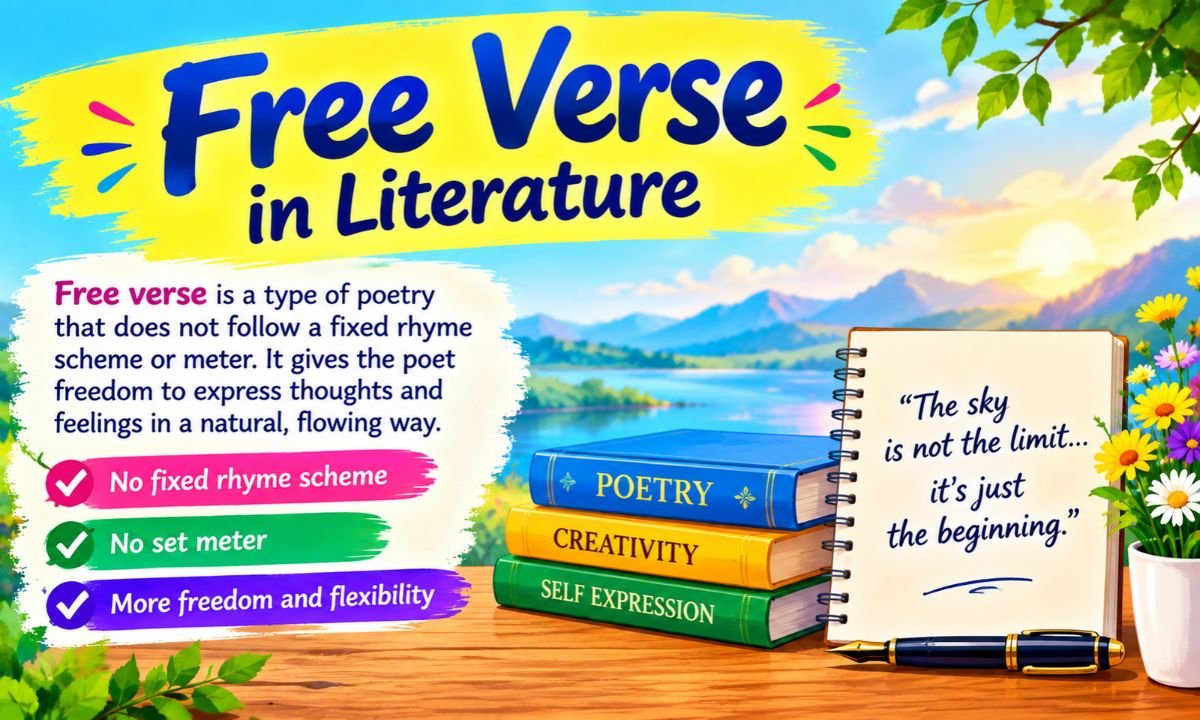
Free verse is poetry that does not follow a fixed meter or a regular rhyme scheme. Instead of counting syllables or matching end sounds, free verse poets shape their lines around natural speech patterns, breath, imagery, and emotional emphasis.
This does not mean free verse has no structure at all. Most free verse poems still use line breaks, repetition, and rhythm deliberately, they simply do not lock themselves into one repeating pattern across the entire poem.
| Poetic Form | Meter | Rhyme |
|---|---|---|
| Free verse | No fixed meter | No fixed rhyme |
| Blank verse | Regular, usually iambic pentameter | No fixed rhyme |
| Rhymed verse | Regular meter | Fixed rhyme scheme |
Because free verse relies on the poet’s own sense of rhythm rather than an inherited formula, it opened poetry up to a much wider range of voices, subjects, and structures, especially throughout the twentieth century.
Read Also This Blog: Blank Verse in Poetry
Key Features That Define Free Verse
- No fixed metrical pattern.
- No required rhyme scheme.
- Line breaks chosen for emphasis, pacing, or meaning.
- Rhythm based on natural speech rather than counted syllables.
- Frequent use of repetition, imagery, and enjambment to create structure.
Who Introduced Free Verse In Poetry?
Walt Whitman is widely credited as the father of American free verse, largely because of his 1855 collection Leaves of Grass, which broke away from traditional meter and rhyme in favor of long, sweeping, unmetered lines.
While Whitman did not literally invent unrhymed, unmetered writing, since earlier examples existed in biblical poetry and isolated experiments by poets like Christopher Smart and William Blake, his work is considered the moment free verse became a defined and influential form within English language poetry.
A Quick Timeline of Free Verse’s Development
- Biblical Hebrew poetry: Early rhythmic, unrhymed patterns found in the Psalms are often cited as a distant ancestor of free verse cadence.
- 1750s to 1790s: Christopher Smart and William Blake experiment with unrhymed, unmetered religious and visionary poetry.
- 1855: Walt Whitman publishes Leaves of Grass, establishing free verse as a serious literary form in English.
- Late 19th century France: French Symbolist poets develop vers libre, directly influenced by Whitman’s example.
- Early 20th century: Free verse becomes a defining feature of literary Modernism, championed by poets like Ezra Pound and T. S. Eliot.
- Mid 20th century: The Black Mountain poets connect free verse structure to breath and natural speech rhythm.
- Late 20th century to toda: Free verse becomes the dominant style in contemporary poetry worldwide.
Whitman’s influence did not stay contained to America. European Symbolist poets studied his unrhymed, unmetered style closely, which helped free verse spread and evolve into a defining feature of modern poetry across multiple languages.
Which Best Describes Free Verse In Poetry?
If you are answering this as an exam or quiz style question, the clearest and most accurate description is this:
Free verse is poetry that does not follow a regular meter or a fixed rhyme scheme, relying instead on natural speech rhythms and deliberate line breaks.
Watch out for common multiple choice traps that confuse free verse with other forms:
| Statement | True or False |
|---|---|
| Free verse always avoids rhyme entirely | False, occasional rhyme can still appear |
| Free verse has no structure whatsoever | False |
| Free verse follows the natural rhythm of speech | True |
| Free verse always uses iambic pentameter | False |
| Free verse became especially popular in the twentieth century | True |
A common mistake is assuming free verse has no rules at all. In reality, most free verse poems still use careful structural choices, such as line length, repetition, and spacing, they simply do not rely on one repeating pattern to hold the entire poem together.
How To Write Free Verse In Poetry?
Writing strong free verse is often harder than it looks, since there is no built in formula to lean on. Structure has to come from intention rather than a counted pattern.
Step by Step Guide
- Start with a strong image, feeling, or idea. Free verse often begins with something concrete rather than a predetermined structure.
- Write in natural phrases. Let your sentence structure guide the rhythm, rather than forcing lines into a set syllable count.
- Use line breaks deliberately. Break lines where you want emphasis, a pause, or a shift in meaning, not simply at a fixed interval.
- Read your draft aloud. Since free verse relies on natural rhythm, hearing it spoken helps reveal where the pacing feels off.
- Use repetition intentionally. Repeated words, phrases, or structures can create rhythm and cohesion without relying on rhyme.
- Revise for unnecessary words. Without meter to justify extra syllables, free verse benefits from tight, purposeful language.
A Simple Practice Exercise
Choose a strong memory or emotion and write eight to ten lines describing it without worrying about rhyme or syllable count. Focus entirely on where natural pauses in thought would fall, then break your lines at those points.
Characteristics Of Free Verse In Poetry
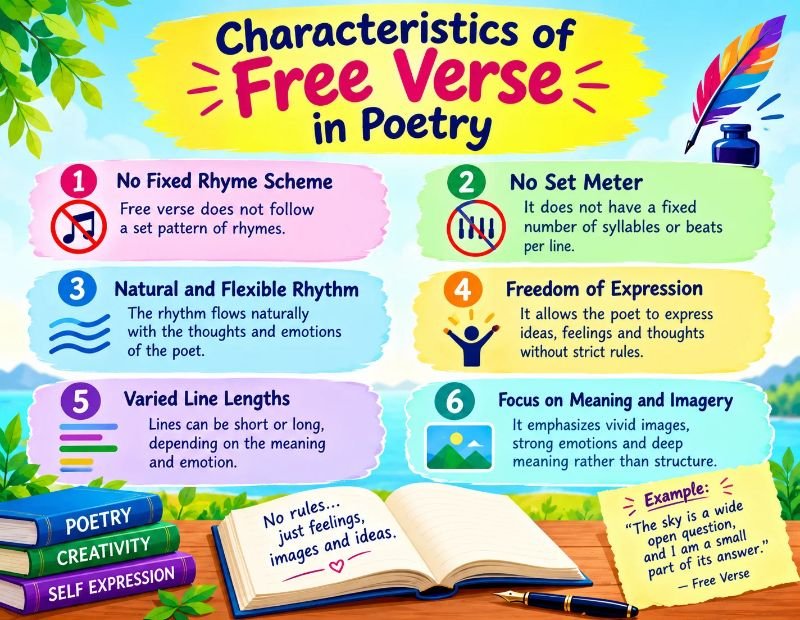
Free verse is defined by a distinct set of structural and stylistic traits.
- No fixed rhyme scheme, though occasional rhyme may still appear.
- No regular meter, allowing lines to vary in length and rhythm.
- Natural, speech like cadence rather than a counted pattern.
- Deliberate line breaks used for emphasis or pacing.
- Frequent use of enjambment, letting sentences flow across multiple lines.
- Reliance on imagery, repetition, and tone to create structure instead of meter.
- Flexibility for varied subject matter, from personal reflection to political and social commentary.
Free Verse Structure At A Glance
| Element | Typical Pattern |
|---|---|
| Rhyme scheme | None required |
| Meter | None required |
| Line length | Variable, based on meaning and rhythm |
| Structural tools | Repetition, imagery, line breaks, tone |
| Common genres | Modern lyric poetry, personal narrative, political poetry |
Effects Of Free Verse In Poetry
Free verse creates a distinct set of effects that explain why it became the dominant form in modern poetry.
- A natural, conversational rhythm that mirrors real thought and speech.
- Greater emotional immediacy, since the poem is not shaped around a formal pattern.
- Flexibility for experimentation, allowing poets to break convention deliberately.
- Emphasis on individual voice, since each poet develops their own internal rhythm.
- Room for visual and spatial creativity, using line breaks and spacing as expressive tools.
Because free verse removes the constraints of meter and rhyme, poets can shape each line entirely around meaning and emotional weight, which is part of why the form became so closely associated with personal, confessional, and socially engaged poetry throughout the twentieth century.
Purpose Of Free Verse In Poetry
Free verse serves several important purposes that explain its lasting popularity.
- Prioritizes authentic voice over inherited formal structure.
- Allows poets to match form to content, adjusting rhythm to fit the poem’s specific emotional tone.
- Removes artificial constraints that might force awkward word choices to fit a rhyme or meter.
- Supports experimentation, making it a natural fit for Modernist and contemporary poetry movements.
- Reflects the rhythms of modern spoken language, rather than older formal poetic conventions.
This freedom does not mean free verse is easier to write well. Without meter or rhyme to lean on, poets must rely entirely on rhythm, imagery, and word choice to create a poem that feels intentional rather than simply unstructured prose broken into lines.
Types Of Free Verse In Poetry
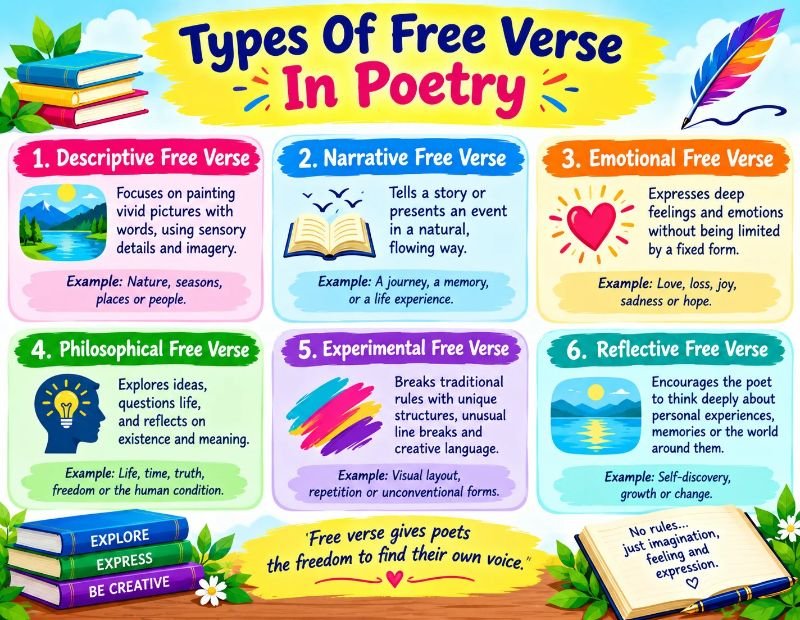
Not all free verse looks or sounds the same. Literary critics have identified several distinct approaches within the broader form.
| Type | Description |
|---|---|
| Iambic free verse in poetry | Retains a loose, irregular echo of traditional meter, associated with poets like T. S. Eliot and W. H. Auden |
| Cadenced free verse in poetry | Built around natural speech rhythm rather than any metrical pattern |
| Projective or breath based free verse | Structured around the poet’s natural breath and speech pacing, associated with the Black Mountain poets |
| Imagist free verse | Focused on precise, concentrated imagery with minimal ornamentation |
| Prose influenced free verse | Uses long, flowing lines closer to prose rhythm, as seen in Whitman’s work |
How Free Verse Evolved Across Types?
Early free verse, particularly Whitman’s long, cascading lines, drew heavily on the rhythms of biblical prose. Later Modernist poets tightened this approach considerably, favoring shorter, more compressed lines focused on precise imagery, while mid twentieth century poets shifted focus again toward natural breath and spoken rhythm as the primary structural tool.
15 Examples Of Free Verse In Poetry
Below are well known works widely recognized for their use of free verse in poetry, along with a short note on what makes each one significant.
- Leaves of Grass by Walt Whitman: The landmark collection that established free verse as a major form in English poetry.
- Song of Myself by Walt Whitman: A sweeping, unmetered exploration of identity and unity with the world.
- The Waste Land by T. S. Eliot: A defining Modernist work blending fragmented imagery with free verse structure.
- The Love Song of J. Alfred Prufrock by T. S. Eliot: Combines loose iambic rhythm with free verse flexibility.
- The Cantos by Ezra Pound: A vast Modernist work built largely on free verse experimentation.
- The Return by Ezra Pound: Praised for its rhythmic control despite the absence of formal meter.
- This Is Just To Say by William Carlos Williams: A famous example of minimalist, conversational free verse.
- The Red Wheelbarrow by William Carlos Williams: Uses careful line breaks to create meaning from a simple image.
- Howl by Allen Ginsberg: A long, breath driven free verse poem influenced directly by Whitman.
- I Sing the Body Electric by Walt Whitman: Uses long, cataloging lines typical of early American free verse.
- In a Station of the Metro by Ezra Pound: A compact Imagist poem demonstrating free verse’s capacity for precision.
- Jubilate Agno by Christopher Smart: An early example of unrhymed, unmetered religious free verse.
- The Argument (from The Marriage of Heaven and Hell) by William Blake: Often cited as one of the earliest free verse experiments in English.
- Diving into the Wreck by Adrienne Rich: A modern free verse poem exploring identity and self discovery.
- Kaddish by Allen Ginsberg: A long, emotionally intense free verse elegy.
- Praise Song for the Day by Elizabeth Alexander: A contemporary free verse poem written for a major public occasion.
A Closer Look At Two Landmark Examples
Whitman’s Leaves of Grass broke from nearly every convention expected of serious poetry at the time, favoring long, cataloging lines that mirrored spoken thought rather than structured verse, and this single collection is often credited with permanently reshaping the direction of English language poetry.
Williams’ This Is Just To Say takes the opposite approach, using extremely short, plain language and careful line breaks to turn a simple domestic moment into a quietly powerful poem, showing just how differently free verse can be applied depending on the poet’s intent.
Examples Of Free Verse Poems
If you are looking specifically for standalone poems rather than long collections, these works are frequently cited as strong examples:
- This Is Just To Say by William Carlos Williams.
- The Red Wheelbarrow by William Carlos Williams.
- In a Station of the Metro by Ezra Pound.
- Diving into the Wreck by Adrienne Rich.
- Praise Song for the Day by Elizabeth Alexander.
- The Love Song of J. Alfred Prufrock by T. S. Eliot
These poems span more than a century, showing how adaptable free verse has remained across vastly different literary movements, from early Modernism to contemporary poetry.
Free Verse In Literature
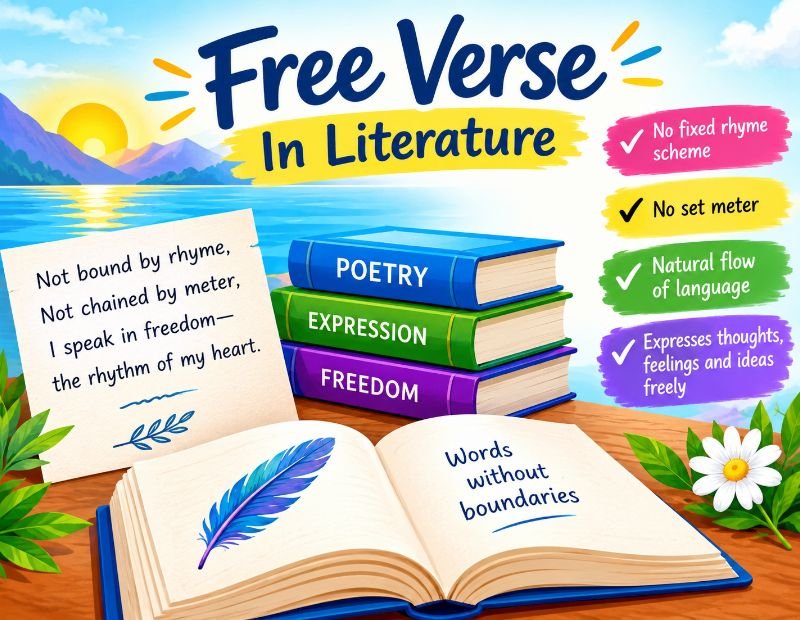
Free verse has shaped far more than individual poems, influencing entire literary movements and generations of writers.
Free Verse And Modernism
Free verse became closely tied to literary Modernism in the early twentieth century, as poets like Ezra Pound and T. S. Eliot used it to break from Victorian formality and reflect the fragmented, rapidly changing modern world.
Confessional Free Verse In Poetry
Later poets used free verse to explore deeply personal subjects with an intimacy that strict meter might have made feel artificial, helping establish confessional poetry as a major twentieth century movement.
Contemporary Free Verse In Poetry
Today, free verse is the dominant form in most contemporary poetry publications, valued for its flexibility and its ability to adapt to nearly any subject, tone, or cultural context.
Examples Of Free Verse Poems For Students
For students studying free verse in poetry for the first time, these accessible, frequently taught examples work especially well for classroom analysis:
| Poem | Poet | Why It Works Well for Study |
|---|---|---|
| This Is Just To Say | William Carlos Williams | Short length with clear, simple language |
| The Red Wheelbarrow | William Carlos Williams | Demonstrates how line breaks shape meaning |
| I Sing the Body Electric | Walt Whitman | Strong imagery useful for studying cataloging technique |
| Praise Song for the Day | Elizabeth Alexander | Accessible modern tone and clear structure |
| Diving into the Wreck | Adrienne Rich | Rich in symbolism, useful for deeper thematic analysis |
Tips for Teaching or Studying These Poems
- Focus on where and why line breaks occur, rather than counting syllables.
- Identify repeated words, phrases, or images that create structure.
- Read the poem aloud to notice its natural rhythm.
- Compare a free verse poem to a rhymed poem to highlight the stylistic difference clearly.
Free Verse In Poetry Vs. Prose
Although free verse avoids meter and rhyme, it is not the same as prose, and the difference matters for accurate analysis.
| Feature | Free Verse | Prose |
|---|---|---|
| Line breaks | Deliberate, meaningful | Determined by page width, not meaning |
| Structure | Built around imagery, rhythm, and emphasis | Built around sentences and paragraphs |
| Reading pace | Shaped intentionally by the poet | Flows continuously without poetic pacing |
| Visual form | Distinct poetic shape on the page | Standard paragraph formatting |
The key distinction lies in intention. In free verse, every line break is a meaningful choice that affects rhythm, emphasis, or meaning, while in prose, line breaks are simply a function of formatting rather than an artistic decision.
Free Verse In Poetry Vs. Blank Verse
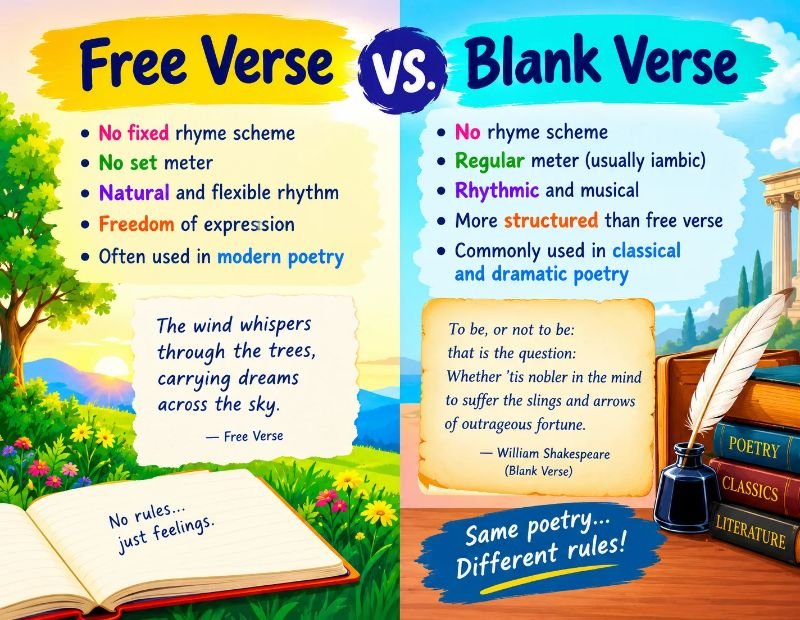
Free verse and blank verse are often confused, but they differ in one major way, meter.
| Feature | Free Verse | Blank Verse |
|---|---|---|
| Meter | None required | Regular, usually iambic pentameter |
| Rhyme | None required | None |
| Rhythm source | Natural speech and emphasis | Counted syllabic pattern |
| Common era | Especially prominent from the 20th century onward | Especially prominent from the 16th through 19th centuries |
| Famous examples | Leaves of Grass, The Waste Land | Paradise Lost, Shakespearean soliloquies |
The simplest way to remember the difference is this: blank verse keeps a strict rhythmic pattern without rhyme, while free verse abandons both meter and rhyme entirely, relying instead on the poet’s own sense of natural rhythm.
Common Mistakes to Avoid When Identifying Free Verse In Poetry
- Assuming free verse in poetry has no structure at all, when in reality it relies heavily on deliberate line breaks and repetition.
- Confusing free verse in poetry with blank verse, since blank verse still follows a strict meter.
- Mistaking free verse in poetry for unformatted prose, overlooking the intentional use of line breaks and pacing.
- Ignoring historical context, since understanding why a poet chose free verse in poetry adds meaningful depth to analysis.
- Overlooking subtle rhythmic patterns, since many free verse poems still contain loose, irregular echoes of traditional meter.
Final Thoughts
Free verse fundamentally changed what poetry could look and sound like, moving away from inherited rhyme and meter toward something closer to natural thought and speech. From Walt Whitman’s sprawling lines in Leaves of Grass to the tightly controlled imagery of the Modernists and the deeply personal voice of confessional poets, free verse has proven remarkably adaptable across more than a century and a half of literary history.
Whether you are studying free verse for an exam, analyzing a Whitman poem, or trying to write your own unstructured verse for the first time, understanding its purpose, characteristics, and history gives you real insight into one of the most influential developments in modern poetry.
Frequently Asked Questions
What is free verse in poetry in simple terms?
It is poetry that does not follow a fixed rhyme scheme or regular meter, relying instead on natural speech rhythm and deliberate line breaks.
Who is considered the father of free verse in poetry?
Walt Whitman is widely credited as the father of American free verse because of his influential 1855 collection Leaves of Grass.
Is free verse in poetry the same as prose broken into lines?
No, free verse in poetry uses deliberate line breaks and rhythm for meaning and emphasis, while prose formatting is not shaped for poetic effect.
What is the main difference between free verse in poetry and blank verse?
Blank verse follows a strict meter without rhyme, while free verse has no required meter or rhyme at all.
Does free verse in poetry ever use rhyme?
Occasionally, but it is never required or used in a fixed, repeating pattern the way traditional rhymed poetry is structured.
Why did free verse in poetry become so popular in the twentieth century?
It allowed poets to break from rigid formal traditions and better reflect natural speech, personal voice, and modern subject matter.
Can free verse in poetry still have structure?
Yes, most free verse in poetry relies on structural tools like repetition, imagery, and intentional line breaks, even without meter or rhyme.