
Some of the most famous lines in English literature were never meant to rhyme. Shakespeare’s soliloquies, Milton’s epic vision of heaven and hell, and Wordsworth’s quiet reflections on nature all share one thing in common, they are written in blank verse. This unrhymed but rhythmic form has shaped English poetry and drama for close to five hundred years, and it remains one of the most studied techniques in literary history.
This guide breaks down everything students, writers, and poetry lovers need to know about blank verse. You will learn its exact meaning, who introduced it to English literature, its defining characteristics, its purpose and effects, and more than fifteen real examples from major poets, along with practical steps for writing your own.
What Is Blank Verse In Poetry?
Blank verse is poetry written in a regular meter, most commonly iambic pentameter, without a fixed rhyme scheme. In simple terms, it follows a steady rhythmic pattern while the line endings do not rhyme with one another.
This makes blank verse different from both free verse, which has no set meter at all, and rhymed poetry, which follows a structured rhyme scheme alongside its meter.
| Poetic Form | Meter | Rhyme |
|---|---|---|
| Blank verse | Regular, usually iambic pentameter | No fixed rhyme |
| Free verse | No fixed meter | No fixed rhyme |
| Rhymed verse (e.g. couplets, sonnets) | Regular meter | Fixed rhyme scheme |
Because blank verse keeps a steady rhythm while sounding close to natural spoken English, it became the preferred form for long narrative poems, dramatic monologues, and stage plays, where a rigid rhyme scheme might feel artificial or restrictive.
Read Also This Blog: Oxymoron In Poetry
Key Features That Define Blank Verse
- Unrhymed line endings.
- A consistent metrical pattern, usually iambic pentameter.
- Ten syllables per line in its most traditional form.
- Five stressed syllables alternating with five unstressed syllables.
- Frequent use in drama, epic poetry, and dramatic monologue.
Who Introduced Blank Verse In Poetry?
Blank verse was introduced into English literature by Henry Howard, Earl of Surrey, in the 1540s, through his translation of Virgil’s Aeneid. His unrhymed, metrically regular translation marked the first known use of the form in the English language.
A Quick Timeline of Blank Verse’s Development
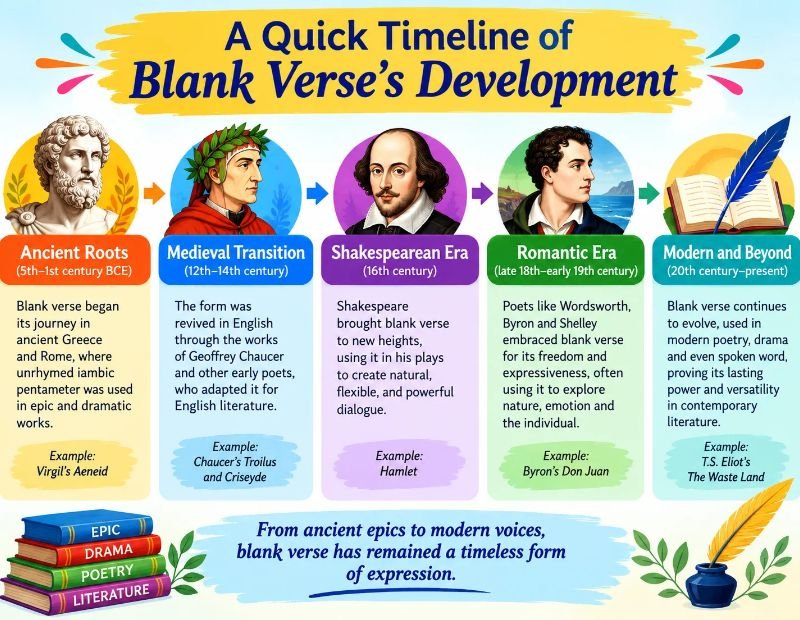
- Renaissance Italy: Unrhymed metrical poetry first appeared here, inspired by classical Greek and Latin verse, which also did not use rhyme.
- 1540s England: Henry Howard, Earl of Surrey, translates Virgil’s Aeneid into English using blank verse for the first time.
- 1561: The play Gorboduc, by Thomas Norton and Thomas Sackville, becomes the first English drama written in blank verse.
- Elizabethan era: Christopher Marlowe popularizes and refines blank verse, establishing it as the leading form for English drama.
- Late 1500s to early 1600s: William Shakespeare uses blank verse extensively across his plays.
- 1667: John Milton publishes Paradise Lost, reviving and elevating blank verse for epic poetry.
- 19th century onward: Romantic and Victorian poets, including Wordsworth, Keats, and Tennyson, continue using blank verse.
- 20th century: Modern poets such as Robert Frost and Wallace Stevens adapt blank verse for contemporary themes.
Classical Latin and Greek verse never relied on rhyme in the first place, which is likely part of why Surrey’s translation of Virgil felt like a natural fit for the unrhymed, metrical style now known as blank verse.
Which Best Describes Blank Verse In Poetry?
If you are answering this as an exam or quiz style question, the most accurate description is straightforward:
Blank verse is poetry written in a regular meter, most often unrhymed iambic pentameter.
Watch out for common multiple choice traps that confuse blank verse with other forms:
| Statement | True or False |
|---|---|
| Blank verse always rhymes | False |
| Blank verse has no meter at all | False |
| Blank verse typically uses iambic pentameter | True |
| Blank verse is only used in short poems | False |
| Blank verse is common in drama and epic poetry | True |
The most frequent mistake students make is confusing blank verse with free verse. Free verse abandons both rhyme and regular meter, while blank verse keeps a steady, countable rhythm even without rhyme.
Which Excerpt From John Milton’s Poetry Is In Blank Verse?
John Milton’s Paradise Lost is the most famous example of blank verse in the English language, and effectively the entire epic poem is written in this form. Milton deliberately chose to avoid rhyme, which he considered an unnecessary constraint for serious poetry, favoring instead the natural rise and fall of unrhymed iambic pentameter to tell the story of humanity’s fall from paradise.
Any passage pulled from Paradise Lost qualifies as blank verse, since the entire twelve book epic maintains a consistent unrhymed iambic pentameter structure from its opening invocation through its final lines. This makes it the single most cited example whenever students are asked to identify blank verse in Milton’s work.
Why Milton Chose Blank Verse?
- He viewed rhyme as a limitation rather than a genuine mark of skill in serious poetry.
- He wanted his epic to echo the grandeur of classical Greek and Latin verse, which also avoided rhyme.
- Blank verse allowed him greater flexibility for long, complex sentences across many lines.
- The form suited the elevated, formal tone required for an epic about creation, temptation, and paradise lost.
How To Write Blank Verse In Poetry?
Writing blank verse in poetry takes practice, but the underlying structure is easier to learn than it looks. Follow these steps to get started.
Step by Step Guide
- Choose iambic pentameter as your base meter. Each line should contain five iambic feet, meaning five pairs of unstressed and stressed syllables, for ten syllables total.
- Read your lines aloud. Blank verse should sound close to natural spoken English, so reading aloud helps you catch awkward or forced rhythm.
- Avoid rhyming line endings intentionally. Focus purely on rhythm rather than matching sounds at the end of each line.
- Use enjambment when needed. Let sentences flow naturally across line breaks rather than forcing every line to end with a pause.
- Vary sentence length within the meter. Long, flowing sentences spread across several lines are common in classic blank verse.
- Revise for natural stress patterns. English naturally stresses certain syllables in words, so choose vocabulary that fits the iambic rhythm without sounding forced.
A Simple Practice Exercise
Try writing five lines describing a familiar scene, such as a sunrise or a busy street, while counting ten syllables per line and avoiding rhyme. Read each line aloud and adjust word choice until the stressed and unstressed syllables fall naturally into an iambic pattern.
Characteristics Of Blank Verse In Poetry
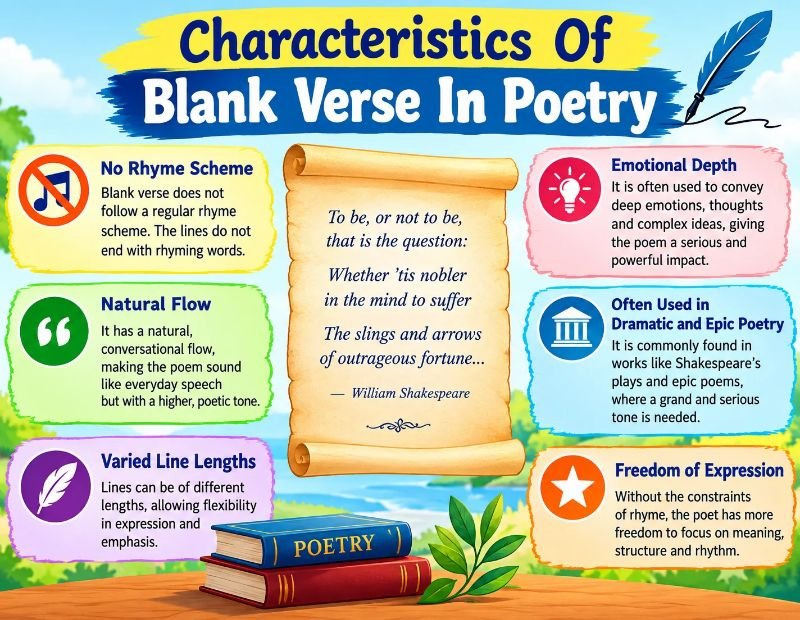
Blank verse is defined by a specific set of structural and stylistic traits that separate it from other poetic forms.
- Unrhymed lines with no fixed end rhyme pattern.
- Regular meter, most commonly iambic pentameter.
- Ten syllables per line in traditional usage.
- Five stressed and five unstressed syllables, alternating in pattern.
- Frequent enjambment, allowing sentences to flow across multiple lines.
- A close resemblance to natural spoken English, making it ideal for dialogue and dramatic speech.
- Flexibility for long form storytelling, especially in epic poetry and drama.
Blank Verse In Poetry Structure At A Glance
| Element | Typical Pattern |
|---|---|
| Rhyme scheme | None |
| Meter | Iambic pentameter |
| Syllables per line | 10 |
| Stress pattern | Unstressed, stressed, repeated five times |
| Common genres | Drama, epic poetry, dramatic monologue |
Effects Of Blank Verse In Poetry
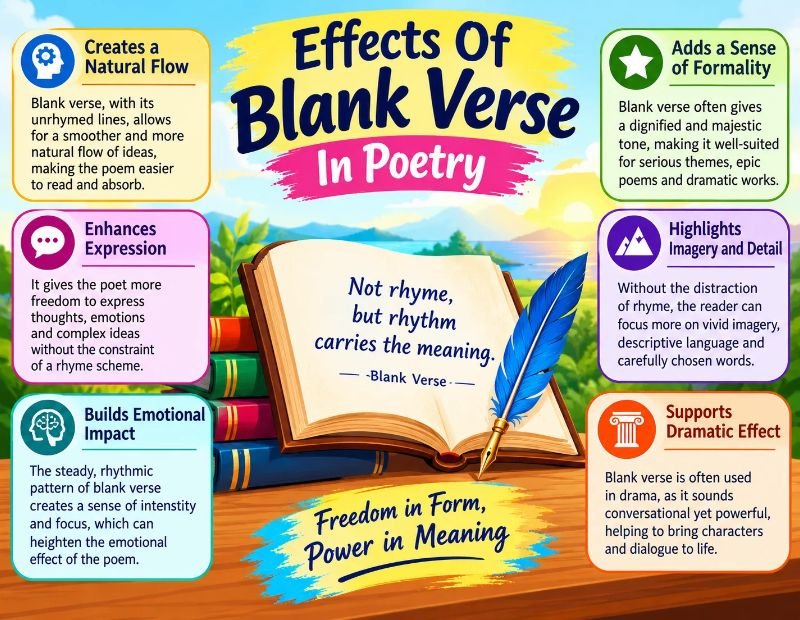
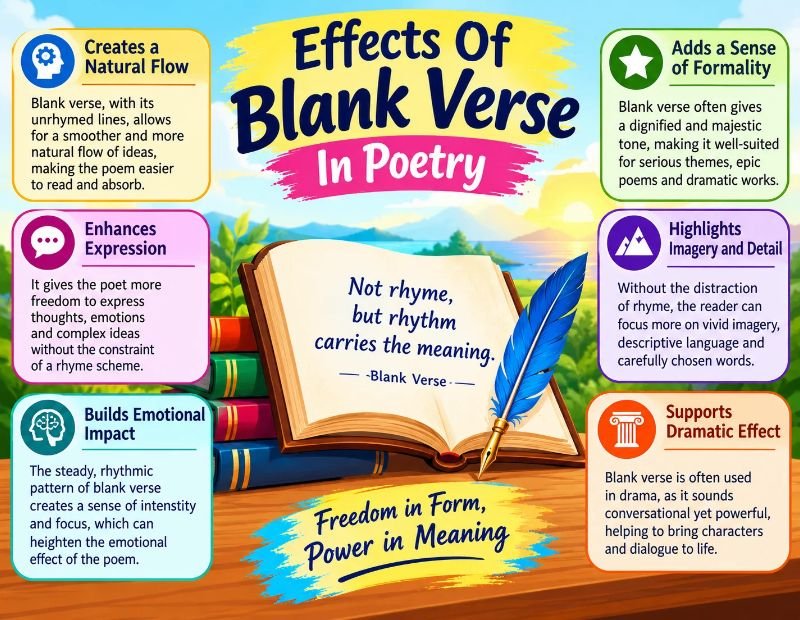
Blank verse creates a distinct set of effects that explain why it has remained popular across centuries of English literature.
- A natural, conversational rhythm that mirrors how people actually speak.
- A sense of grandeur and elevation, especially in epic poetry.
- Flexibility for complex ideas, since sentences are not forced into short rhymed units.
- Emotional intensity in dramatic monologue, allowing characters to speak with psychological depth.
- A steady, memorable rhythm without the sing song quality that heavy rhyme can create.
Because blank verse in poetry avoids the predictable pattern of rhyme, it allows poets to focus entirely on meaning, tone, and pacing, rather than searching for a matching end word. This is part of why it became the standard form for Shakespearean drama, where natural sounding dialogue mattered more than musical rhyme.
Purpose Of Blank Verse In Poetry
Blank verse in poetry serves several important literary purposes that continue to make it relevant today.
- Supports long narrative works where rhyme across hundreds or thousands of lines would become repetitive or forced.
- Enhances dramatic dialogue by sounding closer to natural speech than rhymed verse.
- Elevates tone for serious or epic subject matter without relying on musical rhyme.
- Gives poets structural discipline through meter, while still allowing creative freedom in word choice and phrasing.
- Bridges poetry and prose, offering rhythm and structure without the constraints of a strict rhyme scheme.
This balance between structure and freedom is exactly why blank verse has remained a favored form for both classical and modern poets, from Renaissance drama to twentieth century American poetry.
Types Of Blank Verse In Poetry
While iambic pentameter is by far the most common meter used in blank verse, the form itself is defined by its lack of rhyme rather than one single fixed meter, meaning several variations exist.
| Type | Description |
|---|---|
| Dramatic blank verse | Used in stage plays for dialogue and monologue, popularized by Marlowe and Shakespeare |
| Epic blank verse | Used for long narrative poems, most famously Milton’s Paradise Lost |
| Dramatic monologue blank verse | A single speaker addresses a silent listener, common in Victorian poetry |
| Descriptive or meditative blank verse | Used for reflective, nature focused poetry, common among Romantic poets |
| Modern flexible blank verse | Looser, more relaxed rhythm used by twentieth century poets while still rooted in iambic pentameter |
How Blank Verse In Poetry Evolved Across Types?
Early blank verse in poetry, especially in drama, tended to follow a strict, end stopped rhythm. Over time, poets like Shakespeare introduced more metrical looseness and natural pauses mid line, a technique that later poets built upon even further, eventually leading to the more relaxed, conversational blank verse seen in twentieth century American poetry.
15 Examples Of Blank Verse In Poetry
Below are well known works widely recognized for their use of blank verse in poetry, along with a short note on what makes each one significant.
- Paradise Lost by John Milton: The definitive example of epic blank verse, spanning twelve books without a single rhymed line.
- Hamlet by William Shakespeare: Many of the play’s most famous soliloquies are delivered in unrhymed iambic pentameter.
- Macbeth by William Shakespeare: Uses blank verse extensively for both dialogue and internal reflection.
- Doctor Faustus by Christopher Marlowe: One of the earliest major dramatic works to fully embrace blank verse.
- Gorboduc by Thomas Norton and Thomas Sackville: Recognized as the first English play written in blank verse.
- The Prelude by William Wordsworth: A long autobiographical poem written in reflective blank verse.
- Tintern Abbey by William Wordsworth: A meditative nature poem structured in unrhymed iambic pentameter.
- Ulysses by Alfred, Lord Tennyson: A dramatic monologue exploring aging and purpose through blank verse.
- The Princess by Alfred, Lord Tennyson: A long narrative poem composed largely in blank verse.
- My Last Duchess by Robert Browning: A dramatic monologue widely studied for its use of blank verse to reveal character.
- Birches by Robert Frost : A modern American example of nature themed blank verse.
- Home Burial by Robert Frost: A narrative poem exploring grief, written in flexible blank verse.
- The Idea of Order at Key West by Wallace Stevens: A twentieth century meditation on art and nature in blank verse.
- The Seasons by James Thomson: An eighteenth century long poem that helped keep blank verse popular after Milton.
- The Task by William Cowper: A reflective, wide ranging poem written in blank verse during the late eighteenth century.
- King Lear by William Shakespeare: Uses blank verse to distinguish noble characters’ speech from prose spoken by lower status characters.
- Julius Caesar by William Shakespeare: Balances blank verse dialogue with moments of prose for contrast.
A Closer Look At Two Landmark Examples
Milton’s Paradise Lost opens with an invocation to a heavenly muse, setting an elevated, formal tone that continues in unrhymed iambic pentameter across the entire epic, tracing the fall of Adam and Eve and the larger cosmic conflict between good and evil.
Shakespeare’s Hamlet frequently shifts into blank verse during moments of deep emotional reflection, using the steady rhythm to give the prince’s internal conflict a natural, thoughtful pacing that rhymed verse would likely have disrupted.
Examples Of Blank Verse Poems
If you are looking specifically for standalone poems rather than plays or epics, these works are frequently cited as strong examples:
- Tintern Abbey by William Wordsworth.
- Ulysses by Alfred, Lord Tennyson.
- My Last Duchess by Robert Browning.
- Birches by Robert Frost.
- Home Burial by Robert Frost.
- The Idea of Order at Key West by Wallace Stevens.
- The Prelude by William Wordsworth.
These poems span nearly three centuries, showing just how durable and adaptable blank verse has remained across very different literary movements, from Romanticism to Victorian dramatic monologue to twentieth century American modernism.
Blank Verse In Literature
Beyond individual poems, blank verse has shaped entire genres within English literature, particularly drama and epic storytelling.
Blank Verse In Drama
During the Elizabethan era, blank verse became the dominant form for serious stage dialogue, replacing older rhymed and prose based styles. Its natural rhythm allowed playwrights to write dialogue that felt believable while still maintaining a clear poetic structure, a balance that proved especially powerful for tragedy and historical drama.
Epic Blank Verse In Poetry
Milton’s decision to write Paradise Lost in blank verse cemented the form’s place in epic poetry, proving that unrhymed verse could carry the same weight and grandeur traditionally associated with rhymed classical epics.
Blank Verse In Modern Literature
Even as free verse became dominant in the twentieth century, several major poets continued using blank verse, adapting its strict traditional rhythm into looser, more conversational patterns. This flexibility is part of why blank verse never fully disappeared, unlike some more rigid historical poetic forms.
Examples Of Blank Verse Poems For Students
For students studying blank verse for the first time, these accessible, frequently taught examples work well for classroom analysis:
| Poem | Poet | Why It Works Well for Study |
|---|---|---|
| Birches | Robert Frost | Clear, relatable imagery with steady iambic rhythm |
| Ulysses | Alfred, Lord Tennyson | Strong dramatic monologue structure, easy to analyze line by line |
| Tintern Abbey | William Wordsworth | Reflective tone useful for studying meter and enjambment |
| My Last Duchess | Robert Browning | Compact length with clear character voice |
| Excerpts from Hamlet | William Shakespeare | Widely taught soliloquies with strong emotional context |
Tips for Teaching or Studying These Poems
- Start by counting syllables per line to confirm iambic pentameter.
- Read passages aloud to hear natural stress patterns.
- Identify moments of enjambment versus end stopped lines.
- Compare a blank verse excerpt to a rhymed poem to highlight the difference clearly.
Common Mistakes to Avoid When Identifying Blank Verse In Poetry
- Assuming any unrhymed poem is automatically blank verse, when true blank verse in poetry requires a regular meter as well.
- Confusing blank verse in poetry with free verse, since free verse has no fixed metrical pattern at all.
- Overlooking enjambment, which can make counting syllables per sentence feel confusing at first.
- Ignoring historical context, since recognizing when and why a poet used blank verse adds important meaning to analysis.
- Forgetting that blank verse in poetry can include occasional irregular lines, especially in more flexible modern usage.
Final Thoughts
Blank verse in poetry has quietly shaped English literature for nearly five centuries, from Henry Howard’s early translation of Virgil to Shakespeare’s unforgettable soliloquies, Milton’s towering epic vision, and the more relaxed rhythms of modern American poets. Its defining balance, structured meter without the constraint of rhyme, is exactly what has allowed it to remain useful across drama, epic poetry, and personal reflection alike.
Whether you are studying blank verse for an exam, analyzing a Shakespearean soliloquy, or trying to write your own unrhymed iambic pentameter for the first time, understanding its structure, purpose, and history gives you a genuine appreciation for one of literature’s most enduring poetic forms.
Frequently Asked Questions
What is blank verse in poetry in simple terms?
It is poetry written in a regular meter, usually iambic pentameter, without any fixed rhyme scheme.
Who introduced English blank verse in literature?
Henry Howard, Earl of Surrey, introduced blank verse to English literature in the 1540s through his translation of Virgil’s Aeneid.
Is Paradise Lost written entirely in blank verse in poetry?
Yes, John Milton’s entire twelve book epic is composed in unrhymed iambic pentameter throughout.
What is the difference between blank verse in poetry and free verse?
Blank verse in poetry follows a regular meter without rhyme, while free verse has no fixed meter or rhyme scheme at all.
Why did Shakespeare use blank verse in his plays?
It allowed dialogue to sound natural and conversational while still maintaining a clear, structured poetic rhythm.
What meter is most commonly used in blank verse in poetry?
Iambic pentameter, consisting of five pairs of unstressed and stressed syllables per line, is the most common meter.
Can modern poets still write blank verse in poetry?
Yes, poets like Robert Frost and Wallace Stevens successfully adapted blank verse in poetry for twentieth century poetry, and it remains in use today.