
Every poet alive today started exactly where you are right now, staring at a blank page, unsure how to turn a feeling into a line worth reading. Poetry does not require a special vocabulary or a literature degree. It only asks that you notice something closely and try to say it honestly. That is the entire foundation this guide is built on.
This article walks you through everything a beginner actually needs, what poetry means, how to start writing it, the rules worth knowing, where to submit your work, how to read and analyze poems, and where to explore poetry across different languages and formats. Whether you want to write your first poem tonight or slowly build a lifelong habit, you will find a clear, practical starting point here.
What Does Poetry for Beginners Actually Mean?
Poetry for beginners refers to the foundational skills, techniques, and mindset needed to start writing and understanding poetry without prior training. It covers everything from basic structure and rhythm to confidence building and finding your own voice.
Poetry itself resists a single tight definition, since it can take so many different shapes.
| What Poetry Can Be | Example Context |
|---|---|
| A private outlet for emotion | A journal entry turned into verse |
| A public performance | Spoken word at an open mic |
| A structured literary form | A sonnet or haiku |
| A political statement | Protest poetry and social commentary |
| A playful exercise | Rhymes, wordplay, and limericks |
At its core, poetry is language shaped with intention, where sound, rhythm, and line breaks carry meaning alongside the words themselves. For beginners, the goal is not to master every technical term immediately, but to start noticing how language can do more than simply describe.
Read Also This Blog: Free Verse in Poetry
Why Beginners Often Feel Intimidated by Poetry?
- Poetry is sometimes taught as something to decode rather than experience.
- Classic poems can feel distant or difficult without context.
- Fear of writing something “bad” often stops people before they start.
- Technical terms like meter and enjambment can feel overwhelming early on.
The good news is that none of these barriers are permanent. Poetry becomes far less intimidating once you start writing regularly instead of only reading it from a distance.
Rules to Write Poetry for Beginners
While poetry allows enormous creative freedom, a few guiding principles help beginners avoid common early mistakes.
- There is no single correct way to write a poem. Rules exist to guide you, not to trap you.
- Specific details beat vague language. Concrete images almost always land harder than abstract statements.
- Line breaks matter. Where a line ends affects pacing, emphasis, and meaning.
- Read your poem aloud. Poetry is meant to be heard, not just seen on a page.
- Avoid forcing rhyme. A forced rhyme can weaken an otherwise strong poem.
- Show, rather than explain, emotion. Let imagery and action reveal feeling instead of stating it directly.
- Revise without fear. First drafts are rarely final drafts, even for experienced poets.
A Simple Beginner Checklist
- Did I use at least one specific, sensory detail.
- Did I read the poem aloud before finishing.
- Did I avoid unnecessary filler words.
- Does every line break serve a purpose.
- Does the ending feel earned rather than rushed.
How to Write Short Poetry for Beginners?
Short poems are often the best starting point, since they force clarity without demanding a large time commitment.
Easy Short Poem Formats to Try First
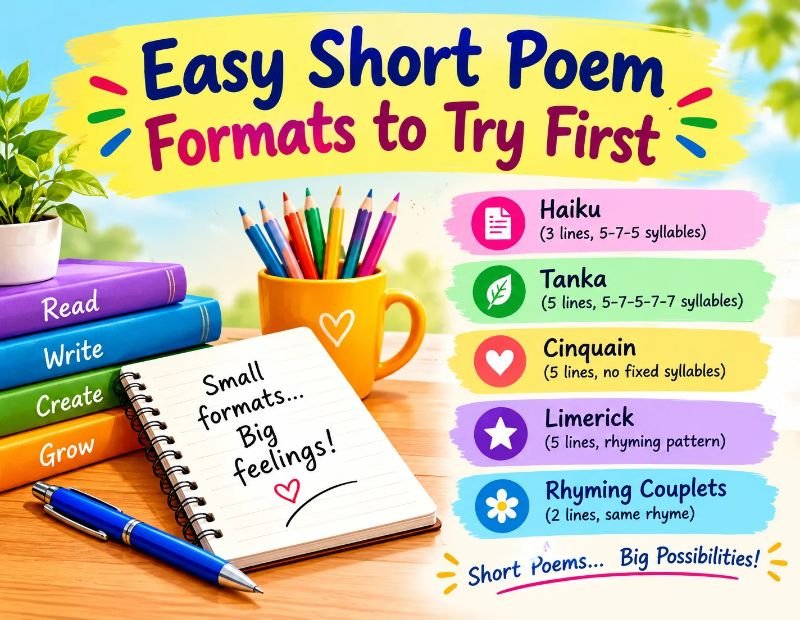
| Format | Structure | Good For |
|---|---|---|
| Haiku | 3 lines, 5-7-5 syllables | Practicing imagery and brevity |
| Couplet | 2 rhyming lines | Practicing rhythm and rhyme |
| Free verse snippet | No fixed structure, 4-6 lines | Practicing natural voice |
| Acrostic | First letters spell a word | Fun, structured beginner exercise |
Steps to Write a Short Poem
- Choose one single image, feeling, or moment as your focus.
- Write down every sensory detail connected to it.
- Select only the strongest two or three details.
- Arrange them into short, deliberate lines.
- Read the poem aloud and trim any unnecessary words.
Short poems teach economy of language early, a skill that continues to matter even as you move toward longer, more complex work.
Where to Submit Poetry for Beginners?
Once you have a few finished poems, sharing them can be a powerful next step, even before you feel fully confident.
Beginner Friendly Places to Submit or Share
- Literary magazines with open submission calls for new and emerging poets.
- Online poetry communities and workshop forums.
- Local open mic nights and community poetry readings.
- University or community literary journals.
- Poetry contests specifically aimed at new writers.
Tips Before Submitting
- Read a publication’s previous issues to understand their style.
- Follow submission guidelines exactly, including formatting and word count..
- Expect rejection as a normal part of the process, not a reflection of your ability.
- Keep a simple tracker of where and when you submitted each poem.
Poetry for Beginners About Life
Life itself is one of the most common and rewarding subjects for beginner poets, since it requires no research, only honest observation.
Common Life Themes New Poets Explore
- Growing up and childhood memory.
- Family relationships and identity.
- Loss, grief, and change.
- Everyday small moments, a morning routine, a walk, a conversation.
- Hope, uncertainty, and self discovery.
Writing about life does not require dramatic events. Some of the most memorable poems come from quiet, ordinary moments described with unusual attention and honesty.
How to Write Poetry for a Beginner’s Book?
If your goal is a full collection rather than a single poem, a slightly different approach helps keep the project manageable.
Steps to Build a Beginner Poetry Collection
- Write consistently first, organize later. Do not worry about a theme until you have a solid body of work.
- Look for natural patterns. After a dozen or more poems, recurring themes or images often emerge on their own.
- Group poems loosely around those themes. This becomes the backbone of your collection.
- Consider the order carefully. The sequence of poems affects how a reader experiences the whole book.
- Revise with fresh eyes. Step away from finished poems for a few weeks before final edits.
- Seek feedback before publishing. A trusted reader or workshop group can catch what you might miss.
Building a full collection is a long term project, so treating early poems as raw material rather than finished chapters helps reduce pressure significantly.
How to Write a Poem by Yourself?
Writing solo, without a class or workshop, is completely possible and how most poets begin.
A Simple Self Guided Process
- Pick a feeling, image, or moment you want to explore.
- Free write for five minutes without editing yourself.
- Underline the strongest phrases or images from that freewrite.
- Build your poem around those strongest fragments.
- Read it aloud and adjust line breaks for rhythm.
- Set it aside, then return with fresh eyes for revision.
Tools That Help Solo Poets
- A dedicated notebook or notes app for quick fragments and ideas..
- A rhyming dictionary or thesaurus for word choice, used sparingly.
- Recorded voice memos to capture spoken rhythm before writing it down.
- A simple daily or weekly writing habit, even five minutes counts.
Poetry for Beginners Reddit
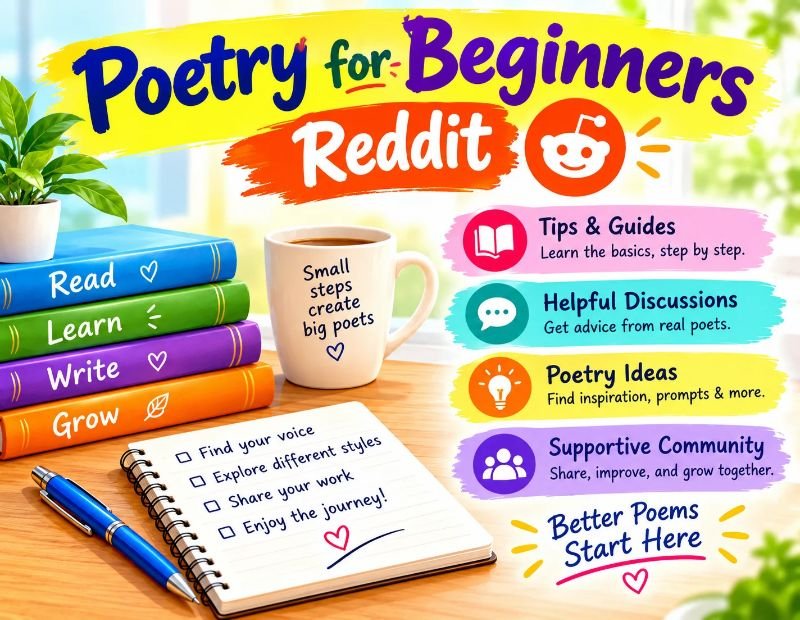
Online communities, particularly on Reddit, have become a popular space for new poets to share work, ask questions, and get informal feedback.
What Beginners Commonly Ask in These Communities?
- Requests for feedback on early drafts.
- Questions about basic structure, meter, or rhyme.
- Recommendations for beginner friendly poetry collections.
- Discussions comparing free verse and traditional forms.
- Encouragement and motivation during creative blocks.
These spaces can be genuinely useful for beginners, since they offer low pressure feedback from other people actively learning the craft, rather than only professional critique.
Poetry for Beginners Course
Structured courses can accelerate learning by offering guided feedback and a clear curriculum, which self study sometimes lacks.
What a Good Beginner Poetry Course Typically Covers?
- Basic poetic terms, meter, imagery, and figurative language.
- Guided writing exercises and prompts.
- Peer or instructor feedback on drafts.
- Introduction to major poetic forms and free verse.
- Revision techniques and workshop etiquette.
Where to Find Beginner Poetry Courses?
- Community colleges and adult education programs.
- Online learning platforms offering self paced poetry classes.
- Local writing centers and literary nonprofits.
- University continuing education departments.
Poetry for Beginners Gabeba Baderoon
“Poetry for Beginners” is also the title of a widely discussed poem by South African poet Gabeba Baderoon, featured in her acclaimed collection The History of Intimacy. The poem reflects on a moment in an evening poetry class for beginners, where a young woman quietly reveals she wants to learn how to write to her imprisoned boyfriend, only to be met with laughter from the group before she withdraws and never returns.
Baderoon has described this moment as central to her own understanding of what poetry actually is, framing it as an act of risk, vulnerability, and connection rather than simple technical skill. The poem is frequently cited in discussions of why beginner spaces in poetry matter, and how easily a first attempt can be discouraged by an unwelcoming environment.
Poetry for Beginners by Margaret Chapman
Poetry For Beginners is also a published nonfiction guidebook written by poet and educator Margaret Chapman, part of the long running “For Beginners” illustrated series. The book traces the history and evolution of poetry from ancient Greece to contemporary writing, using accessible language and illustrations to make the subject approachable for complete newcomers.
Chapman, who has taught poetry extensively through school residencies and community programs, designed the book to demystify poetry’s reputation as difficult or exclusive, instead framing it as a flexible form of expression available to almost anyone willing to try.
Best Poetry for Beginners
For new readers unsure where to start, certain poets and collections consistently stand out for their accessibility and emotional clarity.
| Recommended For | Poet or Collection |
|---|---|
| Accessible, image driven free verse | Mary Oliver |
| Clear, emotionally direct short poems | Langston Hughes |
| Modern, conversational style | Rupi Kaur |
| Strong storytelling through verse | Robert Frost |
| Exploring form and history together | Poetry For Beginners by Margaret Chapman |
Starting with poets known for clarity, rather than dense, highly experimental work, helps build confidence before tackling more challenging poetry later on.
How to Start Poetry for Beginners?
Getting started is often the hardest part, more so than any technical skill.
A Beginner Friendly Starting Routine
- Read a few short poems you genuinely enjoy before writing anything.
- Choose one small, specific moment or feeling as your subject.
- Write freely for a few minutes without worrying about quality.
- Shape those raw lines into a short poem afterward.
- Repeat regularly, even briefly, rather than waiting for inspiration.
Consistency matters far more than any single “perfect” first poem. Most poets look back on their earliest work as a starting point, not a final measure of skill.
How to Analyse Poetry for Beginners?
Analyzing poetry becomes much easier once you know which questions to ask.
Key Questions for Beginner Poetry Analysis
- What is the poem’s central subject or feeling.
- What images or details stand out most strongly.
- Where do the line breaks fall, and why might the poet have chosen them there.
- Is there a shift in tone or perspective partway through the poem.
- What emotional effect does the ending create.
A Simple Step by Step Analysis Method
- Read the poem once for overall impression.
- Read it again slowly, noting striking words or images.
- Identify any patterns in structure, repetition, or sound.
- Consider what the title adds to your understanding.
- Summarize the poem’s core meaning in one or two sentences.
How to Understand Poetry for Beginners?
Understanding poetry is less about finding one hidden correct meaning and more about noticing how language creates effect.
Common Misconceptions That Block Understanding
- Believing every poem has one single hidden meaning.
- Assuming difficult vocabulary is required to “get” a poem.
- Expecting immediate understanding on a first read.
- Overlooking sound and rhythm in favor of only literal meaning.
Poetry often rewards rereading. A poem that feels confusing on a first pass can become much clearer once you slow down and focus on imagery, tone, and structure rather than searching for a single definitive answer.
How to Write Spoken Word Poetry for Beginners?
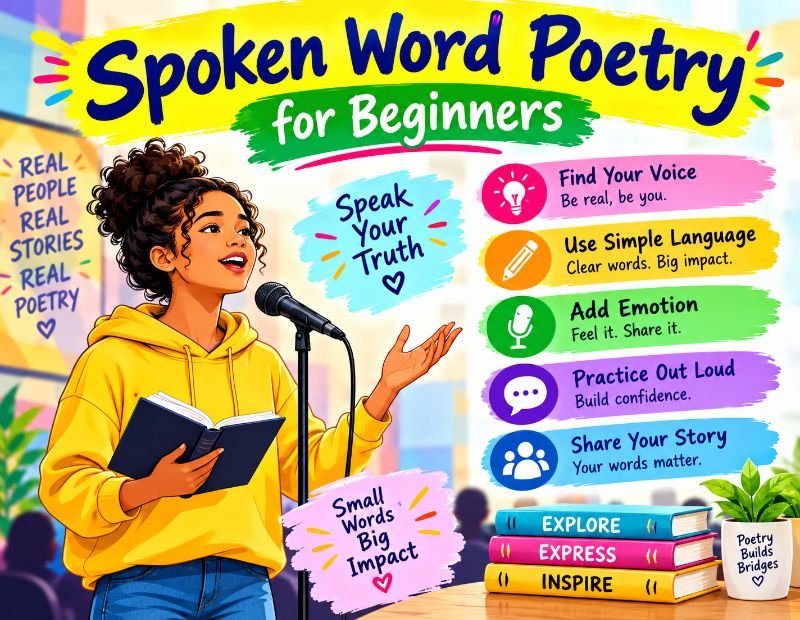
Spoken word poetry is written specifically for performance, which changes how it should be crafted compared to page poetry.
Key Differences Between Spoken Word and Page Poetry
| Element | Spoken Word | Page Poetry |
|---|---|---|
| Primary experience | Heard live | Read silently |
| Rhythm | Often bold and pronounced | Can be subtle |
| Repetition | Frequently used for impact | Used more selectively |
| Delivery | Includes tone, pacing, pauses | Relies purely on text |
Steps to Write Spoken Word Poetry
- Choose a subject with strong emotional stakes.
- Write in a natural, conversational voice.
- Use repetition and rhythm deliberately for emphasis.
- Practice reading it aloud repeatedly before performing.
- Adjust pacing and pauses based on how it sounds, not just how it reads.
Poetry Classes for Beginners
Beyond formal courses, many low commitment options exist for beginners wanting structured guidance.
- Local library workshops, often free or low cost.
- Community center creative writing groups.
- Short term online workshops focused on a single form or theme.
- Weekend retreats and intensive beginner focused sessions.
Poetry Tips for Beginners
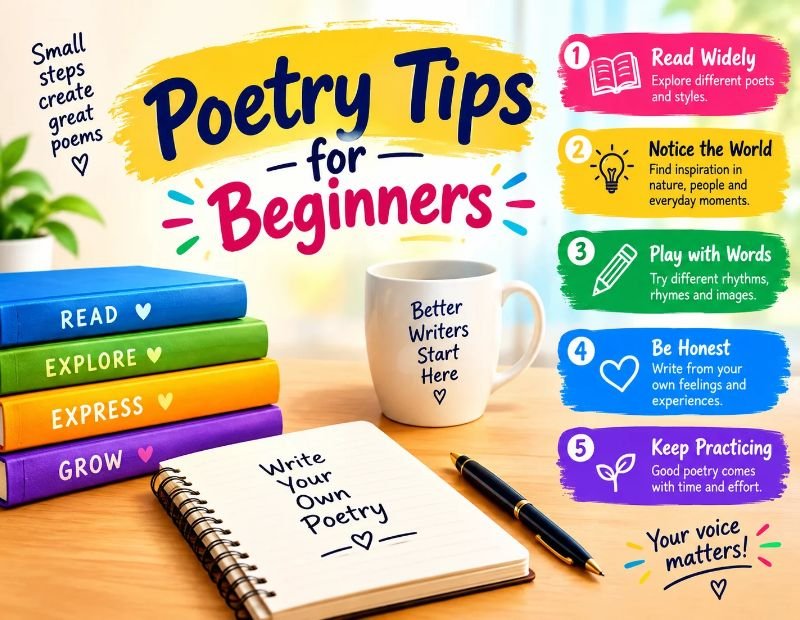
- Write regularly, even if only a few lines at a time.
- Read widely across different poets and styles.
- Do not judge early drafts too harshly.
- Keep a running list of striking words, images, or overheard phrases.
- Study poems you admire to understand how they achieve their effect.
Poetry Prompts for Beginners
- Write about a specific object from your childhood bedroom.
- Describe a sound you associate with a particular memory.
- Write a poem addressed directly to a season.
- Capture a single overheard conversation as a poem.
- Write about the view from your current window.
Poetry Collection for Beginners
For beginners looking to build a personal reading foundation, a small, varied collection works better than diving into one dense anthology.
- A mix of classic and contemporary poets.
- At least one collection of free verse and one of formal, structured poetry.
- A spoken word or performance poetry collection.
- A short anthology covering multiple poets and styles.
French Poetry for Beginners
French poetry offers a strong entry point into rhythm and musicality, given the language’s natural emphasis on sound and cadence. Beginners often start with accessible, widely translated poets before moving into more complex Symbolist or Modernist French poetry, since starting with clear, image driven work builds confidence before tackling denser historical movements.
Spanish Poetry for Beginners
Spanish language poetry for beginners is known for strong imagery and emotional intensity, making it a rewarding entry point for beginners interested in both classic and contemporary Latin American and Spanish poets. Reading bilingual editions, with the original Spanish alongside an English translation, is a particularly helpful starting strategy for new readers.
Urdu Poetry for Beginners
Urdu poetry for beginners, especially the ghazal form, is celebrated for its emotional depth, wordplay, and musical rhythm. Beginners often start with well known, widely anthologized poets before exploring more intricate classical forms, since Urdu poetry frequently rewards understanding both the literal and symbolic layers of each couplet.
English Poetry for Beginners
English poetry for beginners offers perhaps the widest and most accessible entry point for new readers, spanning centuries of classic form alongside contemporary free verse. Beginners are often encouraged to start with shorter, image focused modern poems before working backward into more structurally complex historical poetry, since this builds comfort with poetic language before tackling denser traditional forms.
Common Mistakes Of Poetry For Beginners
- Overusing abstract language instead of grounding the poem in specific, sensory detail
- Forcing rhyme at the expense of natural rhythm and meaning
- Explaining emotion directly rather than showing it through imagery and action
- Comparing early drafts to finished, published poems, which sets unrealistic expectations
- Avoiding revision, treating a first draft as a final version
Final Thoughts
Poetry does not require permission or perfect technique to begin, only a willingness to pay close attention and put language to what you notice. From short first attempts to full collections, from private journaling to spoken word performance, every path into poetry starts the same simple way, one honest line at a time.
Whether you are drawn to Gabeba Baderoon’s reflection on risk and connection, Margaret Chapman’s accessible history of the form, or simply want to write your very first poem tonight, this guide gives you a clear, practical starting point. Keep writing, keep reading, and trust that your voice is already worth putting on the page.
Frequently Asked Questions
What is the easiest type of poetry for beginner to write?
Short forms like free verse snippets, couplets, or haiku are ideal, since they focus on clarity without demanding complex structure.
Do I need to know poetic rules before writing my first poem?
No, basic rules can be learned gradually. Writing first and studying structure alongside your practice works well for most beginners.
How long does it take to get better at writing poetry for beginners?
Consistent practice, even a few minutes regularly, tends to produce noticeable improvement within a few months for most beginners.
Is rhyming necessary in poetry for beginners?
No, free verse without rhyme is widely used and accepted, especially in contemporary poetry for beginners.
Where can beginners get feedback on their poems?
Online communities, local workshops, writing groups, and beginner focused courses all offer accessible feedback opportunities.
What poem is called “Poetry for Beginners” by Gabeba Baderoon about?
It reflects on a poetry for beginner class moment involving vulnerability, risk, and the fear of being judged while learning to write.
Can adults start writing poetry with no prior experience?
Yes, many well known poets began writing later in life, and there is no age requirement or prerequisite experience needed to start.