
Read the line “the sky wore a bruise at sunset” and you do not picture an actual injury. You picture purple and grey clouds, a tender kind of evening, maybe a mood of sadness. That leap from what the words say to what they mean is the heart of figurative poetry.
Figurative poetry uses imaginative language to show ideas, feelings and images in ways plain statements cannot. This guide explains the meaning, rules, characteristics, purposes, types and devices of figurative poetry. It also gives you 25 original examples you can study, borrow ideas from and practise with.
Figurative Poetry Meaning
Figurative poetry is poetry that relies on figurative language. That means words and phrases carry a meaning beyond their literal, dictionary definition. Instead of saying something directly, the poet suggests it through comparison, exaggeration, sound, symbol or contrast.
Here is a simple way to see the difference:
- Literal: The girl was very sad.
- Figurative: Sadness moved into her chest and left its coat on the chair.
Both lines describe the same feeling. The second one makes you feel it, and that is the whole point.
Figurative language is not limited to poems. You find it in songs, novels, speeches and daily conversation. But poetry leans on it more heavily than any other form, which is why it is often called the natural home of figurative expression.
Read Also This Blog: Poetry for Beginners
Rules to Write Figurative Poetry
Poetry has no strict law that every poet must obey, but a few working rules will make your figurative writing stronger.
- Start with a real feeling or image. A comparison works only when it grows from something true.
- Pick fresh comparisons. Phrases like “cold as ice” are worn out. Look for pairings a reader has not met before.
- Keep the comparison logical. The two things you link should share at least one clear quality.
- Stay consistent. If you call grief an ocean, keep the water imagery going instead of jumping to fire in the next line.
- Use one strong device per idea. Stacking five devices in one line confuses the reader.
- Appeal to the senses. Sight, sound, smell, taste and touch make figures of speech land.
- Trust the reader. Do not explain your metaphor after you write it.
- Read it aloud. Sound matters. A figure that looks clever on paper can still sound clumsy.
- Edit ruthlessly. Cut any figure that decorates without adding meaning.
How to Recognize Figurative Poetry?
Spotting figurative poetry is a skill, and you can learn it in a few steps.
- Read the poem twice: Once for the general feel, then again for details.
- Ask whether the line could be literally true: If a river cannot really “swallow the moon,” the line is figurative.
- Look for comparison words: Words such as “like,” “as,” “than” and “seems” often signal a simile.
- Notice human traits on non-human things: A whispering wind or an angry sea is personification.
- Watch for extreme claims: “I could sleep for a century” is hyperbole.
- Underline sensory details: Strong imagery often carries hidden meaning.
- Ask what the comparison suggests: Once you find the figure, think about what qualities move from one thing to the other.
- Connect it to the theme: A good reader links each figure to the poem’s tone, mood and larger message.
This process is a simple form of close reading, and it works on any poem, from a nursery rhyme to a modern free verse piece.
Characteristics of Figurative Poetry
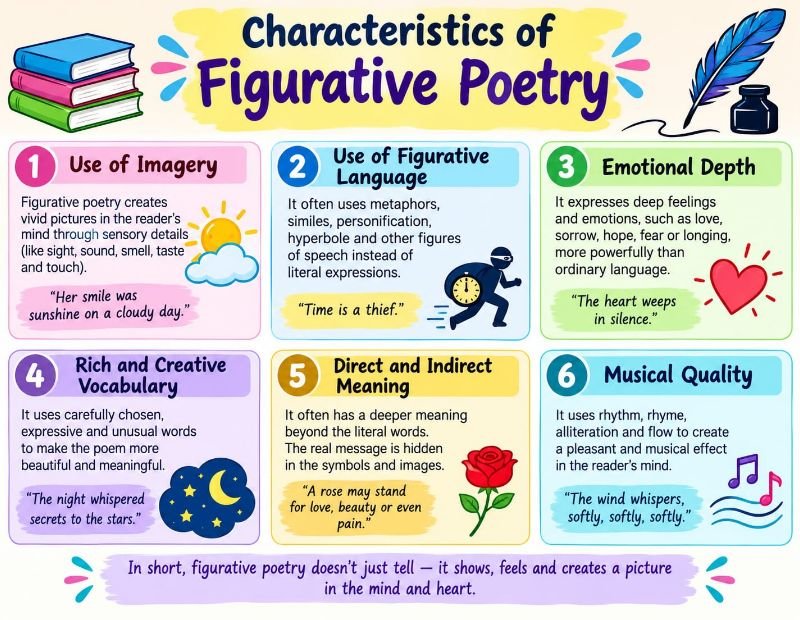
Figurative poetry has several traits that set it apart from plain, literal writing:
- Non-literal meaning: Words point beyond their dictionary definitions.
- Vivid imagery: The reader can see, hear, smell, taste or feel what is described.
- Compression: A single image can carry a whole paragraph of meaning.
- Layered interpretation: More than one reading is often possible.
- Emotional impact: The language is chosen to move the reader, not just inform.
- Symbolic depth: Objects, places and actions stand for larger ideas.
- Musical quality: Many figures use rhythm, repetition and sound patterns.
- Originality: The best figures surprise the reader.
Purpose of Figurative Poetry
Why do poets bother with figures of speech at all? Because they do jobs that literal language cannot.
- To stir the imagination: Figurative language asks the reader to picture something, not just understand it.
- To express the hard to express: Love, loss, fear and wonder are difficult to state plainly. Comparisons give them shape.
- To make ideas memorable: A striking image stays in the mind long after a factual sentence fades.
- To add depth. One line can hold a surface meaning and a hidden one.
- To set tone and mood: A “quiet, folded dusk” feels different from a “blazing, shouting dusk.”
- To connect the abstract and the concrete: Time becomes a thief, hope becomes a lantern.
- To invite interpretation; Readers become active partners in making meaning.
Effects of Figurative Poetry
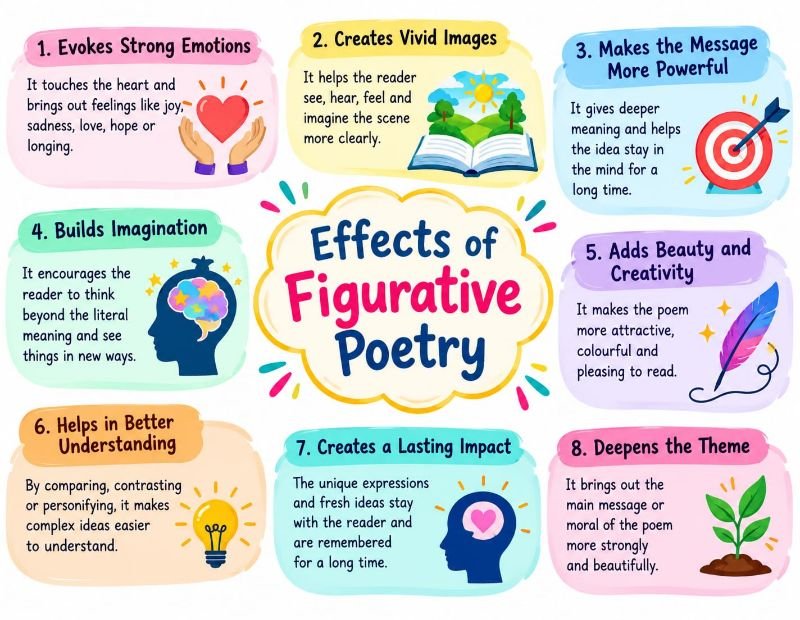
The effect on the reader is where figurative language truly earns its place.
| Effect | What Happens | Example Device |
|---|---|---|
| Emotional response | The reader feels the emotion, not just reads about it | Metaphor, personification |
| Vivid mental pictures | Scenes become clear and sensory | Imagery, simile |
| Emphasis | A key idea stands out | Hyperbole, repetition |
| Musicality | Lines sound pleasing and memorable | Alliteration, assonance |
| Surprise and insight | A new angle on a familiar thing | Paradox, oxymoron |
| Deeper meaning | Layers beyond the literal | Symbolism, allegory |
| Humour or critique | Gentle or sharp commentary | Irony, understatement |
Well-chosen figures also slow the reader down. When a comparison is unexpected, you pause to work out why it fits, and that pause is where the poem does its best work.
Types of Figurative Poetry
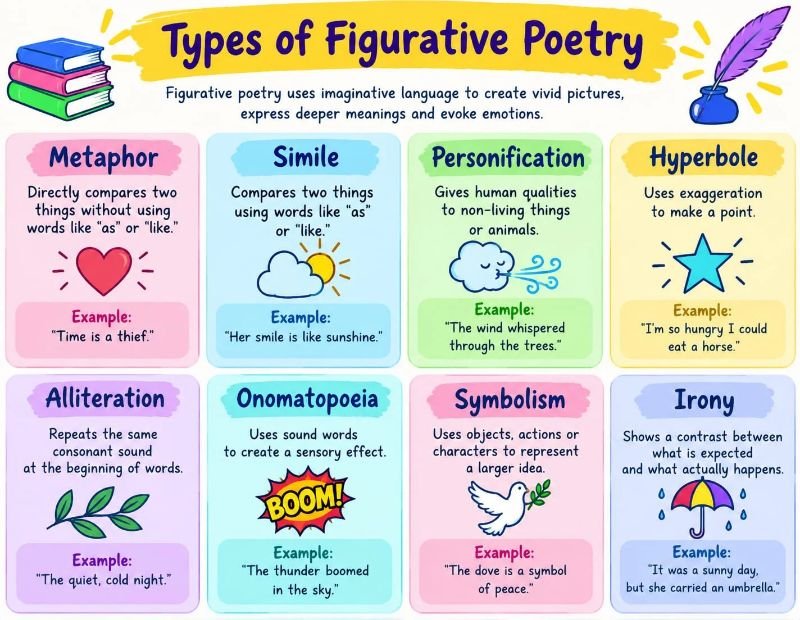
Scholars often group figurative language into broader families. Knowing them helps you sort the many devices you meet.
1. Comparison Based Figures
These link two unlike things. The main types are simile, metaphor, extended metaphor, personification and analogy.
2. Emphasis Based Figures
These strengthen or soften an idea. Hyperbole, understatement and litotes belong here.
3. Sound Based Figures
These use the music of language. Alliteration, assonance, consonance and onomatopoeia are the common ones.
4. Contrast Based Figures
These place opposing ideas side by side. Oxymoron, paradox, antithesis and irony fit this group.
5. Substitution Based Figures
These replace one word with a related one. Metonymy and synecdoche are the key examples.
6. Symbolic and Referential Figures
These point to larger ideas or outside works. Symbolism, allegory and allusion sit here.
7. Sensory Figures
Imagery and synesthesia work directly on the senses.
Tropes vs. Schemes
Grammar experts also split figures of speech into two broad classes:
| Class | Definition | Examples |
|---|---|---|
| Tropes | Change the meaning of words | Metaphor, irony, hyperbole |
| Schemes | Change the order or pattern of words | Anaphora, antithesis, inversion |
25 Examples of Figurative Poetry
Every line below is original. Use them as models, not as text to copy.
| # | Device | Original Example | What It Does |
|---|---|---|---|
| 1 | Simile | Her laughter spilled like coins across the floor. | Compares laughter to bright, scattering coins |
| 2 | Metaphor | The city is a lung that never learns to rest. | Shows the city as a living, breathing thing |
| 3 | Personification | The window sighed as evening leaned against it. | Gives human action to objects |
| 4 | Hyperbole | I have waited a thousand winters for this bus. | Exaggerates for humour or frustration |
| 5 | Symbolism | A cracked bell hangs where the village kept its hope. | The bell stands for lost faith |
| 6 | Imagery | Cinnamon light, warm bread, the kettle’s low hum. | Builds a cosy sensory scene |
| 7 | Alliteration | Silver streams slip softly south. | Repeats the “s” sound for flow |
| 8 | Onomatopoeia | The rain went pitter and plink on the tin roof. | Sound words mimic real sounds |
| 9 | Oxymoron | A loud silence settled in the room. | Joins opposites to show tension |
| 10 | Paradox | The more he gave away, the more he owned. | Seems false but holds a truth |
| 11 | Irony | The fire station burned down on the quietest night. | Outcome opposes expectation |
| 12 | Understatement | After the storm, the roof felt a little airy. | Downplays a big event |
| 13 | Metonymy | The crown grew weary of the pen’s complaints. | Crown means power, pen means writers |
| 14 | Synecdoche | Fifty sails crossed the bay at dawn. | Sails stand for whole ships |
| 15 | Allusion | He carried Pandora’s box in his coat pocket. | Refers to a myth for added weight |
| 16 | Apostrophe | O Moon, patient banker of the night, lend me light. | Addresses a non-human directly |
| 17 | Euphemism | Grandfather has gone to the quiet country. | Softens a painful fact |
| 18 | Anaphora | I remember the rain. I remember the road. I remember your name. | Repeats the opening for rhythm |
| 19 | Litotes | It was no small thing to leave. | Uses a negative to state a positive |
| 20 | Idiom | We finally broke the ice with borrowed jokes. | Uses a set phrase with a figurative sense |
| 21 | Assonance | The low moon groaned over slow, cold roads. | Repeats the long “o” vowel |
| 22 | Antithesis | We built in a day what we mourned for a year. | Balances two opposing ideas |
| 23 | Allegory | Hope wore a threadbare coat and knocked anyway. | Turns an abstract idea into a character |
| 24 | Extended Metaphor | Grief is a house with too many doors, and I have tried each one. | Develops one comparison across lines |
| 25 | Synesthesia | Her voice tasted like warm gold. | Mixes hearing and taste |
Famous Poems to Study with Figurative Poetry
Rather than quote them, here are respected poems where figurative language does heavy lifting. Look them up and read them in full:
- “To Autumn” by John Keats: rich personification of the season.
- “The Road Not Taken” by Robert Frost: an extended metaphor about choices.
- “Hope is the thing with feathers” by Emily Dickinson: hope as a bird.
- “A Poison Tree” by William Blake: anger treated as a growing plant.
- “Ode to a Nightingale” by John Keats: heavy imagery and allusion.
- “The Fish” by Elizabeth Bishop: detailed imagery and simile.
- “Daddy” by Sylvia Plath: bold metaphor and symbolism.
Figurative Poetry vs. Figurative Speech
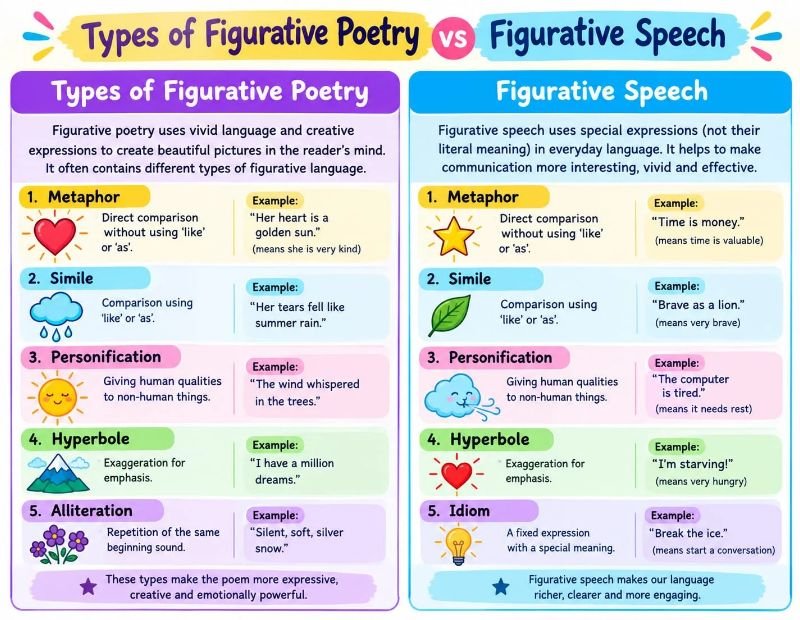
People often mix these two up, so here is a clear comparison.
| Feature | Figurative Poetry | Figurative Speech |
|---|---|---|
| Definition | A poem built around figurative language | Any use of figures of speech in everyday talk or writing |
| Setting | Poems, verse, lyrics | Conversation, speeches, essays, ads |
| Intensity | Often dense and layered | Usually light and casual |
| Purpose | Artistic expression, emotion, imagery | Clarity, humour, emphasis, persuasion |
| Length | Compact but rich | Can be a single phrase |
| Originality | Fresh comparisons are valued | Clichés and idioms are common |
| Example | The evening folded its hands over the town. | It’s raining cats and dogs. |
In short, figurative speech is a tool used by everyone. Figurative poetry is an art form that treats those tools with extra care and purpose.
Devices of Figurative Poetry
Here is a quick guide to the devices you will meet most often, grouped for easy scanning.
Devices of Comparison
- Simile: compares using “like” or “as.”
- Metaphor: states that one thing is another.
- Extended metaphor: carries a metaphor across several lines or the whole poem.
- Personification: gives human traits to non-human things.
- Analogy: explains one idea through a parallel with another.
Devices of Exaggeration and Restraint
- Hyperbole: deliberate overstatement.
- Understatement: deliberate downplaying.
- Litotes: stating something by denying its opposite.
Devices of Contrast
- Oxymoron: two opposite words together, such as “bitter sweet.”
- Paradox: a statement that seems contradictory but reveals truth.
- Antithesis: balanced opposing ideas.
- Irony: meaning that differs from expectation or appearance.
Devices of Sound
- Alliteration: repeated starting consonant sounds.
- Assonance: repeated vowel sounds.
- Consonance: repeated consonant sounds inside words.
- Onomatopoeia: words that imitate sounds.
Devices of Substitution and Reference
- Metonymy: replacing a thing with something closely linked to it.
- Synecdoche: using a part to stand for the whole.
- Allusion: a reference to another work, person or event.
- Symbolism: an object or image representing a larger idea.
- Allegory: a story or poem whose characters and events carry a hidden message.
Devices of Sense and Address
- Imagery: language that appeals to the senses.
- Synesthesia: blending one sense with another.
- Apostrophe: speaking directly to an absent person, object or idea.
Note that some sources treat sound devices as poetic devices instead of strict figurative language. Poetic devices is the wider umbrella. It includes figures of speech but also covers rhyme, meter, form and punctuation.
Creative Uses of Figurative Poetry
Figurative language is useful far beyond the classroom. Here are some fresh ways to use it.
- Song lyrics: most memorable hooks rely on a strong metaphor.
- Greeting cards and toasts: a clever simile turns a plain message into a keepsake.
- Branding and slogans: hyperbole and alliteration make short lines sticky.
- Speeches: a single image can anchor a whole argument.
- Storytelling: figurative openings pull readers in.
- Therapy and journaling: metaphor helps people name feelings they cannot yet describe directly.
- Teaching: figures of speech make abstract lessons easier to remember.
Tips to Improve Your Figurative Poetry
- Read widely. Study how different poets handle comparison and image.
- Keep an image notebook. Jot down odd, striking observations during the day.
- Rewrite your clichés. Take a tired phrase and rebuild it with something specific.
- Practise one device a day. Write a single line using only personification, then only hyperbole.
- Swap the noun. Replace a general word with a precise one. “Bird” becomes “wren,” “tree” becomes “birch.”
- Test each figure. Ask what it adds. If nothing, cut it.
- Read your work to someone. Their reaction shows where a figure lands or falls flat.
Common Mistakes to Avoid
- Mixed metaphors: combining images that clash, such as “the storm of silence bloomed into a mountain.”
- Overloading: cramming too many devices into one stanza.
- Cliché dependence: leaning on stock phrases.
- Over-explaining: killing the effect by spelling out the meaning.
- Forced rhyme: sacrificing meaning just to match sounds.
Frequently Asked Questions
What is figurative poetry in simple words?
Figurative poetry is poetry that uses imaginative, non-literal language such as metaphors and similes to express ideas and feelings in vivid ways.
What are the main types of figurative language in poetry?
The most common are simile, metaphor, personification, hyperbole, imagery, symbolism, alliteration, irony, oxymoron and onomatopoeia.
What is the difference between a simile and a metaphor?
A simile compares two things using “like” or “as,” while a metaphor says one thing is another directly.
Why do poets use figurative language?
Poets use it to create vivid images, express complex emotions, add layers of meaning and make their lines memorable.
How can I identify figurative language in a poem?
Ask whether a line could be literally true. If it cannot, and it suggests a deeper meaning, it is figurative.
Is figurative language the same as poetic devices?
Not exactly. Poetic devices are a wider group that includes figurative language plus sound, structure, rhyme, meter and form.
Is personification a figurative device?
Yes, personification gives human qualities to animals, objects or ideas, and it is one of the most common devices in poetry.
Can figurative poetry be written in free verse?
Yes, figurative language works in any form, including free verse, sonnets, haiku and ballads.
What is an example of figurative poetry?
“The window sighed as evening leaned against it” is a simple example, using personification to create mood.
How many figures of speech are there?
Rhetoricians have catalogued well over 200, though most poets regularly use about twenty.
Conclusion
Figurative poetry turns ordinary words into living pictures. Through comparison, exaggeration, contrast, sound and symbol, poets say things that plain language cannot reach. Once you understand the meaning, rules, types and devices covered in this guide, you can read poems with sharper eyes and write your own with more confidence.
Start small. Pick one device from the table above, write three original lines, and read them aloud. Then try another. With steady practice, your figurative voice will grow stronger and more distinct.