

Most poems do not fail because the writer lacks talent. They fail because the writer stops too early. The first draft shows up, feels finished, and never gets the second look it needs.
Good news: poetry is a skill, and skills grow with practice. You can improve your poetry writing by reading better, observing closely, choosing sharper words, and revising with courage.
This guide gives you 15+ tips, a set of practical techniques, a before and after revision example, and special advice for English, Hindi, and Urdu poets. You will also find a 30 day practice plan and answers to common questions.
What Is Poetry Writing?
Poetry writing is the art of using carefully chosen words, images, sound, and structure to express emotion, ideas, or experience in a compressed form.
A poem says more with fewer words. It relies on imagery, rhythm, line breaks, and figurative language rather than long explanations. Some poems rhyme, and some do not. Some follow strict forms like the sonnet or haiku, while others use free verse.
At its core, poetry writing is about noticing something real and finding the right language for it.
Read Also This Blog: Famous Poets of the World
How to Improve Poetry Writing Skills?
If you want the short version, follow this list:
- Read poetry every day.
- Write a little every day.
- Use concrete images, not vague feelings.
- Replace clichés with fresh comparisons.
- Learn a few literary devices and use them on purpose.
- Read your poem aloud.
- Try different forms.
- Revise more than once.
- Share your work and listen to feedback.
Writing teachers and poetry sites repeat the same core advice: read widely, write often, experiment with form, and treat editing as part of the craft. The rest of this article shows you how to do each step well.
15+ Powerful Tips to Improve Your Poetry Writing
1. Read Poetry Widely to improve poetry writing
Reading is the fastest way to grow. Read classic poets and living poets. Read rhymed poems and free verse. Read poems you love and poems you dislike, then ask why they work or fail.
Keep a reading notebook. Copy down lines that surprise you and note what the poet did. Over time, you will build an instinct for strong language.
2. Build a Daily Writing Habit to improve poetry writing
Ten minutes a day beats a three hour session once a month. Set a small, steady goal. Many writers keep a pocket notebook to capture overheard phrases, odd signs, or small moments from the day.
The habit matters more than the quality at first. Quality comes from volume.
3. Give Yourself Permission to Write Badly to improve poetry writing
Fear blocks more poems than lack of skill. Let the first draft be rough. A messy draft gives you material to shape, but a blank page gives you nothing.
4. Start With Something Concrete to improve poetry writing
Abstract topics like love, loss, and hope are hard to handle directly. Begin with a physical object, a place, or a moment: a cracked mug, a bus stop, your grandfather’s hands.
Concrete detail lets readers feel the emotion without being told what to feel.
5. Show, Don’t Tell to improve poetry writing
Compare these two lines:
- Telling: I felt lonely.
- Showing: Two plates on the table, one still clean.
The second version lets the reader do the feeling. That small shift makes poems stronger.
6. Avoid Clichés to improve poetry writing
Phrases like “heart of gold” or “dark as night” are worn smooth. Readers skim past them. A good test is to ask whether you have heard the phrase before. If yes, replace it with something only you could have noticed.
One practical tip: describe how you actually feel, not how you think a poet should feel.
7. Learn the Main Literary Devices to improve poetry writing
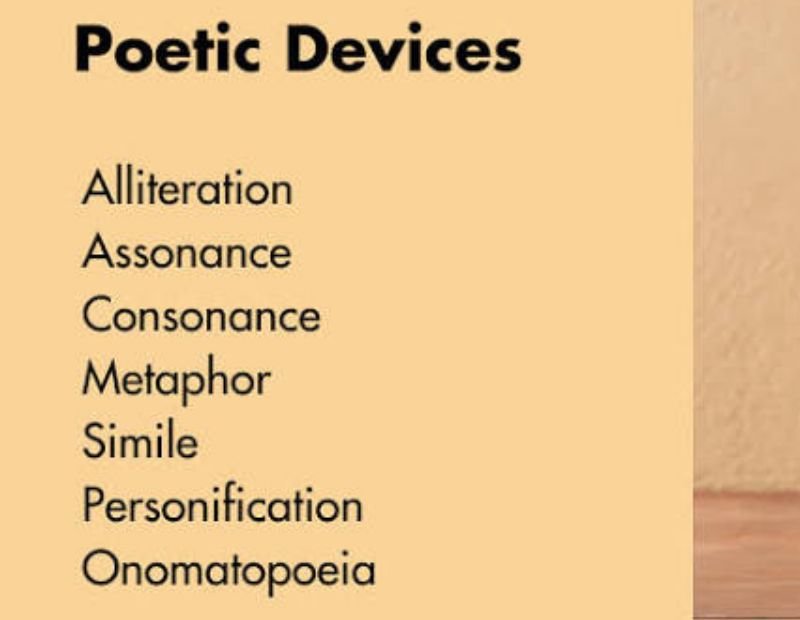
You do not need to memorize a textbook. Start with these:
| Device | What It Does | Quick Example |
|---|---|---|
| Metaphor | Says one thing is another | The city is a sleeping animal |
| Simile | Compares using “like” or “as” | Her voice, like paper tearing |
| Personification | Gives human traits to objects | The kettle sighs |
| Alliteration | Repeats starting sounds | Soft street, silver sleet |
| Assonance | Repeats vowel sounds | Slow rolls the cold moon |
| Enjambment | Carries a sentence across lines | A thought that spills over |
| Juxtaposition | Places opposites together | Silence and a siren |
Pick one device per poem and practice using it with purpose.
8. Train Your Ear for Sound and Rhythm to improve poetry writing
Poetry is music made of words. Notice where a line speeds up, slows down, or stops. Short words and hard sounds feel quick. Long vowels feel slow.
Try writing a few lines in a steady meter, then break the pattern on purpose. Knowing the rule makes the break meaningful.
9. Master the Line Break to improve poetry writing
Where you end a line changes meaning. Break after a strong word to give it weight. Break in the middle of a thought to create tension.
Exercise: take a paragraph you wrote and break it into lines three different ways. Read each version aloud and pick the best one.
10. Experiment With Different Forms to improve poetry writing
Writing in form teaches discipline. Writing out of form teaches freedom. Try both.
- A haiku teaches compression.
- A sonnet teaches argument and turn.
- Free verse teaches rhythm without a safety net.
- An acrostic teaches playful structure.
Playing with form can help you find a style that fits your voice.
11. Use Prompts and Exercises to improve poetry writing
When you feel stuck, prompts break the silence. Try these:
- Write a poem that begins with a smell.
- Describe a room without using the word “I.”
- Write to someone you will never send it to.
- Rewrite a news headline as a poem.
- Describe the same object in three seasons.
12. Revise Like an Editor to improve poetry writing
Most strong poems are made in the rewrite. Let the draft rest for a day, then come back with cold eyes. Cut filler words, weak verbs, and lines that explain too much.
Ask three questions of every line: Is it clear? Is it fresh? Is it needed?
13. Read Aloud to improve poetry writing
Your ear catches what your eye misses. Awkward rhythm, repeated words, and flat endings become obvious when you speak. Record yourself and play it back if you can.
14. Seek Honest Feedback to improve poetry writing
A workshop, writing group, or trusted reader can show you blind spots. Choose people who read poetry and give specific comments. Listen first, then decide what to change. You do not have to accept every suggestion.
15. Find Your Own Voice to improve poetry writing
Imitating poets you admire is a fine way to learn. But over time, let your own vocabulary, rhythm, and subjects take over. Your voice grows from what you notice, how you speak, and what you refuse to fake.
16. Write in Other Genres Too to improve poetry writing
Short stories, essays, and journaling sharpen your language and your eye for detail. Many poets say prose helps them see their poems more clearly.
17. Share, Submit, and Perform to improve poetry writing
Reading at an open mic or submitting to a small journal teaches you how audiences respond. It also builds confidence. Start with local readings or online communities and move up when you are ready.
18. Put Less Pressure on Yourself to improve poetry writing
Poetry should feel like exploration, not an exam. When you relax, the work usually gets better.
10 Best tips to improve poetry writing
| # | Tip | Why It Works |
|---|---|---|
| 1 | Read daily | Builds taste and vocabulary |
| 2 | Write daily | Builds skill through repetition |
| 3 | Use concrete images | Makes feelings visible |
| 4 | Cut clichés | Keeps language fresh |
| 5 | Choose precise verbs | Adds energy and clarity |
| 6 | Control line breaks | Shapes pace and meaning |
| 7 | Read aloud | Reveals rhythm problems |
| 8 | Try new forms | Stretches your range |
| 9 | Revise at least twice | Turns drafts into poems |
| 10 | Get feedback | Shows what you cannot see |
How to Improve Poetry Writing Techniques?
Techniques are the tools you use inside the poem. Here are the ones worth practicing first to improve poetry writing.
| Technique | What to Do | Practice Exercise |
|---|---|---|
| Imagery | Appeal to sight, sound, smell, touch, taste | Write 5 lines using only senses |
| Compression | Remove every nonessential word | Cut a 20 line poem to 10 lines |
| Surprise | End with a turn the reader did not expect | Write a poem that reverses in the last line |
| Repetition | Repeat a word or phrase for effect | Build a poem around a refrain |
| Contrast | Place opposing ideas side by side | Pair a joy and a fear in one image |
| Specificity | Name exact things | Replace “tree” with “walnut tree” |
| Silence | Use white space and short lines | Try a poem of only 6 words per line |
How to Write a Poem by Yourself?
You do not need a teacher to start. Follow this simple process:
- Choose a spark. A memory, an image, a sentence you overheard.
- Free write for five minutes. Do not stop or edit.
- Circle the best images. Highlight the lines that feel alive.
- Shape a first draft. Arrange the strong parts into lines.
- Choose a form or none. Decide on free verse or a set form.
- Cut and sharpen. Remove weak lines and replace vague words.
- Read aloud. Fix rhythm and flow.
- Rest, then revise. Return the next day with fresh eyes.
- Add a title. A good title adds meaning rather than repeating the poem.
A Before and After Revision Example
First draft (original):
I feel so sad today
The rain is falling down
My heart is full of pain
And I just want to frown
Revised version (original):
Rain taps the kitchen window.
My tea has gone cold again.
The second cup you left
still waits beside the sink.
| What Changed | Why It Helps |
|---|---|
| Removed “I feel so sad” | Shows grief instead of naming it |
| Added the second cup | Gives a concrete image with a story |
| Dropped forced rhyme | Lets the language sound natural |
| Shortened and sharpened lines | Creates a quieter, stronger mood |
Which Is the Best Style to improve Poetry Writing?
There is no single best style. The right choice depends on your goal and your experience.
| Style | Best For | Difficulty |
|---|---|---|
| Free verse | Beginners, personal voice, flexible rhythm | Easy to start, hard to master |
| Rhymed verse | Songs, humor, memorable lines | Medium |
| Haiku | Practicing compression and imagery | Easy to learn |
| Sonnet | Learning structure and argument | Hard |
| Prose poetry | Blending story and lyric | Medium |
| Ghazal or nazm | Urdu and Hindi poets exploring tradition | Hard |
| Acrostic | Kids, classroom play, quick drafts | Easy |
Recommendation: Start with free verse and haiku to learn imagery and compression. Then add rhyme and meter to challenge yourself.
How to Improve Poetry Writing in English?
To improve poetry writing in English, focus on these points:
- Expand your vocabulary. Learn one new word a day and use it in a line.
- Study sentence rhythm. Mix short and long sentences.
- Watch for filler words. Cut “very,” “really,” and “just.”
- Choose strong verbs. “Slammed” beats “closed loudly.”
- Read widely. Include American, British, and world poetry in translation.
- Learn basic meter. Understanding iambic and trochaic rhythm helps even if you write free verse.
How to Improve Poetry Writing on Reddit?
Online communities can help, but they work best when you use them well.
- Read the rules first. Many poetry subreddits have posting and critique rules.
- Give feedback before you ask for it. Thoughtful critique earns thoughtful replies. Communities such as r/OCPoetry are built around that exchange.
- Ask specific questions. “Does the ending feel earned?” gets better answers than “What do you think?”
- Filter comments. Look for patterns. If three people stumble over the same line, fix it.
- Do not take every comment as truth. Some advice will be taste, not craft.
- Post only polished drafts. Revise once or twice before sharing.
- Stay kind. A respectful tone keeps you welcome and helps you learn.
How to Improve Poetry Writing Essays?
If you mean essays about poetry, the skill is analysis. A strong poetry essay explains how the poem creates meaning.
Use this structure:
- Introduction: Name the poem, the poet, and your main claim.
- Body paragraphs: Each one should cover one device or idea, such as imagery, tone, or form.
- Evidence: Use short quotations only, and explain each one.
- Effect: Always say what the technique does to the reader.
- Conclusion: Connect your points back to the main idea.
Quick tips:
- Read the poem three times before writing.
- Notice the title, the first line, and the last line.
- Comment on form, such as line length and stanza shape.
- Avoid retelling the poem. Explain how it works.
If you mean writing a poetic essay, such as a lyrical or personal essay, then apply the same poetry skills: concrete images, compression, and rhythm.
How to Improve Poetry Writing in Hindi?
Hindi poetry (कविता) has a rich tradition, from classical forms to modern free verse (नई कविता). Here is how to grow as a Hindi poet.
- Read widely. Study both classical and modern poets. Anthologies of new poetry are a good start.
- Learn the basics of छंद (chhand). Understand मात्रा (matra) counts and तुक (tuk), the rhyme.
- Try a doha. This short couplet form is a good exercise in compression.
- Start with short poems. Practice on abstract and concrete subjects alike.
- Use translation as practice. Translating a short English poem into Hindi, then rewriting it in your own words, can sharpen diction and rhythm.
- Stay with your own voice. Use the language you actually speak, not only formal vocabulary.
- Attend a kavi sammelan or online reading. Listening to live recitation teaches rhythm and delivery.
How to Improve Poetry Writing in Urdu?

Urdu poetry has precise structures, so a little technical knowledge goes a long way.
Know the building blocks of a ghazal:
| Term | Meaning |
|---|---|
| Sher | A couplet that stands on its own |
| Misra | One line of a couplet |
| Matla | The opening couplet, where both lines carry the qafiya and radif |
| Qafiya (قافیہ) | The rhyming word or sound |
| Radif (ردیف) | The exact repeated word or phrase after the qafiya |
| Behr (بحر) | The meter |
| Maqta | The closing couplet, which may include the poet’s pen name |
Practical tips:
- Read before you write. Absorb the work of classical and modern shayars.
- Pick a simple radif and qafiya at first. A complicated pair makes writing harder for beginners.
- Stay with one emotion. A single feeling gives a ghazal more depth.
- Make each sher a complete thought. Each couplet should stand alone while still fitting the whole.
- Read aloud. Urdu poetry is meant to be heard as much as read.
- Learn behr step by step. Many learners study prosody (arooz) in short courses before attempting strict meter.
- Use a qafiya dictionary. It helps you find fitting rhymes while keeping the pattern.
Note that some writers also use free forms like azaad nazm, so you can explore without strict meter while you learn.
Common Mistakes That Hold Poets Back
- Writing only when inspired
- Forcing rhyme at the cost of meaning
- Using abstract words like “pain,” “dream,” and “soul” without images
- Over explaining the point
- Ignoring line breaks
- Never revising
- Comparing yourself to famous poets too early
- Skipping reading
30 Day Poetry Practice Plan
| Week | Focus | Daily Task (15 to 20 minutes) |
|---|---|---|
| 1 | Observation | Write 5 concrete images from your day |
| 2 | Devices | Practice one device per day (metaphor, simile, and so on) |
| 3 | Forms | Try haiku, acrostic, sonnet, and free verse |
| 4 | Revision | Revise one poem each day, then read aloud |
At the end of 30 days, choose your best three poems and share them with a reader or group.
Helpful Habits for Long Term Growth
- Keep a poetry journal for lines, titles, and overheard phrases.
- Read one poem slowly each morning.
- Memorize a poem you love, because memory teaches rhythm.
- Revisit old drafts every few months.
- Attend readings, workshops, or online classes.
- Track your progress by saving dated drafts.
Conclusion
Improve poetry writing is a steady process. Read often, write often, and trust revision. Choose concrete images, cut clichés, and listen to the music of your lines. Experiment with forms until you find the ones that fit your voice, and share your work so you can learn from real readers.
Whether you write in English, Hindi, or Urdu, the path is the same. Start small, stay curious, and keep going. Your next poem is waiting in the next thing you notice.
Frequently Asked Questions (FAQs)
What is poetry writing?
It is the craft of expressing ideas and emotions through compressed language, imagery, rhythm, and form.
How can I improve poetry writing skills quickly?
Read poetry daily, write a little every day, and revise each draft at least twice.
What is the best way to become a better poetry writer?
Combine reading, regular practice, honest feedback, and careful revision.
How do I write a poem by myself?
Pick a concrete image, free write for a few minutes, shape the best lines, then read aloud and revise.
Which is the best style for improve poetry writing?
There is no single best style, but free verse and haiku are great for beginners.
Do I need rhyme to improve poetry writing?
No. Many strong poems do not rhyme, and forced rhyme often weakens a poem.
How do I avoid clichés in poetry?
Replace familiar phrases with specific details from your own experience.
How often should I improve poetry writing?
Aim for a short session daily, even ten minutes, because consistency builds skill.
Is Reddit good for improve poetry writing?
Yes, if you follow rules, give feedback to others, and ask specific questions.
How can I improve poetry writing in Hindi?
Read modern and classical Hindi poets, learn chhand and tuk, and practice with short poems and translation exercises.
How can I improve poetry writing in Urdu?
Start with a simple radif and qafiya, read aloud, and learn behr gradually.
How do I write a good poetry essay?
State a clear claim, analyze devices like imagery and form, support points with short quotes, and explain their effect.
How long does it take to improve poetry writing?
Many writers see clear progress within a few months of steady reading, writing, and revising.