
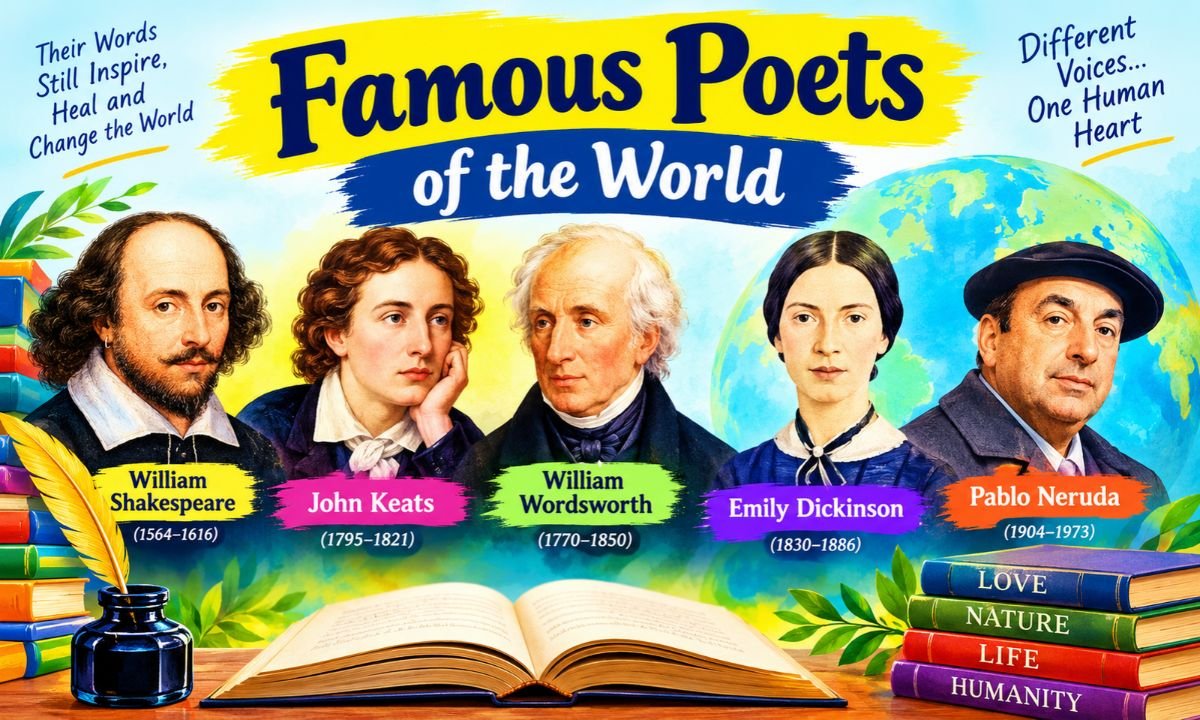
Poetry is one of the oldest art forms humans have. Before novels, newspapers, or films, there were poems spoken around fires, carved into stone, and sung in royal courts. The voices that survived those centuries are the famous poets of the world.
This guide brings together more than 75 remarkable poets across eras, languages, and continents. You will find their best known works, a quick look at what made them matter, and practical advice if you dream of joining their ranks one day.
Definition of a Poet
A poet is a person who writes poetry, which means language shaped by rhythm, imagery, and emotion to express ideas in a compressed and musical way.
Poets work with line breaks, sound, metaphor, and silence. Some write in strict forms like sonnets and ghazals. Others write free verse that follows no fixed pattern. What unites them is a commitment to making language do more than simply inform.
Read Also This Blog: Onomatopoeia in Poetry
Famous Poet Meaning
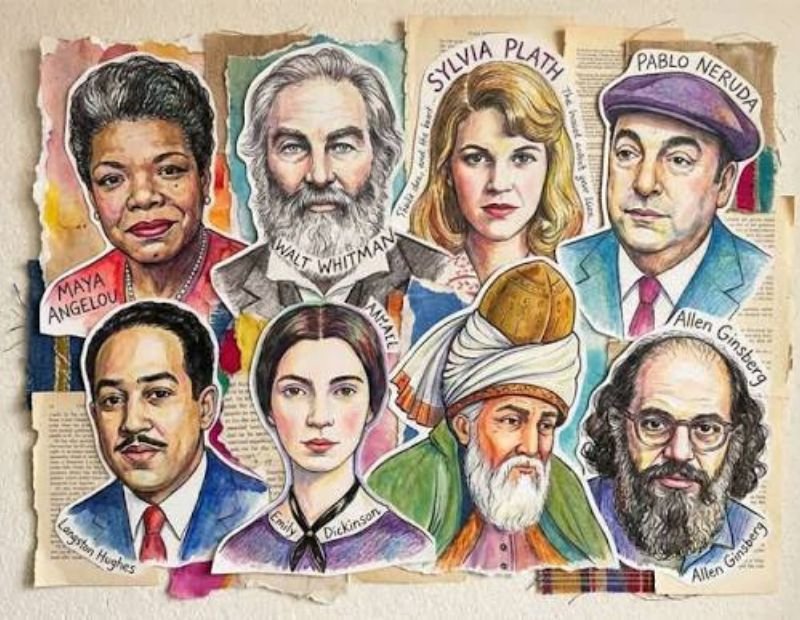
A famous poet is a writer whose poems have gained wide recognition, lasting readership, and cultural influence, often across generations or national borders.
Fame in poetry usually comes from a mix of things:
- Memorable poems that readers quote and recite
- Influence on later writers and literary movements
- Major awards such as the Nobel Prize in Literature or the Pulitzer Prize
- Inclusion in school syllabi and anthologies
- Translation into many languages
- Strong emotional connection with ordinary readers
Who Is the Most Famous Poet Ever?
There is no single agreed answer, because fame depends on language, culture, and era. However, William Shakespeare is the name most often given in English, since his sonnets and plays shaped the language itself.
Other strong contenders include Homer for his ancient epics, Dante for the Divine Comedy, and Rumi for his worldwide spiritual readership. In South Asia, Mirza Ghalib, Allama Iqbal, Kabir, and Tulsidas hold similar status.
Famous Poets of the Ancient and Medieval World
Before the modern centuries, a few giants set the foundations. Here is a quick table of the earliest names that still shape poetry today.
| Poet | Region | Known for |
|---|---|---|
| Homer | Greece | Iliad and Odyssey |
| Sappho | Greece | Lyric fragments about love |
| Virgil | Rome | Aeneid |
| Kalidasa | India | Meghaduta, Abhijnanashakuntalam |
| Li Bai | China | Quiet Night Thoughts |
| Du Fu | China | Poems of war and compassion |
| Rumi | Persia | Masnavi, Divan of Shams |
| Hafez | Persia | Ghazals in the Divan |
| Dante Alighieri | Italy | Divine Comedy |
| Geoffrey Chaucer | England | Canterbury Tales |
Famous Poets of the World in the 18th Century
The 1700s balanced order and reason with the first stirrings of emotion and nature. It was an age of satire, elegy, and early Romantic feeling.
| Poet | Country | Famous work |
|---|---|---|
| Alexander Pope | England | The Rape of the Lock |
| Thomas Gray | England | Elegy Written in a Country Churchyard |
| Robert Burns | Scotland | To a Mouse, Auld Lang Syne |
| William Blake | England | Songs of Innocence and of Experience |
| Phillis Wheatley | United States | Poems on Various Subjects |
| Johann Wolfgang von Goethe | Germany | Faust |
| Friedrich Schiller | Germany | Ode to Joy |
| Mir Taqi Mir | India | Urdu ghazals and Nikat-ush-Shu’ara |
| Yosa Buson | Japan | Haiku and painterly verse |
| Kobayashi Issa | Japan | Haiku about small creatures |
Phillis Wheatley deserves special mention. She was the first African American woman to publish a book of poems, and she did so against enormous odds.
Famous Poets of the World in the 19th Century
The 1800s were a golden age. Romanticism, Victorian reflection, Symbolism, and the birth of modern American verse all appeared in this single century.
| Poet | Country | Famous work |
|---|---|---|
| William Wordsworth | England | I Wandered Lonely as a Cloud |
| Samuel Taylor Coleridge | England | The Rime of the Ancient Mariner |
| Lord Byron | England | Don Juan |
| Percy Bysshe Shelley | England | Ozymandias |
| John Keats | England | Ode to a Nightingale |
| Alfred Tennyson | England | In Memoriam |
| Robert Browning | England | My Last Duchess |
| Elizabeth Barrett Browning | England | Sonnets from the Portuguese |
| Christina Rossetti | England | Goblin Market |
| Matthew Arnold | England | Dover Beach |
| Gerard Manley Hopkins | England | The Windhover |
| Walt Whitman | United States | Leaves of Grass |
| Emily Dickinson | United States | Because I could not stop for Death |
| Edgar Allan Poe | United States | The Raven |
| Henry Wadsworth Longfellow | United States | The Song of Hiawatha |
| Charles Baudelaire | France | Les Fleurs du mal |
| Arthur Rimbaud | France | A Season in Hell |
| Alexander Pushkin | Russia | Eugene Onegin |
| Heinrich Heine | Germany | Book of Songs |
| Mirza Ghalib | India | Diwan-e-Ghalib |
Keats died at just 25, yet his odes are still taught everywhere. Dickinson published only a handful of poems in her lifetime, and her nearly 1,800 poems were discovered after her death.
Famous Poets of the World in the 20th Century
Modernism broke old rules. Poets experimented with free verse, fragmented imagery, protest, and personal confession. Two world wars and independence movements gave the century its urgency.
| Poet | Country | Famous work |
|---|---|---|
| W. B. Yeats | Ireland | The Second Coming |
| T. S. Eliot | United States and England | The Waste Land |
| Robert Frost | United States | The Road Not Taken |
| Ezra Pound | United States | The Cantos |
| Wallace Stevens | United States | The Emperor of Ice Cream |
| Langston Hughes | United States | The Weary Blues |
| Maya Angelou | United States | Still I Rise |
| Gwendolyn Brooks | United States | We Real Cool |
| Allen Ginsberg | United States | Howl |
| Sylvia Plath | United States | Ariel |
| Ted Hughes | England | Crow |
| W. H. Auden | England | Funeral Blues |
| Dylan Thomas | Wales | Do Not Go Gentle into That Good Night |
| Philip Larkin | England | High Windows |
| Seamus Heaney | Ireland | Death of a Naturalist |
| Pablo Neruda | Chile | Twenty Love Poems and a Song of Despair |
| Federico García Lorca | Spain | Gypsy Ballads |
| Rainer Maria Rilke | Austria | Duino Elegies |
| Anna Akhmatova | Russia | Requiem |
| Wisława Szymborska | Poland | View with a Grain of Sand |
| Czesław Miłosz | Poland | The Captive Mind (prose) and Selected Poems |
| Octavio Paz | Mexico | Sunstone |
| Derek Walcott | Saint Lucia | Omeros |
| Rabindranath Tagore | India | Gitanjali |
| Allama Iqbal | India | Bang-e-Dra |
| Faiz Ahmad Faiz | Pakistan | Naqsh-e-Faryadi |
Tagore became the first non European Nobel laureate in Literature in 1913. Several others on this list, including Yeats, Eliot, Neruda, Heaney, Szymborska, Miłosz, Paz, and Walcott, also received the Nobel Prize.
Famous Poets of the World in the 21st Century
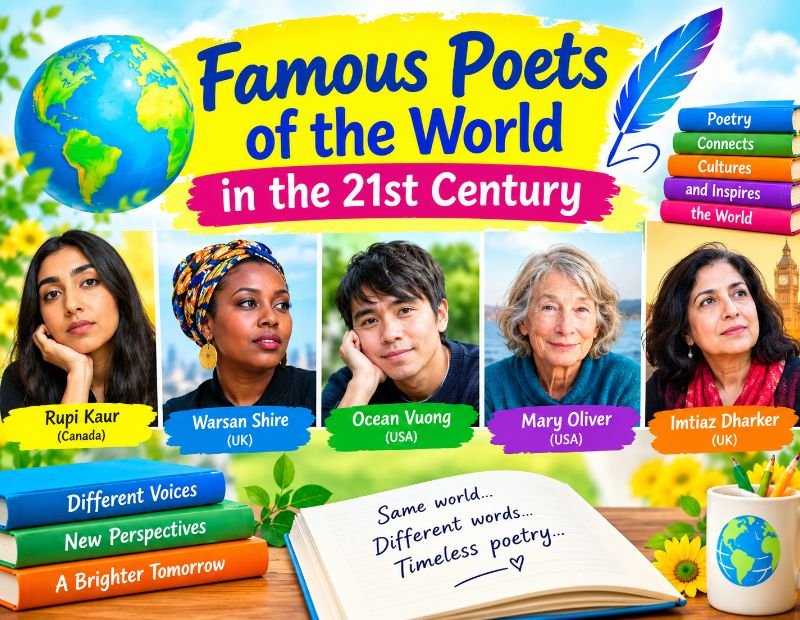
Today’s poetry lives on stages, in social media, and in classrooms at once. Many of these poets are still writing, so their best work may be ahead of them.
| Poet | Country | Famous work |
|---|---|---|
| Louise Glück | United States | The Wild Iris |
| Mary Oliver | United States | Wild Geese |
| Ada Limón | United States | The Carrying, The Hurting Kind |
| Joy Harjo | United States | An American Sunrise |
| Billy Collins | United States | Sailing Alone Around the Room |
| Amanda Gorman | United States | The Hill We Climb |
| Ocean Vuong | United States | Night Sky with Exit Wounds |
| Claudia Rankine | United States | Citizen |
| Tracy K. Smith | United States | Life on Mars |
| Natasha Trethewey | United States | Native Guard |
| Jericho Brown | United States | The Tradition |
| Danez Smith | United States | Don’t Call Us Dead |
| Kaveh Akbar | United States | Pilgrim Bell |
| Ilya Kaminsky | United States | Deaf Republic |
| Anne Carson | Canada | Autobiography of Red |
| Carol Ann Duffy | Scotland | Rapture |
| Simon Armitage | England | Seamus Heaney’s translation tradition, original collections like Zoom! |
| Warsan Shire | Somali British | Teaching My Mother How to Give Birth |
| Kae Tempest | England | Let Them Eat Chaos |
| Rupi Kaur | Canada | Milk and Honey |
Louise Glück won the Nobel Prize in Literature in 2020. She passed away in 2023, and her work remains widely read.
Most Famous Poets of the World in 2025
Fame changes every year, but certain names dominate search interest, school lists, and social media. Rankings are always subjective, yet these poets appear again and again.
- William Shakespeare for timeless sonnets
- Rumi for spiritual and love poetry
- Emily Dickinson for compact, haunting verse
- Robert Frost for accessible nature poems
- Maya Angelou for strength and resilience
- Pablo Neruda for romance and politics
- Mary Oliver for gentle reflections on nature
- Rupi Kaur for short, shareable poems
- Amanda Gorman for public and performance poetry
- Gulzar for lyrical poetry in Hindi and Urdu
Social media has changed how poems travel. A short poem can now reach millions in a day, which has opened the door for new voices.
Famous Poets of English
English poetry spans more than a thousand years. If you want a simple path through it, follow these major stops.
- Medieval: Geoffrey Chaucer
- Renaissance: William Shakespeare, John Donne, Edmund Spenser, Christopher Marlowe
- 17th century: John Milton, Andrew Marvell
- Romantic: Wordsworth, Coleridge, Byron, Shelley, Keats
- Victorian: Tennyson, Browning, Rossetti
- Modern: Yeats, Eliot, Auden, Larkin
- Contemporary: Seamus Heaney, Carol Ann Duffy, Simon Armitage, Benjamin Zephaniah
John Milton’s Paradise Lost remains one of the greatest epic poems in the language. Benjamin Zephaniah, who died in 2023, brought Black British voices and performance poetry into mainstream classrooms.
Famous Poets of Urdu
Urdu poetry is known for the ghazal, the nazm, and the marsiya. Its emotional depth and musical sound have made it beloved across Pakistan, India, and the diaspora.
| Poet | Known for |
|---|---|
| Mir Taqi Mir | Master of the classical ghazal, called the god of poetry |
| Mirza Ghalib | Philosophical and witty ghazals |
| Allama Iqbal | Poet of the East and philosopher of selfhood |
| Faiz Ahmad Faiz | Revolutionary and romantic poetry |
| Josh Malihabadi | Passionate nazms and revolutionary themes |
| Firaq Gorakhpuri | Modern ghazal with deep feeling |
| Nasir Kazmi | Gentle, melancholic ghazals |
| Ahmad Faraz | Romantic and protest verse |
| Parveen Shakir | Pioneer of feminine voice in Urdu |
| Jaun Elia | Raw, ironic poetry beloved by young readers |
| Habib Jalib | Poet of the people and political resistance |
| Sahir Ludhianvi | Poetry and film songs with social conscience |
| Kaifi Azmi | Progressive poet and lyricist |
| Gulzar | Contemporary poet and filmmaker |
Famous Poets of Hindi
Hindi poetry covers devotional bhakti verse, the Chhayavad movement, and modern social poetry.
| Poet | Known for |
|---|---|
| Kabir | Dohas on unity and honest living |
| Tulsidas | Ramcharitmanas |
| Surdas | Devotional verses on Krishna |
| Mirabai | Bhajans of love and devotion |
| Jaishankar Prasad | Kamayani |
| Suryakant Tripathi Nirala | Free verse pioneer |
| Sumitranandan Pant | Nature poetry of the Chhayavad school |
| Mahadevi Verma | Lyrical poems of longing and sorrow |
| Maithili Sharan Gupt | National poet, Bharat Bharati |
| Ramdhari Singh Dinkar | Poems of heroism like Rashmirathi |
| Harivansh Rai Bachchan | Madhushala |
| Subhadra Kumari Chauhan | Jhansi Ki Rani |
| Atal Bihari Vajpayee | Politician and poet |
| Kumar Vishwas | Popular stage poetry |
20 Famous Poets of the World with Their Work
Here is a compact reference for twenty poets whose names appear on almost every list of the greatest.
| Poet | Best known work | Why they matter |
|---|---|---|
| Homer | Iliad, Odyssey | Father of epic poetry |
| Dante | Divine Comedy | Defined Italian literature |
| Rumi | Masnavi | Mystical love poetry |
| Shakespeare | Sonnet 18 | Shaped English language |
| Matsuo Basho | The Narrow Road to the Deep North | Master of haiku |
| John Milton | Paradise Lost | Greatest English epic |
| William Blake | Songs of Innocence and of Experience | Visionary Romantic |
| William Wordsworth | Lyrical Ballads | Nature and everyday speech |
| John Keats | Ode to a Nightingale | Sensory beauty |
| Walt Whitman | Leaves of Grass | Voice of democracy |
| Emily Dickinson | Hope is the thing with feathers | Daring brevity |
| Rabindranath Tagore | Gitanjali | Nobel winning mysticism |
| W. B. Yeats | The Second Coming | Irish modern master |
| T. S. Eliot | The Waste Land | Landmark of modernism |
| Robert Frost | The Road Not Taken | Rural, accessible wisdom |
| Pablo Neruda | Twenty Love Poems | Love and politics |
| Maya Angelou | Still I Rise | Courage and dignity |
| Allama Iqbal | Bang-e-Dra | Awakening and selfhood |
| Mirza Ghalib | Diwan-e-Ghalib | Peak of Urdu ghazal |
| Sylvia Plath | Ariel | Confessional intensity |
Powerful Words from Famous Poets
A few short lines show why these poets endure.
- John Keats: “A thing of beauty is a joy for ever.” Beauty lasts beyond the moment.
- Percy Bysshe Shelley: “If Winter comes, can Spring be far behind?” Hope follows hardship.
- Emily Dickinson: “Hope is the thing with feathers.” Hope as a small, singing bird.
- Walt Whitman: “I contain multitudes.” Every person is many people at once.
- Robert Frost: “Two roads diverged in a wood.” Life is a series of choices.
How to Become a Famous Poet of the World?
Fame is never guaranteed, but a steady path improves your odds. Follow these steps.
- Read widely. Study classic and contemporary poets in different languages and styles.
- Write every day. Even ten minutes builds skill and discipline.
- Find your own voice. Imitate to learn, then write about what only you can say.
- Join a workshop. Honest feedback helps you grow faster.
- Revise without mercy. Great poems are rewritten many times.
- Submit to magazines. Start with local and online journals, then aim higher.
- Perform your work. Open mics and readings build an audience and confidence.
- Share online. Instagram, YouTube, and blogs let your poems travel.
- Publish a collection. A chapbook or book gives your work permanence.
- Enter contests and fellowships. Awards bring attention and credibility.
- Be patient. Many famous poets were recognized late.
Basic Rules to Write the Best Poetry
Rules in poetry are meant to be understood first, then bent. These basics help beginners write stronger poems.
- Show, do not tell. Use images instead of stating emotions directly.
- Choose precise words. Replace vague words with exact, vivid ones.
- Use fresh metaphors. Avoid clichés like “heart of stone.”
- Listen to sound. Read aloud and notice rhythm, rhyme, and repetition.
- Cut the extra. Every word must earn its place.
- Use line breaks with purpose. A break creates a pause or a surprise.
- Be honest. Readers feel false emotion quickly.
- Start with a concrete detail. A single image can open a whole poem.
- Learn forms. Sonnets, haiku, ghazals, and villanelles teach discipline.
- End with resonance. Leave the reader thinking, not lectured.
Conclusion
The famous poets of the world come from every century, language, and background, yet they share one gift. They found words that made people feel seen. From Homer’s ancient epics to Rupi Kaur’s modern verses, from Ghalib’s ghazals to Dickinson’s quiet dashes of genius, each poet added a new voice to a conversation that never ends.
If you want to explore further, pick one poet from this list and read five of their poems slowly. Then write one of your own. That is how every famous poet began.
Frequently Asked Questions
What is the definition of a poet?
A poet is someone who writes poetry, using rhythm, imagery, and emotion to express ideas in condensed, artistic language.
What does famous poets mean?
A famous poets are writer whose poems are widely read, remembered, and influential across generations.
Who is the most famous poet ever?
Shakespeare is the most commonly named, though Homer, Dante, and Rumi are also strong contenders.
Who are the famous poets of the 18th century?
The famous poets: Alexander Pope, Robert Burns, William Blake, Thomas Gray, Goethe, Schiller, and Mir Taqi Mir are among the best known.
Who are the famous poets of the 19th century?
The famous poets: Wordsworth, Keats, Byron, Shelley, Tennyson, Whitman, Dickinson, Poe, and Ghalib are leading names.
Who are the famous poets of the 20th century?
The famous poets: Yeats, Eliot, Frost, Neruda, Maya Angelou, Seamus Heaney, Tagore, and Faiz are among the most celebrated.
Who are the famous poets of the 21st century?
The famous poets: Louise Glück, Ada Limón, Amanda Gorman, Ocean Vuong, Joy Harjo, and Rupi Kaur are widely recognized.
Who are the famous English poets?
The famous poets of English :Chaucer, Shakespeare, Milton, Wordsworth, Keats, Tennyson, Yeats, Auden, and Larkin are major names.
Who are the famous Urdu poets?
The famous poets of Urdu :Mir Taqi Mir, Ghalib, Iqbal, Faiz, Ahmad Faraz, Parveen Shakir, and Jaun Elia are among the most loved.
Who are the famous Hindi poets?
Kabir, Tulsidas, Mahadevi Verma, Nirala, Harivansh Rai Bachchan, and Ramdhari Singh Dinkar are well known.
Who are the most famous poets of the world in 2025?
Shakespeare, Rumi, Dickinson, Frost, Maya Angelou, Mary Oliver, Rupi Kaur, and Amanda Gorman remain very popular.
How can I become a famous poet?
Read widely, write daily, find your voice, share your work through readings and publications, and stay patient.
What are the basic rules for writing good poetry?
Use vivid imagery, precise words, strong sound, purposeful line breaks, and honest emotion, and cut every unnecessary word.