
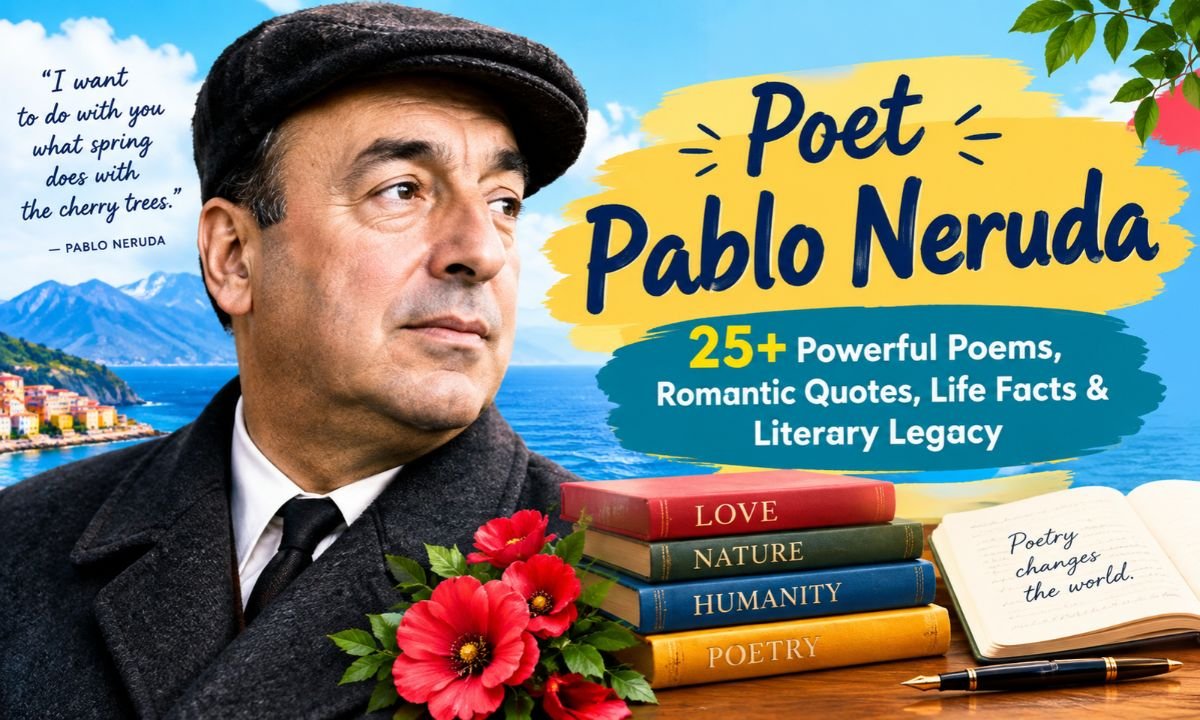
Poet Pablo Neruda is one of the most loved voices in world literature. He wrote about passionate love, the sea, politics, loneliness, onions and socks, and he made all of it sound like music. Readers still reach for his books today, more than fifty years after his death.
This guide covers who he was, where he came from, how he studied, what he wrote and why it lasts. It also includes original poems written in his spirit, because his actual poems are still under copyright.
A quick note on the poems: Neruda’s own verses are protected, so I have not copied them here. Every poem below is original and written in the mood of his work. Each one is marked with the sign ❖ so you can spot it easily.
Poet Pablo Neruda: Quick Facts

| Detail | Information |
|---|---|
| Birth name | Ricardo Eliécer Neftalí Reyes Basoalto |
| Pen name | Pablo Neruda |
| Born | 12 July 1904, Parral, Chile |
| Died | 23 September 1973, Santiago, Chile |
| Nationality | Chilean |
| Occupations | Poet, diplomat, senator, translator |
| Best known for | Love poetry, political epic, odes to everyday objects |
| Major honour | Nobel Prize in Literature, 1971 |
| First book | Crepusculario (1923) |
| Breakthrough book | Twenty Love Poems and a Song of Despair (1924) |
Read Also This Blog: Poetry Contest
Poet Pablo Neruda Was From Which South American Country?
Poet Pablo Neruda was from Chile. He was born in Parral, a small town in the Maule region of central Chile, and he grew up in the rainy southern town of Temuco. The wet forests, rivers, rail yards and ocean air of Chile appear again and again in his writing. That is why he is called the Chilean poet Pablo Neruda, and why he is celebrated as a national treasure.
For crossword fans, a clue like “Poet Pablo Neruda, for one” usually points to the answer CHILEAN or POET, depending on the number of squares.
Poet Pablo Neruda Biography
Early Life in Chile
Neruda’s mother, a schoolteacher, died of tuberculosis only weeks after he was born. His father worked on the railways and moved the family to Temuco, where he married again. Neruda later called his stepmother his “Mamadre,” a tender mix of the Spanish words for mother and mother again.
Temuco was a frontier town, damp and green and full of trains. The young boy collected beetles, feathers, stones and odd objects. That habit of collecting stayed with him for life.
A Teenage Poet and a New Name
Neruda started writing as a child. By his mid teens his poems were appearing in local papers. His father did not approve of a son who wrote verse, so the teenager took a pen name to stay out of trouble.
He chose Pablo Neruda, partly in honour of the Czech writer Jan Neruda. He used the name for the rest of his life, and in 1946 it became his legal name.
Gabriela Mistral and Early Encouragement
In Temuco he met Gabriela Mistral, who ran a girls’ school and went on to win the Nobel Prize herself. She encouraged the shy boy and handed him books. Many biographers see her as his first real literary mentor.
Diplomat and Wanderer
In 1927 Neruda began a diplomatic career. He served as consul in Rangoon, Colombo, Batavia, Singapore, Buenos Aires, Barcelona, Madrid and Mexico. These postings were lonely and strange, and they fed the dark, dreamlike poems of Residence on Earth.
In Spain he befriended Federico García Lorca and other poets of the Generation of 27. The Spanish Civil War shook him deeply. After Lorca was killed, Neruda turned toward a poetry of struggle and solidarity.
Politics, Exile and Return
Neruda was elected a senator in 1945 and joined the Communist Party of Chile. When the government turned against the party, he spoke out, and in 1948 he had to go into hiding. He escaped across the Andes on horseback in 1949 and spent years in exile.
He came home in 1952. In 1970 he was named a presidential candidate for his party, then stepped aside in support of Salvador Allende. Allende made him ambassador to France.
Nobel Prize and Final Days
In 1971 Neruda received the Nobel Prize in Literature. He was by then seriously ill with cancer. He returned to Chile and died on 23 September 1973, just days after the military coup.
Thousands of mourners joined his funeral procession, which became one of the first public protests against the new regime. In later years, questions were raised about whether his death was natural. Investigations have stayed inconclusive, and the matter is still debated.
Poet Pablo Neruda Education
Neruda’s schooling shaped his taste for language and for teaching.
- He studied at the Liceo de Hombres in Temuco, the boys’ secondary school of his hometown.
- In 1921 he moved to Santiago to study French and pedagogy at the Instituto Pedagógico of the University of Chile.
- He planned to become a French teacher, but poetry quickly took over his life.
- Much of his real education came from reading, travel, translation and friendships with other writers.
He read French poets, Spanish classics, Whitman and Rimbaud. He also translated works into Spanish, which sharpened his ear for rhythm.
Chilean Poet Pablo Neruda: Why His Style Feels Different
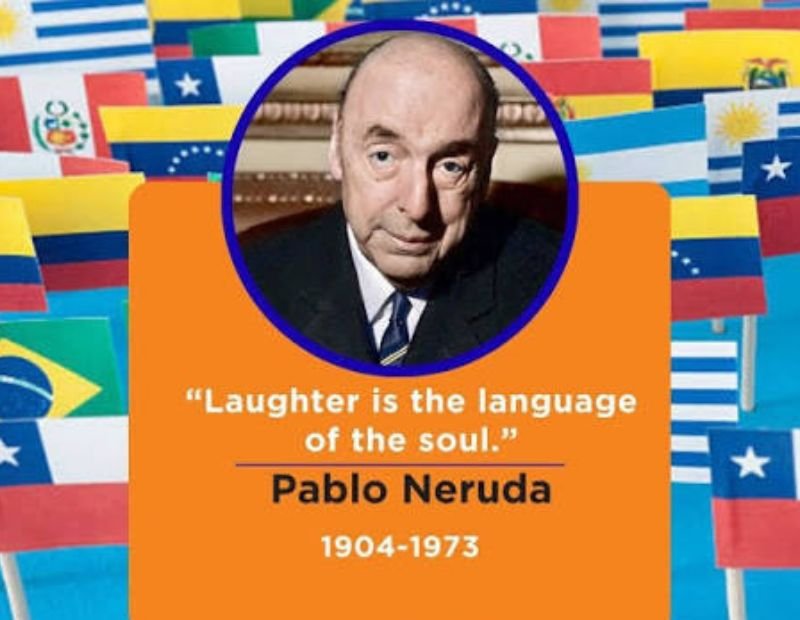
Neruda did not write in just one voice. His career moved through several distinct phases.
- Romantic early phase: Young love, rain, longing and the night.
- Surrealist phase: Strange images, fear and isolation, seen mostly in Residence on Earth.
- Political phase: Epic verse about history, workers and Latin America, as in Canto General.
- Elemental phase: Simple odes to ordinary things such as bread, salt, tomatoes and socks.
- Late reflective phase: Memory, ageing, sea and silence.
This range is a big reason scholars rank him among the greatest Spanish poets of the twentieth century. Readers who dislike one phase often fall in love with another.
Major Works of Poet Pablo Neruda
| Book | Year | What It Is Known For |
|---|---|---|
| Crepusculario | 1923 | Debut collection of twilight moods |
| Twenty Love Poems and a Song of Despair | 1924 | Youthful desire and heartbreak, hugely popular |
| Residence on Earth | 1933 to 1935 | Surreal, anxious, dense images |
| Canto General | 1950 | Epic history of Latin America |
| Elementary Odes | 1954 to 1959 | Praise for simple everyday things |
| Extravagaria | 1958 | Playful, personal, reflective |
| One Hundred Love Sonnets | 1959 | Mature love, written for his wife Matilde |
| Memoirs (posthumous) | 1974 | His own account of an eventful life |
Poetry Foundation by Poet Pablo Neruda: Where to Read Him Online
If you want reliable biographies and translated selections, start with trusted literary sites.
- Poetry Foundation hosts a biography page and selected poems with translator credits.
- Poets.org from the Academy of American Poets offers a short profile and teaching resources.
- NobelPrize.org provides his Nobel biography and the award speech.
- Fundación Pablo Neruda in Chile runs the official archive, museums and house tours.
Always check which translator you are reading. A poem can feel quite different in the hands of Alastair Reid, Mark Eisner, Stephen Mitchell or William O’Daly. Reading two translations side by side is one of the best ways to understand his craft.
Spanish Poetry by Poet Pablo Neruda

Neruda wrote in Spanish, and many fans say the original has a music no translation fully catches. His Spanish is simple on the surface and rich underneath. He loved long lists, rolling repetition, and the sound of the letter r.
If your Spanish is limited, try a bilingual edition. The Spanish text sits on one page, the English on the other, and you can follow the rhythm even without perfect fluency. Listening to recordings of Neruda reading his own work is another good habit.
Poetry Analysis by Poet Pablo Neruda: Themes to Look For
When analysing his work, these ideas appear again and again:
- Love and the body: Desire is physical, earthy and never shy.
- Nature as a character: The sea, mountains, rain and stones feel alive.
- Loneliness and absence: Even his happy poems hold a shadow.
- Everyday objects: He praises plain things as if they were treasures.
- Social justice: His later poems side with working people.
- Memory and time: Love fades, but language keeps it alive.
Poetic Devices He Loved
- Metaphor: Lovers become land, sea or fire.
- Personification: The ocean has moods; the night has hands.
- Anaphora: Repeating a phrase at the start of lines to build rhythm.
- Free verse: Looser lines that follow breath and feeling.
- Sensory imagery: Salt, wet wood, smoke, bread and wind.
Keeping Quiet: Quick Answers From a Famous Neruda Poem
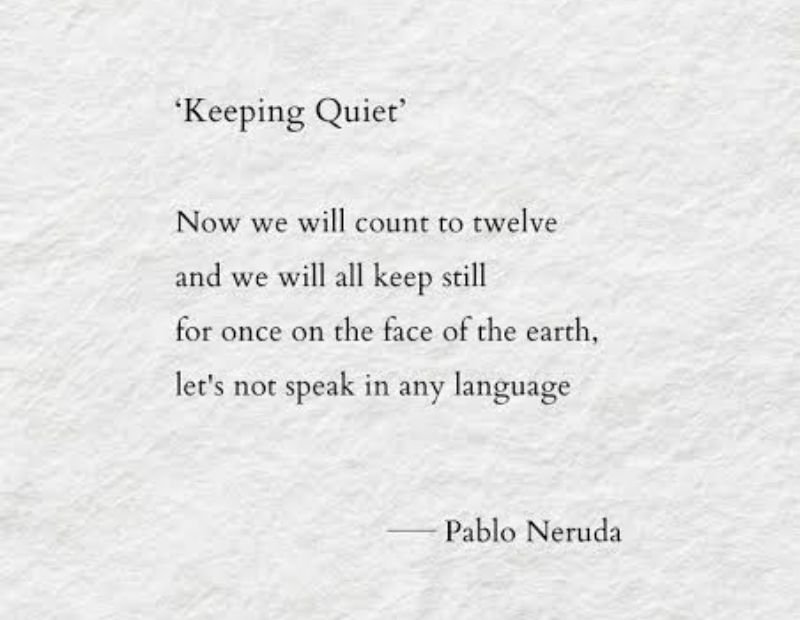
“Keeping Quiet” is among his most studied poems, especially in school courses. It asks people to stop for one moment and be still.
What is the exotic moment poet Pablo Neruda wishes for?
He wishes for a brief moment of worldwide stillness. Everyone would stop speaking and rushing, with no engines or hurry, and share a sudden, strange togetherness.
What is the sadness that poet Pablo Neruda refers to in Keeping Quiet?
It is the sadness of never truly understanding ourselves, together with the way people threaten each other and themselves with destruction. A silent pause, he suggests, might interrupt that cycle.
Poet Pablo Neruda Quotes: What His Words Teach Us
Because translated lines are protected, here are the ideas behind his most shared sayings, in plain words. Many popular “Neruda quotes” online are actually misattributed, so always check a source.
- On love: He believed love should be honest and unpolished, with no fancy masks.
- On time: Love can be brief while forgetting takes far longer.
- On poetry: He saw poetry as a bridge between solitary people.
- On silence: He valued quiet as a path to understanding.
- On everyday life: Ordinary things deserve praise and wonder.
If you want exact wording, quote from a published translation and credit the translator.
3 Famous 4 Lines Poems in the Spirit of Poet Pablo Neruda
These are original poems, written as tributes to his themes of sea, silence and memory.
❖
The sea keeps every letter I never sent,
folding each one into a wave.
At dusk it hands them back as salt,
and I read them with my tongue.
❖
A train still crosses the wet south of my memory,
carrying rain, lamps and one small boy.
He presses his forehead to the glass
and learns the names of everything that passes.
❖
Come, let us sit inside the quiet hour,
where no clock insists and no door slams.
Let the world forget our names a while,
so that we may remember them ourselves.
8 Short 2 Lines Poetry in the Spirit of Poet Pablo Neruda
❖
Your name is a small lamp
I carry through the night of my hands.
❖
Salt, bread and rain,
the three honest gods of my kitchen.
❖
The ocean never explains itself,
and still we trust its sentences.
❖
I found your absence in my coat pocket,
warm like a coin I forgot to spend.
❖
Mountains lean on the sky to rest,
and I lean on your silence.
❖
A sock, a spoon, a candle flame,
the small kings of ordinary days.
❖
Winter writes its letters on the window,
and my breath answers in white.
❖
Every road to you is made of rain,
yet I keep walking in my thin shoes.
5 Love 4 Lines Poems in the Spirit of Poet Pablo Neruda
❖
I do not love you like a rose in a vase,
but like roots that drink the dark.
What I feel for you has no petals,
only a stubborn, quiet growing.
❖
When you laugh the house exhales,
and every window learns your shape.
I follow that sound from room to room,
a sailor chasing his own harbour.
❖
Tonight the moon is lying in your hair,
and I am jealous of its patient light.
Let it keep the sky; I want the dark
that sleeps beside your breathing.
❖
Distance is only a long, lonely sentence,
and I am learning how to punctuate it.
Each letter I write is a small bridge
built from ink, longing and bad handwriting.
❖
If love is an ocean, let me be shoreline,
broken a little by every returning wave.
I will stay, wet and willing,
and call that wearing away a home.
Fascinating Life Facts About Poet Pablo Neruda
- He wrote in green ink. He said green was the colour of hope and of nature.
- He collected almost everything. Shells, bottles, ship figureheads, maps and masks filled his houses.
- He built three famous homes. La Chascona in Santiago, La Sebastiana in Valparaíso and Isla Negra on the coast are now museums.
- He married three times. His wives were María Antonieta Hagenaar, Delia del Carril and Matilde Urrutia.
- He was a senator. Poetry and politics were never separate in his life.
- He hid from the police. In 1948 and 1949 he moved between safe houses before escaping Chile.
- Neruda appears on screen. The film Il Postino imagines a friendship between the poet and a village postman, based on a novel by Antonio Skármeta.
- His book sold in the millions. Twenty Love Poems and a Song of Despair became one of the best selling poetry books ever.
Poet Pablo Neruda’s Literary Legacy
Neruda changed what readers expect from poetry. He proved that a poem could be intimate and political, sensual and philosophical, humble and grand, all at once. He wrote for lovers, workers, students and strangers.
His influence reaches across Latin American literature and far beyond it. Songwriters, novelists and filmmakers borrow his images. Students in schools around the world study his work. His houses draw visitors from every continent.
Critics still debate parts of his story, including his political loyalties and some personal choices. Honest readers hold both the brilliance and the complexity. That balance is part of why he remains alive on the page.
How to Start Reading Poet Pablo Neruda?
- Begin with a short selection of love poems in a bilingual edition.
- Read the Elementary Odes next for warmth and humour.
- Try Extravagaria for his playful, reflective side.
- Move on to Canto General when you want history and scale.
- Finish with his Memoirs to meet the man behind the poems.
Frequently Asked Questions About Poet Pablo Neruda
Who was poet Pablo Neruda?
He was a Chilean poet, diplomat and politician who won the 1971 Nobel Prize in Literature. He is among the most widely read poets of the twentieth century.
Poet Pablo Neruda was from which South American country?
He was from Chile. He was born in Parral and raised in Temuco.
What was Pablo Neruda’s real name?
His birth name was Ricardo Eliécer Neftalí Reyes Basoalto. He took “Pablo Neruda” as a teenage pen name and made it legal in 1946.
What did poet Pablo Neruda study?
He studied French and pedagogy at the University of Chile in Santiago. He planned to become a teacher.
What is poet Pablo Neruda best known for?
He is best known for Twenty Love Poems and a Song of Despair, Canto General and his everyday odes.
Which poem by Neruda is taught in schools?
“Keeping Quiet” is widely taught. It calls for a moment of shared stillness and self understanding.
What is the exotic moment poet Pablo Neruda wishes for?
A brief pause when everyone is silent and still, free of rush and noise, united in a strange new calm.
What is the sadness poet Pablo Neruda refers to in Keeping Quiet?
It is the sadness of never understanding ourselves and of threatening each other and ourselves with death.
What is the answer to the crossword clue “Poet Pablo Neruda, for one”?
The usual answers are CHILEAN or POET, depending on the grid length.
When did Pablo Neruda win the Nobel Prize?
He won it in 1971, honoured for poetry that gave life to the dreams and destiny of a continent.
How did Pablo Neruda die?
He died on 23 September 1973 in Santiago. The official cause was cancer, though his death has been investigated and is still discussed.
Where can I read Neruda’s poetry online?
Try the Poetry Foundation, Poets.org and the Nobel Prize website for biographies and selected translations.
Is it okay to quote Neruda online?
Short, credited quotations are usually fine. Always name the translator and avoid unverified quotes from social media.
Conclusion
Poet Pablo Neruda gave the world a voice that could whisper to one lover and speak to a whole continent. His life moved from a rainy Chilean town to embassies, exile, the Nobel stage and a deeply public funeral. His poems carry desire, grief, justice and quiet joy in equal measure.
Start with a love poem, an ode or “Keeping Quiet,” and let his language work on you slowly. Then try writing your own lines in his spirit, as the poems above attempt to do.