
If you have ever searched for a poem at midnight, chances are the Poetry Foundation was one of the first results. It is one of the biggest poetry hubs on the internet, and it is also a real organization with a real building, a real library, and more than a century of history behind its magazine.
This guide explains what the Poetry Foundation is, how its website, app, and magazine work, how to submit your work, and where to find famous poems by Emily Dickinson, Robert Frost, T. S. Eliot, Mary Oliver, and more. You will also find original five line poems written for this article, a resource table, and answers to common questions.
Poetry Foundation Meaning
The Poetry Foundation is a Chicago based literary organization that works to bring poetry into everyday life. Its own mission statement says it transforms lives through the power of words. In plain terms, it publishes poetry, supports poets, funds literary projects, and gives the public free access to a huge library of poems and poetry education.
A Short History
- 1912: Harriet Monroe founds Poetry magazine in Chicago. It is widely described as the oldest monthly journal devoted to verse in the English speaking world.
- 1941: The Modern Poetry Association is formed to support the magazine.
- 2002 to 2003: Philanthropist Ruth Lilly, an heir to the Eli Lilly fortune, makes a historic gift to the magazine. Reports describe it as roughly 200 million dollars by the time it was delivered.
- 2003: The Poetry Foundation is established from the Modern Poetry Association.
- 2022: The foundation changes from an operating foundation to a nonoperating one and focuses on grantmaking to nonprofit organizations that support poetry and the literary arts.
Ruth Lilly wrote poetry herself. She once sent poems to the magazine and was turned down kindly. She later became one of its greatest supporters. That story is a favorite among poetry fans.
Read Also This Blog: Poet Walt Whitman
Poetry Foundation Logo
The Poetry Foundation logo appears across its website, magazine, event materials, and mobile app. It helps readers recognize official content quickly, which matters because so many poetry sites exist online.
If you plan to use the logo in an article, school project, or event poster, check the foundation’s terms of use and press pages first. Brand marks are usually protected, so it is best to ask permission before using them for anything beyond simple editorial reference.
Poetry Foundation Login
Most of the website is free to read without signing in. You can browse poems, poet biographies, essays, and guides without creating an account.
A login or account step mainly appears when you do something personal, such as:
- Subscribing to Poetry magazine
- Signing up for newsletters
- Managing a print or digital subscription
- Using a submission platform for the magazine
Always use the official Poetry Foundation website to sign in, and avoid third party sites that ask for passwords.
Poetry Foundation Websites
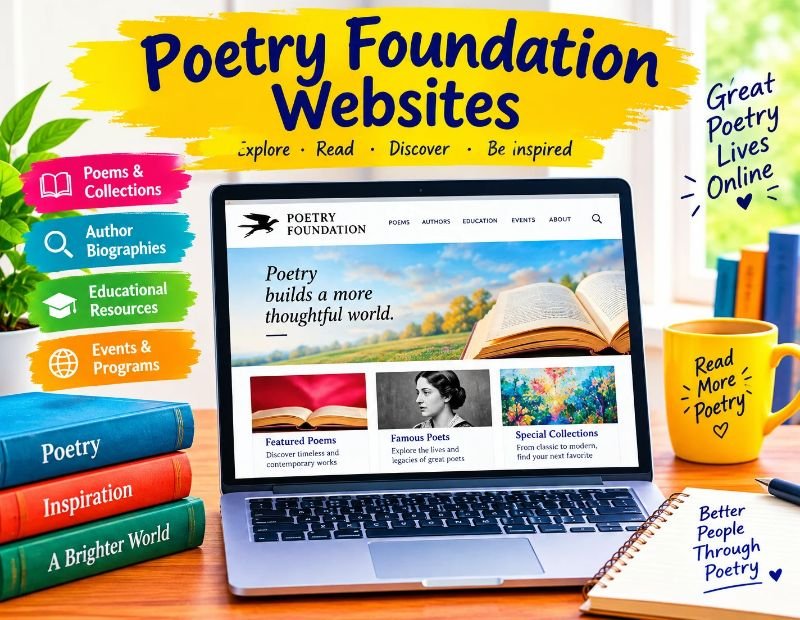
The main site, poetryfoundation.org, is the center of everything. It works like a giant digital library with a clean menu that groups content into clear sections.
| Website Section | What You Will Find |
|---|---|
| Poems & Poets | Thousands of poems, poet profiles, collections, and Poem Guides |
| Poem of the Day | One featured poem every day |
| Topics & Themes | Poems sorted for adults, teens, children, and educators |
| Glossary of Poetic Terms | Short definitions of forms, devices, and styles |
| Features | Articles, books, podcasts, videos, and the magazine |
| Poetry Magazine Archive | Past issues searchable back to the early twentieth century |
| Grants & Programs | Awards, events, library details, and partnerships |
| About Us | History, team, trustees, reports, and visitor information |
The site also uses clear categories, which is why it often ranks well for poem titles, poet names, and poetic terms.
Poetry Foundation App
The Poetry Foundation offers a mobile app so readers can carry poems in their pocket. It is useful for commuting, quick reading breaks, and finding a poem that fits your mood.
Typical reasons readers enjoy it:
- Easy browsing of poems by theme or mood
- Quick access to the Poem of the Day
- A simple reading layout for small screens
- A discovery tool for new poets
Features can change over time, so check the app store listing for the latest details.
Poetry Foundation Magazine
Poetry magazine is the foundation’s flagship publication. It prints new poems, reviews, essays, and commentary. It has a reputation for finding major voices early, and it has published or helped launch poets such as T. S. Eliot, Ezra Pound, and Gwendolyn Brooks.
What makes the magazine special:
- A long history that began in 1912
- A strong focus on new and emerging voices as well as established names
- A willingness to publish many styles rather than one fixed school
- Digital access to a historic archive
- A popular poetry podcast that has won major recognition
For students and teachers, the magazine archive is a goldmine for studying how poetry has changed over the decades.
Poetry Foundation Submission
Many writers dream of seeing their work in Poetry magazine. Here is how the process generally works.
Basic Submission Steps
- Read the magazine first. Study recent issues to understand its taste.
- Visit the official submission page. Poetry uses an online submission platform.
- Check the calendar. Submissions have been closed each year from June 15 to September 15, so timing matters. Look at the current page for open calls.
- Follow the guidelines for your form. Poetry and other types of writing may have different rules.
- Send your best work. Quality matters more than quantity.
- Wait patiently. The magazine has warned that responses can take up to eight months because of the number of submissions.
Tips to Improve Your Chances
- Revise before you send. Read each poem aloud.
- Avoid cliches and predictable endings.
- Keep your cover note short and polite.
- Do not send the same poem to several places at once unless the rules allow it.
- Keep submitting. Even famous poets collect rejections.
Remember that the foundation website also accepts essay pitches through a separate form, so check which door fits your work.
Poetry Foundation Poem of the Day
Poem of the Day is a simple but powerful habit builder. Each day, the website features one poem, usually with a short introduction about the poet. Readers use it for:
- A calm start to the morning
- Classroom warmups
- Journaling prompts
- Discovering poets outside their usual taste
- Building a regular reading routine
If you read just one poem a day, you will have read more than 360 poems by the end of a year. That is a quiet but real way to grow as a reader and writer.
15+ Inspiring Resources at the Poetry Foundation
Here is a quick list of the best tools and treasures connected to the foundation.
| # | Resource | Why It Matters |
|---|---|---|
| 1 | Poetry magazine | The historic flagship journal of new verse |
| 2 | Poem of the Day | A daily reading habit |
| 3 | Poems and Poets database | Browse by name, theme, or era |
| 4 | Poem Guides | Short explanations that make hard poems easier |
| 5 | Glossary of Poetic Terms | Quick help with meter, form, and devices |
| 6 | Collections | Curated sets by topic or occasion |
| 7 | Poetry podcast | Conversations about poems and the writing life |
| 8 | Magazine archive | Past issues searchable back to 1912 |
| 9 | Harriet blog | News and commentary about the poetry world |
| 10 | Poetry Out Loud | A national recitation contest for students, created with the National Endowment for the Arts in 2006 |
| 11 | Public library in Chicago | The Midwest’s only library dedicated to poetry |
| 12 | Events and readings | Free live and online programs |
| 13 | Pegasus Awards | Prizes celebrating excellence in poetry and poetry criticism |
| 14 | Ruth Lilly Poetry Prize | A major lifetime achievement award for American poets |
| 15 | Ruth Lilly and Dorothy Sargent Rosenberg Fellowships | Five yearly fellowships for emerging poets |
| 16 | Children and teen sections | Poems chosen for younger readers |
| 17 | Educator resources | Lesson help for teachers |
| 18 | Newsletters | Poems and news delivered by email |
| 19 | Grants program | Support for nonprofit poetry organizations |
| 20 | Mobile app | Poetry on the go |
Poetry Foundation Chicago
The Poetry Foundation lives at 61 West Superior Street in Chicago, in a modern building that was designed to be a public home for poetry. The location sits in the River North area and feels open and welcoming.
Visitors can expect:
- A public library dedicated to poetry
- A performance space for readings and talks
- Exhibitions and art displays
- A calm, quiet reading atmosphere
- Free programs, often with an online option
Chicago has a deep poetic tradition, and the foundation helps keep that tradition alive. If you ever visit the city, it is a lovely stop for readers and writers.
National Poetry Foundation and American Poetry Foundation
These two phrases cause some confusion, so here is a simple guide.
| Name | What It Usually Means |
|---|---|
| Poetry Foundation | The Chicago based foundation behind Poetry magazine and poetryfoundation.org |
| National Poetry Foundation | A separate academic organization connected to the University of Maine, known for scholarship on modernist poetry |
| American Poetry Foundation | Not an official name for a major organization. People often use it when they mean the Poetry Foundation, which is American |
If you are looking for poems, the magazine, or the Poem of the Day, you almost certainly want the Chicago based Poetry Foundation.
Famous Poems and Poets Readers Look For
Many searches pair the foundation’s name with a famous poem or poet. Below are short guides to the most popular ones. For copyright reasons, these sections explain and summarize the poems rather than reprint them. You can read the full texts on the official website, where available.
Wild Geese by Mary Oliver
This modern favorite is about self acceptance and belonging. It tells readers they do not have to be perfect to deserve a place in the world, and it uses nature as a gentle guide. It was published in the 1980s and remains one of the most shared poems online. Readers often turn to it during hard seasons of life.
The Hollow Men by T. S. Eliot
Published in 1925, this poem reflects the emptiness and spiritual drift many felt after the First World War. It uses fragmented images, repeated phrases, and a haunting rhythm. Its famous ending about how the world ends has been quoted for decades. Eliot also first appeared in Poetry magazine in 1915 with a famous early work, which shows how important the magazine was to modern literature.
Emily Dickinson
Dickinson wrote nearly eighteen hundred poems, yet only a handful were published while she was alive. Her work is known for short lines, bold ideas about death, nature, and the soul, and unusual punctuation and slant rhyme. She is a regular on school reading lists, and the foundation’s biography and poem pages make her easy to explore. The foundation also named a first book award in her honor.
Robert Frost
Frost wrote about rural life, but his poems often hide deeper meaning. His best known road poem is often read as a celebration of individual choice, though many critics say its tone is more playful and ironic. His simple language and strong rhythm make him ideal for beginners.
Ozymandias by Percy Bysshe Shelley
This 1818 sonnet describes a broken statue in the desert and the boast carved on its base. It is a short, sharp lesson about pride and the fading of power. Teachers love it because its message is clear and its structure is easy to study.
The Raven (Often Searched as “The Ravan”)
Some readers type “Ravan” when they mean “The Raven” by Edgar Allan Poe. That famous poem uses a repeating refrain, dark mood, and strong internal rhyme to portray grief and obsession. Its musical sound makes it a good poem to read aloud.
Quick Comparison of Famous Poets
| Poet | Known For | Style | Good Starting Theme |
|---|---|---|---|
| Mary Oliver | Nature and belonging | Simple, warm, conversational | Self acceptance |
| T. S. Eliot | Modernist poetry | Fragmented, symbolic | Modern emptiness |
| Emily Dickinson | Short, bold poems | Slant rhyme, compact lines | Death and the soul |
| Robert Frost | Rural scenes with deep meaning | Plain speech, steady meter | Choice and nature |
| Percy Bysshe Shelley | Romantic ideals | Formal, dramatic | Power and time |
| Edgar Allan Poe | Dark, musical verse | Refrain and internal rhyme | Grief |
8 Poems of 5 Lines, Original Pieces Inspired by Poetry Foundation Themes
Short poems are perfect for beginners. These eight five line poems are original, written for this article, and each one follows a theme you will often see among the foundation’s collections.
1. Morning
Light climbs the kitchen wall,
the kettle clears its throat.
Somewhere a neighbor laughs,
and the day, still unwritten,
leans over my shoulder to read.
2. Rain
Rain taps the window twice,
then forgets what it came to say.
I keep the question warm,
like tea gone nearly cold,
and let the gray hours answer.
3. Migration
They cross the sky in a ragged line,
no map, no argument.
I stand below with my small plans
and learn how much of living
is simply going on together.
4. Home
The porch light stays on for no one,
a small and stubborn sun.
Inside, the clock keeps counting
what we never say aloud:
you are still the place I come back to.
5. City
Buses sigh at every corner.
A stranger’s umbrella blooms.
We pass like unfinished sentences,
and for one bright block
the whole street rhymes.
6. Grief
The chair still keeps your shape.
I leave the window open
so the evening can sit there too.
It does not ask me to be fine.
It only stays until the stars come.
7. Hope
Under the frozen yard
a seed rehearses summer.
Nothing about it looks like progress.
Still, the dark is busy,
and the thaw is on its way.
8. Words
I gathered every word I owned
and spread them on the table.
Most were plain, a few were bright.
I chose the quiet ones
and said them slowly to the dark.
Why Five Lines Work?
- They are short enough to finish in a minute.
- They force you to choose strong images.
- They teach line breaks and rhythm.
- They are easy to share and memorize.
How to Read Poems Like a Pro?
You do not need a degree to enjoy poetry. Try this simple method the next time you open a poem on the foundation’s website.
- Read it once for sound. Say it aloud, even quietly.
- Read it again for meaning. Look at the images, the setting, and the speaker.
- Check the title. Titles often hold a hint.
- Notice the form. Is it a sonnet, free verse, or something else?
- Look up unknown terms. The glossary is perfect for this.
- Read the Poem Guide. Use it after your own reading, not before.
- Write one sentence about how it made you feel. This builds personal connection.
Poetry Foundation for Students and Teachers
The foundation is a strong ally in classrooms. Teachers can find lesson help, themed collections, and recitation programs. Students can explore poets by era, topic, or form.
Easy classroom ideas:
- Start each class with a Poem of the Day
- Ask students to compare two poems on the same theme
- Hold a mini recitation contest inspired by Poetry Out Loud
- Have students write a five line response to a poem
- Use the glossary to build poetry vocabulary
Why the Poetry Foundation Ranks Well Online?
Readers often wonder why this site appears so high in search results. A few reasons stand out.
- Authority: It is connected to a historic magazine and a respected nonprofit.
- Depth: It hosts a huge number of poems, poet pages, essays, and guides.
- Clear structure: Poems, poets, themes, and terms each have their own clean page types.
- Freshness: Daily features and new issues keep the site active.
- Trust: Its content is edited, sourced, and written by literary professionals.
If you run a poetry blog, you can learn from this model. Build clear categories, link related pages, answer simple questions directly, and keep updating your content.
Conclusion
The Poetry Foundation is far more than a website. It is a living literary institution with a magazine that began in 1912, a public library in Chicago, a global digital archive, a mobile app, major prizes, and programs that support poets at every stage. Whether you want to read Emily Dickinson, study Eliot, find a short poem for the day, or submit your own work, it offers a trusted starting point.
Start small. Open the Poem of the Day tomorrow morning, read it aloud, and write one line in response. Over time, that tiny habit can become a real love of poetry.
Frequently Asked Questions
What is the Poetry Foundation?
It is a Chicago based literary organization that publishes Poetry magazine and promotes poetry through its website, programs, and grants.
Who founded Poetry magazine?
Harriet Monroe founded Poetry magazine in Chicago in 1912.
Who funded the Poetry Foundation?
Philanthropist Ruth Lilly made a major gift that led to the foundation’s creation in 2003.
Is the Poetry Foundation website free?
Yes. Most poems, poet pages, and articles can be read for free online.
Does the Poetry Foundation have an app?
Yes. It offers a mobile app for browsing poems, and you can find it in your device’s app store.
How do I submit poems to Poetry magazine?
Use the official submission page, follow the guidelines, and check the calendar, since submissions have closed from June 15 to September 15 each year.
How long does a response take?
The magazine has said it may take up to eight months to reply because of the high volume.
What is the Poem of the Day?
It is a daily featured poem on the foundation’s website, often with a short note about the poet.
Where is the Poetry Foundation located?
It is at 61 West Superior Street in Chicago, Illinois.
Is the National Poetry Foundation the same organization?
No. It is a separate academic body linked to the University of Maine.
Can I read Mary Oliver’s Wild Geese on the site?
You can search the official website to see whether the poem is available, since availability depends on rights and permissions.
What is Poetry Out Loud?
It is a national poetry recitation contest for students, created in 2006 by the Poetry Foundation and the National Endowment for the Arts.
What awards does the Poetry Foundation give?
It gives the Ruth Lilly Poetry Prize, the Pegasus Awards, and several fellowships for emerging poets.
Is the Poetry Foundation good for beginners?
Yes. Its guides, glossary, and themed collections make poetry easier to approach.