
Poetry has always been the quiet voice that says what the heart cannot say in plain words. English poetry, in particular, has shaped how millions of people express love, loss, hope and courage across centuries. Whether you are a student trying to understand the roots of English verse, a teacher searching for a short poem for kids, or someone simply looking for a few lines to lift a heavy day, this guide brings everything together in one place.
In this article you will find the meaning of English poetry, its history, the poets who shaped it, its structure, and a huge collection of poems for every mood including love, sadness, motivation, kids, adults, Christmas, Easter and more. Every poem below is written fresh, in a natural poetic voice, so you get original verses you will not find copied anywhere else.
What Is English Poetry?
English poetry is a form of literary art written in the English language that uses rhythm, imagery, emotion and sound to express ideas in a way ordinary prose cannot. It relies on devices like rhyme, meter, metaphor and alliteration to create a musical and emotional effect on the reader.
Unlike a story or an essay, poetry compresses meaning into fewer words. A single stanza can carry the weight of an entire life experience. That is why poetry is often called the most concentrated form of language.
Key Features of English Poetry
- Uses rhythm and meter to create a musical flow 🎵
- Relies heavily on imagery and sensory language 🌿
- Often uses rhyme schemes, though free verse skips this rule ✍️
- Expresses emotion, philosophy or storytelling in condensed form 💭
- Uses literary devices such as metaphor, simile, alliteration and symbolism 🌸
Read Also This Blog: Funny Poetry in Urdu
A Short History of English Poetry
English poetry did not begin overnight. It evolved through distinct eras, each shaped by the culture, politics and language of its time.
Old English Poetry (Anglo Saxon Period)
The earliest English poetry was oral, alliterative and often about heroism and fate. Works like Beowulf belong to this era. The language was closer to German than to modern English, so most readers today need a translation to understand it.
Middle English Poetry
This period saw the rise of a more recognisable English, largely thanks to one writer who is widely credited with giving English poetry its national identity. Regional dialects slowly merged into a shared literary language during this time.
The Renaissance and Elizabethan Era
This era brought sonnets, blank verse and dramatic poetry to new heights. It is the age most associated with the transformation of poetic structure and emotional depth in English literature.
The Romantic Period
Poets in this era turned toward nature, imagination and individual emotion, moving away from strict formal rules toward more personal expression.
Modern and Contemporary English Poetry
Twentieth and twenty first century poetry broke away from traditional rhyme and meter almost entirely. Free verse, fragmented structure and everyday language became common tools for modern poets.
| Era | Approximate Period | Defining Trait |
| Old English | 5th to 11th century | Oral, alliterative, heroic themes 🛡️ |
| Middle English | 12th to 15th century | National language forming, storytelling verse 📖 |
| Renaissance | 16th to early 17th century | Sonnets, drama, refined structure 🎭 |
| Romantic | Late 18th to mid 19th century | Nature, emotion, imagination 🌄 |
| Modern | 20th century onward | Free verse, experimentation, realism 🌆 |
Who Is Known As the Father of English Poetry?
Geoffrey Chaucer is widely recognized as the father of English poetry. He earned this title because he was among the first major writers to compose in English at a time when French and Latin dominated literature in Britain. His masterpiece, a collection of tales told by pilgrims travelling together, elevated the East Midland dialect into what would eventually become standard English.
Chaucer did not just write in English, he made English respectable as a literary language. Before him, poetry in England existed but lacked a unifying national voice. His storytelling style, humor and deep understanding of human character influenced generations of poets who came after him.
Why Chaucer Earned This Title?
- He wrote almost entirely in English rather than French or Latin 🪶
- His work elevated a regional dialect into a national literary language 🏛️
- He introduced complex characters and realistic storytelling into verse 🎨
- His influence shaped English poetry for the next several centuries 🌟
How Did Shakespeare Change English Poetry?
If Chaucer gave English poetry its foundation, Shakespeare gave it wings. Shakespeare transformed English poetry through his mastery of the sonnet form, his invention of thousands of new words and phrases, and his ability to blend poetic verse seamlessly into drama.
He popularised iambic pentameter in a way that made it feel natural rather than mechanical. His sonnets explored love, time, beauty and mortality with a psychological depth that had not been seen before. He also broke rules when needed, bending rhythm to match emotional intensity rather than forcing emotion into rigid meter.
Shakespeare’s Contributions to English Poetry
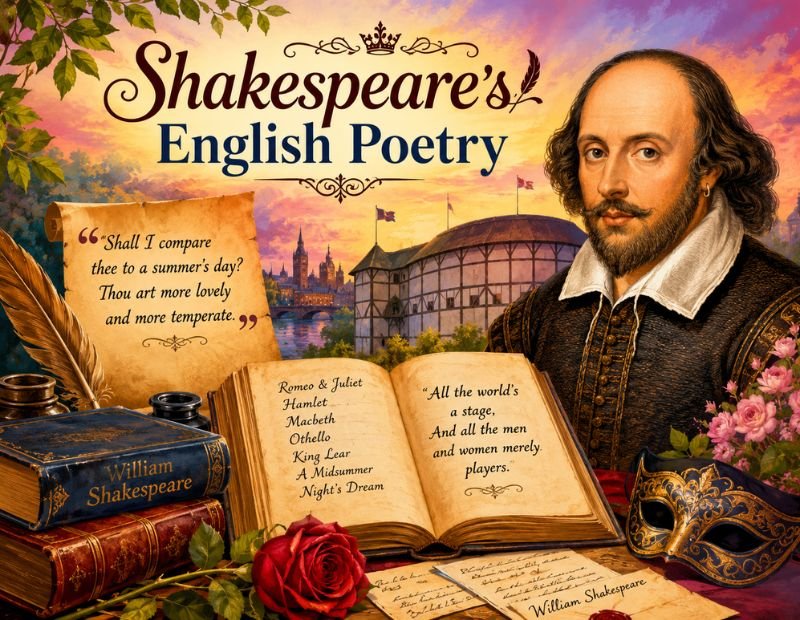
- Refined and popularised the English sonnet structure 📝
- Introduced thousands of new words still used in English today 💬
- Blended poetic language naturally into theatrical dialogue 🎭
- Explored universal themes of love, death and time with lasting depth ⏳
- Balanced formal structure with emotional freedom in his verse 🕊️
Structure of English Poetry
Understanding structure helps both new readers and beginner poets appreciate how a poem is built. While modern poetry often abandons formal rules, classical English poetry follows identifiable patterns.
Common Structural Elements
- Stanza: a grouped set of lines, similar to a paragraph in prose 📚
- Meter: the rhythmic pattern of stressed and unstressed syllables ⏱️
- Rhyme scheme: the pattern in which end words rhyme, often labelled with letters like AABB or ABAB
- Line length: short or long lines to control pacing and emphasis ➖
- Form: fixed structures such as the sonnet, ballad, ode or free verse 🏗️
| Poetic Form | Typical Structure | Common Use |
| Sonnet | Fourteen lines, structured rhyme scheme | Love, philosophy, reflection ❤️ |
| Ballad | Rhyming stanzas, often four lines each | Storytelling, folk themes 🎻 |
| Ode | Formal, elevated tone, often addressed to a subject | Praise, tribute 🌞 |
| Free Verse | No fixed rhyme or meter | Modern, personal expression 🍃 |
| Haiku Inspired English Verse | Very short, imagery focused | Nature, mindfulness 🍂 |
5 Best English Poets
While opinions vary, a handful of poets are consistently regarded as the most influential voices in English literary history.
- Geoffrey Chaucer, the father of English poetry and pioneer of the vernacular 🪶
- William Shakespeare, master of the sonnet and dramatic verse 🎭
- William Wordsworth, a defining voice of the Romantic movement 🌄
- John Keats, known for rich imagery and emotional intensity 🌹
- Emily Dickinson, celebrated for compact, deeply personal verse ✨
English Poetry on Life

Poetry about life often reflects on time, purpose and the quiet lessons we learn along the way.
I.
Life begins as a whisper, not a shout,
a small breath learning to trust the wind.
It stumbles through mornings it did not plan,
and grows wiser in the falling, not the winning.
We chase horizons that keep quietly moving,
mistaking distance for a lack of progress.
But every mile we walked in doubt
was still a mile that shaped who we became.
II.
Some days life feels like an open window,
light pouring in without asking permission.
Other days it feels like a locked door,
patient, waiting for us to find the key ourselves.
Yet even in the waiting there is motion,
a quiet current beneath the stillness.
Life does not pause because we feel lost,
it simply walks beside us until we catch up.
III.
Time does not hand us a finished picture,
it hands us fragments and calls it living.
We piece together laughter beside losses,
and somehow the picture still feels whole.
Maybe that is the quiet lesson of life,
not that pain and joy take turns politely,
but that they sit together at the same table,
teaching us to hold both without breaking.
Motivational English Poetry
Even the smallest flame refuses to fear the dark,
so let your quiet courage outshine every doubt.
The mountain does not rise in a single breath,
and neither will you, so keep climbing anyway.
Fall as many times as the storm demands,
but rise every single time like the sun always does.
Short English Poetry
- Quiet moon, hold my worries tonight, so I can rest.
- Small seeds grow into forests of hope, if we wait.
2 Line English Poetry
- Hope is the whisper the heart repeats,
even when the world stays silent.
- A single kind word can rebuild what silence slowly broke.
Some hearts speak loudest in the language of quiet patience.
4 Line English Poetry
The morning light forgives the darkest night,
and paints the sky in colors soft and new.
So let your heart forgive what once felt heavy,
and rise again the way the dawn always does.
A single candle does not fear the dark,
it simply burns and lets its light be seen.
So do not shrink to make your presence smaller,
just burn, just shine, just quietly be brave.
Rivers do not rush to prove their strength,
they carve through stone with patience, not with force.
So trust the slow and steady work within you,
your quiet effort is still shaping something great.
Modern English Poetry
Modern English poetry often abandons strict rhyme in favor of raw honesty and everyday language.
- I do not need my sentences to rhyme to make you feel something real.
I only need to tell you the truth,
even when the truth does not sound pretty.
- We scroll through borrowed lives on borrowed screens,
searching for meaning in filtered light.
But somewhere beneath the noise,
a quiet voice still asks us to simply feel.
Most Famous English Poetry Themes
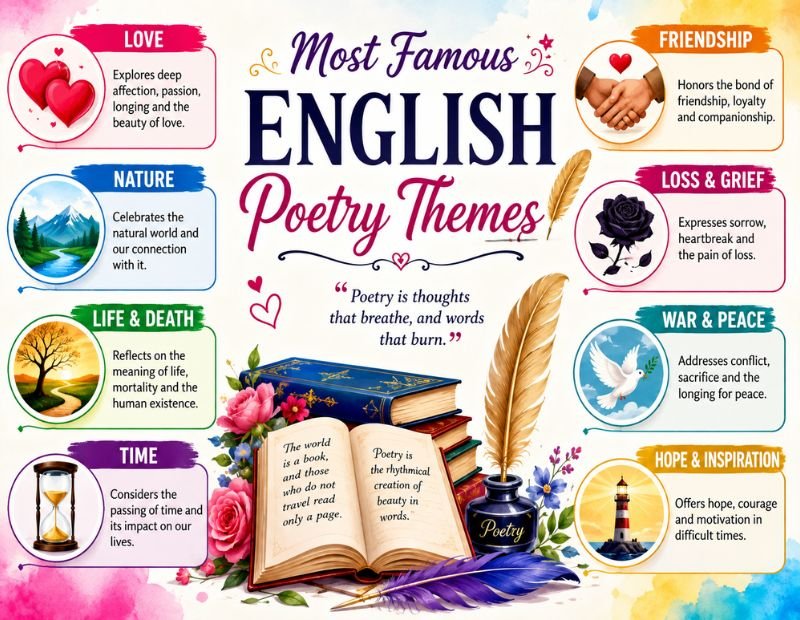
Certain themes have remained central to English poetry across every era.
| Theme | Why It Endures |
| Love | Universal emotion explored in every century 💞 |
| Death and Mortality | Reflects human fear and acceptance of time ⌛ |
| Nature | A mirror for human emotion and change 🍁 |
| War | Captures both heroism and tragedy ⚔️ |
| Identity | Explores the self and personal meaning 🪞 |
Attitude English Poetry
- I do not bend for those who never lifted me,
I do not shrink to fit a smaller frame.
My worth was never yours to measure,
And my silence was never your permission.
- I walked through fire wearing calm like armor,
So do not mistake my peace for weakness.
The storm you expected already passed through me,
And I am still standing, unshaken.
English Poetry for Boys
Stand strong like the oak that bends but never breaks in the storm.
Your courage today becomes the mountain someone else climbs tomorrow.
A brave heart is not one without fear, but one that walks forward anyway.
Let your hands stay gentle even while your spirit stays fearless.
Dream louder than the doubts that whisper you are too young to try.
The boy who dares quietly today becomes the man who leads tomorrow.
English Poetry for Girls
She carries storms inside her gentle chest,
yet still chooses softness as her strength.
Her dreams are not too loud for this world,
the world simply needs to learn to listen.
Like a quiet flame that refuses to die,
she glows brighter with every wind that tries.
English Poetry for Kids
The sun wakes up with a great big yawn,
and paints the sky before the day is born.
A little bee hums a busy small tune,
dancing through flowers beneath the warm noon.
My puppy runs with a wag and a bound,
turning our quiet yard into playful sound.
English Poetry for Adults
Between deadlines and dreams, I still find pockets of grace,
small moments where the tired heart remembers how to breathe.
We grew up believing love would feel like fireworks,
but it feels more like a steady hand through ordinary days.
Some evenings I sit with my quiet and call it peace,
other evenings I sit with my quiet and call it grief.
Love English Poetry
Your name lingers on my lips like a prayer I never tire of repeating,
a quiet devotion I carry through every ordinary hour.
I did not choose to love you, I simply stopped resisting the pull,
the way rivers never choose the sea, yet always find their way there.
In a world full of loud things, your love is the softest kind of certain,
the one truth I never have to question twice.
Sad English Poetry
Some nights the silence speaks louder than words,
And the empty side of the bed feels colder than winter.
I still reach for a hand that is no longer there,
And call a name the wind no longer answers.
Grief does not leave,
It simply learns to sit quietly,
Folded into the corners of ordinary days.
Some sadness does not need fixing,
It only needs to be allowed to exist.
Romantic English Poetry
Your voice finds me quietly in the middle of loud days, and everything softens.
I fell for you the way evening falls into night, slow, certain, unstoppable.
Every road I have ever walked seems to have been leading me toward you.
Deep English Poetry
We spend our whole lives becoming,
Yet fear the very changing that shapes us.
Some truths are too heavy for speech,
So the soul writes them quietly into silence.
Beneath every calm face lives a war
No one else was invited to witness.
Christmas English Poetry
Snow drifts softly over sleeping town,
Wrapping silence in a quiet gown.
Candlelight hums where family gathers near,
Warming December’s coldest hour of the year.
Stars lean closer on this holy night,
Guiding weary hearts back home to the light.
Easter English Poetry
Soft light breaks where winter once lingered long,
Easter morning hums a quiet, hopeful song.
Empty tombs speak louder than despair ever could,
hope rises gently, just as new life understood.
Lilies bloom where sorrow used to stay,
grace walks softly on this Easter day.
Best Old and Modern English Poetry Alliteration
Alliteration, the repetition of initial consonant sounds, has been used from Old English verse to modern spoken word.
The wild wind whispers through the weathered woods.
Silent shadows softly settle over sleeping streets.
Gentle gulls glide gracefully across the golden glow.
17th Century English Poetry Manuscript
Manuscript poetry from the seventeenth century often circulated privately among readers before formal publication, especially metaphysical and devotional verse. These handwritten collections give scholars insight into how poems were shared, revised and personalised long before printed anthologies became common. Studying these manuscripts helps historians understand the private, intimate side of English poetic culture during this era.
Matter and Making in Early English Poetry
Early English poetry was deeply concerned with both matter, meaning the subject or content of a poem, and making, meaning the craft and construction behind it. Scholars studying this period often examine how medieval poets balanced storytelling substance with technical skill, revealing that poetic craftsmanship in English literature has always been treated as a deliberate art rather than accidental inspiration.
Frequently Asked Questions
What is the meaning of English poetry?
English poetry is literary writing in the English language that uses rhythm, imagery and emotional language to express ideas more powerfully than plain prose.
Who is called the father of English poetry?
Geoffrey Chaucer is called the father of English poetry for pioneering English as a serious literary language.
How did Shakespeare influence English poetry?
Shakespeare refined the sonnet form, introduced new vocabulary and blended poetic verse naturally into dramatic dialogue.
What is the basic structure of an English poem?
Most traditional English poems use stanzas, meter and a rhyme scheme, though modern poetry often uses free verse instead.
What are the most common themes in English poetry?
Love, death, nature, identity and war are among the most enduring themes across every era of English poetry.
Is free verse still considered real poetry?
Yes, free verse is a legitimate and widely respected poetic form that prioritises natural rhythm and honest expression over strict rules.
Conclusion
English poetry is far more than an academic subject, it is a living tradition that continues to evolve while still carrying the fingerprints of Chaucer, Shakespeare and every poet who dared to put raw emotion into carefully chosen words. From short two line verses to deep reflective stanzas, poetry gives us a way to say what ordinary conversation often cannot.
Whether you came here to understand its history, learn its structure, or simply find a few lines that speak to your heart today, English poetry remains one of the most powerful tools we have for connection, healing and self expression. Keep reading it, keep writing it, and let it continue to grow with you.