
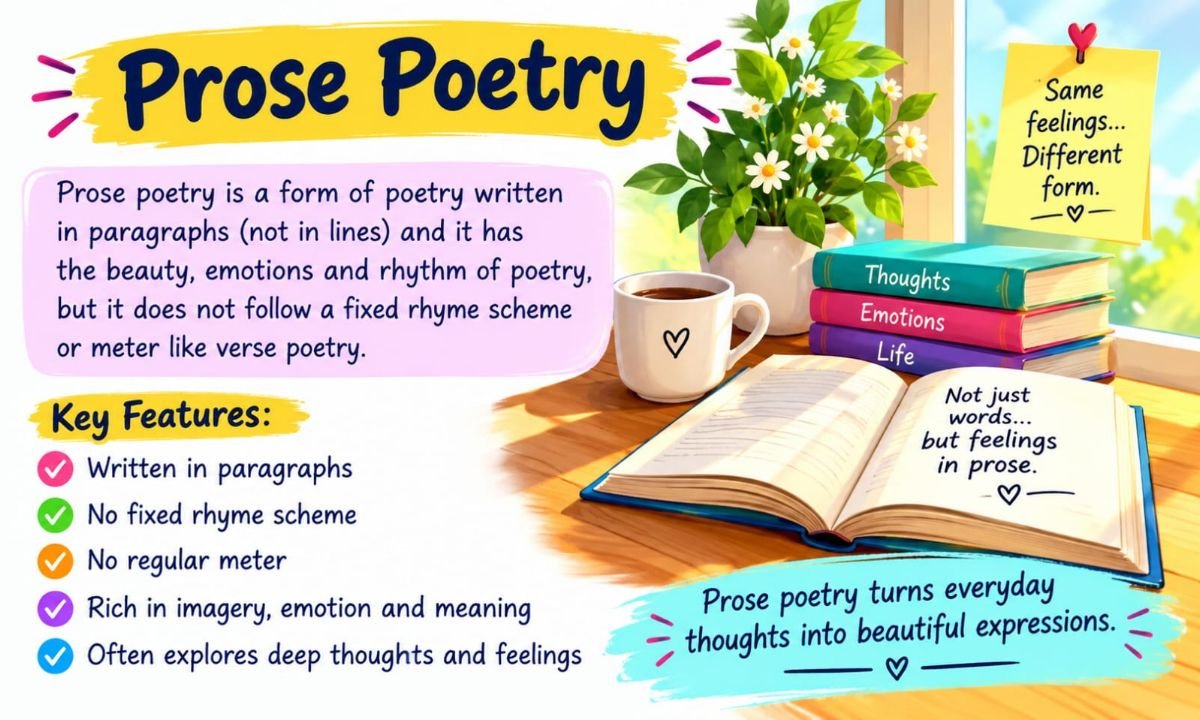
Prose poetry looks like a paragraph but sounds like a song. It has no line breaks and no stanzas, yet it carries imagery, rhythm, and emotion in every sentence.
If you have ever read a short block of text and felt it was too musical to be plain prose, you were probably reading a prose poem. This guide explains the meaning of prose poetry, its features, types, and history. You will also find examples, writing steps, and answers to common questions.
What Is Prose Poetry? (Meaning)
Prose poetry is a hybrid form that uses the language of poetry inside the shape of prose. It is written in sentences and paragraphs, but it relies on imagery, sound, and compression the way a poem does.
A prose poem may look like an ordinary paragraph at first glance. Read it closely, though, and you notice repetition, rhythm, and carefully chosen words. Prose poetry combines lyrical elements of traditional poetry with prose features such as standard punctuation and the absence of line breaks. masterclass
In simple terms:
- Poetry uses lines and stanzas.
- Prose uses sentences and paragraphs.
- Prose poetry uses paragraphs but thinks like a poem.
Read Also this Blog: Concrete Poetry
Prose Poetry vs Prose vs Poetry
| Feature | Prose | Poetry | Prose Poetry |
|---|---|---|---|
| Layout | Paragraphs | Lines and stanzas | Paragraphs |
| Line breaks | No | Yes | No |
| Main goal | Tell, explain, inform | Evoke feeling through form | Evoke feeling through sentences |
| Sound devices | Occasional | Frequent | Frequent |
| Focus | Plot, argument, character | Image, emotion, music | Image, emotion, moment |
| Length | Any length | Any length | Usually short |
How to Recognize Prose Poetry?
Not every beautiful paragraph is a prose poem. Use this quick checklist to spot one.
- Look at the shape. It appears as a block of text with no line breaks.
- Listen to the sentences. Read it aloud. Does it have a pulse, a pattern, or a repeated phrase?
- Check the images. Prose poems lean on vivid pictures rather than plot.
- Notice the length. Most are brief, often a paragraph or a page.
- Ask what it does. A story moves forward. A prose poem circles a moment, an idea, or a feeling.
- Test for compression. If every sentence feels necessary and dense, it is likely poetic.
Characteristics of Prose Poetry
The most common features are easy to remember:
- No line breaks. The text runs to the margin like a paragraph.
- Lyrical language. Word choice, sound, and rhythm matter as much as meaning.
- Strong imagery. Concrete, sensory details carry the emotion.
- Compression. Every sentence works hard, and nothing is padded.
- Repetition and pattern. Phrases, structures, or sounds return like a refrain.
- Figurative language. Metaphor, simile, and personification are common.
- Freedom of form. The writer decides the shape, so the genre welcomes experiments.
- A focus on a single moment or mood. Prose poems often explore intense snapshots of small moments. studysmarter
Writing teachers also describe the form as unconfined. It has no line breaks and is not shaped by the margins of the page. writers
Elements of Prose Poetry
Think of these as the building blocks you can adjust.
| Element | What It Does | Example Technique |
|---|---|---|
| Imagery | Creates a picture in the reader’s mind | Sensory detail: smell, sound, texture |
| Rhythm | Gives the sentences a beat | Mixing short and long sentences |
| Repetition | Builds emphasis and music | Repeating a phrase at the start of sentences |
| Figurative language | Adds layered meaning | Metaphor, simile, personification |
| Juxtaposition | Creates surprise | Placing two unlike images side by side |
| Sound devices | Adds musical quality | Alliteration, assonance, internal rhyme |
| Voice | Gives personality | First person confession, address to “you” |
| Compression | Keeps the piece tight | Cutting every nonessential word |
Purpose of Prose Poetry
Why do writers choose this form over a regular poem or a short story?
- To break free of line based rules. Without line breaks, the writer can follow thought and speech more naturally.
- To capture a moment. The form suits memory, observation, and sudden insight.
- To mix storytelling with lyricism. A prose poem can hint at a story without becoming one.
- To feel modern and urgent. Historically, the form has been linked with city life, rebellion, and change. It can be seen as a reaction against the more traditional poetic forms of its time. studysmarter
- To make poetry approachable. Readers who find line breaks intimidating often feel comfortable with paragraphs.
Effects of Prose Poetry on the Reader
A well made prose poem leaves a distinct impression.
- Intimacy. The paragraph feels like a private confession.
- Surprise. The reader expects plain prose and receives a poem.
- Momentum. With no line breaks, the reader tends to read faster and more continuously.
- Dreamlike atmosphere. Surreal images flow without the pause of a line ending.
- Lingering echo. Because the form is short and dense, it stays in the mind.
Types of Prose Poetry
There is no official list, but critics and teachers often group prose poems like this:
| Type | Description | Typical Subject |
|---|---|---|
| Lyrical prose poem | Emotion and music lead the piece | Love, grief, nature |
| Narrative prose poem | Hints at a story in poetic language | Memory, childhood, travel |
| Surreal prose poem | Dream logic and strange images | The unconscious, absurd scenes |
| Fable or parable style | Short tale with a twist or moral | Animals, objects, odd characters |
| Urban or observational | Street scenes and city detail | Crowds, cafes, loneliness |
| List or catalogue poem | Built from repeated items or phrases | Inventories, memories, rules |
| Dialogue based poem | Uses speech but keeps poetic density | Conversations, interrogations |
| Micro prose poem | One to three sentences | A single image or thought |
Many pieces blend two or more types, and that blending is part of the form’s charm.
Short Prose Poetry
Short prose poetry is the easiest place to start. A few sentences can hold a whole mood.
Sample (original):
The kettle clicks off and the kitchen exhales. Steam climbs the window, erasing the street, the bus stop, the man with the newspaper. For one minute the world is only a warm square of glass, and I am the only person in it.
Notice the sound in “clicks off” and “exhales,” the single clear image of steam, and the quiet shift in the last line from the room to the self.
Prose Poetry About Life
Life is a popular theme because the form handles ordinary moments so well.
Sample (original):
My grandmother folded each morning into squares. Tea first, then the radio, then the neighbor’s cough through the wall. A day, she said, is a small cloth. You either iron it or wear it wrinkled. I wear mine wrinkled. Every evening I find her creases in my own hands.
This piece uses repetition (“first,” “then”), a metaphor (the day as cloth), and a closing image that turns memory into something physical.
Prose Poetry for Students
Prose poetry is a friendly entry point for students because it removes the pressure of rhyme and meter.
Why it works in class:
- Students focus on ideas and images before technical rules.
- It connects reading, writing, and speaking skills.
- It helps learners notice how sentence length changes mood.
Simple classroom activities:
- Pick an object in the room and describe it in five sentences, using at least two senses.
- Rewrite a short free verse poem as a paragraph, then compare how the rhythm changes.
- Write a prose poem that starts every sentence with the same word.
- Read a published prose poem aloud and mark where the sentences speed up or slow down.
Prose Poetry Supplementary: In many school and college courses, prose poetry appears in supplementary reading lists. These extra texts let teachers show genre blending, since students see how poetic technique works outside the usual poem layout. If your syllabus lists a supplementary reader, look for short prose poems from the authors named later in this article.
15 Examples of Prose Poetry
Here are well known writers and works that shape the form. Read them in full from authorized editions or libraries.
- Charles Baudelaire, Le Spleen de Paris (Paris Spleen). A collection of fifty short pieces published after his death in 1869. It gave the form much of its modern identity. poetryintranslation
- Aloysius Bertrand, Gaspard de la Nuit. An earlier French work with medieval, fantastical scenes that inspired Baudelaire.
- Arthur Rimbaud, Illuminations. Published in 1886, it helped establish prose poetry in France. The images are bright, strange, and dreamlike. britannica
- Stéphane Mallarmé, Divagations. Published in 1897, it also firmly planted the form in French literature. britannica
- Ivan Turgenev, Poems in Prose. Short reflective pieces on age, nature, and conscience.
- Oscar Wilde, Poems in Prose. Brief parables with a moral twist.
- Gertrude Stein, Tender Buttons. Experimental objects, food, and rooms written as playful word music.
- Amy Lowell, “Bath.” Cited as an example of poetic prose that uses heightened emotion and imagery without verse. yourdictionary
- Carolyn Forché, “The Colonel.” A chilling testimony in paragraph form, often taught as a political prose poem.
- Russell Edson, The Tunnel. Absurd, fable like scenes with dark humor.
- Charles Simic, The World Doesn’t End. A Pulitzer Prize winning book of surreal prose poems.
- Anne Carson, Short Talks. Tiny, witty pieces that mix philosophy and observation.
- Margaret Atwood, Murder in the Dark. Short prose pieces that sit between fiction and poetry.
- Claudia Rankine, Citizen: An American Lyric. Blends prose poems, essay, and images to explore everyday racism.
- David Ignatow, selected prose poems and notebooks. Plain spoken, sharp, and unflinching (more on him below).
Prose Poetry Books to Read Next
Start with these if you want to build a small library:
- Paris Spleen by Charles Baudelaire (try a modern translation)
- Illuminations by Arthur Rimbaud
- Tender Buttons by Gertrude Stein
- The World Doesn’t End by Charles Simic
- The Tunnel by Russell Edson
- Citizen by Claudia Rankine
- Short Talks by Anne Carson
- Anthologies of prose poems edited for classroom or general use
Anthologies are especially useful because they show how different voices handle the same form.
Prose Poetry in Literature: History and Literary Meaning
The modern prose poem was born in nineteenth century France. Bertrand’s Gaspard de la Nuit came first. Then Baudelaire reshaped the idea for city life.
Baudelaire’s own preface praised a poetic prose that is musical without strict rhythm or rhyme. He wanted it supple enough to follow the lyric movements of the soul and the shifts of conscience. Interestingly, in his preface he called the work “prose lyrique,” and the familiar title was chosen by editors after his death. grokipediapoetryfoundation
Why did the form matter? Baudelaire saw it as suited to expressing the uncertainty, flux, and freedom of his age. The city was loud, crowded, and fragmented. A paragraph that bends and breaks fit that experience better than a regular stanza. goodreads
From France, the form spread to English, Russian, Spanish, and many other literatures. In the twentieth and twenty first centuries, poets used it for protest, memory, humor, and experiments with identity. Today, it also overlaps with flash fiction and the lyric essay, which makes the boundaries delightfully blurry.
Prose Poetry and Drama
Drama and prose poetry meet in a few useful ways.
- Poetic monologues. A character may speak in a dense, image rich paragraph that works like a prose poem inside a play.
- Prose in Shakespeare. His characters shift between verse and prose, and the prose passages can still carry rich imagery.
- Stage and performance. Poets often perform prose poems aloud, where rhythm and breath replace line breaks.
- Dialogue structure. Some prose poems use a question and answer or script like format.
So while prose poetry is not drama, its musical sentences work well on stage.
Prose Poetry in Hindi
In Hindi, prose poetry is commonly rendered as गद्य काव्य (gadya kavya). A Hindi dictionary lists “prose poetry” under that term. oneindia
Modern Hindi writing also uses free verse and poetic prose widely, so the line between them can be thin. If you are exploring this area, search for gadya kavya and compare it with muktak and free verse in Hindi poetry anthologies. Reading a few examples side by side will help you see where lyrical prose ends and poetry begins.
Prose Poetry in Tamil
Tamil literature has a notable early example. The poet Subramania Bharati wrote experimental pieces known as வசன கவிதை (vasana kavithai), often translated as prose poetry. One widely shared example is his piece addressing the wind, which is presented as prose poetry with translations. lyricaldelights
These pieces show that the form was never only European. Tamil writers used it to loosen traditional metrical rules and speak in a more natural voice.
Prose Poetry vs Free Verse
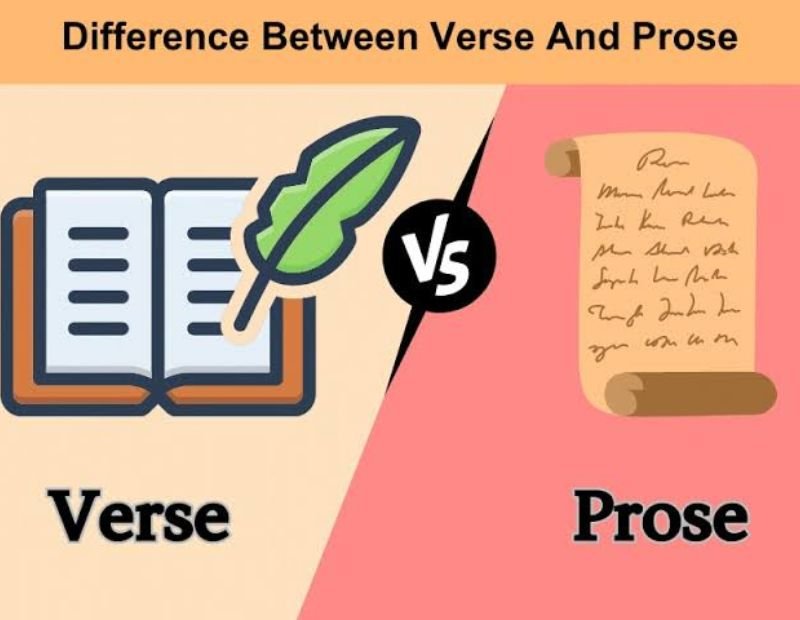
These two are close cousins, and that is why people confuse them. Free verse is often described as the poetic form closest to prose poetry. The main difference is visual and structural. studysmarter
| Point | Free Verse | Prose Poetry |
|---|---|---|
| Line breaks | Yes, chosen for effect | No |
| Layout | Stanzas or lines | Paragraphs or blocks |
| Rhythm control | Line endings shape the pause | Sentence length and punctuation shape the pause |
| Rhyme and meter | Optional | Optional, usually light |
| Typical length | Varies | Usually short |
| Feels like | A poem on the page | A paragraph that sings |
A simple test: if you can only change the effect by moving line breaks, it is free verse. If you must change sentences to change the effect, it is prose poetry.
David Ignatow Prose Poetry Analysis
David Ignatow (1914 to 1997) was an American poet from New York. He wrote mostly free verse about urban life, work, and moral struggle, and later turned more often to prose poems.
What his style looks like:
- Plain language. One critic noted that his poems, both lyric and prose, rely on direct statement and few poetic devices. Marvin Bell described his approach as skeletal and apparently artless. poetryfoundation
- Everyday scenes. He wrote about common human foibles and working class city life.
- Emotional honesty. He refused to offer easy comfort, and he asked readers to face hard truths.
Why prose mattered to him: Ignatow said that the lyric form seemed to demand more closure than the prose poem, so leaving line based composition helped him express himself more fully. That is a useful insight for any writer. Prose lets a thought stay open. poetryfoundation
Example for study: One educational site uses his piece “Information” to show how a work with complete sentences and paragraph form is clearly prose in format, even though the writing is creative. It is a handy classroom case for comparing formats. yourdictionary
A common mix up: “The Bagel” and “Rescue the Dead” are famous Ignatow poems, but both are written in lines, so they are free verse rather than prose poems. For true prose poem practice, look at his later collections and notebook style entries. Critics note a growing fondness for prose poems in books such as Facing the Tree and Tread the Dark. enotes
Takeaway: Ignatow shows that prose poetry does not need ornament. Sharp observation and plain words can be just as powerful.
How to Write Prose Poetry?
You can write your first one in about twenty minutes.
- Start with one image. Choose something small: a cup, a doorway, a train window.
- Write it as a paragraph. Do not think about lines. Just write sentences.
- Add sensory detail. Include at least two senses beyond sight.
- Play with rhythm. Mix one long, flowing sentence with a short, blunt one.
- Use repetition once or twice. A repeated phrase gives shape without rhyme.
- Add one surprise. Place two unlike things side by side, or change direction in the last sentence.
- Cut ruthlessly. Remove any sentence that explains what the image already shows.
- Read it aloud. Listen for places where the music stumbles, then fix them.
- Give it a strong title. In a short piece, the title can carry extra meaning.
Common Mistakes to Avoid
- Writing a short story with no real imagery
- Adding line breaks and calling it a prose poem
- Using vague, abstract words instead of concrete details
- Over explaining the meaning at the end
- Stuffing every sentence with metaphors until nothing stands out
Quick Tips for Readers
- Read slowly the first time and aloud the second.
- Underline repeated words and strong images.
- Ask what the paragraph is circling, not what happens next.
- Compare it with a free verse poem on a similar theme.
Conclusion
Prose poetry proves that poetry does not need line breaks to be powerful. It borrows the music, image, and compression of verse and delivers them in the clean shape of a paragraph. From Baudelaire’s Paris to Tamil vasana kavithai, from Stein’s playful objects to Ignatow’s plain, hard truths, the form keeps adapting to new voices.
To get started, read a few of the examples above, then write one small paragraph about something you saw today. Keep it short, keep it concrete, and read it aloud. That is all it takes to begin.
Frequently Asked Questions (FAQs)
What is prose poetry in simple words?
Prose poetry is poetry written in paragraphs instead of lines. It uses imagery, rhythm, and emotion but looks like ordinary prose.
Who invented prose poetry?
The form began in nineteenth century France, with Aloysius Bertrand as an early forerunner and Charles Baudelaire as the writer who made it famous.
What is the difference between prose poetry and poetic prose?
A prose poem is a complete poem written in paragraph form. Poetic prose is prose, such as fiction or essay, that simply uses lyrical language.
How is prose poetry different from free verse?
Free verse uses line breaks to shape rhythm. Prose poetry uses sentences and paragraphs, so punctuation and sentence length create the rhythm.
Does prose poetry have to rhyme?
No. Rhyme is optional and usually light, because the form depends more on rhythm, repetition, and imagery.
How long is a prose poem?
Most are a few sentences to a page. Some experimental pieces run longer, but brevity is typical.
What are the main characteristics of prose poetry?
It has no line breaks, uses vivid imagery and lyrical language, and is compressed and often built around a single moment or mood.
What is prose poetry called in Hindi?
It is commonly called गद्य काव्य (gadya kavya).
What is prose poetry called in Tamil?
It is known as வசன கவிதை (vasana kavithai).
Can students write prose poetry easily?
Yes. It is beginner friendly because there are no rhyme or meter rules to master first.
Is David Ignatow a prose poet?
He is mainly known for free verse, but he also wrote and valued prose poems in his later career.
Is a prose poem the same as flash fiction?
Not exactly. Flash fiction centers on story, while a prose poem centers on image, sound, and feeling, though the two can overlap.