
Poetry rarely works by accident. Behind every line that gives you chills or makes an image stick in your head, there is usually a poetic device doing the quiet work. Poetic devices are the tools poets use to shape sound, meaning, rhythm, and emotion, turning ordinary words into something that resonates long after you finish reading.
If you have ever wondered why a certain poem feels musical, why a metaphor lands harder than a plain description, or how poets create rhythm without a single musical instrument, the answer lies in poetic devices. This guide breaks down more than 25 poetic devices with clear meanings and real examples, organized so you can actually use them, whether you are studying for an exam, analyzing a poem, or writing your own verse.
What Are Poetic Devices?
Poetic devices are techniques poets use to enhance the meaning, sound, and emotional impact of their writing. They include everything from rhyme and rhythm to metaphor and imagery. Some devices shape how a poem sounds when read aloud, while others shape how a reader interprets its meaning.
In simple terms, a poetic device is any tool that helps a poem communicate more than its literal words. A poem about rain might use imagery to help you feel the dampness, alliteration to mimic the sound of falling drops, and metaphor to compare rain to grief. Together, these devices give the poem depth that plain prose usually cannot achieve.
Read Also This Blog: Personification in Poetry
Why Poetic Devices Matter?
Poetic devices are not decoration. They are functional. Here is why poets rely on them so heavily.
- They create rhythm and musicality, making poems pleasant to read aloud 🎵
- They help condense complex emotions into a few carefully chosen words 💭
- They build vivid imagery that helps readers visualize a scene or feeling 🖼️
- They add layers of meaning through symbolism and figurative language 🔍
- They make poems memorable, which is why so many lines get quoted for generations 📖
Understanding these devices also makes you a sharper reader. Once you can spot a metaphor or notice consonance in a line, poetry stops feeling mysterious and starts feeling like a craft you can actually study.
Types of Poetic Devices
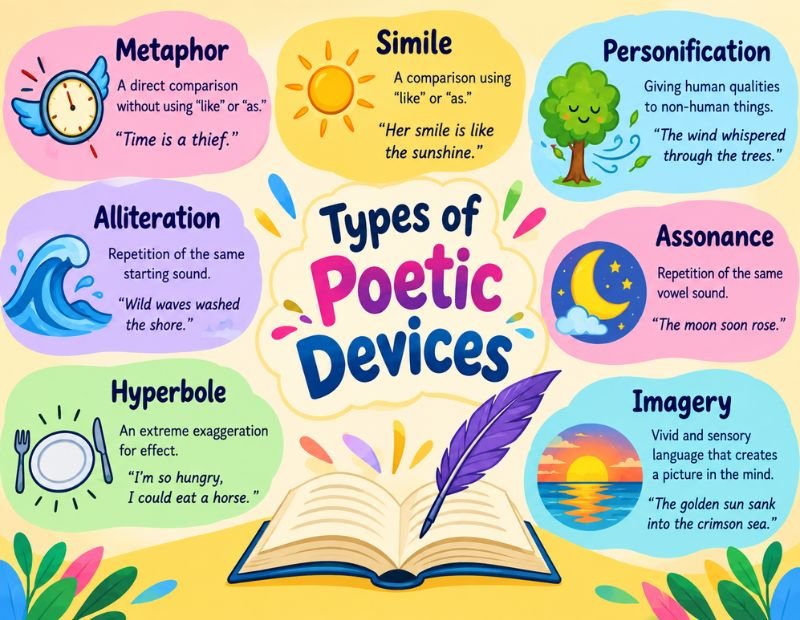
Poetic devices generally fall into a few broad categories. Understanding these categories makes it easier to remember dozens of individual devices, since each one usually serves a specific purpose within its group.
Poetic Devices of Form
These devices deal with the structure of a poem, including stanza length, line breaks, rhyme scheme, and meter. Form devices shape how a poem looks on the page and how it flows when read.
Poetic Devices of Sound (Diction)
Sound devices focus on how words sound together. This includes alliteration, assonance, consonance, and onomatopoeia. These devices give poems their musical quality.
Poetic Devices of Meaning (Figurative Language)
These devices go beyond the literal meaning of words. Metaphor, simile, personification, symbolism, and irony all fall into this category, adding depth and multiple layers of interpretation.
Poetic Devices of Repetition and Punctuation
Repetition devices like anaphora and refrain, along with punctuation choices like enjambment and caesura, control pacing and emphasis within a poem.
Complete List of Poetic Devices with Meanings and Examples
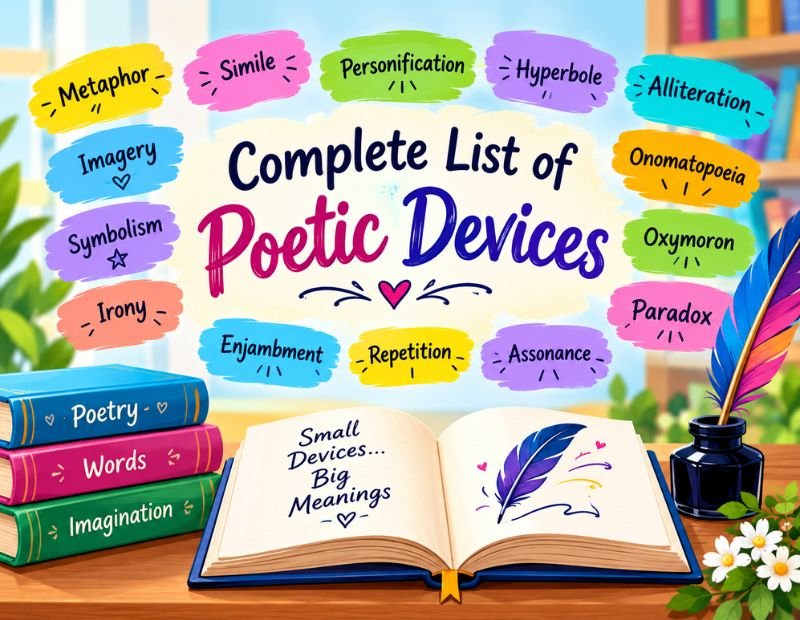
Below is a quick reference table covering the most common poetic devices, followed by detailed explanations for each.
| Poetic Device | Meaning | Example |
|---|---|---|
| Alliteration | Repetition of consonant sounds at the start of nearby words | Peter Piper picked a peck of pickled peppers |
| Assonance | Repetition of vowel sounds within nearby words | The rain in Spain falls mainly on the plain |
| Consonance | Repetition of consonant sounds within or at the end of words | Mike likes his new bike |
| Onomatopoeia | Words that imitate the sound they describe | Buzz, crash, sizzle, whisper |
| Metaphor | A direct comparison between two unlike things without using like or as | Time is a thief |
| Simile | A comparison using like or as | Brave as a lion |
| Personification | Giving human traits to non human things | The wind whispered through the trees |
| Imagery | Descriptive language that appeals to the five senses | The burnt orange leaves crunched underfoot |
| Symbolism | Using an object or idea to represent something deeper | A dove representing peace |
| Hyperbole | Deliberate exaggeration for emphasis | I have told you a million times |
| Irony | A contrast between expectation and reality | A fire station burning down |
| Allusion | A brief reference to a person, event, or work | A Herculean effort |
| Anaphora | Repetition of a word or phrase at the start of successive lines | We shall fight, we shall never surrender |
| Enjambment | A sentence or thought that continues past a line break without pause | A line ending mid thought that flows into the next |
| Caesura | A pause or break within a line of poetry | To be, or not to be, that is the question |
| Rhyme | Matching end sounds in lines of poetry | Cat and hat |
| Meter | The rhythmic pattern of stressed and unstressed syllables | Iambic pentameter |
| Refrain | A repeated line or group of lines in a poem | A chorus that returns after each stanza |
| Apostrophe | Addressing someone absent or something non human as if it can respond | O Death, where is thy sting |
| Synecdoche | Using a part to represent the whole | Wheels referring to a car |
| Metonymy | Substituting a related term for the thing itself | The crown referring to royalty |
| Juxtaposition | Placing two contrasting ideas side by side | Light and darkness in the same stanza |
| Cacophony | Harsh, jarring sounds used for effect | Words with hard consonants like clash and crack |
| Euphony | Pleasant, smooth sounding words used for effect | Soft vowel heavy words like lull and gentle |
| Allegory | A story with a hidden symbolic meaning | Animal Farm representing political events |
| Tone | The poet’s attitude toward the subject | A poem written with a mournful tone |
Sound Devices Explained
Sound devices are what give poetry its musical rhythm, even without music. They rely on repetition of specific sounds to create a pattern the ear can follow.
- Alliteration repeats consonant sounds at the beginning of words close together, often creating emphasis or a playful tone 🔤
- Assonance repeats vowel sounds within a line, softening the rhythm and adding musicality 🎶
- Consonance repeats consonant sounds anywhere in a word, not just the beginning, giving lines a subtle echo effect 🔁
- Onomatopoeia uses words that sound like what they describe, helping readers hear the poem as much as read it 👂
Figurative Language Devices Explained
Figurative devices are the heart of poetic meaning. They allow poets to say more with fewer words by comparing, exaggerating, or symbolizing ideas.
- Metaphor compares two unrelated things directly, suggesting they share a deeper quality 🌟
- Simile makes the same kind of comparison but uses like or as, making the connection more explicit 🔗
- Personification gives human qualities to objects, animals, or abstract ideas, making them feel alive 🍃
- Imagery paints a sensory picture using descriptive language tied to sight, sound, touch, taste, or smell 🎨
- Symbolism uses an object or action to represent a larger idea or emotion 🕊️
Structural and Repetition Devices Explained
These devices control pacing, emphasis, and the overall shape of a poem on the page.
- Enjambment lets a sentence flow past the end of a line without a pause, creating momentum 🏃
- Caesura creates a deliberate pause within a line, often for dramatic effect ⏸️
- Anaphora repeats a phrase at the start of multiple lines to build intensity or emphasis 📣
- Refrain repeats a line or stanza throughout a poem, similar to a chorus in a song 🔂
10 Poetic Devices With Examples
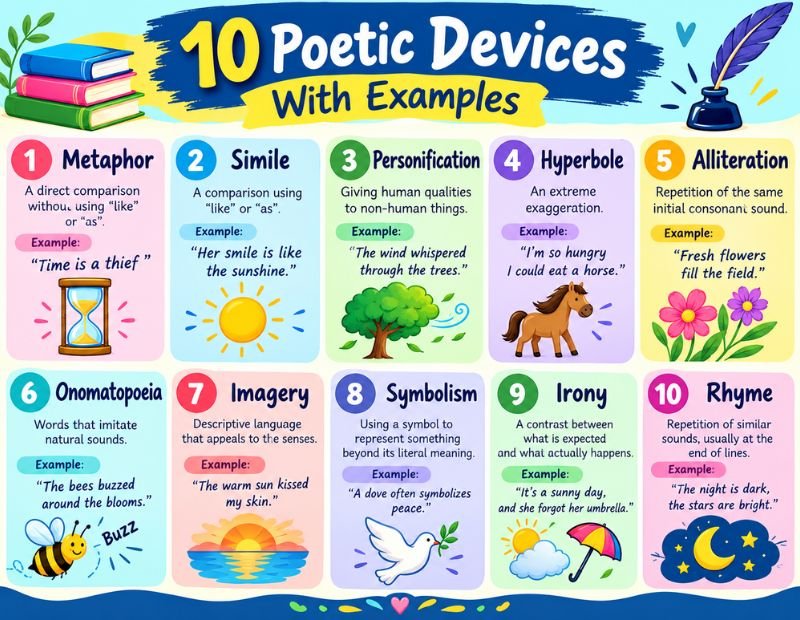
If you only remember a handful of poetic devices, start with these ten. They appear most often in classic and contemporary poetry alike.
- Alliteration, seen in phrases like wild and windy weather 🌬️
- Simile, seen in comparisons like quiet as a mouse 🐭
- Metaphor, seen in lines describing the classroom as a zoo 🦁
- Personification, seen in phrases like the stars danced in the sky ⭐
- Onomatopoeia, seen in words like clang, hiss, and pop 💥
- Hyperbole, seen in lines like I could sleep for a year 😴
- Imagery, seen in descriptions of golden sunlight spilling across the floor ☀️
- Symbolism, seen in a broken mirror representing shattered identity 🪞
- Rhyme, seen in matching end words like moon and June 🌙
- Repetition, seen in a phrase repeated for emotional weight throughout a poem 🔄
Poetic Devices vs Literary Devices
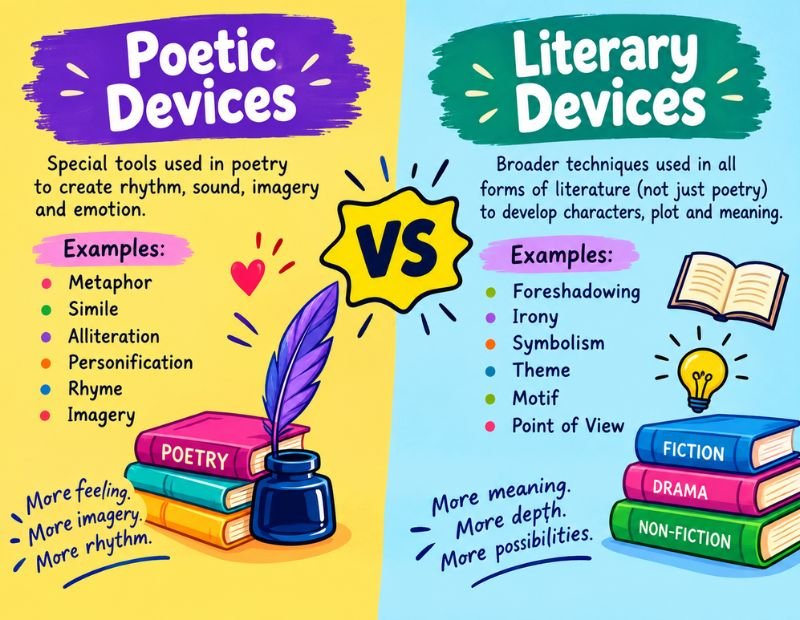
People often use these two terms interchangeably, but there is a subtle difference worth knowing, especially for essays and exams.
| Aspect | Poetic Devices | Literary Devices |
|---|---|---|
| Scope | Specific to poetry, focused on sound and form | Used across all writing, including prose and drama |
| Focus | Rhythm, rhyme, meter, and sound patterns | Plot, character, theme, and narrative structure |
| Examples | Alliteration, meter, enjambment, caesura | Foreshadowing, flashback, characterization |
| Overlap | Metaphor, simile, and symbolism appear in both | Metaphor, simile, and symbolism appear in both |
In short, all poetic devices are a type of literary device, but not all literary devices are considered poetic devices, since some apply only to storytelling elements found in novels and plays.
How to Identify Poetic Devices in a Poem?
Spotting poetic devices becomes easier with a simple, repeatable process. Try this approach the next time you read or analyze a poem.
- Read the poem aloud first to notice rhythm, rhyme, and repeated sounds 🔊
- Underline any comparisons that use like or as, which usually signal a simile 🖊️
- Look for words describing sights, sounds, smells, tastes, or textures, which point to imagery 👀
- Check line endings for patterns that suggest rhyme scheme or meter 📏
- Notice any objects or actions that seem to carry a deeper meaning, which often signals symbolism 🔎
- Pay attention to line breaks that cut off a thought, which usually indicates enjambment ✂️
Tips for Using Poetic Devices in Your Own Writing
Knowing the definitions is only half the process. Using poetic devices well takes a bit of practice and restraint.
- Start with one or two devices per stanza instead of overloading every line ✍️
- Choose devices that match the emotion you want to convey, calm poems suit euphony, tense poems suit cacophony 🎭
- Read your work aloud to test whether the rhythm feels natural 🗣️
- Avoid forcing a metaphor or simile if it does not fit the tone of the poem 🚫
- Study poets you admire and notice which devices they lean on most often 📚
- Revise with intention, since the strongest poems often come from editing, not the first draft 🔁
Conclusion
Poetic devices are the building blocks that transform plain language into poetry that moves people. From the rhythmic pull of alliteration to the emotional weight of metaphor, each device serves a specific purpose in shaping how a poem sounds and what it means. Once you can recognize these techniques, both reading and writing poetry become far more rewarding, since you start noticing the craft behind every carefully placed word. Whether you are analyzing a classic poem for class or writing your first stanza, this list of poetic devices gives you a solid foundation to build on.
Frequently Asked Questions
What are poetic devices?
Poetic devices are techniques poets use, such as metaphor, rhyme, and imagery, to enhance the sound, meaning, and emotional impact of a poem.
How many poetic devices are there?
There is no fixed number, but most guides cover between 20 and 30 common poetic devices used across classic and modern poetry.
What is the difference between a poetic device and a literary device?
Poetic devices focus specifically on sound, rhythm, and form in poetry, while literary devices apply more broadly to all types of writing.
What are the most common poetic devices?
Alliteration, simile, metaphor, personification, imagery, and rhyme are among the most frequently used poetic devices.
Can poetic devices be used in prose writing?
Yes, many poetic devices like metaphor, imagery, and repetition are also used in prose and speeches to add emotional impact.
Why do poets use sound devices like alliteration and assonance?
Sound devices create rhythm and musicality, making poems more pleasant to read aloud and easier to remember.
What is the easiest poetic device to spot in a poem?
Rhyme is usually the easiest to spot, since it appears clearly at the end of lines with matching sounds.