
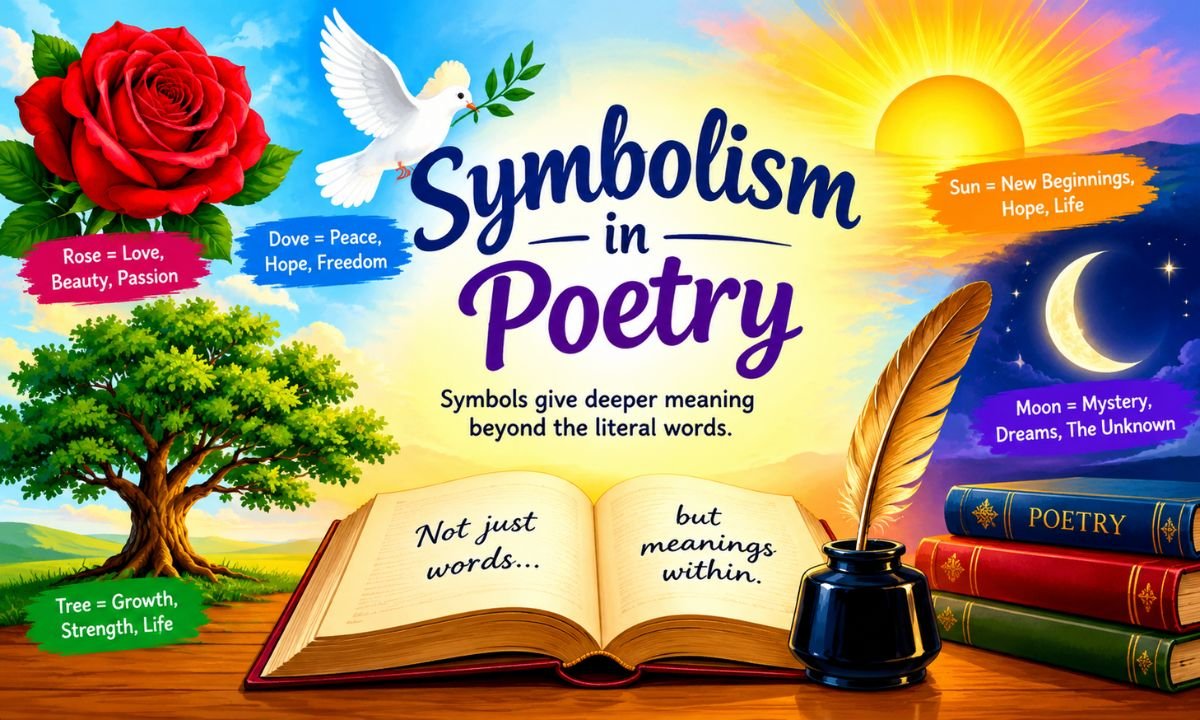
Poetry rarely says exactly what it means. A poet who wants to describe loneliness might not write the word “lonely” at all. Instead, they might describe a single moon wandering across an empty sky. That single image can carry more emotional weight than a whole paragraph of plain description. This is the quiet power of symbolism in poetry.
If you have ever read a poem and felt something you could not fully explain, symbolism was probably at work. In this guide, you will learn what symbolism in poetry actually means, why poets use it, the different types you will encounter, and more than 20 real examples pulled from classic and modern verse. Whether you are a student prepping for an exam, a teacher building a lesson plan, or simply a reader who loves poetry, this article will give you a complete, easy to follow breakdown.
What Is Symbolism in Poetry? Meaning Explained
Symbolism in poetry is a literary device where an object, color, action, person, or place represents an idea, emotion, or theme beyond its literal meaning. Instead of stating a feeling directly, the poet uses an image that carries that feeling for them.
For example:
- A rose often stands for love or beauty 🌹
- A storm often stands for conflict or inner turmoil ⛈️
- A caged bird often stands for a longing for freedom 🕊️
Symbols work because they tap into shared human associations. Readers do not need the poet to explain that winter means death or decline. Most people already connect cold, bare landscapes with endings, so the poet can rely on that shared understanding to say more with less.
Read Also This Blog: Poetic Devices
How Symbolism Differs From Metaphor and Allegory?
People often confuse symbolism with metaphor and allegory, but they are not the same thing.
| Literary Device | What It Does | Example |
|---|---|---|
| Symbolism | An object represents a broader idea throughout a piece | A dove representing peace |
| Metaphor | A direct comparison between two unlike things | “Her voice was music” |
| Allegory | An entire story with a fixed, single hidden meaning | Animal Farm representing political revolution |
The simplest way to remember the difference: metaphor is usually a single line, symbolism runs through an image across a whole poem, and allegory shapes the entire narrative around one closed meaning.
Why Do Poets Use Symbolism? The Purpose and Importance
Symbolism is not decoration. It is one of the main tools poets use to make language do more work. Here is why it matters so much in poetry.
- It adds emotional depth. A symbol can hold complicated feelings that plain words cannot fully capture 💭
- It creates layers of meaning. The same poem can be read differently by different readers, which keeps the work alive over time 📚
- It allows subtlety. Poets writing under censorship or in conservative periods often used symbols to say things they could not say directly ✍️
- It builds connection. Universal symbols like water, light, and the sun let readers from different cultures relate to the same poem 🌍
- It makes abstract ideas concrete. Concepts like grief, hope, or time are hard to picture, but a wilting flower or a ticking clock makes them visible 🕰️
Types of Symbolism in Poetry
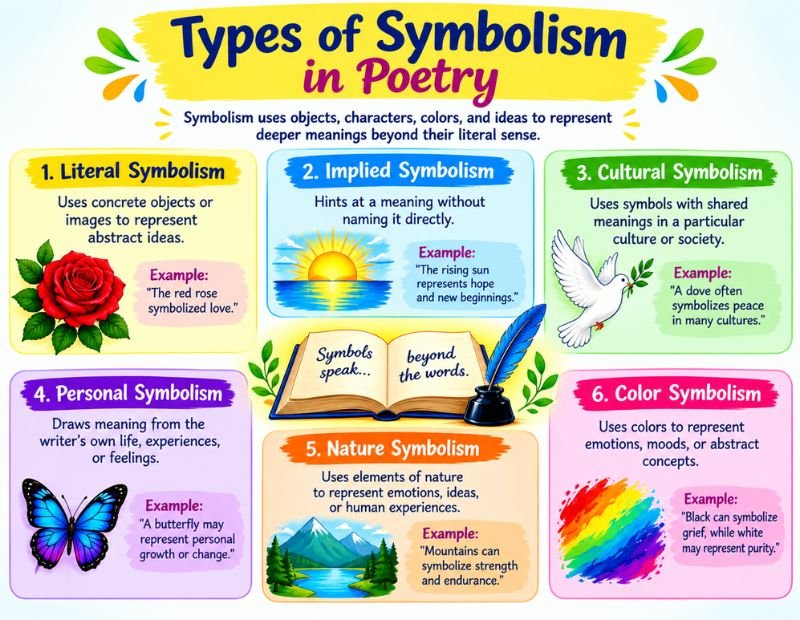
Not all symbols work the same way. Scholars generally group poetic symbols into a few categories.
Universal or Archetypal Symbols
These are symbols that carry similar meaning across almost every culture. Light usually means knowledge or hope. Water usually means life, cleansing, or renewal. Spring usually means new beginnings. Because these meanings are so widely shared, readers grasp them almost instantly, no matter their background.
Cultural or Conventional Symbols
These symbols are tied to a specific tradition and may not translate outside it. The cross carries deep meaning in Christian writing. The lotus carries meaning in Indian and Buddhist poetry. A red string carries meaning in East Asian folklore. Readers unfamiliar with the culture may miss the symbol entirely, which is why context matters so much when analyzing poetry.
Personal or Private Symbols
Sometimes a poet builds their own private symbol system. A specific object, like a childhood house or a particular bird, might mean something only within that poet’s body of work. Readers need to study the poet’s other pieces to fully understand these symbols.
Natural Symbols
Poets frequently draw symbols from nature because natural imagery is something every reader has experienced. Seasons, weather, animals, and plants all fall into this category and often overlap with universal symbols.
20+ Examples of Symbolism in Poetry
Below are well known examples that show symbolism at work across different poems and eras.
- The Rose in “A Red, Red Rose” by Robert Burns – The red rose symbolizes deep, romantic love 🌹
- The Nightingale in “Ode to a Nightingale” by John Keats – The bird’s song symbolizes beauty and a longing to escape mortality 🎶
- The Tiger in “The Tyger” by William Blake – The tiger symbolizes raw power and the mystery of creation 🐯
- The Withered Leaf in various Romantic poems – A dried, falling leaf symbolizes old age and approaching death 🍂
- The Moon in Percy Bysshe Shelley’s “To the Moon” – The moon symbolizes loneliness and constant, restless change 🌙
- The Sunflower in Blake’s “Ah, Sun-Flower” – The flower symbolizes a weary human soul chasing something eternal 🌻
- The Caged Bird in Maya Angelou’s poetry – The bird symbolizes oppression and the deep yearning for freedom 🐦
- The Road in Robert Frost’s “The Road Not Taken” – The diverging road symbolizes life choices and their consequences 🛤️
- The Wind in many elegies – Wind often symbolizes uncontrollable fate or the passage of time 🌬️
- The Storm in confessional poetry – A storm symbolizes emotional chaos or inner conflict ⚡
- The Garden in devotional poetry – A garden symbolizes paradise, innocence, or a state of grace 🌳
- The Mirror in modern poetry – A cracked or clouded mirror symbolizes a fractured sense of identity 🪞
- Snow and Winter in seasonal poems – Snow symbolizes stillness, isolation, or emotional numbness ❄️
- The River in coming of age poems – A flowing river symbolizes the passage of time or the journey of life 🌊
- The Candle or Flame in love poems – A flickering flame symbolizes passion, hope, or a fragile life force 🕯️
- The Dove with an Olive Branch – This pairing symbolizes peace after conflict 🕊️
- The Butterfly in transformation poems – A butterfly symbolizes change, growth, or rebirth 🦋
- The Rainbow after a storm – A rainbow symbolizes hope returning after hardship 🌈
- Bangles and the Palanquin in Sarojini Naidu’s poetry – These objects symbolize Indian cultural identity and womanhood 💍
- The House in family themed poems – A childhood house often symbolizes memory, belonging, or roots 🏡
- Thorns alongside a Rose – Thorns symbolize the pain that often accompanies love 🥀
Popular Symbols in Poetry Explained
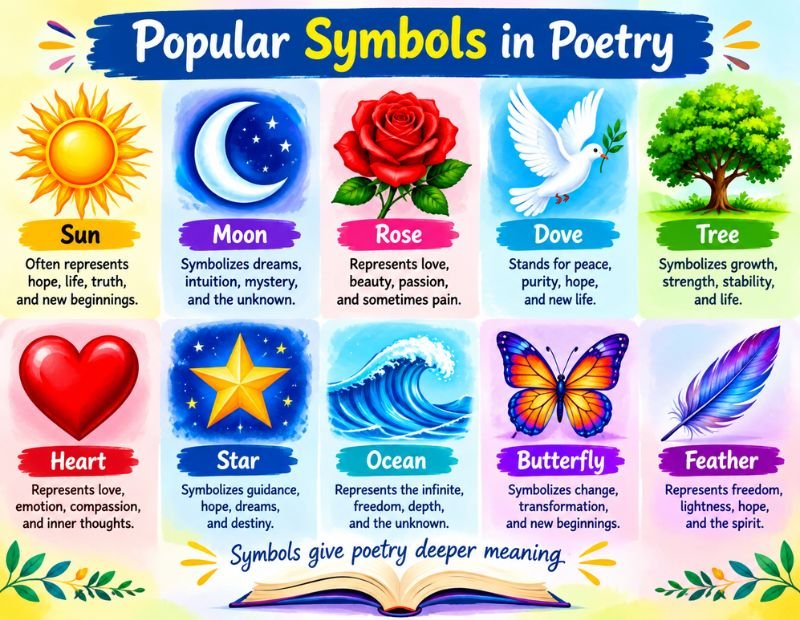
Some symbols appear so often in poetry that they deserve their own closer look.
Moon Symbolism in Poetry
The moon is one of the most recurring symbols in poetry. It often represents change, mystery, femininity, and solitude. Because the moon constantly shifts shape while always returning to fullness, poets use it to describe cycles, emotional highs and lows, and the passage of time.
Rose Symbolism in Poetry
The rose almost always points to love, beauty, or desire. A red rose usually symbolizes romantic passion, while a wilting or thorned rose can symbolize the pain, loss, or fragility that often comes wrapped around love.
Luna Symbolism in Poetry
Luna, the Roman goddess associated with the moon, is often invoked in poetry as a symbol of the feminine divine, intuition, and the mysterious side of the night. Poets use “Luna” instead of “moon” when they want to add a mythic or goddess like quality to the image.
Opal Symbolism in Poetry
Opals are less common than roses or moons, but when poets use them, the shifting colors inside the stone usually symbolize complexity, hidden emotion, or a personality that reveals different sides depending on the light.
Short Poems With Strong Symbolism
Short poems are often the clearest place to study symbolism because every image has to carry weight. A few short lines about a leaf falling from a branch, a candle burning low, or a bird leaving its nest can symbolize entire life stages in just a handful of words. This is why teachers frequently use short poems to introduce the concept before moving on to longer, more complex works.
How to Use Symbolism in Poetry?
If you want to write poetry that uses symbolism effectively, keep these tips in mind.
- Show, don’t tell. Instead of writing “I felt trapped,” try an image like a bird pressed against glass 🪟
- Choose objects with built in associations. Water, fire, light, and darkness already carry meaning, so they do a lot of work quickly 🔥
- Let a symbol evolve. A rose that means love at the start of a poem can mean loss by the end 🌹
- Repeat the image with purpose. If you mention rain at the beginning, middle, and end of a poem, readers will start searching for its meaning ☔
- Stay consistent with tone. A symbol should match the emotional register of the rest of the poem 🎭
- Avoid overused symbols unless you twist them. Flip a common symbol, like using fire for comfort instead of destruction, to keep the poem fresh 🔄
Symbolism in Poetry for Students
Symbolism In Poetry for students means the goal is to notice a symbol and then ask what larger idea it could represent. A simple four step method works well.
- Identify the object, color, or image that repeats or stands out
- Ask what that image commonly represents in culture or nature
- Check how the image connects to the poem’s overall theme
- Confirm your reading by looking at how the symbol is used elsewhere in the poem
Effects of Symbolism In Poetry on the Reader
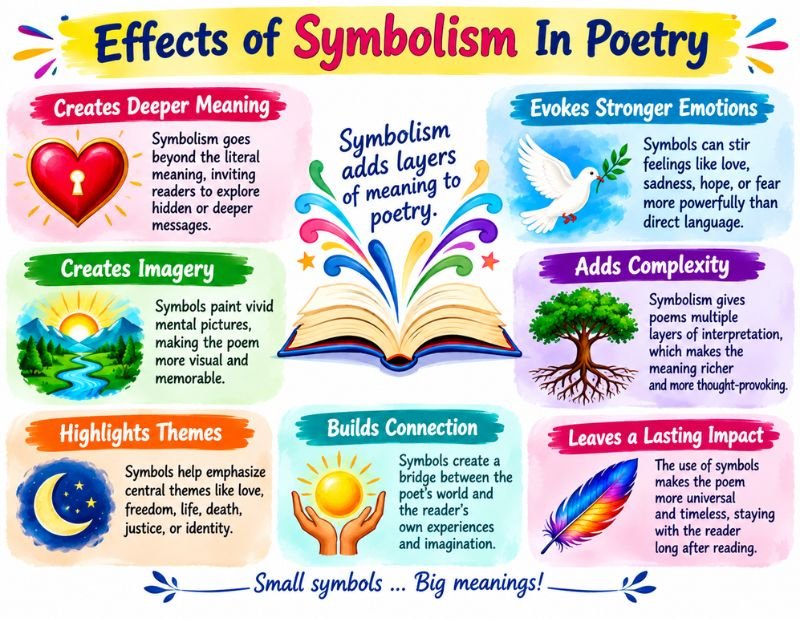
Symbolism in poetry slows readers down and invites them to think rather than simply absorb information. It turns reading into an active experience, where the reader has to connect the image to a feeling or idea rather than being told what to feel outright.
Symbolism in Poetry for Teachers
Teachers can use symbolism in poetry to build critical thinking skills in the classroom. A useful classroom approach includes:
- Starting with short, accessible poems before moving to complex ones 📖
- Asking students to bring in an object and explain what it could symbolize in a poem they write 🖊️
- Comparing how the same symbol, like the moon, is used differently by two different poets 🌗
- Discussing cultural symbols so students understand that meaning can change depending on background 🗺️
Symbolism in Poetry for Kids
For younger readers, symbolism in poetry can be introduced in a simple, playful way. Ask a child what a rainbow makes them think of, or what a sunny day feels like compared to a rainy one. Most kids will instinctively connect a rainbow with hope or happiness and rain with sadness, which shows they already understand the basic idea of symbolism even before they know the word for it.
Quick Reference Table: Common Poetic Symbols and Their Meanings
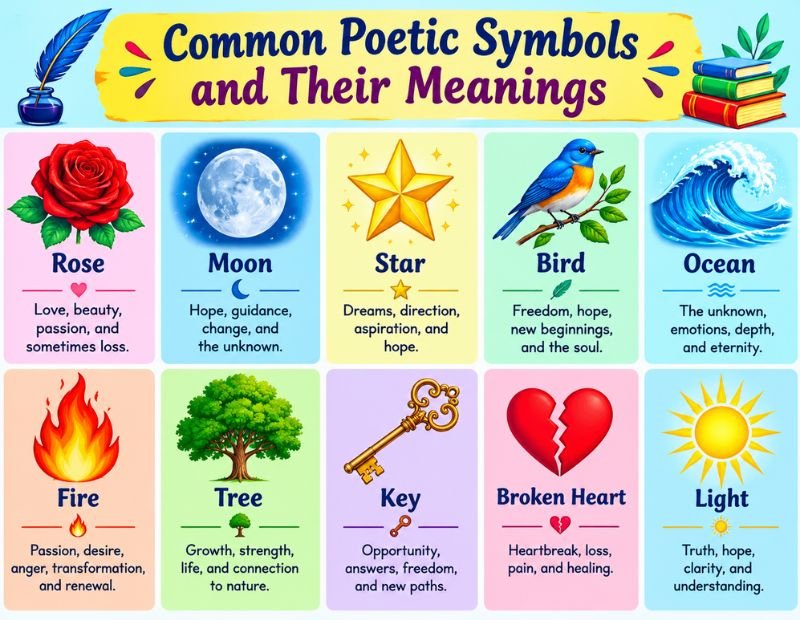
| Symbol | Common Meaning |
|---|---|
| Rose | Love, beauty, passion |
| Moon | Change, mystery, solitude |
| Water | Life, purification, renewal |
| Fire | Passion, destruction, energy |
| Winter or Snow | Death, stillness, isolation |
| Spring | New beginnings, youth |
| Bird in a cage | Restriction, longing for freedom |
| Storm | Conflict, emotional turmoil |
| Light | Knowledge, hope, truth |
| Darkness | Fear, the unknown, despair |
| Road or Path | Life choices, journey |
| Mirror | Identity, self reflection |
Conclusion
Symbolism in poetry turns simple objects into carriers of deep emotion and meaning. A moon becomes loneliness, a rose becomes love, and a storm becomes inner turmoil. Once you learn to spot these patterns, you will never read a poem the same way again. Whether you are analyzing a classic poem for class, teaching students how to find hidden meaning, or writing your own verse, understanding symbolism gives you a much richer way to connect with poetry. Start small, look for repeated images, ask what they might represent, and you will find that even the shortest poem can hold an entire world of meaning.
Frequently Asked Questions
What is symbolism in poetry in simple words?
Symbolism is when a poet uses an object, color, or image to represent a bigger idea or feeling instead of stating it directly.
What is the most common symbol used in poetry?
The rose is one of the most common symbols and usually represents love, beauty, or passion.
What does the moon usually symbolize in poetry?
The moon typically symbolizes change, mystery, solitude, and the passage of time.
How is symbolism in poetry different from a metaphor?
A metaphor is usually a single direct comparison, while symbolism is an image that carries meaning across an entire poem.
Why do poets use symbolism in poetry instead of plain language?
Symbolism allows poets to express complex emotions and ideas more powerfully and subtly than plain, literal language.
Can the same symbol mean different things in different poems?
Yes, a symbol’s meaning can shift depending on the poem’s context, culture, and the poet’s personal intent.
Is symbolism only used in poetry?
No, symbolism appears in novels, films, art, and everyday culture, though poetry uses it especially densely due to its compact form.
How can beginners start identifying symbolism in a poem?
Look for objects or images that repeat, then ask what larger idea or emotion that image could represent within the poem’s theme.