
Read a poem out loud and notice how it makes you feel. Does it sound angry, tender, mocking, or hopeful? That feeling is tone, and it is one of the most powerful forces shaping how readers connect with a poem.
Tone is not decoration. It is the emotional lens through which every image, word, and line break is filtered. In this guide, you will learn what tone in poetry really means, the major types of tone poets use, how tone differs from mood and theme, and real examples that show tone working in action, including simple examples for students and kids.
What Does Tone in Poetry Mean?
Tone in poetry refers to the speaker’s attitude toward the subject, the audience, or the poem’s events. It is how the poet feels about what they are writing, and that feeling colors every choice on the page.
Tone in poetry can be conveyed through several tools working together:
- Word choice and diction 📝
- Sentence structure and syntax 🧩
- Imagery and figurative language 🌄
- Rhythm, sound, and punctuation 🎶
- Point of view and speaker perspective 👤
A poem about rain could feel peaceful and dreamy, or it could feel gloomy and threatening. The rain does not change. The tone does.
Read Also This Blog: Diction in Poetry
Tone in Poetry Refers To the Poet’s Voice, Not the Reader’s Feelings
A common mix up is confusing tone with mood. Tone refers to the attitude of the speaker or poet. Mood refers to the atmosphere the reader feels while reading. They are closely linked but are not the same thing, which we explain further below.
Mood and Tone in Poetry: What Is the Difference?
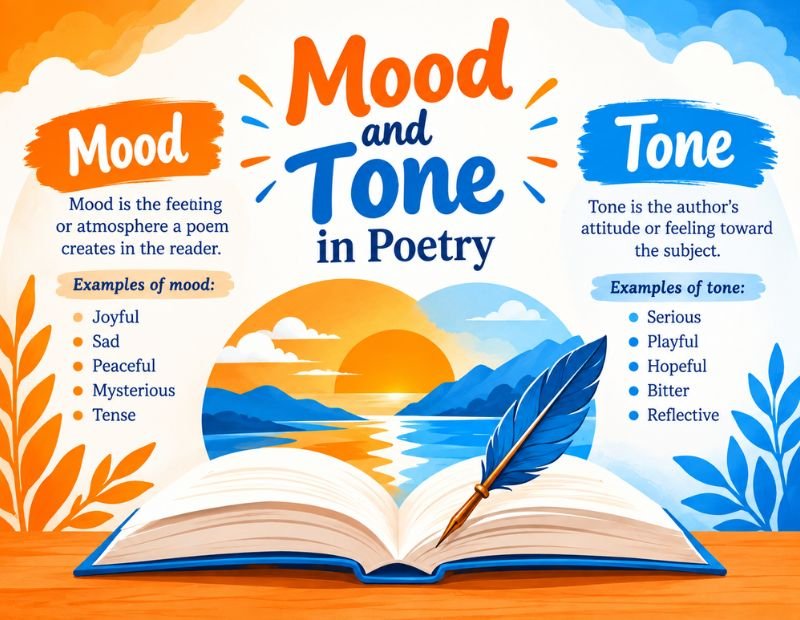
Many students struggle with separating these two ideas, so here is a simple breakdown.
| Element | Definition | Created By | Experienced By |
|---|---|---|---|
| Tone | The poet’s or speaker’s attitude toward the subject | Word choice, syntax, imagery | The poem itself |
| Mood | The emotional atmosphere the poem creates | Setting, sound, pacing | The reader |
A poem can have a bitter tone while creating a mood of sadness or unease in the reader. Tone comes from the writer’s stance. Mood is the emotional result felt by whoever is reading it.
Theme and Tone in Poetry
Theme is the central idea or message of a poem, while tone is the emotional attitude the poet takes toward that theme. The same theme, such as loss, can be treated with a grieving tone in one poem and an accepting or even hopeful tone in another.
For example, two poems can share the theme of death. One might use a reverent, gentle tone, while another uses an angry, defiant tone. The theme stays constant, but tone shapes how that theme is delivered.
Types of Tone in Poetry
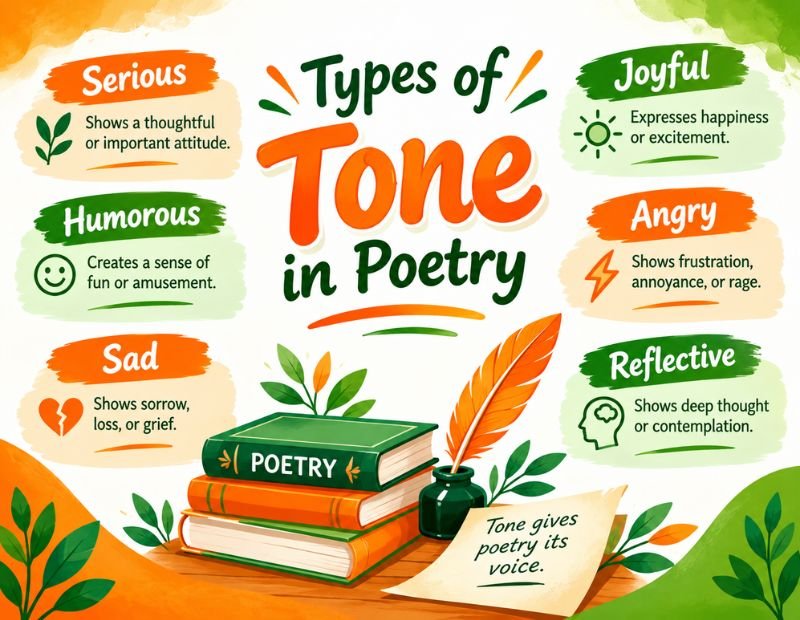
Poets rely on a wide range of tones depending on subject matter and purpose. Below are the most common categories you will encounter.
1. Emotional Tones
These tones connect directly with feelings such as joy, grief, love, or fear.
- Joyful 😊
- Melancholic 😔
- Passionate 🔥
- Nostalgic 🍂
2. Atmospheric Tones
These tones build a specific mood or setting within the poem.
- Eerie 👻
- Peaceful 🌿
- Mysterious 🌫️
- Dreamlike ✨
3. Social and Political Tones
These tones reflect the poet’s stance on society, injustice, or power.
- Defiant ✊
- Critical 🗯️
- Sarcastic 😏
- Empowering 💪
4. Philosophical Tones
These tones explore deeper questions about life, existence, and meaning.
- Reflective 🪞
- Questioning ❓
- Accepting 🕊️
- Detached 🧊
5. Narrative Tones
These tones shape how a poem tells a story or addresses an audience.
- Confessional 🗝️
- Instructive 📘
- Playful 🎈
- Formal 🎩
Tone in Poetry Examples
Real examples make tone far easier to understand. Here are well known instances of tone shaping a poem’s emotional impact.
- Maya Angelou’s “Still I Rise” carries a defiant and empowering tone through bold, confident word choice 🌟
- Sylvia Plath’s “Daddy” shifts from a childlike tone to a furious, accusatory tone as the poem develops 🔥
- Robert Frost’s “The Road Not Taken” uses a reflective, quietly ironic tone to explore choice and regret 🍁
- Langston Hughes’s “I, Too” carries a dignified and hopeful tone despite addressing exclusion 🕊️
- Emily Dickinson’s “I heard a Fly buzz, when I died” uses dashes and pacing to create an intimate, questioning tone 🪶
Notice how each poet uses different techniques, from punctuation to word choice, to build a distinct emotional voice.
Examples of Tone in Poetry for Students
For students learning to identify tone, short and clear examples work best. Here are simple ways tone appears in accessible poems.
- A poem describing sunshine with words like “warm,” “golden,” and “gentle” carries a cheerful tone ☀️
- A poem describing a storm with words like “crashing,” “violent,” and “dark” carries a frightening tone ⛈️
- A poem using words like “perhaps,” “maybe,” and “I wonder” carries a thoughtful, uncertain tone 🤔
- A poem repeating exclamation marks and words like “hooray” carries an excited tone 🎉
Examples of Tone in Poetry for Kids
Younger readers can grasp tone quickly through simple, relatable comparisons.
- A poem about a puppy playing in the park can feel happy and silly 🐶
- A poem about losing a favorite toy can feel sad and disappointed 🧸
- A poem about a thunderstorm at night can feel scary and nervous ⚡
- A poem about a birthday party can feel excited and joyful 🎂
Teaching kids to ask “how does this poem make me feel” is one of the simplest ways to introduce tone recognition.
How Tone in Poetry Can Be Conveyed?
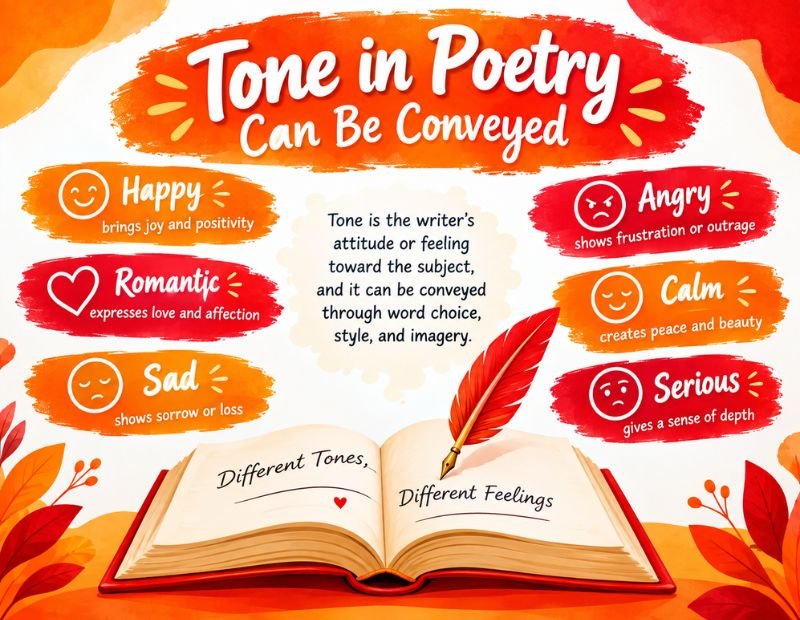
Tone does not appear from a single technique. It is built through a combination of poetic tools working together.
| Technique | How It Shapes Tone |
|---|---|
| Diction | Formal or casual words create serious or relaxed tones |
| Imagery | Bright or dark imagery creates hopeful or gloomy tones |
| Punctuation | Exclamation points, dashes, or ellipses shift pacing and emotion |
| Rhythm | Fast rhythms build urgency, slow rhythms build calmness |
| Repetition | Repeated words or lines intensify emotional weight |
| Point of view | First person creates intimacy, third person creates distance |
Effects of Tone in Poetry
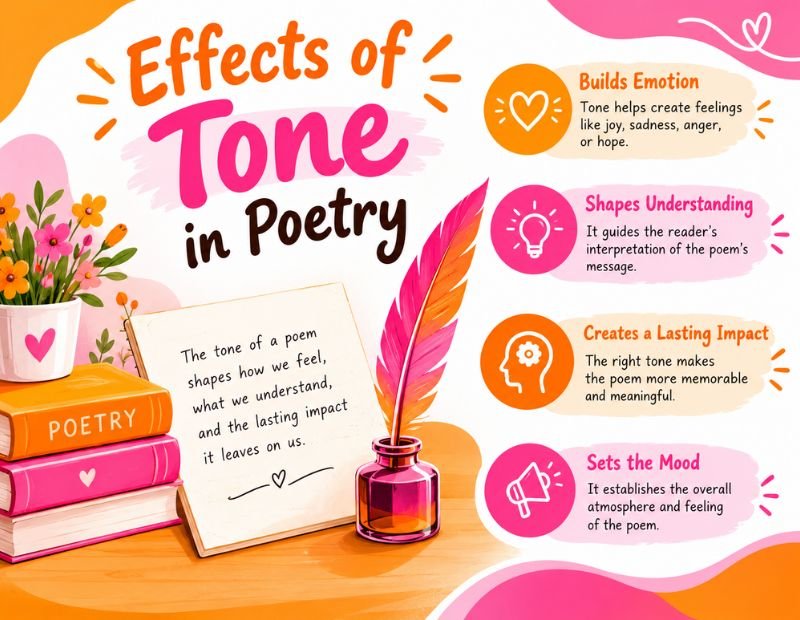
Tone shapes the reading experience in several powerful ways.
- Guides reader interpretation of the poem’s deeper meaning 🧭
- Builds emotional connection between the reader and the speaker ❤️
- Reinforces theme, making the central message land more powerfully 📌
- Creates contrast, especially when tone shifts unexpectedly within a poem 🔄
- Enhances memorability, since strong emotional tones stay with readers longer 🧠
Purpose of Tone in Poetry
Tone serves several important functions within a poem’s overall design.
To Reveal the Speaker’s Attitude
Tone tells readers exactly how the speaker feels about their subject, whether that subject is love, war, nature, or loss.
To Shape Reader Response
A carefully controlled tone guides how readers should feel while reading, even before they consciously register the poem’s meaning.
To Add Depth Through Contrast
Some of the most memorable poems use irony, pairing a light or playful tone with a serious or tragic subject, creating tension that makes the poem more powerful.
Reflective Tone in Poetry
A reflective tone is one of the most common tones in poetry, especially in poems about memory, aging, nature, or personal growth. This tone is slow, thoughtful, and often introspective, inviting readers to pause and consider deeper meaning alongside the speaker.
Reflective tone is typically built through:
- Quiet, measured pacing 🕰️
- Questions rather than declarations ❓
- Imagery drawn from memory or nature 🍃
- A calm, unhurried speaker voice 🌙
Robert Frost is one of the most recognized poets for mastering reflective tone, often blending simple rural imagery with deeper existential questioning.
Importance of Tone in Poetry
Tone matters because it directly shapes how a reader experiences and understands a poem.
- It transforms plain language into emotionally rich communication 💬
- It helps readers distinguish sincerity from irony or sarcasm 🎭
- It strengthens the relationship between form, theme, and feeling 🔗
- It gives poems their unique emotional identity and voice 🎤
Without tone, poetry would read like a flat list of facts rather than a living, breathing expression of human experience.
Words to Describe Tone in Poetry
Having a strong vocabulary of tone words makes analysis much easier. Here are commonly used descriptive terms grouped by category.
| Category | Tone Words |
|---|---|
| Positive | Joyful, hopeful, playful, celebratory, tender |
| Negative | Bitter, angry, mournful, cynical, hostile |
| Neutral | Objective, detached, matter of fact, clinical |
| Reflective | Nostalgic, wistful, contemplative, introspective |
| Intense | Passionate, urgent, defiant, furious |
Using precise tone words instead of generic terms like “sad” or “happy” makes poetry analysis far more effective and specific.
Conclusion
Tone in poetry is the emotional heartbeat behind every line, word, and image a poet chooses. It reveals the speaker’s attitude, shapes how readers interpret meaning, and transforms simple language into a powerful emotional experience. From reflective and nostalgic tones to defiant and joyful ones, understanding tone allows readers to connect with poetry on a much deeper level.
The next time you read a poem, pay close attention to how it makes you feel and why. That awareness is the first step toward truly understanding the craft and emotional power behind poetry.
Frequently Asked Questions
What is tone in poetry?
Tone in poetry is the speaker’s or poet’s attitude toward the subject, audience, or events of the poem, expressed through word choice and style.
How is tone different from mood?
Tone is the poet’s attitude, while mood is the emotional atmosphere the reader feels while reading the poem.
What are common types of tone in poetry?
Common types include emotional, atmospheric, social, philosophical, and narrative tones, ranging from joyful to defiant to reflective.
How can tone be conveyed in poetry?
Tone is conveyed through diction, imagery, punctuation, rhythm, repetition, and point of view working together.
Why is tone important in poetry?
Tone shapes how readers interpret and emotionally connect with a poem, making it essential for understanding deeper meaning.
Can tone change within a single poem?
Yes, many poems shift tone to reflect changing emotions, turning points, or contrasts between ideas.