
Every great poem starts with a single decision: which word goes where. That decision is called diction, and it is the quiet engine behind every unforgettable poetic line you have ever read. Whether a poet chooses “weep” instead of “cry” or “crimson” instead of “red,” that tiny choice shapes how a reader feels, thinks, and remembers the poem.
In this guide, you will learn what diction in poetry really means, the major types of diction poets rely on, how diction shapes tone and imagery, and real literary examples that show these ideas in action. By the end, you will know exactly how to identify, analyze, and even use diction like a skilled poet.
What Is Diction in Poetry?
Diction in poetry refers to a poet’s deliberate choice and arrangement of words to create meaning, mood, rhythm, and style. It is not just about which words are used, but why those specific words were chosen over other possible options.
Poetic diction depends on:
- The denotation (literal dictionary meaning) of a word 📖
- The connotation (emotional association) a word carries 💭
- The sound and rhythm the word creates when read aloud 🎵
- The context of the poem’s subject, tone, and audience 🎯
A poet writing about death, for example, could use “passed away,” “perished,” or “slipped into the dark.” Each phrase describes the same event, yet each creates a completely different emotional experience for the reader.
Read Also This Blog: Imagery in Poetry
Why Diction Matters More in Poetry Than in Prose?
Poetry works with limited space. A novel can spend paragraphs building emotion, but a poem often has only a few lines or even a few words to do the same job. This is why every single word in a poem is chosen with extreme precision, making diction one of the most powerful literary devices in a poet’s toolkit.
Types of Diction in Poetry
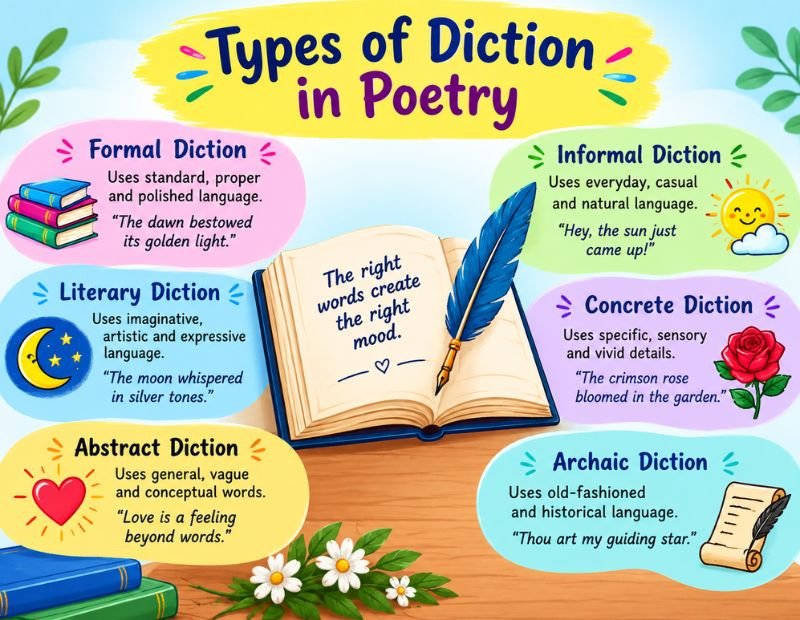
Poets do not use just one style of language. Depending on the mood, subject, and audience, they shift between several distinct types of diction. Below is a breakdown of the most common types you will encounter in poetry.
| Type of Diction | Description | Common Use in Poetry |
|---|---|---|
| Formal Diction | Sophisticated, grammatically precise language | Odes, elegies, classical poetry |
| Informal Diction | Everyday, relaxed language | Modern free verse, conversational poems |
| Colloquial Diction | Region or culture specific expressions | Folk poetry, dialect poems |
| Slang Diction | Highly informal, trend based language | Contemporary and spoken word poetry |
| Abstract Diction | Words describing ideas or feelings | Love poems, philosophical verse |
| Concrete Diction | Words describing specific, tangible things | Imagist poetry, nature poems |
| Poetic Diction | Elevated, archaic, or musical language | Traditional and Romantic era poetry |
| Pedantic Diction | Overly technical or academic word choice | Satirical or intellectual poetry |
1. Formal Diction in Poetry
Formal diction uses polished, rule following language. It avoids contractions, slang, and casual phrasing. This type of diction often appears in poems written for solemn occasions such as memorials, tributes, or classical themes.
Example: “Shall I compare thee to a summer’s day?” from Shakespeare’s sonnets reflects elevated, formal word choice.
2. Informal and Colloquial Diction
Informal diction feels closer to natural speech. Colloquial diction goes a step further, using phrases tied to a specific region, era, or community. Poets like Langston Hughes often used colloquial diction to capture authentic voices and lived experiences.
3. Abstract vs Concrete Diction
- Abstract diction describes emotions, ideas, or concepts that cannot be touched, such as love, freedom, or grief 💫
- Concrete diction describes things you can see, touch, hear, or measure, such as a rose, a river, or a storm 🌊
Poets often blend both. Emily Dickinson frequently paired abstract themes like death with concrete imagery like a carriage or a fly to make invisible ideas feel physically real.
4. Poetic Diction
Poetic diction refers to elevated, sometimes archaic language used specifically to create musicality and beauty. Words like “o’er,” “thee,” or “morn” fall under this category. While less common in modern poetry, poetic diction remains iconic in classical and Romantic works by poets such as Wordsworth and Keats.
Diction in Poetry Examples
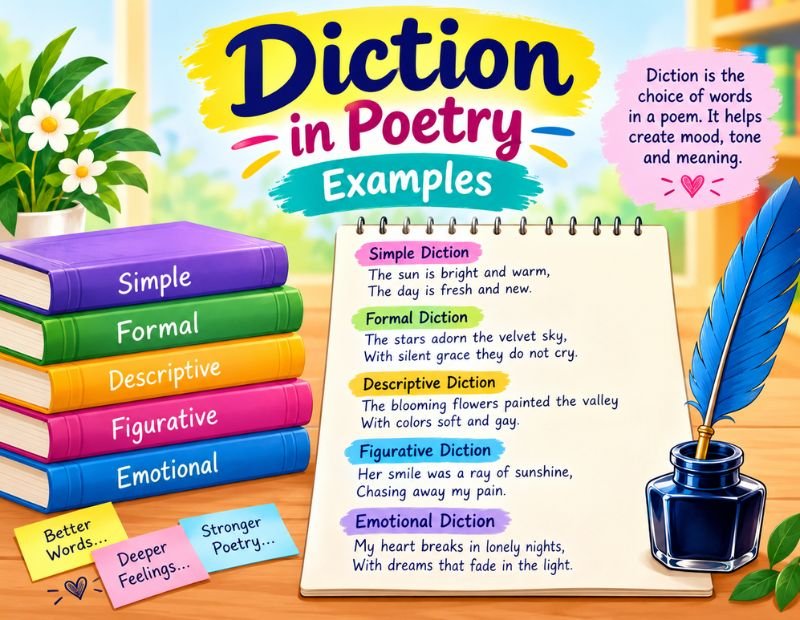
Understanding diction becomes much easier with real examples. Here are a few well known instances where word choice completely shapes the poem’s impact.
- Robert Frost’s “The Road Not Taken” uses simple, concrete diction like “roads,” “wood,” and “traveler” to create a reflective, accessible tone 🌲
- Sylvia Plath’s poetry often uses harsh, intense diction such as “blood,” “scar,” and “ash” to convey trauma and emotional weight 🔥
- Maya Angelou’s “Still I Rise” uses bold, empowering diction like “rise,” “moon,” and “tide” to build strength and resilience 🌙
- William Blake’s “The Tyger” uses forceful, rhythmic diction such as “burning,” “dread,” and “hand” to create awe and fear ⚡
These examples prove one thing clearly: diction is never accidental. Every word is selected to serve the poem’s larger emotional and thematic purpose.
Effects of Diction in Poetry
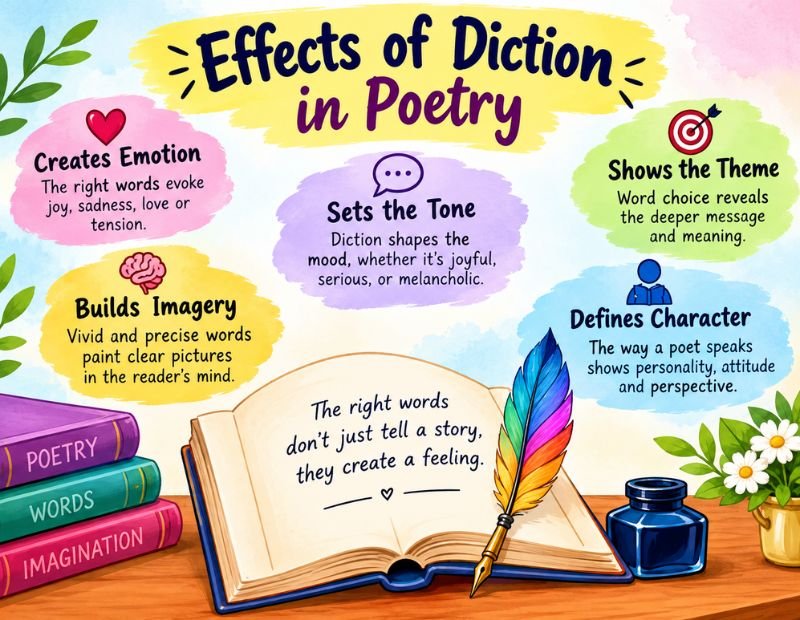
The right diction can transform an ordinary line into something unforgettable. Here are the major effects diction creates in poetry.
- Sets the tone of the poem, whether joyful, mournful, angry, or peaceful 🎭
- Builds imagery, helping readers visualize scenes clearly 🖼️
- Establishes rhythm and musicality, especially through sound heavy words 🎶
- Reveals character or speaker identity, especially in dramatic monologues 🗣️
- Creates emotional connection, pulling readers into the speaker’s experience ❤️
- Reflects cultural or historical context, grounding the poem in a specific time or place 🕰️
Purpose of Diction in Poetry
Diction is not decorative. It serves clear functional purposes within a poem.
To Establish Tone and Mood
The tone of a poem, whether it feels hopeful, bitter, nostalgic, or fearful, comes directly from word choice. A poem describing autumn using words like “decay” and “wither” creates a very different mood than one using “golden” and “harvest.”
To Strengthen Imagery
Strong diction helps readers form vivid mental pictures. Instead of writing “the sky was pretty,” a poet might write “the sky bled orange and violet,” using diction to intensify the visual experience.
To Reflect the Speaker’s Voice
In many poems, the diction reflects who is speaking. A child speaker in a poem would use simpler diction than a philosopher or a soldier, making word choice essential to characterization.
Tone and Diction in Poetry
Tone and diction are deeply connected. Tone is the attitude the poem expresses toward its subject, and diction is the tool used to build that attitude.
| Desired Tone | Type of Diction Used |
|---|---|
| Romantic | Soft, sensory, elevated words |
| Angry | Sharp, blunt, forceful words |
| Melancholic | Slow, heavy, reflective words |
| Playful | Light, rhythmic, informal words |
| Solemn | Formal, restrained, dignified words |
Syntax and Diction in Poetry
While diction focuses on word choice, syntax focuses on how those words are arranged. Together, they shape the overall reading experience.
- Short, fragmented syntax paired with sharp diction can create urgency or panic ⚡
- Long, flowing syntax paired with soft diction can create calmness or nostalgia 🍂
- Inverted syntax paired with formal diction can create a classical, elevated feel 📜
Poets like E. E. Cummings famously broke traditional syntax rules while carefully controlling diction to create experimental, highly personal poems.
Imagery and Diction in Poetry
Imagery relies heavily on diction. Specific, sensory word choices allow readers to see, hear, smell, taste, and feel what the poem describes.
For instance, instead of saying “the flower was nice,” a poet using strong diction might write “the lily unfurled its pale, trembling petals.” This single shift in word choice transforms a flat statement into a vivid image.
Style and Diction in Poetry
A poet’s overall style, the recognizable fingerprint of their work, is largely built through consistent diction choices. Some poets favor short, punchy words, while others favor long, flowing, musical vocabulary.
- Hemingway influenced poets often use minimalist, concrete diction ✏️
- Victorian poets often use ornate, formal diction 🕯️
- Modern spoken word poets often use raw, conversational diction 🎤
Language and Diction in Poetry
Language is the broader system of communication, while diction is the specific selection made within that language. A poet writing in English still has thousands of synonym choices for a single idea, and diction is the filter that narrows those choices down to the most effective one.
Importance of Diction in Poetry
Diction matters because it directly controls how readers experience a poem. Strong diction can:
- Make abstract emotions feel real and relatable 💡
- Turn ordinary scenes into memorable images 🌟
- Create a distinct voice that readers recognize instantly 🎙️
- Strengthen the emotional and thematic impact of the entire poem 📈
Without careful diction, even a poem with a powerful idea can feel flat or forgettable.
How to Describe Diction in Poetry?
When analyzing diction in an essay or classroom discussion, focus on these key steps.
- Identify unusual or repeated words in the poem 🔍
- Determine denotation and connotation of those words 📚
- Consider the tone those words create 🎭
- Link diction to theme, asking what larger idea the words support 🧠
- Compare diction choices to see if the poet shifts style within the poem 🔄
Useful descriptive terms for diction include formal, informal, colloquial, abstract, concrete, elevated, plain, musical, or harsh.
Diction in Poetry Analysis and Essay Writing
When writing a diction analysis essay, structure your points clearly:
- Start with the poem’s overall tone 🎯
- Identify specific word choices that support that tone 🖊️
- Explain the connotation behind those words 💭
- Connect diction to the poem’s theme or message 🔗
- Conclude with the overall effect diction has on the reader 🏁
This structure works well for academic essays, literature exams, and even poetry PPT presentations for classroom teaching.
Formal Diction in Poetry: A Closer Look
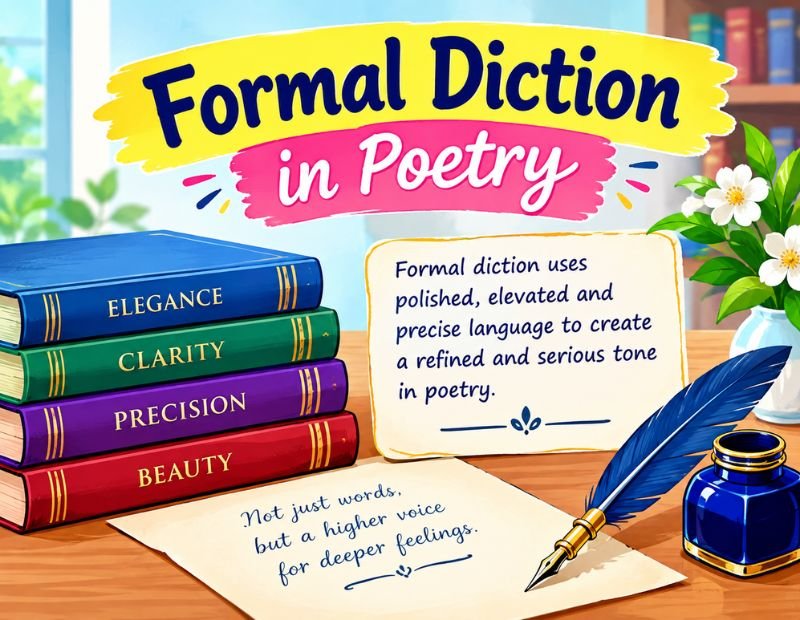
Formal diction remains one of the most studied categories because it appears frequently in classical literature. It relies on precise grammar, elevated vocabulary, and a respectful tone. Poets use formal diction when addressing serious themes such as mortality, honor, or spirituality.
Conclusion
Diction in poetry is far more than a stylistic detail. It is the foundation that shapes tone, imagery, rhythm, and emotional impact in every line a poet writes. From formal and poetic diction to colloquial and concrete word choices, each type serves a distinct purpose in shaping how readers experience a poem.
The next time you read a poem, pause and ask why the poet chose that specific word instead of another. That single question will unlock a much deeper understanding of the craft behind poetry, and it will sharpen your own writing whether you are analyzing verse or creating it yourself.
Frequently Asked Questions
What is diction in poetry?
Diction in poetry is a poet’s deliberate choice of words used to shape tone, imagery, rhythm, and meaning within a poem.
What are the main types of diction in poetry?
The main types include formal, informal, colloquial, slang, abstract, concrete, poetic, and pedantic diction.
How does diction affect tone in a poem?
Diction directly shapes tone because specific word choices create emotional impressions such as sadness, joy, anger, or calmness.
What is the difference between diction and syntax?
Diction refers to word choice, while syntax refers to how those words are arranged into sentences and lines.
Why is diction important in poetry analysis?
Diction reveals the poet’s intent, tone, and thematic focus, making it essential for understanding a poem’s deeper meaning.
Can diction change within a single poem?
Yes, poets often shift diction within a poem to reflect changing emotions, characters, or turning points in the narrative.