

Grief has always found its voice in poetry, and few forms express loss as powerfully as the elegy. From ancient laments to modern tributes, elegies allow poets to mourn, reflect, and ultimately find meaning in death. This guide breaks down everything you need to know about elegy in poetry, including its meaning, history, structure, types, themes, and 15+ influential examples every poetry lover should read.
What Is Elegy In Poetry? Meaning Explained
An elegy is a reflective, mournful poem, usually written to lament the death of a person, though it can also mourn a broader loss such as youth, love, or an entire way of life. In classical literature, the term originally referred to any poem written in a specific meter, regardless of subject. Over time, especially from the 16th century onward, elegy came to mean specifically a poem of lamentation.
Key ideas behind the meaning of elegy include:
- A meditative, serious tone focused on loss 🕯️
- Mourning for a specific person or humanity as a whole 🌍
- A blend of sorrow with reflection on mortality 💭
- Movement from grief toward acceptance or consolation 🌅
Simple Definition Of Elegy In Poetry
In the simplest terms, an elegy in poetry is a sad, thoughtful poem written to honor someone who has died. It expresses sorrow, celebrates the person’s life, and often ends with a sense of peace or hope, rather than staying trapped in grief alone.
Read Also This Blog: Narrative Poetry
How To Write An Elegy In Poetry?
Writing an elegy in poetry can feel intimidating, but breaking it into stages makes the process manageable.
- Choose your subject – Decide who or what you are mourning, a person, a pet, or even a lost time in life 🕊️
- Recall specific memories – Use real, vivid details instead of vague statements about loss 🧠
- Set the tone early – Open with grief, longing, or reflection to establish the mood 🌧️
- Use imagery and nature – Many elegies connect emotion to nature, seasons, or landscapes 🍂
- Address the deceased directly – Speaking “to” the person often deepens emotional impact 💌
- Move toward resolution – End with acceptance, hope, or a tribute rather than despair alone 🌤️
- Revise for rhythm and sound – Read aloud to check that the poem flows naturally 🎼
Characteristics Of Elegy In Poetry
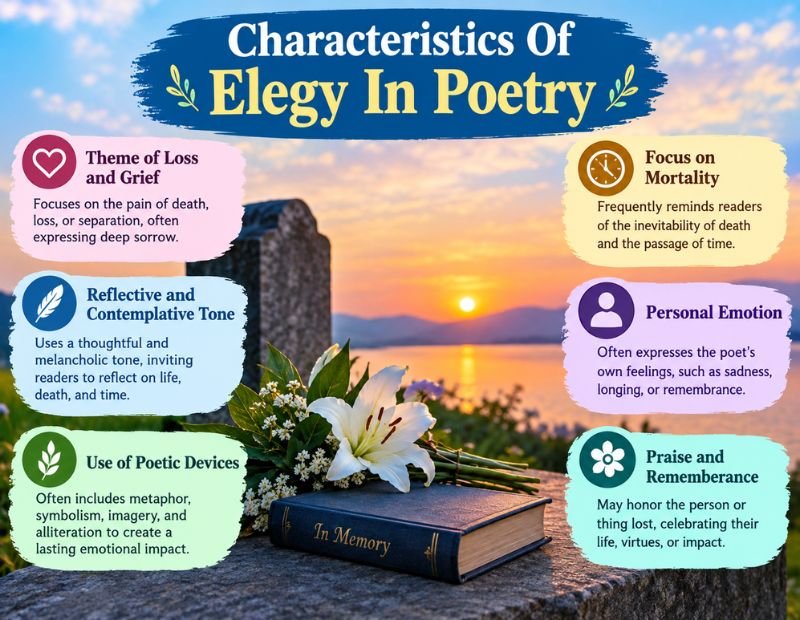
Most elegies share a set of recognizable features, regardless of era or author.
- Serious, mournful, and reflective tone 🖤
- Focus on death, loss, or mortality 💀
- Personal or universal subject matter 🌐
- Movement from sorrow to acceptance or consolation 🕊️
- Use of poetic devices like metaphor, apostrophe, and imagery 🎨
- Often addressed directly to the deceased 📝
Types Of Elegy In Poetry
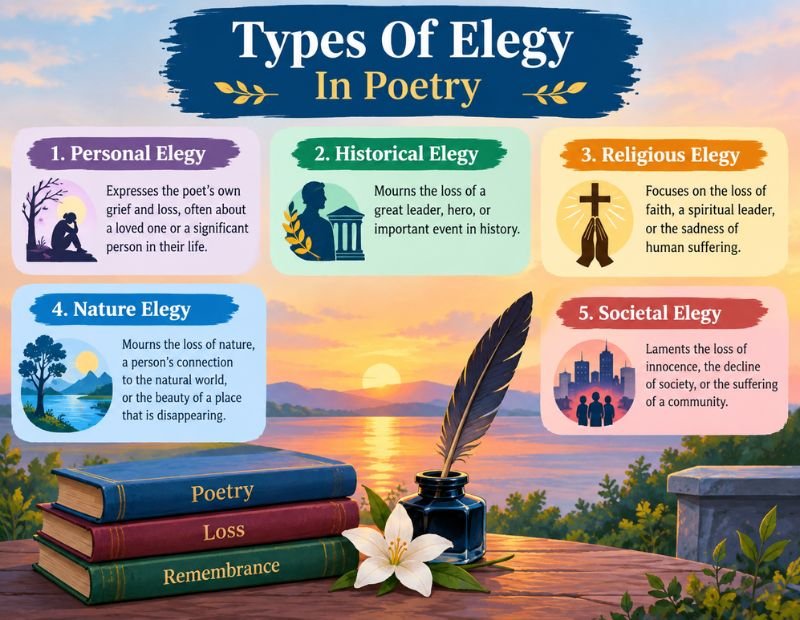
Elegies are not all written the same way. Over centuries, several distinct types have developed.
| Type | Description | Example |
|---|---|---|
| Pastoral Elegy | Mourns the dead using shepherd imagery and idealized rural settings | “Lycidas” by John Milton |
| Personal Elegy | Mourns a specific individual, often a friend or family member | “In Memoriam A.H.H.” by Alfred, Lord Tennyson |
| Meditative Elegy | Reflects broadly on death and mortality rather than one person | “Elegy Written in a Country Churchyard” by Thomas Gray |
| Modern Elegy | Free verse, less formal structure, contemporary themes of loss | “Duino Elegies” by Rainer Maria Rilke |
| National Elegy | Mourns a public figure or collective tragedy | “O Captain! My Captain!” by Walt Whitman |
What Is Pastoral Elegy In Poetry?
A pastoral elegy in poetry is a specific type of elegy that borrows imagery from pastoral poetry, portraying the deceased as an idealized shepherd in a peaceful rural setting. This tradition traces back to Greek poet Theocritus and Roman poet Virgil, who were known for portraying themselves and others as shepherds in verse.
Typical features of a pastoral elegy include:
- An invocation to the Muse for inspiration 🎶
- A procession of mourners honoring the dead 🚶
- Nature reacting sympathetically to the loss 🌿
- References to classical mythology, such as nymphs or fauns 🏺
- A closing tone of acceptance or hope for immortality ✨
The most celebrated example of English pastoral elegy is John Milton’s “Lycidas,” written after the drowning death of his college friend Edward King. Other major examples include Percy Bysshe Shelley’s “Adonais,” mourning the death of John Keats, and Matthew Arnold’s “Thyrsis.”
What Is Elegy In Lyric Poetry?
Elegy is often considered a subcategory of lyric poetry because it expresses personal emotion rather than telling an extended story. While lyric poetry broadly covers any short poem expressing feeling, elegy narrows that focus specifically to mourning and reflection on death or loss.
What Is Elegy In Poetry Literature?
Within literature more broadly, elegy holds a respected place as one of the oldest poetic traditions. It appears across cultures and languages, from ancient Greek and Roman verse to English, French, and German poetry. Famous international examples include Alphonse de Lamartine’s “Le Lac” in French literature and Rainer Maria Rilke’s “Duino Elegies” in German literature, showing how universal the form truly is.
Structure Of Elegy In Poetry
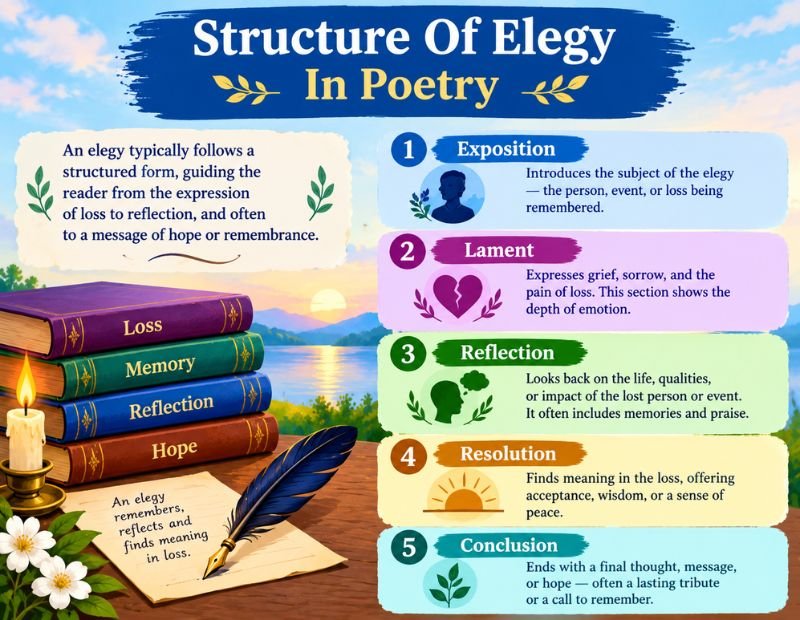
While modern elegies often use free verse, traditional elegies tend to follow a loose three part emotional structure.
| Stage | Purpose |
|---|---|
| Lament | Expresses raw grief and sorrow over the loss |
| Praise | Celebrates the life, virtues, or achievements of the deceased |
| Consolation | Offers comfort, acceptance, or hope, often through nature or faith |
This progression from sorrow to solace is one of the defining structural patterns readers can expect, even when meter and rhyme vary widely between poets.
Effects Of Elegy In Poetry On Readers
Elegies create a powerful emotional response because they tap into universal human experiences of loss.
- Encourages readers to process grief through shared language 💔
- Builds empathy by connecting personal loss to universal mortality 🤝
- Offers comfort through rhythm, imagery, and closure 🌙
- Preserves memory and legacy of the person being mourned 📜
- Provides a safe emotional outlet for both poet and reader 🕊️
Purpose Of Elegy In Poetry
At its core, the purpose of elegy is to give shape and voice to grief. It allows poets to honor the dead, express personal sorrow, and reflect on mortality in a way that feels structured rather than overwhelming. Beyond personal mourning, elegies often carry philosophical weight, encouraging readers to consider the meaning of life, death, and legacy.
Famous Examples Of Elegy In Poetry

Here are 15+ influential elegies every reader of poetry should know.
- “Lycidas” by John Milton 🌊
- “Adonais” by Percy Bysshe Shelley 🌹
- “Thyrsis” by Matthew Arnold 🌾
- “Elegy Written in a Country Churchyard” by Thomas Gray ⛪
- “In Memoriam A.H.H.” by Alfred, Lord Tennyson 🕯️
- “When Lilacs Last in the Dooryard Bloom’d” by Walt Whitman 🌸
- “O Captain! My Captain!” by Walt Whitman ⚓
- “Thanatopsis” by William Cullen Bryant 🌳
- “Duino Elegies” by Rainer Maria Rilke 🌌
- “Le Lac” by Alphonse de Lamartine 🏞️
- “Night Thoughts” by Edward Young 🌙
- “The Grave” by Robert Blair ⚰️
- “Do Not Go Gentle into That Good Night” by Dylan Thomas 🔥
- “Funeral Blues” by W.H. Auden 🖤
- “Mid Term Break” by Seamus Heaney 🌷
- “Refugee Blues” by W.H. Auden 🌧️
These poems span centuries and countries, showing how the elegy has continually adapted while keeping its emotional core intact.
Frequently Asked Questions
What is the simplest definition of an elegy?
An elegy is a sorrowful, reflective poem written to mourn the death of a person or a significant loss.
What are the three main parts of an elegy?
Most traditional elegies follow lament, praise, and consolation, moving from grief toward acceptance.
What is the difference between an elegy and a eulogy?
An elegy is a poem, while a eulogy is a spoken tribute delivered at a funeral or memorial service.
What is the most famous pastoral elegy in English?
John Milton’s “Lycidas” is widely regarded as the greatest example of pastoral elegy in English literature.
Can an elegy be about something other than death?
Yes, elegies can also mourn lost youth, lost love, or broader themes of mortality and change.
Do modern elegies follow strict rhyme and meter?
No, many modern elegies use free verse, focusing more on emotional honesty than formal structure.
Why do poets use nature imagery in elegies?
Nature imagery, especially in pastoral elegies, reflects the poet’s grief and symbolizes cycles of life and death.
Conclusion
Elegy remains one of poetry’s most emotionally resonant forms, giving voice to grief across centuries and cultures. From Milton’s pastoral mourning in “Lycidas” to Auden’s raw modern sorrow in “Funeral Blues,” elegies show how poets transform personal and collective loss into lasting art. Understanding its structure, types, and purpose not only deepens appreciation for classic works but also offers a meaningful framework for anyone hoping to write their own tribute in verse.