
Poetry has given us many forms, but few have lasted as long or influenced as many writers as the sonnet. From Petrarch’s love poems in 13th century Italy to Shakespeare’s timeless verses and modern poets experimenting with the form today, the sonnet remains one of the most studied and admired structures in literature.
If you have ever wondered what makes a sonnet different from other poems, or why this 14 line form has survived for over 700 years, this guide covers everything you need to know. You will learn the meaning, structure, types, purpose, and best examples of sonnets in poetry, along with a breakdown of rhyme schemes and answers to the most common questions readers ask.
Sonnet In Poetry Meanings
A sonnet in poetry is a fourteen line poem, traditionally written in iambic pentameter, that follows a fixed rhyme scheme and a tightly organized thematic structure 🖋️. The sonnet in poetry is defined by its length, its meter, and the way it builds a poetic argument within those fourteen lines. Academy of American Poets
The word sonnet comes from the Italian term “sonetto,” which loosely translates to “little song” or “little sound” 🎵. Poets use the form to express a complete thought or feeling, and while sonnets can take several shapes, they always share a compact, musical quality. No Sweat Shakespeare
Sonnets in poetry originated in Italy and later spread across Europe, eventually becoming a defining form in English literature. The form was created in the 13th century, and its name comes from an Italian word meaning little sound. Over time, poets in England, France, and beyond adapted the structure to fit their own languages and literary traditions.
In simple terms, a sonnet in poetry is not just a short poem. It is a disciplined poetic form built around structure, rhythm, and a shift in thought known as the volta.
“On First Looking into Chapman’s Homer” — John Keats
Much have I travell’d in the realms of gold,
And many goodly states and kingdoms seen;
Round many western islands have I been
Which bards in fealty to Apollo hold.
Oft of one wide expanse had I been told
That deep-brow’d Homer ruled as his demesne;
Yet did I never breathe its pure serene
Till I heard Chapman speak out loud and bold:
Then felt I like some watcher of the skies
When a new planet swims into his ken;
Or like stout Cortez when with eagle eyes
He star’d at the Pacific—and all his men
Look’d at each other with a wild surmise—
Silent, upon a peak in Darien.
“Ozymandias” — Percy Bysshe Shelley
I met a traveller from an antique land,
Who said—“Two vast and trunkless legs of stone
Stand in the desert. . . . Near them, on the sand,
Half sunk, a shattered visage lies, whose frown,
And wrinkled lip, and sneer of cold command,
Tell that its sculptor well those passions read
Which yet survive, stamp’d on these lifeless things,
The hand that mock’d them and the heart that fed;
And on the pedestal, these words appear:
‘My name is Ozymandias, King of Kings;
Look on my Works, ye Mighty, and despair!’
Nothing beside remains. Round the decay
Of that colossal Wreck, boundless and bare
The lone and level sands stretch far away.”
“When I Have Fears That I May Cease to Be” — John Keats
When I have fears that I may cease to be
Before my pen has glean’d my teeming brain,
Before high-piled books, in charactery,
Hold like rich garners the full-ripen’d grain;
When I behold, upon the night’s starred face,
Huge cloudy symbols of a high romance,
And think that I may never live to trace
Their shadows, with the magic hand of chance;
And when I feel, fair creature of an hour,
That I shall never look upon thee more,
Never have relish in the faery power
Of unreflecting love;—then on the shore
Of the wide world I stand alone, and think
Till Love and Fame to nothingness do sink.
Characteristics of a Sonnet in Poetry
Every sonnet in poetry, regardless of type, shares a set of defining features. Understanding these characteristics helps readers and writers recognize the form instantly.
Here are the core characteristics of a sonnet:
- Fourteen lines, always, without exception 📏
- Written mostly in iambic pentameter, meaning ten syllables per line arranged in five unstressed and stressed pairs 🎶
- A fixed rhyme scheme that changes depending on the sonnet type 🔗
- A volta, or turn, where the tone, argument, or perspective shifts 🔄
- A tightly organized thematic structure that builds toward a resolution 🧩
- Division into stanzas such as quatrains, an octave, a sestet, or a closing couplet 📚
Sonnets in poetry are known for balancing strict form with expressive depth, using their limited length to push poets toward precision rather than looseness. This is part of why the form has survived so long. The rules force clarity. Literary Devices
The meter deserves special attention because it shapes how a sonnet in poetry sounds when read aloud. An iamb is a poetic beat made of one unstressed syllable followed by one stressed syllable, and a line written in pentameter contains five of these beats. Put together, iambic pentameter creates a natural, heartbeat like rhythm that mirrors ordinary speech patterns, which is one reason sonnets feel so personal and conversational despite their formal structure. StudioBinder
Read Also This Blog: Elegy in Poetry
Effects Of Sonnet In Poetry
The sonnet in poetry does more than organize words on a page. Sonnet in poetry shapes how readers experience emotion, argument, and resolution within a poem.
Here are the main effects a sonnet in poetry creates:
- Builds tension gradually before releasing it at the volta 🎯
- Creates a musical, rhythmic reading experience through consistent meter 🎼
- Forces emotional focus because of the limited fourteen line space ❤️
- Delivers a satisfying sense of closure, especially with a final couplet 🔚
- Encourages readers to notice subtle shifts in tone or meaning 🧠
- Adds weight and memorability to short, powerful statements 💡
Because the sonnet in poetry is so compact, every word carries more responsibility. Poets cannot rely on length to build an argument, so each line has to earn its place. This is part of why sonnets in poetry often feel more intense or emotionally charged than free verse poems of similar length.
Types Of Sonnet In Poetry
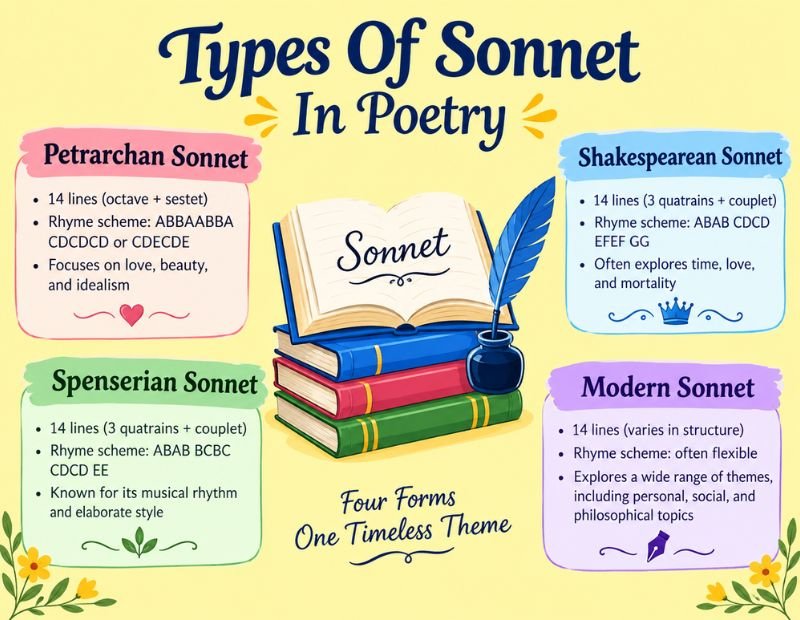
While the Petrarchan and Shakespearean sonnets are the most recognized, several other variations exist, each with its own structure and history.
| Sonnet Type | Origin | Structure | Rhyme Scheme |
|---|---|---|---|
| Petrarchan (Italian) | Italy, 13th century | Octave + Sestet | ABBAABBA CDECDE or CDCDCD |
| Shakespearean (English) | England, 16th century | 3 Quatrains + Couplet | ABAB CDCD EFEF GG |
| Spenserian | England, Edmund Spenser | 3 Quatrains + Couplet | ABAB BCBC CDCD EE |
| Miltonic | England, John Milton | Modified Petrarchan | ABBAABBA CDECDE (no strict pause at line 8) |
| Curtal Sonnet | Gerard Manley Hopkins | 10.5 lines (shortened) | ABCABC DBCDC |
Sonnets in poetry have been popular in both English and Italian poetry for centuries, and while other languages have their own sonnet traditions, England and Italy remain the two most influential in Western literature. The Spenserian sonnet follows the same overall structure as the Shakespearean form but uses interlocking rhymes across its quatrains, following the pattern ABAB BCBC CDCD EE.
Historically, Wyatt and Surrey are credited with developing the English sonnet, condensing the fourteen lines into three quatrains followed by a closing couplet. This structure became the foundation for what most readers now call the Shakespearean sonnet. The Poetry Foundation
Beyond the three major types, poets have created further variations, including the caudate sonnet, which adds extra lines or codas to the traditional fourteen, and the curtal sonnet, a shortened form that keeps the proportional balance of the Italian sonnet while trimming its overall length.
Purpose Of Sonnet In Poetry
Sonnets in poetry are not just decorative. They serve specific literary purposes that explain why poets keep returning to this form centuries after its creation.
Common purposes of a sonnet include:
- Expressing complex emotions like love, grief, or longing in a controlled space 💔
- Presenting an argument or problem and resolving it within the poem 🧭
- Exploring universal themes such as time, mortality, and beauty ⏳
- Demonstrating a poet’s technical skill within a demanding structure 🏆
- Creating a memorable, quotable closing statement through the couplet or sestet 📝
- Offering a personal reflection that still follows a shared, recognizable pattern 🌱
The volta plays a central role in fulfilling this purpose, acting as a pivotal shift in theme or perspective that reshapes how the reader understands everything that came before it. In a Shakespearean sonnet, this shift typically happens near line 12 or 13, while in a Petrarchan sonnet it usually appears after line 8, right at the transition between the octave and the sestet.
“Let me not to the marriage of true minds”
Let me not to the marriage of true minds
Admit impediments. Love is not love
Which alters when it alteration finds,
Or bends with the remover to remove.
O no! it is an ever-fixed mark
That looks on tempests and is never shaken;
It is the star to every wandering bark,
Whose worth’s unknown, although his height be taken.
Love’s not Time’s fool, though rosy lips and cheeks
Within his bending sickle’s compass come;
Love alters not with his brief hours and weeks,
But bears it out even to the edge of doom.
If this be error and upon me proved,
I never writ, nor no man ever loved.
“My mistress’ eyes are nothing like the sun”
My mistress’ eyes are nothing like the sun;
Coral is far more red than her lips’ red;
If snow be white, why then her breasts are dun;
If hairs be wires, black wires grow on her head.
I have seen roses damask’d, red and white,
But no such roses see I in her cheeks;
And in some perfumes is there more delight
Than in the breath that from my mistress reeks.
I love to hear her speak, yet well I know
That music hath a far more pleasing sound;
I grant I never saw a goddess go;
My mistress, when she walks, treads on the ground.
And yet, by heaven, I think my love as rare
As any she belied with false compare.
5 Best Examples Of Sonnet In Poetry
To understand how theory becomes practice, it helps to look at real sonnets that shaped the tradition.
- Sonnet 18 by William Shakespeare – Compares a loved one’s beauty to a summer’s day, ending with a couplet that claims poetry itself grants immortality 🌞
- Canzoniere by Francesco Petrarch – A sequence of poems dedicated to his idealized love, Laura, that established the Petrarchan form 💗
- Sonnet 130 by William Shakespeare – A witty, honest poem that rejects exaggerated comparisons often used in love poetry 😄
- Death Be Not Proud by John Donne – A metaphysical sonnet that challenges the power of death through direct argument ⚰️
- How Do I Love Thee by Elizabeth Barrett Browning – A Petrarchan style sonnet listing the many ways love can be expressed 💞
Each of these examples shows a different application of the same fourteen line rule, proving how flexible the form can be despite its strict boundaries.
Shakespearean Sonnet In Poetry
The Shakespearean sonnet in poetry, also called the English or Elizabethan sonnet, is built from three quatrains followed by a rhyming couplet. Its rhyme scheme runs ABAB CDCD EFEF GG, with all fourteen lines written in iambic pentameter.
Although the turn traditionally occurs in the third quatrain, Shakespeare often broke this convention by placing the volta in the final couplet instead, using the last two lines to deliver a twist, summary, or resolution. This is part of what makes his sonnets feel so punchy and quotable.
Key features of the Shakespearean sonnet in poetry:
- Three quatrains that build an idea or argument step by step 🧱
- A final couplet that delivers resolution or a sharp conclusion 🎯
- Rhyme scheme ABAB CDCD EFEF GG 🔗
- Flexible volta placement, often saved for the last two lines 🔄
“Shall I compare thee to a summer’s day?”
Shall I compare thee to a summer’s day?
Thou art more lovely and more temperate:
Rough winds do shake the darling buds of May,
And summer’s lease hath all too short a date;
Sometime too hot the eye of heaven shines,
And often is his gold complexion dimm’d;
And every fair from fair sometime declines,
By chance or nature’s changing course untrimm’d;
But thy eternal summer shall not fade,
Nor lose possession of that fair thou ow’st;
Nor shall death brag thou wander’st in his shade,
When in eternal lines to time thou grow’st:
So long as men can breathe or eyes can see,
So long lives this, and this gives life to thee.
“When, in disgrace with fortune and men’s eyes”
When, in disgrace with fortune and men’s eyes,
I all alone beweep my outcast state,
And trouble deaf heaven with my bootless cries,
And look upon myself and curse my fate,
Wishing me like to one more rich in hope,
Featured like him, like him with friends possess’d,
Desiring this man’s art and that man’s scope,
With what I most enjoy contented least;
Yet in these thoughts myself almost despising,
Haply I think on thee, and then my state,
Like to the lark at break of day arising
From sullen earth, sings hymns at heaven’s gate;
For thy sweet love remember’d such wealth brings
That then I scorn to change my state with kings.
“That time of year thou mayst in me behold”
That time of year thou mayst in me behold
When yellow leaves, or none, or few, do hang
Upon those boughs which shake against the cold,
Bare ruin’d choirs, where late the sweet birds sang.
In me thou see’st the twilight of such day
As after sunset fadeth in the west,
Which by and by black night doth take away,
Death’s second self, that seals up all in rest.
In me thou see’st the glowing of such fire,
That on the ashes of his youth doth lie,
As the death-bed whereon it must expire,
Consumed with that which it was nourish’d by.
This thou perceiv’st, which makes thy love more strong,
To love that well which thou must leave ere long.
Petrarchan Sonnet
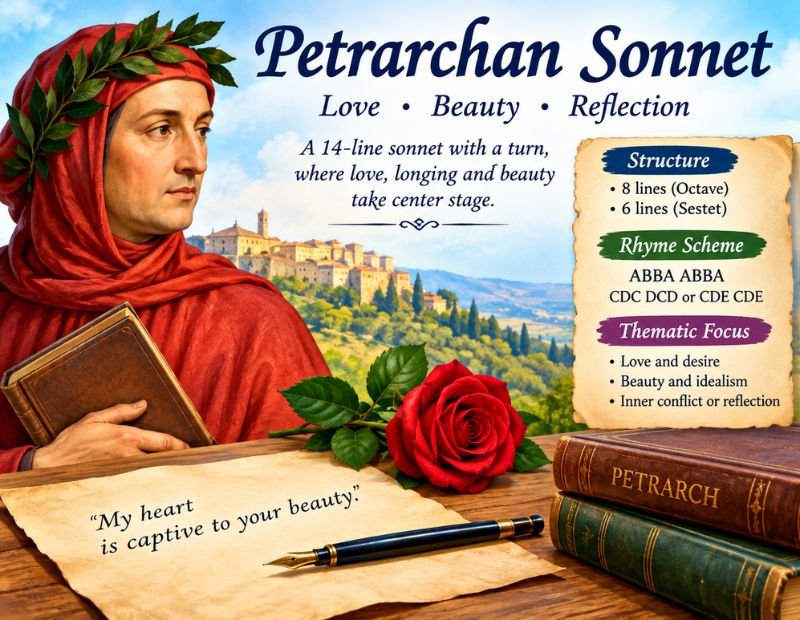
The Petrarchan sonnet in poetry, also known as the Italian sonnet in poetry, is the older of the two major forms. It consists of an opening octave made from two quatrains, followed by a sestet made from two tercets. LitCharts
The octave typically follows an ABBAABBA rhyme scheme, while the sestet can follow either CDECDE or CDCDCD. Structurally, the octave usually presents a problem or proposition, while the sestet responds to or resolves it. LitChartsLitCharts
Key features of the Petrarchan sonnetin poetry:
- Octave (8 lines) followed by sestet (6 lines) 📖
- Rhyme scheme ABBAABBA CDECDE or CDCDCD 🔗
- Volta appears between line 8 and line 9 🔄
- Often centers on idealized or unattainable love ❤️
Sonnet Rhyme Scheme
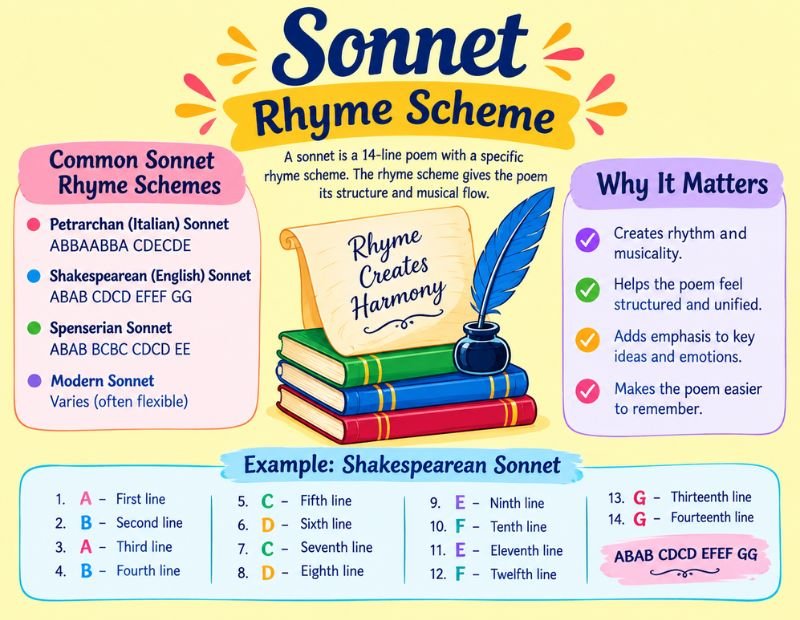
Rhyme scheme is one of the clearest ways to identify which type of sonnet you are reading. Each letter represents a rhyming sound, and lines sharing the same letter rhyme with each other.
| Sonnet Type | Rhyme Scheme | Stanza Breakdown |
|---|---|---|
| Petrarchan | ABBAABBA CDECDE | Octave + Sestet |
| Shakespearean | ABAB CDCD EFEF GG | 3 Quatrains + Couplet |
| Spenserian | ABAB BCBC CDCD EE | 3 Quatrains + Couplet |
| Curtal | ABCABC DBCDC | Two Tercets + Half Stanza |
A quick way to remember the difference is this: Petrarchan sonnets group their rhymes into two large blocks, while Shakespearean sonnets spread their rhymes across smaller, evenly sized sections ending in a punchy couplet.
What is Italian Sonnet In Poetry?
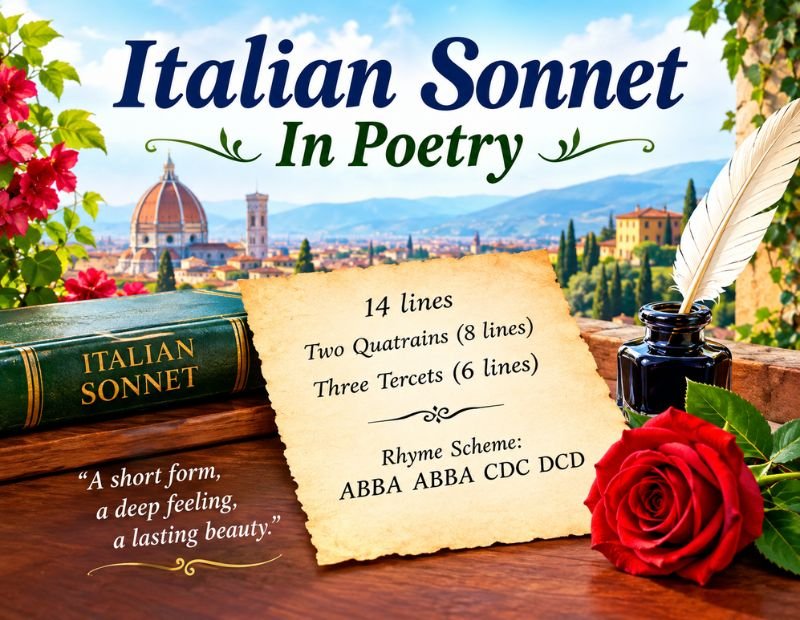
The Italian sonnet in poetry is another name for the Petrarchan sonnet, named after the form’s most famous practitioner, the poet Francesco Petrarch. Although the sonnet form is credited to Giacomo da Lentini in the 13th century, it was Petrarch who popularized it, writing poems that expressed his unrequited love for a woman named Laura. LitCharts
Other notable Italian sonneteers who worked within this tradition include Dante Alighieri, Guido Cavalcanti, and Michelangelo, each contributing to the form’s early development before it eventually crossed into English literature.
What makes the Italian sonnet distinct:
- Divided into an octave and a sestet rather than quatrains and a couplet 📚
- The volta arrives earlier, usually right after line 8 🔄
- Often more meditative and philosophical in tone 🌙
- The sestet’s meter tends to be more flexible than the rest of the poem, allowing either the first or second syllable in a foot to carry the stress 🎶
The Italian sonnet’s early arrival in English poetry came through translation. Thomas Wyatt introduced the form to English readers in the 16th century by translating Petrarch’s work, and his contemporary, the Earl of Surrey, later modified the structure into what became the English sonnet.
Frequently Asked Questions
What is a sonnet in poetry in simple words?
A sonnet in poetry is a 14 line poem with a fixed rhyme scheme and rhythm, usually written to explore a single emotion or idea in a compact, structured way.
How many lines does a sonnet in poetry have?
A sonnet in poetry always has exactly fourteen lines, regardless of which type or variation it follows.
What is the main difference between a Shakespearean and Petrarchan sonnet?
A Shakespearean sonnet uses three quatrains and a closing couplet, while a Petrarchan sonnet uses an octave followed by a sestet with an earlier volta.
What is a volta in a sonnet in poetry?
The volta is the turning point in a sonnet where the tone, argument, or perspective shifts, usually near line 8 or line 12 to 13.
Why is iambic pentameter used in sonnets?
Iambic pentameter creates a natural, rhythmic flow that mirrors everyday speech, making sonnets easier to read aloud and more emotionally resonant.
Who invented the sonnet in poetry form?
The sonnet kin poetry is credited to Giacomo da Lentini in 13th century Sicily, though Francesco Petrarch later popularized the form across Europe.
Can a sonnet in poetry be about topics other than love?
Yes. While many classic sonnets in poetry focus on love, poets have also used the form to explore death, time, nature, politics, and personal identity.
Conclusion
The sonnet in poetry has survived for over seven hundred years because it manages to balance strict form with genuine emotional depth. Whether you are reading a Shakespearean sonnet with its confident closing couplet, or a Petrarchan sonnet with its reflective sestet, the form consistently rewards careful, patient reading.
Understanding the structure, rhyme scheme, and purpose behind a sonnet in poetry does not just help with literary analysis. sonnet in poetry also reveals why this small, disciplined poetic form continues to influence writers, songwriters, and storytellers today. Once you can spot a volta or recognize a rhyme scheme at a glance, sonnets stop feeling like distant academic exercises and start feeling like what they always were: small, carefully built machines for expressing big feelings.