
Poetry lives inside its lines, and every one of those lines has a name. That name is verse. Whether you are a student prepping for an exam, a songwriter shaping lyrics, or a curious reader who keeps seeing the word “verse” pop up in literature class, this guide breaks the concept down completely. You will learn what verse means, how it differs from a stanza, the major types of verse used across centuries of poetry, and more than 20 examples that make the idea click instantly.
What Is Verse in Poetry?
Verse is a single line of poetry, or sometimes a group of lines, arranged with intentional rhythm, meter, or rhyme. Unlike prose, which flows in sentences and paragraphs, verse is built line by line, and each line break is a deliberate choice made by the poet.
In simple terms, verse is the basic building block of a poem, much like a brick is the basic building block of a wall. Depending on context, the word can refer to:
- A single line of a poem 🎯
- A stanza or grouped set of lines 📝
- An entire poem or body of poetry ✍️
- A specific poetic form, such as free verse or blank verse 🔤
The exact meaning shifts depending on how it is used in a sentence, so context always matters when interpreting the term.
Morning Light
The golden sun begins to rise,
And paints its colors through the skies.
A gentle breeze moves through the trees,
While birds sing softly with the breeze.
The Journey
I walk along a winding road,
And carry dreams beneath my load.
Though clouds may gather overhead,
I keep the hope that lies ahead.
A Quiet Night
The moonlight rests upon the sea,
And silver waves drift peacefully.
The stars awaken one by one,
While darkness hides the setting sun.
The Power of Hope
When shadows fall and nights seem long,
A little hope can make us strong.
It lights the heart with gentle flame,
And helps us rise and try again.
Seasons of Life
The leaves may fall, the flowers fade,
Yet beauty lives in every shade.
The seasons change, the years move on,
But new beginnings greet the dawn.
What Is Verse in Literature?
In literature, verse is the broader category that separates poetic writing from prose writing. Any text arranged with rhythm, pattern, line breaks, or meter can be called verse, even if it does not rhyme.
Think of verse as poetry’s wider umbrella. All poetry is technically verse, but not everything labeled verse is considered formal poetry. Song lyrics, nursery rhymes, chants, and even some religious texts use verse structure without always being classified as literary poetry.
Read Also This Blog: Sonnet in Poetry
Verse vs Prose
The easiest way to understand verse in literature is to compare it directly with prose.
| Feature | Verse | Prose |
|---|---|---|
| Structure | Lines and stanzas | Sentences and paragraphs |
| Rhythm | Often patterned or metrical | Natural speech rhythm |
| Line breaks | Deliberate and meaningful | Determined by grammar |
| Common use | Poems, lyrics, epics | Novels, essays, articles |
| Flexibility | Can be strict or free | Generally more flexible |
This table highlights why poets are said to “write in verse” while novelists write in prose.
What Is a Blank Verse in Poetry?
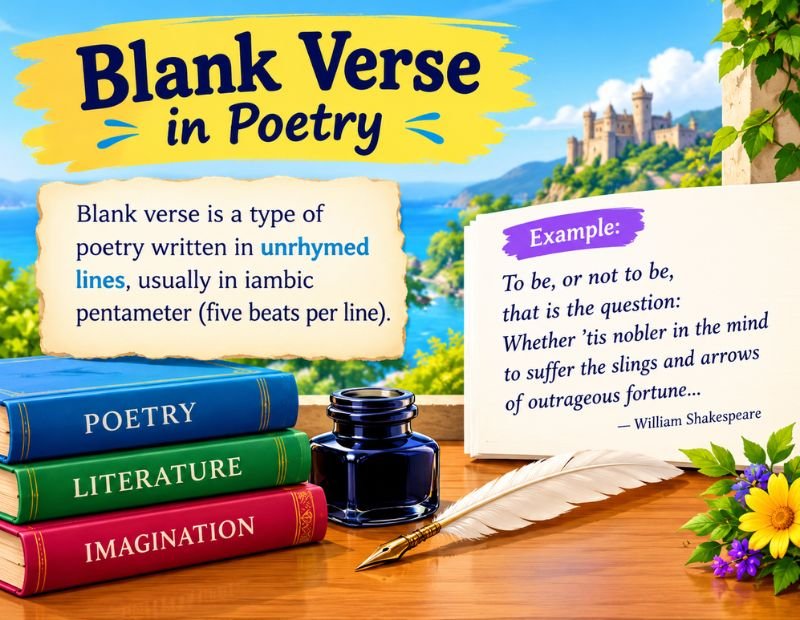
Blank verse is a type of poetic structure written in unrhymed iambic pentameter. That means each line contains ten syllables arranged in five pairs, alternating between an unstressed and a stressed beat.
Blank verse keeps a steady rhythmic pattern but drops the rhyme scheme entirely. This gives poets the discipline of meter combined with the freedom of natural, conversational phrasing.
Key characteristics of blank verse include:
- No end rhyme between lines 🚫
- Strict iambic pentameter rhythm 🎵
- Frequently used in dramatic and epic poetry 🎭
- Sounds closer to natural spoken English than rhymed verse 🗣️
Blank verse became especially popular in English drama and epic storytelling because its rhythm mimics the natural cadence of speech while still feeling elevated and poetic.
Original example of blank verse:
The morning sun climbs slow above the hills
And paints the valley gold before the noon
Free Verse in Poetry
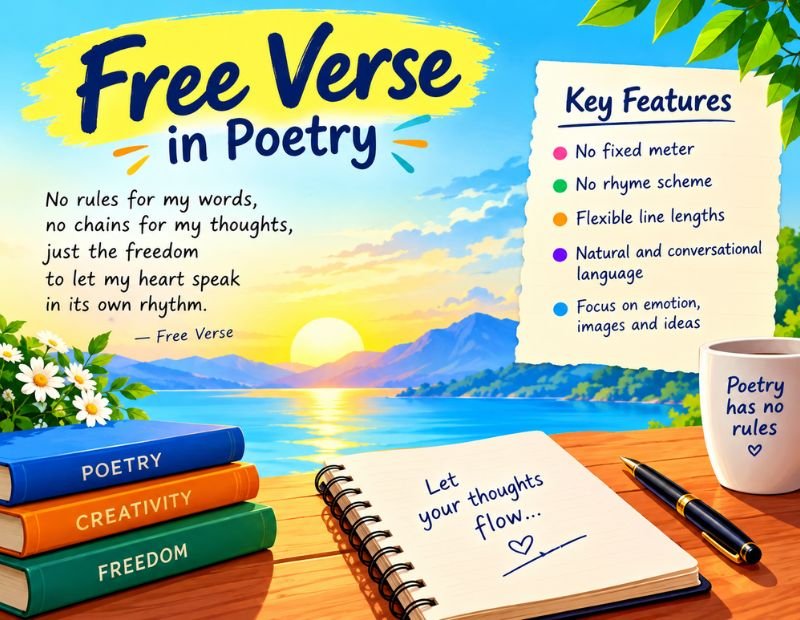
Free verse is poetry that has no fixed meter and no required rhyme scheme. Instead of following strict rules, free verse mirrors natural speech patterns, giving poets maximum creative flexibility.
Free verse became dominant in modern and contemporary poetry because it allows the poet’s voice and subject matter to shape the rhythm, rather than forcing ideas into a rigid structural mold.
Common traits of free verse include:
- Irregular line lengths 📏
- No consistent rhyme pattern 🔁
- Rhythm driven by natural speech and emphasis 💬
- Heavy reliance on imagery, repetition, and line breaks for effect 🌿
Original example of free verse:
The rain does not ask permission
it simply arrives
soaking the pavement
without apology
Free Verse vs Blank Verse
| Feature | Free Verse | Blank Verse |
|---|---|---|
| Meter | None | Strict iambic pentameter |
| Rhyme | None | None |
| Structure | Flexible | Fixed rhythmic pattern |
| Feel | Conversational and modern | Formal yet unrhymed |
Types of Verse in Poetry
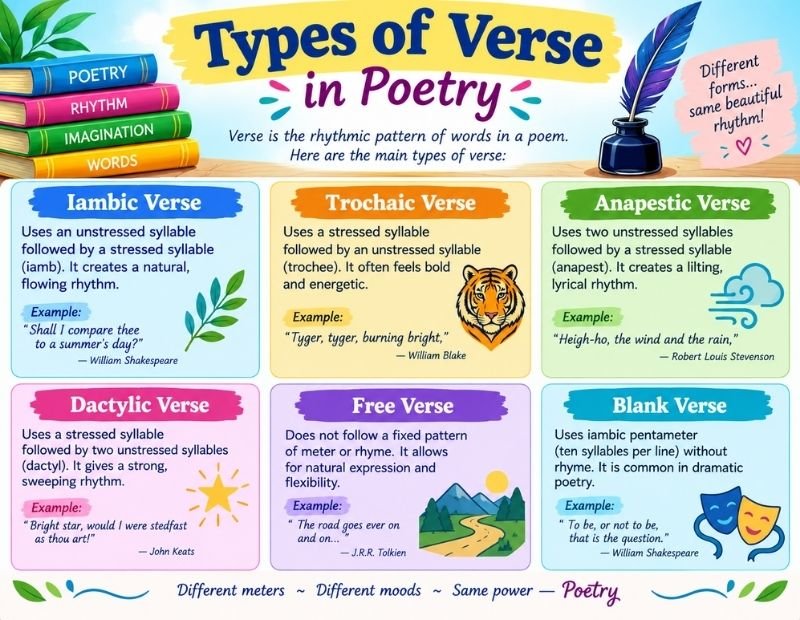
Poetry has developed several distinct verse types over centuries, each with its own rules and effects. Here are the most widely recognized types of verse in poetry.
1. Rhymed Verse
Rhymed verse follows a specific rhyme scheme, often paired with a consistent meter. Sonnets, limericks, and many classic poems fall under this category.
2. Blank Verse
As explained above, this type uses meter without rhyme, most famously seen in dramatic and epic English poetry.
3. Free Verse
Free verse rejects both meter and rhyme, focusing instead on natural rhythm and expressive language.
4. Metrical Verse
Metrical verse follows a regular pattern of stressed and unstressed syllables, regardless of whether it rhymes.
5. Syllabic Verse
Syllabic verse is structured by counting syllables per line rather than stressed beats, as seen in haiku poetry.
6. Accentual Verse
This type counts only the number of stressed syllables per line, ignoring the total syllable count entirely.
| Verse Type | Rhyme | Meter | Example Use |
|---|---|---|---|
| Rhymed Verse | Yes | Sometimes | Sonnets, limericks 🎼 |
| Blank Verse | No | Yes | Drama, epics 🎭 |
| Free Verse | No | No | Modern poetry 🌊 |
| Metrical Verse | Optional | Yes | Classical poetry 📜 |
| Syllabic Verse | Optional | Syllable count | Haiku 🍃 |
| Accentual Verse | Optional | Stress count | Old English poetry ⚔️ |
Elements of Verse in Poetry
To fully understand verse, it helps to break down the core elements that shape it.
- Rhythm, the natural flow and beat created by stressed and unstressed syllables 🥁
- Meter, a regular, repeating pattern of rhythm across lines 📐
- Rhyme scheme, the pattern of end sounds across lines, if present 🔗
- Line breaks, deliberate pauses that control pacing and emphasis ⏸️
- Stanza structure, how lines are grouped together within the poem 🧱
- Sound devices, including alliteration, assonance, and consonance that enhance musicality 🎶
These elements work together to give verse its distinctive musical and structural identity compared to ordinary prose.
Forms of Verse in Poetry
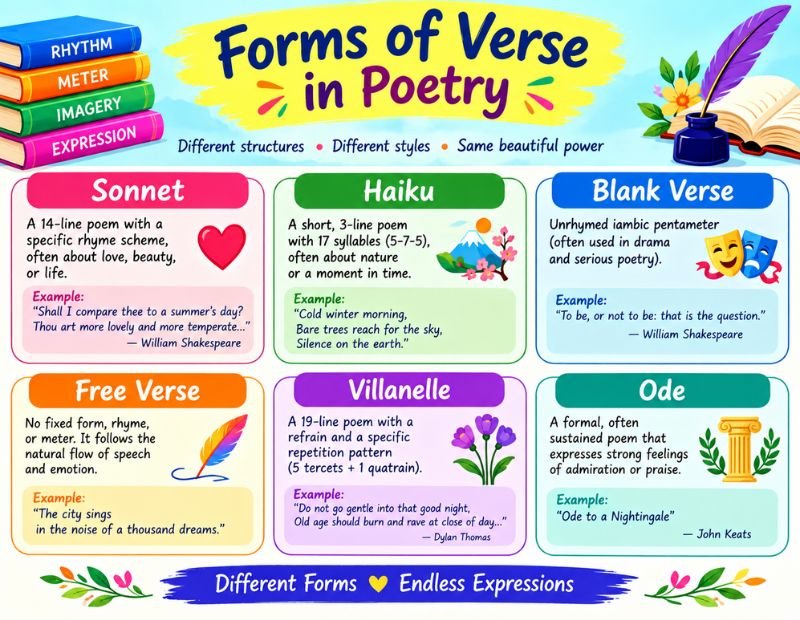
Beyond the broad types, poetry also uses specific verse forms, meaning fixed structural templates poets follow.
- Sonnet, a fourteen line poem, usually in iambic pentameter, with a fixed rhyme scheme 💗
- Haiku, a three line Japanese form following a five seven five syllable pattern 🌸
- Ballad, a narrative verse form often written in quatrains with an ABCB rhyme scheme 🎻
- Ode, a formal lyrical verse that praises a person, object, or idea 🏆
- Villanelle, a nineteen line poem with two repeating refrains 🔄
- Limerick, a five line humorous verse with an AABBA rhyme scheme 😄
- Epic, a long narrative verse recounting heroic deeds, often in a grand meter ⚔️
Each verse form comes with its own rules for line count, rhyme, and rhythm, giving poets a menu of structures to choose from depending on their creative goal.
Verse vs Stanza in Poetry
One of the most common points of confusion is the difference between a verse and a stanza. While the terms are sometimes used loosely and interchangeably, there is a technical distinction.
| Aspect | Verse | Stanza |
|---|---|---|
| Definition | A single line, or sometimes the whole poem | A grouped set of lines forming a unit |
| Scope | Can be one line or many | Always multiple lines grouped together |
| Usage | Broad and flexible term | More precise, structural term |
| Example | “The wind blew cold that night” | A four line grouping forming one section |
In casual usage, people often say “verse” when they technically mean “stanza.” Formally, however, a stanza is a specific grouping of verses, similar to how a paragraph groups sentences in prose.
Short Verse in Poetry
Short verse in poetry refers to brief lines or mini poems that deliver meaning in a compact form. These are popular because they are easy to memorize, quote, and share.
Characteristics of short verse include:
- Minimal word count, often under ten words per line ✂️
- Strong emotional or visual impact despite brevity 💥
- Common in haiku, epigrams, and proverbs 📿
- Frequently used in greeting cards and social captions 💌
Original short verse example:
Silence speaks
where words grow tired
Verse in Poetry With 8 Lines
An eight line verse in poetry is often called an octave when it functions as a complete stanza unit. This structure is common in sonnets, where the first eight lines set up a theme before a shift, or turn, happens in the remaining lines.
8 lines verse in poetry examples:
The autumn leaves fall soft and slow,
Painting paths in amber light,
Beneath a sky of fading glow,
They drift like whispers into night.
The wind hums low a gentle tune,
As branches bow and let them go,
Beneath the rising harvest moon,
The forest breathes a quiet flow.
The morning wakes with golden light,
And paints the clouds in shades of bright.
A gentle breeze begins to sing,
While flowers dance beneath the spring.
The quiet earth feels fresh and new,
The sky unfolds a brighter blue.
Hope rises softly with the day,
And guides the wandering heart its way.
Beneath the moon, the rivers gleam,
The night unfolds a silver dream.
The stars appear in endless skies,
Like little lamps before our eyes.
A peaceful silence fills the air,
While whispered winds move everywhere.
The world grows still beneath the light,
And dreams awaken through the night.
When storms arrive and skies turn gray,
Keep walking through the fading day.
Though distant roads may seem unclear,
Let courage silence every fear.
The darkest clouds will drift away,
And sunshine will return someday.
With every step, let hope arise,
Until your dreams touch brighter skies.
These eight lines structure demonstrates how verse can build a self contained scene with rhythm and rhyme working together.
Verse In Poetry Examples for Students
Below are more than 20 examples of verse, organized by type, to help students quickly identify and understand each category.
Rhymed verse examples:
- Twinkle twinkle little star, how I wonder what you are 🌟
- The cat sat still upon the mat, content and calm, both round and fat 🐱
- Roses are red, violets are blue, poetry is fun, and so are you 🌹
Blank verse examples (original):
- The evening falls in shades of soft gray light 🌆
- He walked alone beneath the silent trees 🌲
- Her voice was quiet like the falling snow ❄️
Free verse examples (original):
- the river does not care where it is going 🌊
- footsteps on wet leaves, a sound like forgetting 🍂
- morning light spills across an empty chair ☀️
Syllabic verse (haiku style) examples:
- Old pond, quiet still / a frog leaps into water / silence breaks the calm 🐸
- Winter morning light / footprints vanish in the snow / breath hangs in the air ❄️
Short verse and proverb style examples:
- Time heals what reason cannot ⏳
- Small steps still move the mountain 🏔️
- Quiet hearts speak loudest truths 🤍
Epic style verse example (original):
- Sing, O muse, of the wanderer’s long road home, through storm and sorrow, till his journey’s close 🗺️
These examples show how verse adapts across tone, structure, and purpose while keeping its defining trait, intentional line based rhythm.
Verse Meaning in a Song
In music, a verse refers to the section of a song that carries the storyline or main narrative, usually appearing before the chorus. Unlike the chorus, which repeats the same lyrics and melody throughout the song, each verse typically introduces new lyrics while keeping a consistent melody.
Key features of a song verse in poetry include:
- Advances the story or theme of the song 🎤
- Usually followed by a repeating chorus 🔁
- Melody often stays similar across verses, but lyrics change 🎹
- Common structure includes verse, chorus, verse, chorus, bridge, chorus 🎸
This usage of “verse” closely mirrors its poetic meaning, since both rely on structured, rhythmic lines that build toward a larger whole.
Another Word for Verse in Poetry
If you are looking for synonyms or related terms for verse in poetry, here are some commonly used alternatives depending on context.
| Context | Alternative Term |
|---|---|
| A single line | Line, verse line |
| A grouped section | Stanza, strophe |
| A poem in general | Poem, rhyme, ode |
| A metrical unit | Poetic foot, meter |
| A musical section | Lyric, refrain |
Choosing the right synonym depends heavily on whether you are discussing structure, rhythm, or the poem as a whole.
Why Understanding Verse in poetry Matters?
Learning how verse works is not just an academic exercise. It sharpens how you read, write, and even listen to music, because verse is the skeleton that holds rhythm, emotion, and meaning together in poetic language. Once you can spot the type of verse a poem uses, whether it is rhymed, blank, or free, you gain a much clearer sense of the poet’s intention and craftsmanship.
For students, recognizing verse types also helps significantly with literary analysis essays, exam questions, and creative writing assignments, since teachers frequently ask learners to identify meter, rhyme scheme, and structural choices.
Conclusion
Verse in poetry is far more than just a fancy word for a line of poetry. Verse in poetry is the structural foundation that shapes rhythm, meaning, and emotional impact across every form of poetic writing, from ancient epics to modern song lyrics. Understanding the difference between blank verse and free verse, knowing how verse relates to stanza, and recognizing the various verse forms gives you a much deeper appreciation for how poets craft their work.
Whether you are analyzing a classic sonnet, writing your own short verse, or simply trying to understand a songwriter’s lyrics, this foundational knowledge of verse will make you a sharper, more confident reader and writer of poetry.
FAQs
What is verse in poetry in simple words?
Verse is a single line or group of lines in a poem, arranged with intentional rhythm, meter, or rhyme.
What is the difference between verse and stanza?
A verse can be one line or the whole poem, while a stanza is always a grouped set of lines forming a structural unit.
What is blank verse in poetry?
Blank verse in poetry written in unrhymed iambic pentameter, meaning it follows a strict rhythm but has no rhyme scheme.
What is free verse in poetry?
Free verse in poetry with no fixed meter or rhyme scheme, relying instead on natural speech rhythm and expressive language.
What is another word for verse in poetry?
Common alternatives include line, stanza, strophe, poem, and lyric, depending on the context.
What does verse mean in a song?
In a song, verse refers to the section that introduces new lyrics and advances the story, usually placed before the chorus.
How many lines are in a verse?
A verse in poetry can be as short as one line or as long as an entire poem, since the term is flexible depending on context.
What is the main purpose of verse in poetry?
Verse in poetry gives its rhythmic structure, helping convey emotion, meaning, and musicality through deliberate line arrangement.