
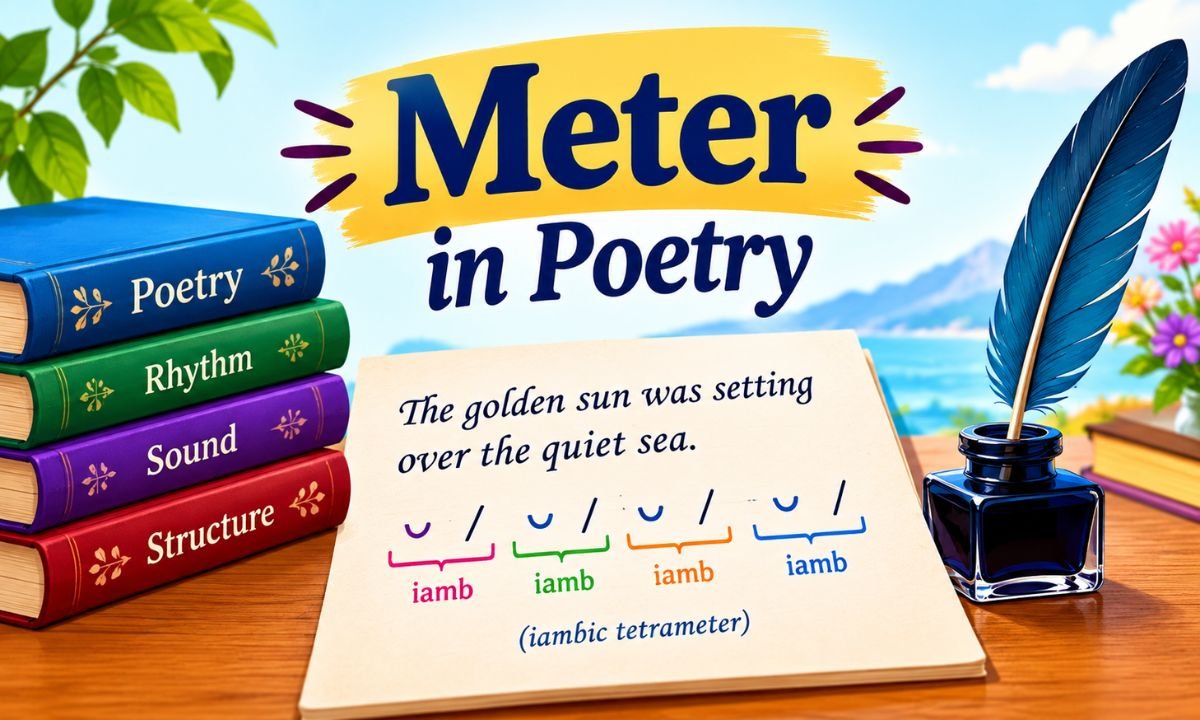
Poetry has a heartbeat, and that heartbeat is called meter. Every time a poem feels musical, rhythmic, or almost like a chant, meter is doing the work behind the scenes. This complete guide explains what meter in poetry actually means, breaks down every major type with clear examples, and shows you exactly how to identify meter in any poem, whether you are a student, teacher, or poetry enthusiast.
Definition of Meter in Poetry
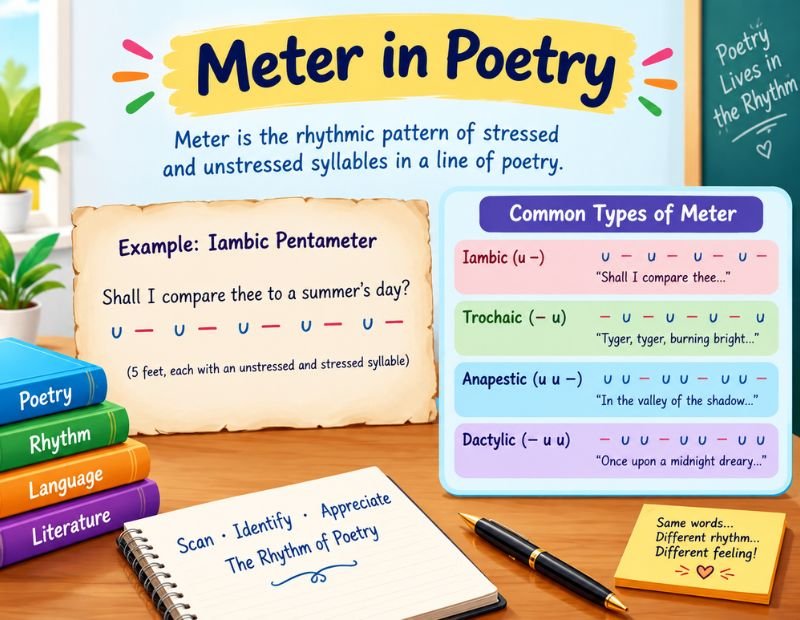
Meter is the measured, repeating pattern of stressed and unstressed syllables in a line of poetry. It gives verse its rhythm, much like a beat gives structure to a piece of music.
In simple terms, meter counts two things:
- The number of syllables in a line 🔢
- The pattern of stress, meaning which syllables are emphasized and which are not 🎯
When poets arrange stressed and unstressed syllables into a consistent, repeating pattern, that pattern becomes the poem’s meter. This rhythmic structure is one of the oldest tools in poetry, dating back to oral storytelling traditions where rhythm helped audiences remember long verses.
Read Also This Blog: Verse in Poetry
Why Meter Matters in Poetry?
Meter shapes how a poem sounds when read aloud. It can create a calm, flowing tone, a fast urgent pace, or a heavy, dramatic weight, depending on which pattern the poet chooses. Meter also helps poets:
- Build musicality and rhythm into language 🎵
- Emphasize key words or emotions through stress placement 💥
- Create a formal, structured feel, especially in classical poetry 📜
- Contrast against free verse to highlight tone shifts 🔄
What Is a Metrical Foot?
Before understanding meter fully, it helps to know the term “foot.” A metrical foot is the smallest repeating unit of stressed and unstressed syllables in a line of poetry. Meter is essentially a line made up of repeated feet.
For example, a line built from five repeating two syllable feet is called pentameter, while a line built from four feet is called tetrameter.
| Number of Feet | Term |
|---|---|
| 1 | Monometer |
| 2 | Dimeter |
| 3 | Trimeter |
| 4 | Tetrameter |
| 5 | Pentameter |
| 6 | Hexameter |
| 7 | Heptameter |
| 8 | Octameter |
Types of Meter in Poetry
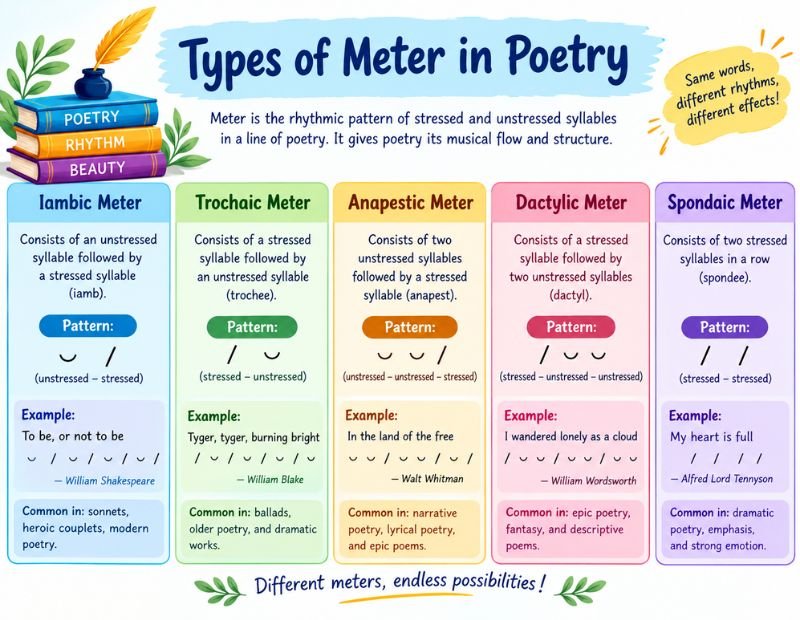
There are several major types of metrical feet used in English poetry, each identified by its unique stress pattern. Understanding these patterns is the foundation for identifying meter in any poem.
1. Iambic Meter
Iambic meter consists of an unstressed syllable followed by a stressed syllable, sounding like duh DUH. This is the most common and natural sounding meter in English poetry because it closely mirrors everyday speech rhythm.
Original example:
The bird has flown across the sky
2. Trochaic Meter
Trochaic meter reverses the iamb, starting with a stressed syllable followed by an unstressed one, sounding like DUH duh. It creates a strong, driving rhythm often used for chants and dramatic effect.
Original example:
Thunder rolling, shadows falling
3. Anapestic Meter
Anapestic meter uses two unstressed syllables followed by one stressed syllable, sounding like duh duh DUH. This creates a fast, galloping rhythm.
Original example:
And the wind swept across the wide open sea
4. Dactylic Meter
Dactylic meter is the reverse of anapestic, using one stressed syllable followed by two unstressed syllables, sounding like DUH duh duh. It creates a rolling, tumbling rhythm.
Original example:
Merrily, merrily, over the hills
5. Spondaic Meter
Spondaic meter consists of two stressed syllables in a row, sounding like DUH DUH. This meter is rarely sustained across an entire poem but is often used briefly for emphasis.
Original example:
Stop now, hold fast, stand still
6. Pyrrhic Meter
Pyrrhic meter contains two unstressed syllables together, with no strong emphasis on either. It is almost never used as a full line pattern but appears occasionally within lines of other meters.
| Meter Type | Stress Pattern | Sound |
|---|---|---|
| Iambic | Unstressed then stressed | duh DUH 🎯 |
| Trochaic | Stressed then unstressed | DUH duh 🔥 |
| Anapestic | Unstressed, unstressed, stressed | duh duh DUH 🌊 |
| Dactylic | Stressed, unstressed, unstressed | DUH duh duh 🎡 |
| Spondaic | Stressed, stressed | DUH DUH ⚡ |
| Pyrrhic | Unstressed, unstressed | duh duh 🍃 |
Monometer in Poetry
Monometer refers to a line of poetry that contains only one metrical foot. Because it is so short, monometer is rare and usually appears for stylistic effect rather than throughout an entire poem.
Key points about monometer:
- Contains just one foot per line 1️⃣
- Often used to create a dramatic pause or minimalist effect ✋
- Rarely sustained across a full poem 📉
- Common in experimental or playful verse 🎭
Original monometer example:
Alone.
Unknown.
Still stone.
Iambic Meter in Poetry
Iambic meter deserves special attention because it is the most widely used meter in English poetry. Its natural duh DUH rhythm closely resembles the rise and fall of ordinary spoken English, which is why it feels so effortless to read.
The most famous form of iambic meter is iambic pentameter, which contains five iambic feet per line, totaling ten syllables. This pattern has been used across centuries of poetry and drama because of its balanced, natural flow.
Common uses of iambic meter include:
- Shakespearean plays and sonnets 🎭
- Epic poetry, including unrhymed blank verse 📖
- Romantic and Victorian era poetry 🌹
- Modern formal poetry that echoes classical rhythm 🖋️
Original iambic pentameter example:
The morning light returns to greet the hills
Common Meter
When a poem alternates between iambic tetrameter and iambic trimeter across its lines, this combination is called common meter. It is frequently used in hymns and traditional ballads because of its singable, rhythmic quality.
Trochaic Meter in Poetry
Trochaic meter flips the iamb, leading with a stressed syllable and ending on an unstressed one. This creates a falling, forceful rhythm that feels more urgent and less natural than iambic meter, which is exactly why poets use it to stand out.
Reasons poets choose trochaic meter include:
- Creating a chant like, hypnotic rhythm 🔮
- Producing a heavier, more dramatic tone 🎬
- Disrupting a poem’s usual iambic flow for emphasis ⚠️
- Evoking urgency, danger, or intensity 🔥
Original trochaic example:
Shadows creeping, midnight sleeping
Trochaic meter is famously associated with dark, atmospheric poetry, since its falling rhythm naturally creates tension and unease.
Regular Meter in Poetry
Regular meter refers to a consistent, unchanging metrical pattern maintained throughout most or all of a poem. When a poem sticks closely to one type of foot and one line length without major deviation, it is considered metrically regular.
Features of regular meter:
- Consistent syllable count across lines 📏
- Predictable stress pattern throughout ✅
- Creates a strong sense of musical structure 🎶
- Common in classical and formal poetry 📚
In contrast, irregular meter shifts patterns within the same poem, often to reflect changing emotion or pacing.
| Feature | Regular Meter | Irregular Meter |
|---|---|---|
| Pattern | Consistent throughout | Shifts within the poem |
| Predictability | High | Low |
| Common Use | Classical, formal poetry | Modern, expressive poetry |
| Effect | Musical, structured | Dynamic, unpredictable |
Rhyme and Meter in Poetry
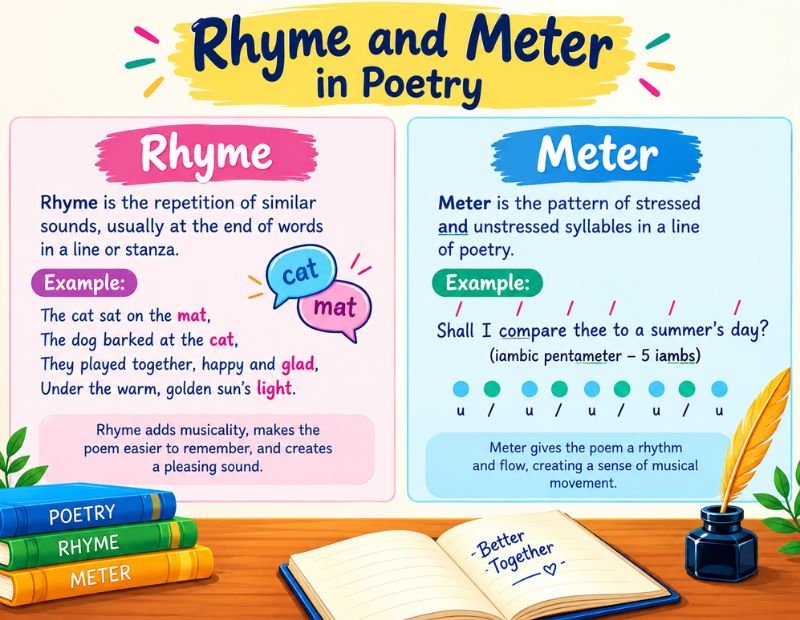
Rhyme and meter often work together, but they are not the same thing. Meter controls rhythm through stressed and unstressed syllables, while rhyme controls sound repetition at the ends, or sometimes within, lines of poetry.
| Aspect | Rhyme | Meter |
|---|---|---|
| Focus | Sound repetition | Syllable stress pattern |
| Location | Usually end of lines | Throughout the entire line |
| Required in poetry | No | No |
| Can exist without the other | Yes | Yes |
A poem can have both rhyme and meter, only one, or neither. Blank verse, for example, uses strict meter without any rhyme, while free verse uses neither.
Rhythm and Meter in Poetry
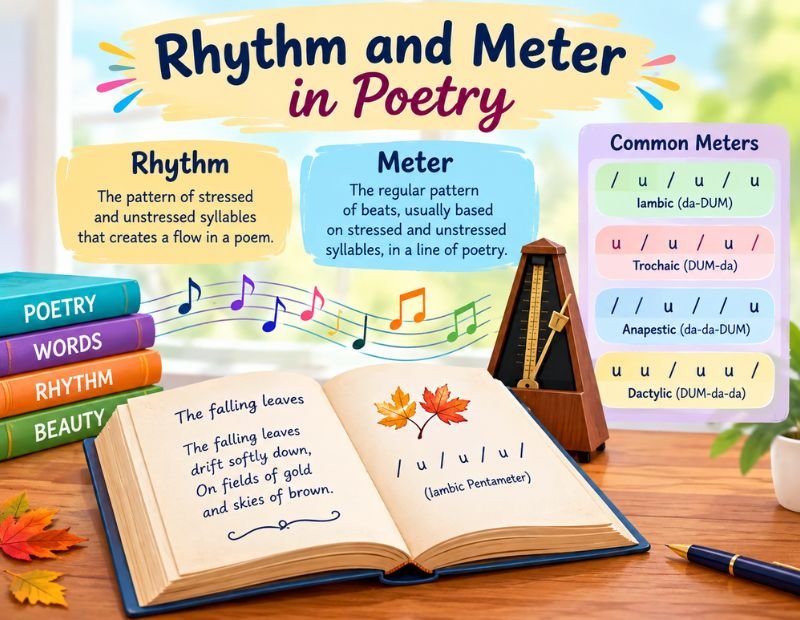
Many students confuse rhythm and meter, but there is a clear distinction. Rhythm is the overall musical flow of language, shaped naturally by word choice, punctuation, and phrasing. Meter, on the other hand, is a formalized, measurable pattern of that rhythm.
Simply put:
- Rhythm is the broader, natural musical quality of language 🎼
- Meter is a strict, countable pattern within that rhythm 📐
- All metrical poetry has rhythm, but not all rhythmic poetry follows strict meter 🔁
Free verse, for instance, has rhythm, since word choice and line breaks still create a musical flow, but it lacks formal meter entirely.
How to Identify the Meter in Poetry?
Identifying meter takes practice, but the process becomes easier once you know the steps. Here is a simple method students and teachers can follow.
- Read the line aloud naturally, without forcing emphasis 🗣️
- Mark each syllable as stressed or unstressed using symbols, such as a slash for stressed and a curved line for unstressed ✍️
- Group the syllables into repeating patterns, called feet 👣
- Identify the type of foot, such as iambic or trochaic, based on the stress pattern 🔍
- Count how many feet appear in the line to name the meter, such as tetrameter or pentameter 🔢
- Compare multiple lines to check if the pattern stays consistent throughout the poem 📊
A helpful trick is to say the line the way you would in normal conversation, rather than forcing it into a rhythm you expect. The natural stress pattern usually reveals the true meter.
Meter in Poetry PPT and Classroom Teaching
Meter is a popular classroom topic because it combines listening, reading, and pattern recognition skills. When creating a meter in poetry presentation or lesson plan, educators often structure the content around these key sections:
- Definition and importance of meter 📘
- Explanation of stressed and unstressed syllables 🔤
- Breakdown of major meter types with sound patterns 🎵
- Practice examples with marked stress patterns ✅
- Group activities where students clap or tap out the rhythm 👏
- Comparison between meter, rhythm, and rhyme 📊
This structure works well for slideshows, worksheets, and interactive lessons, since it moves from simple definitions to hands on practice.
Examples of Meter in Poetry
Below are original examples demonstrating different meters, organized for clarity and easy classroom or study use.
Iambic examples:
- The sun has set behind the hill 🌅
- She walked alone along the shore 🌊
- His voice was calm yet filled with fire 🔥
Trochaic examples:
- Rolling thunder, crashing waters 🌩️
- Winter whispers, cold and silent ❄️
Anapestic examples:
- And the ship sailed away with the tide of the moon 🚢
- In the dark of the night came a soft distant sound 🌙
Dactylic examples:
- Whispering, wandering, lost in the woods 🌲
- Gathering, scattering, leaves in the wind 🍂
Spondaic examples:
- Stand firm, hold tight 🗿
- Dead calm, still night 🌌
Examples of Meter for Teachers
Teachers often need clear, simple examples to demonstrate meter without overwhelming students. Useful classroom approaches include:
- Using nursery rhymes to show basic iambic and trochaic patterns 🧸
- Clapping syllables aloud before marking stress patterns 👏
- Comparing a metrical poem with a free verse poem side by side ⚖️
- Assigning students to write a four line poem in strict iambic meter ✍️
Examples of Meter for Students
Students benefit from short, relatable examples that are easy to scan and mark. Helpful practice lines include:
- I walk to school each sunny day ☀️
- The dog runs fast across the yard 🐕
- We sing a song beneath the stars ⭐
Marking these lines syllable by syllable helps students visually understand where the stress naturally falls.
Examples of Meter in poetry for Kids
For younger learners, meter is best introduced through rhythm games and simple rhymes rather than technical terms. Fun approaches include:
- Clapping out the beats of a favorite nursery rhyme 👏
- Tapping a desk to the rhythm of a poem being read aloud 🥁
- Using simple two syllable words to demonstrate stressed and unstressed sounds 🔤
- Turning meter practice into a rhyming game with silly sentences 🎉
Kid friendly example:
The cat sat on the mat today
This playful, low pressure approach helps children absorb the concept of rhythm before introducing formal terminology.
Meter in poetry vs Verse vs Stanza
Since these terms are often confused together, here is a quick comparison to clarify each one.
| Term | Definition |
|---|---|
| Meter | The rhythmic pattern of stressed and unstressed syllables |
| Verse | A single line, or sometimes a full poem |
| Stanza | A grouped set of lines forming a structural unit |
Understanding this distinction helps avoid confusion when analyzing poems academically.
Why Poets Choose Different Meters?
Poets do not select meter randomly. Each pattern carries its own emotional and rhythmic weight, which shapes how a reader experiences the poem.
- Iambic meter feels natural and conversational, ideal for storytelling and drama 🗣️
- Trochaic meter feels forceful and urgent, often used for tension or intensity 🔥
- Anapestic meter feels light and galloping, common in playful or musical verse 🎠
- Dactylic meter feels rolling and grand, often used in classical epic poetry 🏛️
Choosing the right meter allows poets to reinforce the emotional tone of their subject matter through sound alone.
Conclusion
Meter in poetry is the rhythmic backbone of poetry, shaping how a poem sounds, feels, and moves. From the natural flow of iambic meter to the forceful beat of trochaic patterns, every metrical choice adds another layer of meaning to a poem beyond its words alone. Once you learn to identify stressed and unstressed syllables and recognize common foot patterns, you will start noticing meter everywhere, from classic sonnets to modern song lyrics. Whether you are a student preparing for an exam, a teacher building a lesson plan, or simply a poetry lover exploring rhythm, mastering meter opens up a much deeper appreciation for the craft of poetic writing.
FAQs
What is meter in poetry?
Meter in poetry is the measured pattern of stressed and unstressed syllables that creates rhythm in a line of poetry.
What are the main types of meter in poetry?
The main types of meter in poetry are iambic, trochaic, anapestic, dactylic, spondaic, and pyrrhic, each defined by a unique stress pattern.
What is the most common meter in poetry English ?
Iambic pentameter is the most common meter in poetry, widely used in sonnets, plays, and classical English poetry.
What is the difference between meter and rhythm?
Rhythm is the natural musical flow of language, while meter is a strict, countable pattern within that rhythm.
What is monometer in poetry?
Monometer is a line of poetry containing only one metrical foot, making it very short and rare.
How do you identify meter in a poem?
Read the line aloud, mark stressed and unstressed syllables, group them into feet, and count the repeating pattern.
Does every poem have meter?
No, free verse poems intentionally avoid a fixed metrical pattern, relying instead on natural speech rhythm.
What is the difference between iambic and trochaic meter in poetry?
Iambic meter stresses the second syllable in each foot, while trochaic meter stresses the first syllable instead.