
Poetry has always found ways to turn ordinary stories into unforgettable songs, and the ballad sits right at the heart of that tradition. From medieval minstrels singing in village squares to modern songwriters topping music charts, the ballad has survived centuries because it does one thing better than almost any other poetic form: it tells a story that people want to hear again and again.
If you have ever wondered what makes a ballad different from a sonnet, or why so many love songs are called ballads, this guide breaks it all down in simple language. You will learn the meaning, characteristics, structure, types, rhyme scheme, meter, and stanza pattern of ballads, along with 20+ examples that show the form in action.
What Is a Ballad In Poetry?
A ballad in poetry is a narrative poem that tells a story, usually set to a simple rhythm that made it easy to sing, memorize, and pass down by word of mouth. Unlike a sonnet or an ode, which often explores a single emotion or idea, a ballad moves through events in a clear sequence, much like a short story told in verse.
Most ballads share three qualities:
- They tell a story with a beginning, middle, and end 🎭
- They use simple, direct language anyone can follow 🗣️
- They often include repetition, refrains, or a chorus like structure 🔁
The word ballad comes from the Old French term balade, which was linked to dance songs. Over time it evolved into the story driven poems and songs we recognize today.
Read Also This Blog: Haiku in Poetry
Ballad Meaning In Poetry
At its core, a ballad meaning centers on storytelling through song like verse. It is a poem written to be spoken, sung, or recited, and it usually focuses on one dramatic incident rather than a sprawling plot. Think of tragic love, betrayal, heroism, or a single unforgettable event.
Because ballads were traditionally passed down orally before being written down, the meaning of a ballad also carries a sense of community memory. It is poetry that belonged to ordinary people long before it belonged to poets and publishers.
Characteristics Of Ballad In Poetry
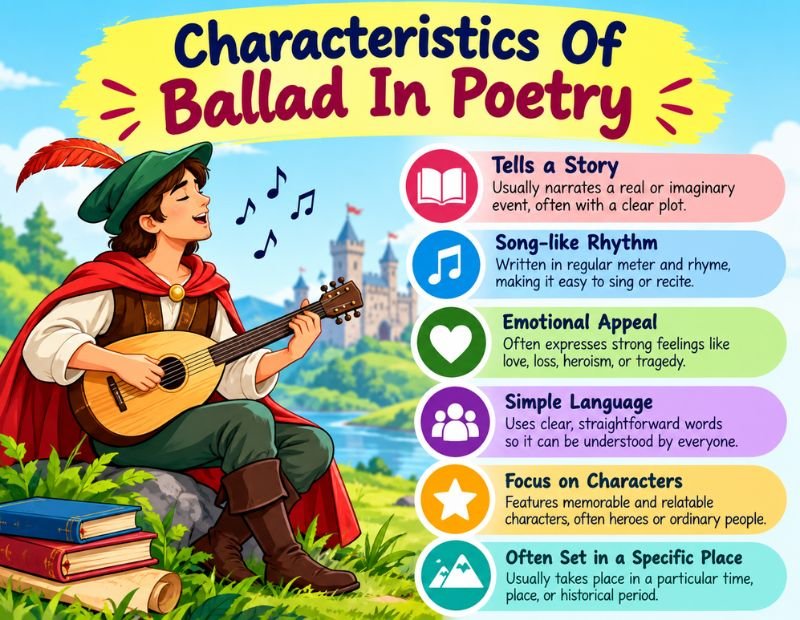
Ballad in poetry share a recognizable set of features that separate them from other poetic forms. Here are the defining characteristics:
- Narrative focus: every ballad tells a story with characters, conflict, and an outcome 📖
- Simple language: word choice stays accessible rather than ornate or academic ✍️
- Musical rhythm: the lines are built to be sung or chanted aloud 🎶
- Quatrain stanzas: most ballads are written in four line stanzas 🔢
- Repetition and refrains: key lines or phrases repeat to build emotion and aid memory 🔂
- Dialogue: many ballads use direct speech between characters to drive the story 💬
- Impersonal tone: traditional ballads rarely reveal the author’s personal opinion, they simply narrate 🎙️
- Compression: ballads skip unnecessary detail and jump straight into the action ⚡
These traits explain why ballads feel different from lyric poems, which tend to focus inward on a single emotion rather than outward on a sequence of events.
Effects Of Ballad In Poetry
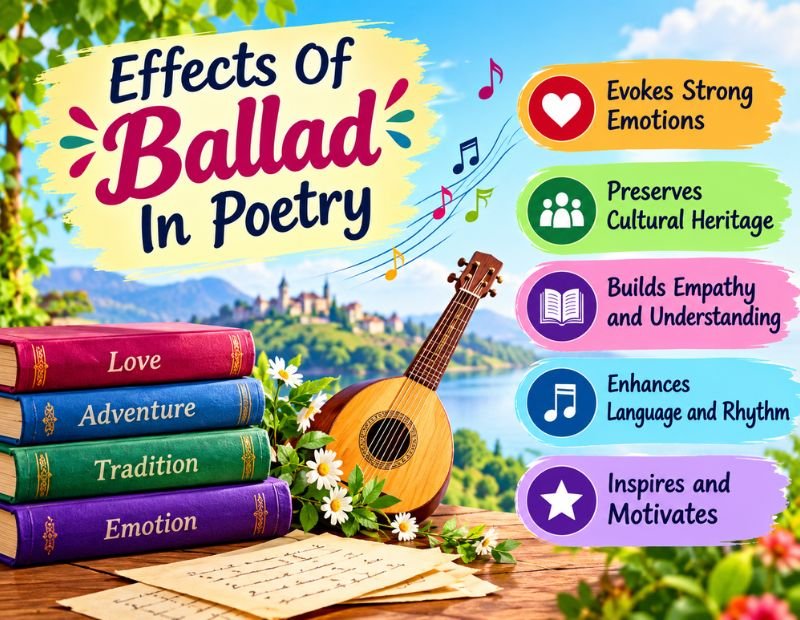
Ballad in poetry create a distinct emotional and artistic impact on readers and listeners. The most common effects include:
- Emotional intensity: the focus on one dramatic event pulls readers into the story fast
- Memorability: rhyme, meter, and repetition make ballads easy to remember and recite
- Universality: because the language is simple, ballads connect with wide audiences across generations
- A sense of tradition: ballads often feel timeless, linking readers to oral storytelling roots
- Musicality: the rhythmic pattern gives even silent reading a song like quality
This combination of emotion and rhythm is why ballads have survived from medieval folk culture all the way into modern pop and country music.
Purpose Of Ballad In Poetry
Historically, ballad in poetry served several practical and artistic purposes:
- To preserve stories, legends, and historical events before written records were common 🏰
- To entertain communities through public recitation or performance 🎪
- To pass moral lessons or warnings through memorable storytelling ⚖️
- To document current events, especially through broadside ballads sold on printed sheets in the streets 📰
- To give poets a structured form for exploring tragedy, romance, and heroism 💔
In modern usage, the purpose has shifted slightly. Contemporary ballad in poetry, especially in music, are often used to express deep personal emotion, particularly romantic longing or heartbreak.
Structure Of Ballad In Poetry
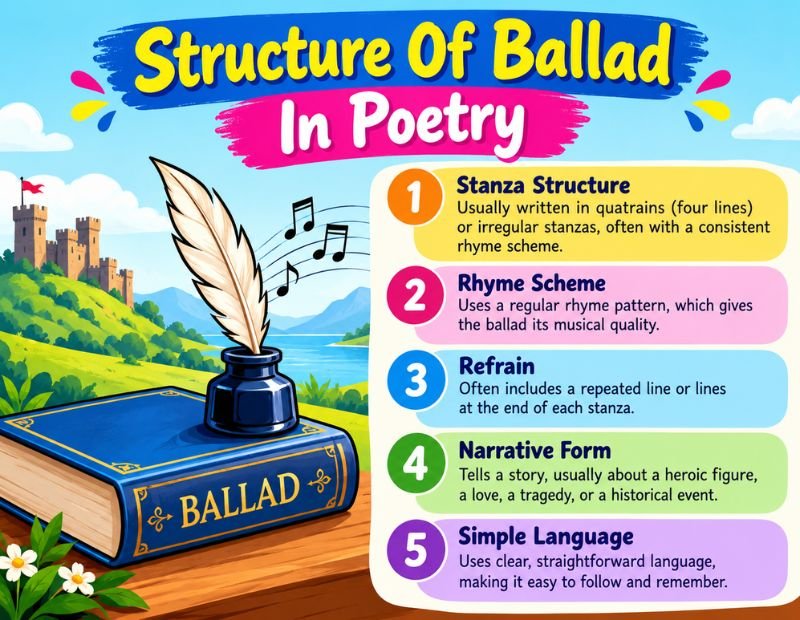
The traditional ballad structure is built around simplicity and rhythm, which is what made it so easy to sing and remember. Here is a breakdown of the typical structure.
| Structural Element | Typical Pattern |
|---|---|
| Stanza length | Four line stanzas known as quatrains |
| Rhyme scheme | ABCB or ABAB |
| Line length | Alternating four stress and three stress lines |
| Meter | Ballad meter, a mix of iambic tetrameter and iambic trimeter |
| Refrain | A repeated line or phrase, common but not required |
| Narrative style | Chronological storytelling with minimal description |
| Point of view | Often third person and impersonal |
This structure is flexible. Not every ballad in poetry follows the pattern exactly, but most recognizable ballads lean on some version of this framework.
Types Of Ballad In Poetry
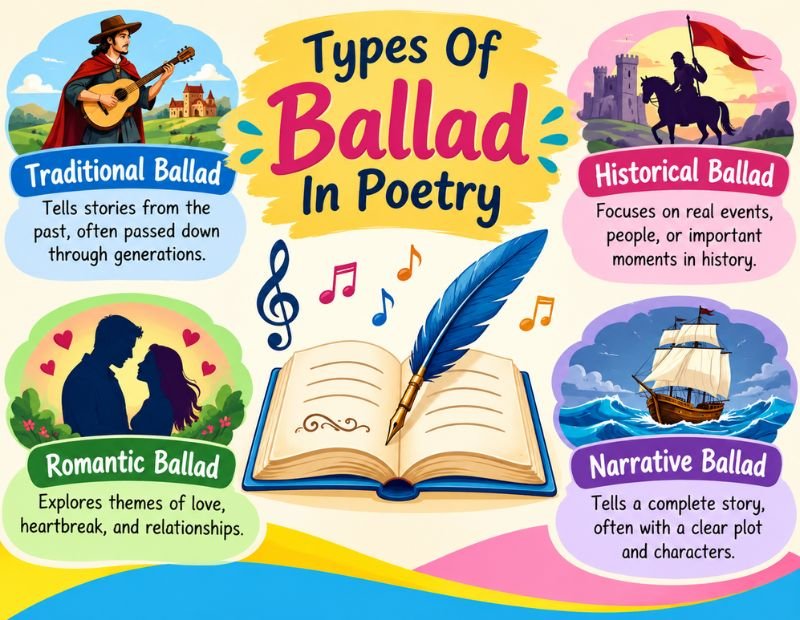
There are several recognized types of ballad in poetry, each shaped by history, authorship, and purpose.
1. Folk Ballad In Poetry (Traditional Ballad)
These are anonymous ballads passed down orally through generations. They often center on local legends, tragic romances, or historical events. “Barbara Allen” is one of the most famous examples, existing in hundreds of regional variations.
2. Literary Ballad In Poetry
Written by known poets who imitate the folk ballad style with more deliberate craftsmanship. Examples include John Keats’s “La Belle Dame sans Merci” and Samuel Taylor Coleridge’s “The Rime of the Ancient Mariner.”
3. Broadside Ballad In Poetry
Popular in the sixteenth and seventeenth centuries, these ballads were printed cheaply on single sheets and sold on the streets. They usually reported current events, crimes, or sensational stories of the day.
4. Lyrical Ballad In Poetry
A blend of personal emotion and narrative storytelling, made famous by William Wordsworth and Samuel Taylor Coleridge in their landmark 1798 collection “Lyrical Ballads.”
5. Sea Ballad In Poetry (Maritime Ballad)
Focused on sailors, shipwrecks, and ocean voyages, often filled with adventure and danger.
6. Border Ballad In Poetry
Originating from the England Scotland border region, these ballads often depict feuds, raids, and clan conflicts.
7. Modern or Musical Ballad In Poetry
Contemporary songs, often slow tempo and emotionally driven, found across pop, rock, and country music. Power ballads fall under this category.
Here is a quick comparison table for clarity:
| Type | Author | Common Theme | Example |
|---|---|---|---|
| Folk Ballad | Anonymous | Legends, tragedy | Barbara Allen |
| Literary Ballad | Known poet | Romance, supernatural | La Belle Dame sans Merci |
| Broadside Ballad | Printers or hacks | Current events, crime | Street sheet ballads |
| Lyrical Ballad | Known poet | Nature, emotion, narrative | Lyrical Ballads by Wordsworth and Coleridge |
| Sea Ballad | Anonymous or known | Voyages, shipwrecks | The Rime of the Ancient Mariner |
| Border Ballad | Anonymous | Feuds, raids | Border ballads collections |
| Modern Ballad | Songwriter | Love, heartbreak | Power ballads in music |
Short Ballad In Poetry
Not every ballad in poetry is long. Short ballad in poetry compress a complete story into just a few quatrains while still keeping the core elements intact: narrative, rhyme, and rhythm. A short ballad might focus on a single moment, such as a farewell, a betrayal, or a moment of loss, rather than a full sequence of events. These compact ballads are popular in classrooms and among beginner poets because they teach the form without demanding a lengthy narrative.
Ballad Rhyme Scheme
The most common ballad rhyme scheme is ABCB, where only the second and fourth lines rhyme. Some ballads use ABAB, where alternating lines rhyme throughout the stanza.
Example of ABCB pattern:
The wind blew cold across the moor, (A) The night grew dark and still, (B) A rider came to the old church door, (C) And climbed the silent hill. (B)
This scheme creates a natural, song like flow that is easy to sing and remember, which explains why it became the standard across centuries of oral tradition.
What Is a Literary Ballad?
A literary ballad is a ballad written by a known, identifiable poet who consciously borrows the style, tone, and structure of traditional folk ballads. Unlike anonymous folk ballads shaped by generations of retelling, literary ballads reflect one poet’s deliberate artistic choices.
Famous examples of literary ballads include:
- “La Belle Dame sans Merci” by John Keats 🌹
- “The Rime of the Ancient Mariner” by Samuel Taylor Coleridge ⚓
- “Annabel Lee” by Edgar Allan Poe 🕯️
- “During Wind and Rain” by Thomas Hardy 🌧️
- “The Ballad of Reading Gaol” by Oscar Wilde ⛓️
These poems keep the storytelling spirit of folk ballads while adding more polished language, symbolism, and personal voice.
What Is a Lyrical Ballad In Poetry?
A lyrical ballad combines the narrative drive of a traditional ballad with the introspective, emotional quality of lyric poetry. The term became especially significant after William Wordsworth and Samuel Taylor Coleridge published their 1798 collection titled “Lyrical Ballads,” which is often credited with launching the English Romantic movement in poetry.
Lyrical ballads focus not only on what happens in the story but also on how the events make the characters or narrator feel. This blend of storytelling and emotional reflection set the stage for a more personal, nature focused style of poetry that followed in the nineteenth century.
Ballad Meter In Poetry
Ballad meter refers to the specific rhythmic pattern used in traditional ballads. It typically alternates between:
- Lines of iambic tetrameter, which contain four stressed syllables 🎵
- Lines of iambic trimeter, which contain three stressed syllables 🎼
This alternating four stress and three stress pattern creates a natural rise and fall that mirrors the rhythm of speech and song. It is one of the reasons ballads feel so easy to read aloud or set to music, even without any instrumental accompaniment.
Ballad Stanza In Poetry
The ballad stanza is the basic structural unit of most ballads. It typically consists of:
- Four lines, known as a quatrain 📝
- Alternating four stress and three stress lines ⚖️
- An ABCB or ABAB rhyme scheme 🔗
A classic ballad stanza example looks like this:
She walked alone beneath the moon, (4 stress) Her heart was full of fear, (3 stress) She heard a voice, a haunting tune, (4 stress) And no one else was near. (3 stress)
This four line pattern repeats throughout the poem, sometimes with variations, to carry the story forward stanza by stanza.
20+ Powerful Examples Of Ballads In Poetry
Here is a list of well known ballads across different eras and styles that showcase the range of the form:
- “Barbara Allen” (Folk Ballad)
- “The Rime of the Ancient Mariner” by Samuel Taylor Coleridge
- “La Belle Dame sans Merci” by John Keats
- “Annabel Lee” by Edgar Allan Poe
- “The Ballad of Reading Gaol” by Oscar Wilde
- “During Wind and Rain” by Thomas Hardy
- “John Henry” (Folk Ballad)
- “Sir Patrick Spens” (Traditional Scottish Ballad)
- “The Twa Corbies” (Traditional Ballad)
- “Lord Randall” (Traditional Ballad)
- “The Highwayman” by Alfred Noyes
- “Tam Lin” (Traditional Border Ballad)
- “The Ballad of Jesse James” (Folk Ballad)
- “Casey at the Bat” by Ernest Thayer
- “The Wreck of the Hesperus” by Henry Wadsworth Longfellow
- “The Cremation of Sam McGee” by Robert Service
- “The Demon Lover” (Traditional Ballad)
- “Get Up and Bar the Door” (Traditional Scottish Ballad)
- “The Unquiet Grave” (Traditional Ballad)
- “Thomas the Rhymer” (Traditional Ballad)
- “The Ballad of the Harp Weaver” by Edna St. Vincent Millay
- “Mary Hamilton” (Traditional Ballad)
Each of these poems demonstrates the ballad’s core strength: turning a single dramatic story into memorable, rhythmic verse.
Ballad vs Other Poetic Forms
To understand ballads more clearly, it helps to compare them against other common poetic forms.
| Feature | Ballad | Sonnet | Epic |
|---|---|---|---|
| Length | Short to medium | Fourteen lines | Very long |
| Focus | Single dramatic event | Single emotion or idea | Full heroic journey |
| Rhyme Scheme | ABCB or ABAB | Varies, often ABAB CDCD EFEF GG | Varies widely |
| Origin | Oral, folk tradition | Literary tradition | Oral and literary tradition |
| Musicality | High, meant to be sung | Moderate | Low to moderate |
Conclusion
The ballad remains one of the most enduring forms in poetry because it blends story, rhythm, and emotion into something that feels natural to speak and sing. Whether it is an anonymous folk tale passed down for centuries or a modern power ballad playing on the radio, the core idea stays the same: a story worth telling, told in a way people will not forget.
Understanding the meaning, structure, rhyme scheme, meter, and types of ballads gives you the tools to recognize this form wherever it appears, and even try writing one yourself. Start with a simple quatrain, keep the language direct, focus on one dramatic moment, and let the rhythm carry the story forward.
Frequently Asked Questions
What is a ballad in simple words?
A ballad is a story poem, often meant to be sung, that focuses on one dramatic event using simple language and rhyme.
What is the most common rhyme scheme in a ballad?
The most common rhyme scheme is ABCB, where the second and fourth lines rhyme.
How many lines are in a ballad stanza?
A standard ballad stanza has four lines, known as a quatrain.
What is the difference between a folk ballad and a literary ballad?
A folk ballad is anonymous and passed down orally, while a literary ballad is written by a known poet imitating that style.
What is ballad meter?
Ballad meter alternates between iambic tetrameter and iambic trimeter, creating a four stress then three stress rhythm.
Are modern songs considered ballads?
Yes, slow, emotional songs, especially about love or loss, are commonly called ballads in modern music.
What is a lyrical ballad?
A lyrical ballad combines narrative storytelling with personal emotional reflection, popularized by Wordsworth and Coleridge.
What is the purpose of a ballad?
Ballads preserve stories, entertain audiences, and pass down history or moral lessons through memorable, rhythmic verse.