
Epic poetry is one of the oldest and most powerful forms of storytelling in human history. Long before novels, before printing presses, and even before writing itself, communities gathered to listen to long, rhythmic tales about gods, warriors, and impossible journeys. These stories became the epics we still study today.
If you have ever wondered what makes a poem “epic,” how it differs from a novel, or why Homer’s Odyssey is still taught thousands of years later, this guide covers everything you need. You will learn the meaning of epic poetry, its characteristics, purpose, types, famous examples, and even how epic traditions developed in places like the Philippines.
What Does Epic In Poetry Mean?
An epic in poetry is a long narrative poem written in an elevated, formal style that tells the story of a legendary or heroic figure. These heroes usually represent the values, courage, and identity of an entire culture, and their journeys often decide the fate of a nation, a people, or even the universe itself.
Epics are not short, personal reflections like lyric poems. They are sweeping, book-length narratives that combine adventure, mythology, history, and moral teaching into a single grand story. Most classic epics were composed in verse using a specific meter, such as dactylic hexameter in ancient Greek and Latin epics.
At their core, epic poems answer a simple cultural need: they preserve a community’s memory of its heroes, its gods, and the events that shaped its worldview.
Key Features Of The Definition
- A long narrative poem, often divided into multiple books or cantos
- A central hero of great, sometimes superhuman, importance
- Elevated, formal, and often grand language
- A vast setting that may include the human world, the underworld, and the heavens
- Themes of honor, fate, war, loyalty, and mortality
Read Also This Blog: Ode in Poetry
How To Write An Epic In Poetry?
Writing an epic poem today is a creative challenge, but it becomes manageable once you break it into stages. Modern poets rarely follow every ancient convention, yet most successful epics still borrow the core structure.
- Choose a hero worth following. The protagonist should have a clear goal, admirable or complex qualities, and enough at stake to sustain hundreds of lines.
- Decide on the central conflict. This could be a war, a long journey home, a quest for redemption, or a battle against fate itself.
- Build a vast, layered setting. Epics often move between kingdoms, battlefields, oceans, and sometimes supernatural realms.
- Draft an invocation. Traditionally, the poet calls upon a muse or divine power to inspire the storytelling.
- Structure the plot into books or cantos. Breaking the poem into sections makes a lengthy narrative easier to write and read.
- Use elevated, rhythmic language. Epic poetry relies on formal diction, repeated epithets, and figurative language such as extended similes.
- Include a moral or cultural lesson. Even action-driven epics usually reflect on courage, fate, honor, or the human condition.
Rules To Write An Epic In Poetry
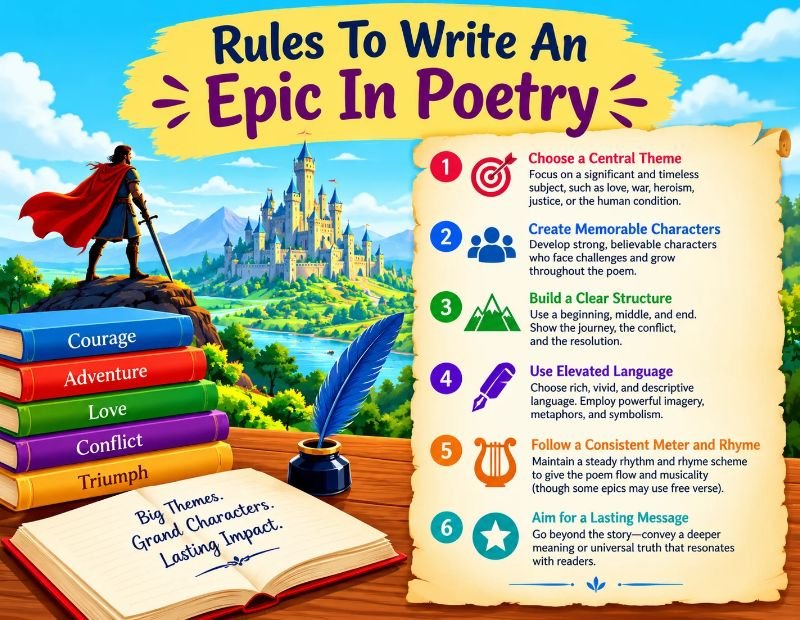
Classical epics tend to follow a recognizable set of conventions. While modern poets take creative liberties, these traditional rules are useful guidelines for anyone attempting the form.
| Traditional Rule | What It Means |
|---|---|
| Invocation of the muse | Poem opens with an appeal to a divine source of inspiration |
| In medias res | The story begins in the middle of the action, not at the very start |
| Elevated style | Formal, dignified language throughout, avoiding casual speech |
| Epic hero | A larger-than-life figure of noble or national significance |
| Vast setting | Action spans multiple nations, realms, or even the cosmos |
| Divine intervention | Gods or supernatural forces influence human events |
| Epic similes | Long, elaborate comparisons that extend over several lines |
| Catalogues | Lists of armies, heroes, or ships to emphasize scale |
| Epithets | Repeated descriptive phrases attached to characters, like “swift-footed Achilles” |
Does An Epic Have To Be A Poem?
No, not strictly. Traditionally, an epic was always a long narrative poem written in verse, and works like the Iliad, Beowulf, and the Ramayana fit this definition perfectly. However, the term has broadened over time.
Today, literary critics also use “epic” to describe long prose narratives that share the same scope, heroism, and grandeur as classic verse epics. Novels such as Leo Tolstoy’s War and Peace or Gabriel García Márquez’s One Hundred Years of Solitude are often called epic novels because they capture sweeping historical events and larger-than-life characters, even though they are written in prose rather than metrical verse.
So while the original and most technically accurate form of an epic is a poem, the modern, looser use of the word includes prose works with epic scope and ambition.
Characteristics Of Epic In Poetry
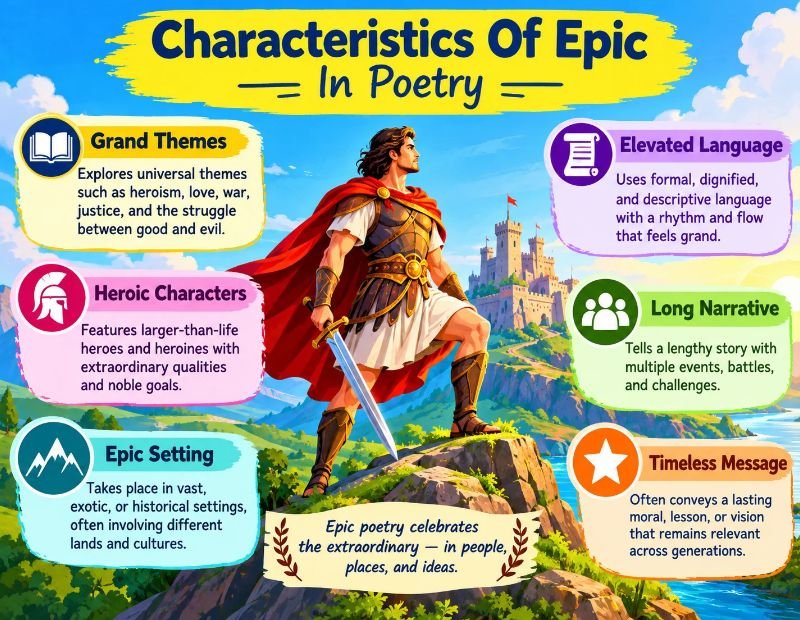
Epic poems share a recognizable set of traits across cultures, even when they were composed thousands of miles and centuries apart.
- Length and scale: Epics are extensive works, frequently divided into books, cantos, or chapters, much like a novel.
- Heroic protagonist: The hero is admired, often partly divine or protected by the gods, and performs deeds beyond ordinary human ability.
- Supernatural elements: Gods, monsters, magic, and journeys to the underworld are common.
- Universal setting: The action often stretches across nations, oceans, and even different realms of existence.
- Elevated language: Poets avoid everyday speech in favor of formal, dignified, and sometimes archaic diction.
- Objective narrator: The narrator typically sees and knows everything, presenting events with authority.
- Epic similes and epithets: Extended comparisons and repeated descriptive tags reinforce the hero’s stature.
- Cultural and religious significance: Epics often reflect a society’s values, beliefs, and history.
Purpose Of Epic In Poetry
Epic in poetry served several important functions in ancient societies, many of which still apply today.
- Preserving history and memory: Before written records were common, epics carried a culture’s history from one generation to the next through oral performance.
- Reinforcing cultural identity: By celebrating a hero who embodies a society’s ideals, epics helped define what that culture valued most, such as courage, loyalty, or wisdom.
- Teaching moral lessons: Epic heroes face temptation, hardship, and impossible choices, offering audiences models of virtue and warnings against pride or excess.
- Explaining the unknown: Many epics touch on the origins of the world, the nature of the gods, and the mysteries of death, giving audiences a framework for understanding life.
- Entertaining audiences: At their heart, epics are gripping stories filled with battles, monsters, and emotional stakes designed to captivate a listening crowd.
Effects Of Epic In Poetry
The impact of epic poetry extends far beyond its original audience.
- Epics shaped the foundations of Western and Eastern literature, influencing poets, novelists, and filmmakers for centuries.
- They established the archetype of the hero’s journey, a narrative pattern still used in modern storytelling.
- Epic poetry preserved languages and cultural memory in oral societies where writing was uncommon.
- They inspired countless works of art, music, and later, cinema, from Renaissance paintings to modern epic films.
- Epics continue to shape how we think about heroism, fate, and the human relationship with forces beyond our control.
Types Of Epic In Poetry
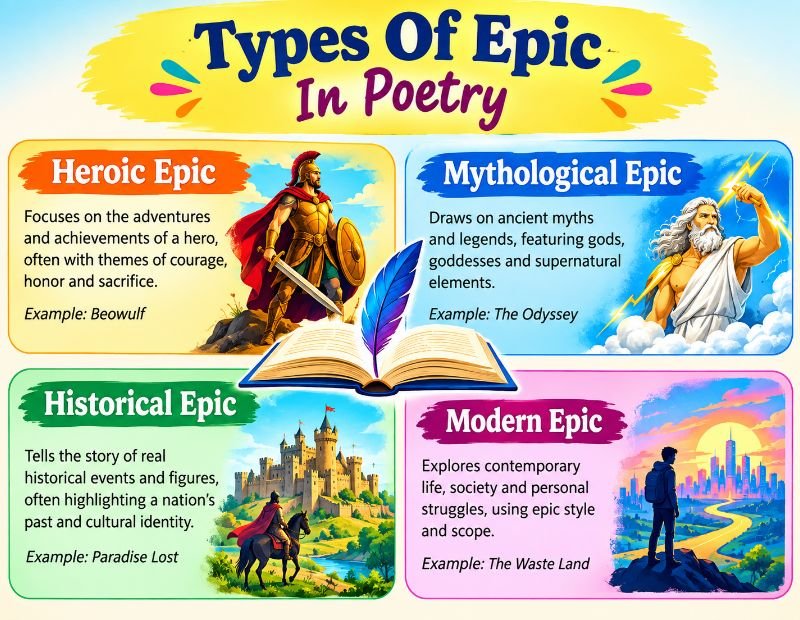
Scholars generally divide epic poetry into two broad categories, along with several notable subtypes.
Primary (Folk) Epic In Poetry
Primary epics, sometimes called folk epics or oral epics, developed from oral tradition before they were ever written down. They were composed by unknown poets or communities and passed down through generations of singers and storytellers.
- Examples: The Iliad, The Odyssey, Beowulf, The Epic of Gilgamesh
Secondary (Literary) Epic In Poetry
Secondary epics, also called literary epics, are consciously written by a single identifiable author who imitates the style and structure of earlier folk epics.
- Examples: Virgil’s Aeneid, John Milton’s Paradise Lost, Dante’s Divine Comedy
Other Notable Types
- National epics: Poems that celebrate the founding or history of a specific nation, such as the Aeneid for Rome.
- Religious epics: Works centered on theological themes, such as Paradise Lost.
- Mock epics: Comic poems that use epic conventions to describe trivial subjects, discussed in more detail below.
- Romantic epics: Poems emphasizing chivalry, love, and adventure, such as Edmund Spenser’s The Faerie Queene.
Famous Epic In Poetry: 25+ Examples
Below is a broad collection of celebrated epic poems from across world literature.
| Epic Poem | Author / Origin | Culture or Language |
|---|---|---|
| The Epic of Gilgamesh | Unknown | Sumerian/Mesopotamian |
| The Iliad | Homer | Ancient Greek |
| The Odyssey | Homer | Ancient Greek |
| The Aeneid | Virgil | Ancient Roman |
| Beowulf | Unknown | Old English |
| The Ramayana | Valmiki | Sanskrit, India |
| The Mahabharata | Vyasa | Sanskrit, India |
| Shahnameh | Ferdowsi | Persian |
| Paradise Lost | John Milton | English |
| The Divine Comedy | Dante Alighieri | Italian |
| The Faerie Queene | Edmund Spenser | English |
| Orlando Furioso | Ludovico Ariosto | Italian |
| The Lusiads | Luís de Camões | Portuguese |
| The Song of Roland | Unknown | Old French |
| El Cid | Unknown | Spanish |
| The Nibelungenlied | Unknown | Middle High German |
| Kalevala | Elias Lönnrot (compiler) | Finnish |
| The Cantos | Ezra Pound | American/Modernist |
| Paterson | William Carlos Williams | American |
| The Anniad | Gwendolyn Brooks | American |
| Metamorphoses | Ovid | Ancient Roman |
| Argonautica | Apollonius of Rhodes | Ancient Greek |
| Biag ni Lam-ang | Unknown, Ilocano tradition | Philippines |
| Ibalon | Unknown, Bicolano tradition | Philippines |
| Hinilawod | Unknown, Panay tradition | Philippines |
| Darangen | Unknown, Maranao tradition | Philippines |
| Hudhud ni Aliguyon | Unknown, Ifugao tradition | Philippines |
Epic Poem Vs. Novel
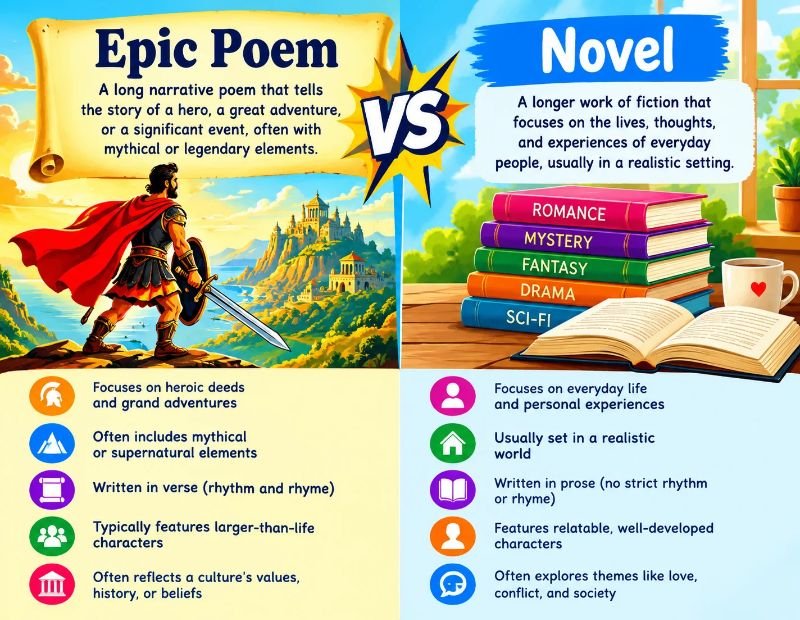
Because modern epics are sometimes written as long prose narratives, people often confuse epic poems with novels. Here is how they compare.
| Feature | Epic Poem | Novel |
|---|---|---|
| Form | Written in verse, often with meter | Written in prose |
| Origin | Rooted in oral tradition | Rooted in print culture |
| Narrator | Objective, all-knowing, formal tone | Can vary widely in perspective and tone |
| Language | Elevated, formal, poetic devices | Ranges from formal to conversational |
| Structure | Divided into books or cantos | Divided into chapters |
| Hero | Larger-than-life, culturally symbolic | Can be ordinary or flawed |
| Purpose | Cultural memory, moral teaching, oral performance | Entertainment, character study, social commentary |
Mock Epic In Poetry
A mock epic in poetry, also called a mock-heroic poem, borrows the grand style and conventions of traditional epics but applies them to a trivial or comic subject. The contrast between the elevated language and the small-scale topic creates humor and satire.
Alexander Pope’s The Rape of the Lock is the most famous English example, using epic machinery, invocations, and heroic battles to describe a society dispute over a stolen lock of hair. Mock epics are valuable because they poke fun at the seriousness of traditional epic conventions while still showing deep familiarity with the form.
Common Features Of Mock Epic In Poetry
- A trivial subject treated with exaggerated seriousness
- Formal, elevated diction used ironically
- Traditional epic devices such as invocations and epic similes
- A satirical or humorous tone throughout
Muse Of Epic In Poetry In Greek Mythology
In Greek mythology, the nine Muses were goddesses who inspired art, literature, and science. The Muse most closely associated with epic poetry is Calliope, often considered the eldest and most distinguished of the nine.
Calliope was traditionally invoked by epic poets at the beginning of their works, asking her to inspire and guide the telling of heroic deeds. This is why classical epics like the Iliad and the Odyssey open with a formal invocation, a poet’s request for divine assistance in recounting a story too vast for human memory alone.
Epic In Poetry In Literature
Epic poetry has left a permanent mark on world literature, influencing genres far beyond poetry itself.
- Ancient Greece: Homer’s Iliad and Odyssey established the foundational conventions of Western epic poetry, including invocations, epithets, and epic similes.
- Ancient Rome: Virgil’s Aeneid used the epic form to celebrate Rome’s legendary founding and imperial destiny.
- Medieval Europe: Works like Beowulf, The Song of Roland, and El Cid blended history, legend, and Christian values.
- The Renaissance: Poets such as Edmund Spenser and later John Milton adapted classical epic structure to explore religious and moral themes.
- South Asia: The Ramayana and Mahabharata remain central to Hindu literature, religion, and culture, and are still performed and studied today.
- Modernist poetry: Twentieth-century poets like Ezra Pound and William Carlos Williams reimagined epic form for a fragmented, modern world.
Epic conventions also influenced the modern novel, epic films, and even video game storytelling, where a lone hero embarks on an extraordinary journey against overwhelming odds.
Epic In Poetry In The Philippines
The Philippines has a rich tradition of indigenous epic poetry, passed down orally for generations before some were eventually transcribed. Filipino epics, often called folk epics or ethno-epics, recount the adventures of legendary heroes and reflect the beliefs, values, and history of specific ethnic communities.
Notable Philippine Epic In Poetry
- Biag ni Lam-ang (Life of Lam-ang): An Ilocano epic about a hero who could speak immediately after birth and who defeats his father’s killers as a child. It was first written down around 1640 by Pedro Bukaneg, often called the father of Ilocano poetry.
- Ibalon: A Bicolano epic also known by the name of its hero, Handiong or Handyong.
- Hinilawod: A lengthy epic from the island of Panay in the Visayas, following the adventures of legendary heroes.
- Darangen: An epic of the Maranao people of Mindanao.
- Hudhud ni Aliguyon: An Ifugao epic tradition from the Cordillera region.
Philippine epic heroes, much like their counterparts elsewhere in the world, are portrayed as strong, brave warriors with great fighting skill and a restless, adventurous spirit, often endowed with supernatural or magical powers, objects, and guardian spirits that guide them in times of need. These epics remain an important part of Filipino cultural heritage, studied in schools and performed during cultural festivals to preserve indigenous oral traditions.
Frequently Asked Questions
What is the simplest definition of an epic in poetry?
An epic poem is a long narrative poem written in a formal style that tells the story of a heroic figure whose actions matter to an entire culture or nation.
What are the six main elements of an epic in poetry?
The six commonly cited elements are a heroic protagonist, a vast setting, supernatural involvement, elevated language, an invocation of the muse, and a narrative told in the third person.
Is the Bible considered an epic in poetry?
Certain sections of the Bible share epic qualities like grand scale and heroic figures, but the Bible as a whole is not classified as a single epic poem.
Who is considered the father of epic in poetry?
Homer is traditionally regarded as the father of epic in poetry because his works, the Iliad and the Odyssey, shaped the conventions followed by later poets.
What is the difference between an epic in poetry and a ballad?
An epic in poetry is a lengthy, formal narrative about a major hero and cultural events, while a ballad is a much shorter poem or song, often focused on a single dramatic incident.
Can a modern poem be called an epic?
Yes, modern poets like Ezra Pound and Derek Walcott have written long narrative works that critics classify as epics, even though they depart from strict classical conventions.
Conclusion
Epic poetry stands as one of humanity’s greatest literary achievements, connecting ancient oral storytellers to modern novelists and filmmakers. From Homer’s battlefields to the heroic journeys preserved in Filipino folk epics like Biag ni Lam-ang and Ibalon, this form has carried culture, history, and moral wisdom across thousands of years.
Whether you are a student analyzing Paradise Lost, a writer attempting your own epic, or simply a curious reader, understanding the meaning, characteristics, and types of epic poetry opens a window into how civilizations have told their most important stories. The epic tradition proves that some tales are simply too large, too meaningful, and too human to ever be forgotten.