
Irony is one of the most powerful tools a poet can use, turning a simple line into something layered, surprising, or quietly devastating. It’s the reason a poem about a confident, powerful man can end in ruin, or why a soldier’s patriotic slogan can feel like the cruelest line in the entire piece.
This guide breaks down everything you need to understand irony in poetry, its meaning, characteristics, purpose, types, and real examples from some of literature’s most studied poems. Whether you’re a student preparing for an exam, a writer trying to use irony effectively, or simply curious how this device works, you’ll find a clear, structured breakdown here.
What Is Irony in Poetry?
Irony in poetry happens when there’s a gap between what’s expected and what actually occurs, or between what’s said and what’s actually meant. This contrast is often subtle, but it’s what gives many poems their emotional punch, dark humor, or lasting impact.
Unlike straightforward description, irony asks the reader to notice a mismatch. A poem might describe something as glorious while quietly revealing it to be tragic. A speaker might say one thing while clearly meaning another. A reader might understand something a poem’s speaker doesn’t realize yet.
This technique is used across nearly every literary form, but in poetry specifically, irony tends to be compressed into just a few lines, making it especially sharp and memorable.
Read Also This Blog: Epic in Poetry
Irony in Poetry Meaning
At its core, irony in poetry means creating a deliberate contrast between appearance and reality, or between expectation and outcome. Poets use this contrast to:
- Challenge the reader’s assumptions.
- Add emotional or thematic complexity.
- Criticize a person, institution, or belief.
- Create humor, tension, or heartbreak.
- Reveal deeper truths beneath a simple surface.
Because poetry is often so condensed, irony becomes an efficient way to say more with less, letting a single unexpected twist reshape how an entire poem is understood.
Characteristics of Irony in Poetry
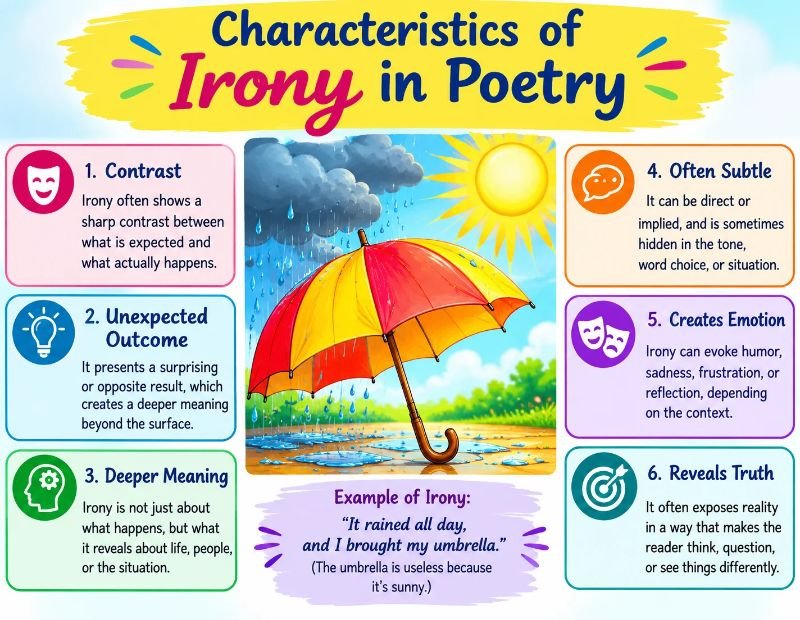
Ironic poetry tends to share a few recognizable traits, regardless of the poet or era.
- A clear contrast between what is stated or expected and what is actually true.
- A shift in tone, often moving from confident or celebratory to tragic or absurd.
- Understatement or overstatement, used to highlight the gap between appearance and reality.
- A twist near the end, especially in shorter poems, where the irony becomes clear.
- Reader awareness, where the audience often understands more than the speaker or subject of the poem.
These characteristics don’t always appear all at once, but most ironic poems rely on at least two or three of them working together.
Purpose of Irony in Poetry
Poets don’t use irony just to be clever. It serves several deliberate literary purposes.
- To critique power or arrogance, especially in poems about rulers, war, or human pride.
- To reveal hidden truths, showing readers something a poem’s speaker or subject fails to see.
- To create emotional impact, making an ending feel more powerful through contrast.
- To add humor or satire, especially in poems criticizing social norms or institutions.
- To reflect real life, since irony often mirrors how outcomes in reality rarely match expectations.
This is why irony appears so frequently in war poetry, political poetry, and satire specifically, since these genres often deal directly with the gap between belief and reality.
Effects of Irony in Poetry
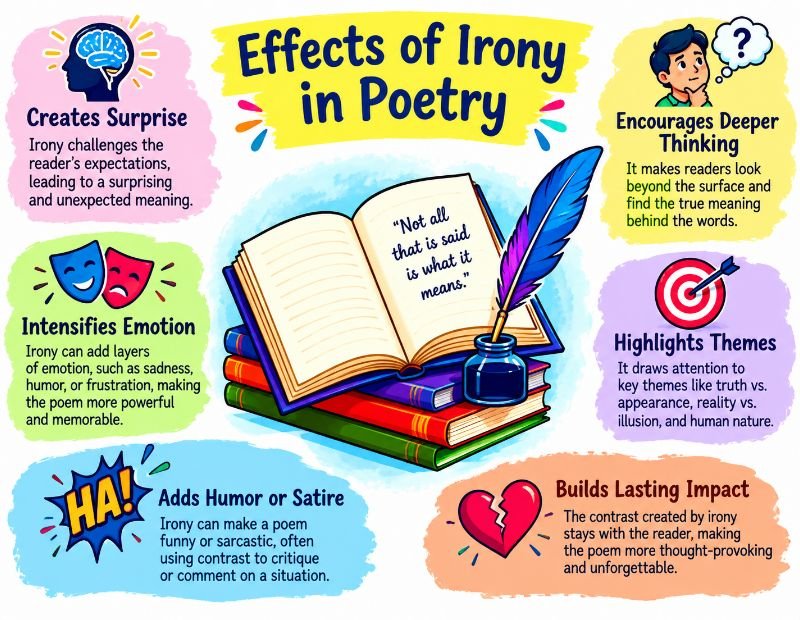
When used well, irony changes how a reader experiences a poem, often long after the first read.
| Effect | What It Does |
|---|---|
| Emotional impact | Makes tragic or absurd endings feel more powerful through contrast |
| Reader engagement | Encourages closer reading and rereading to catch hidden meaning |
| Memorability | Twist endings or contrasts tend to stick with readers longer |
| Critical distance | Allows poets to criticize without stating their opinion directly |
| Complexity | Adds layers of meaning beyond the literal words on the page |
This is part of why so many of the most frequently studied poems in literature rely on irony as a central device rather than a minor stylistic choice.
Types of Irony in Poetry
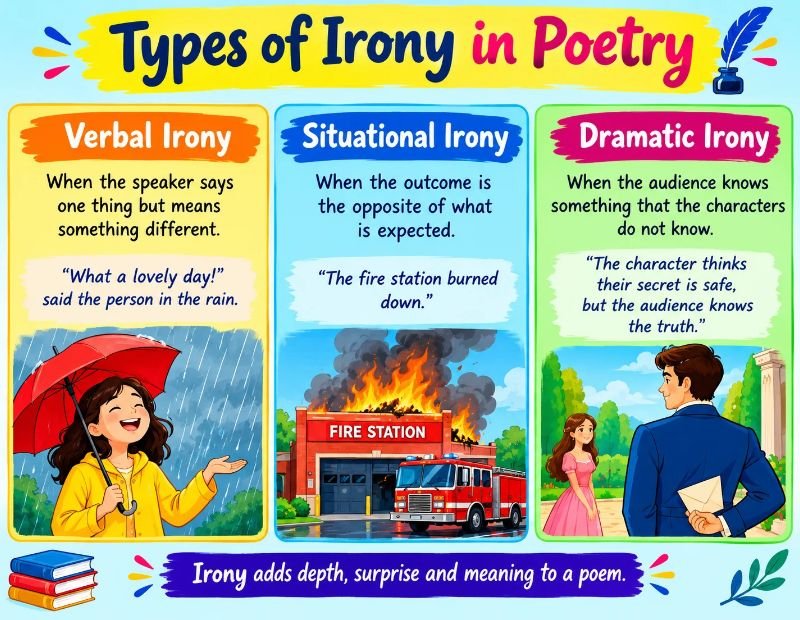
Most irony in poetry falls into three major categories, though a few additional types show up in more advanced literary analysis.
Verbal Irony in Poetry
Verbal irony occurs when a poem’s speaker says one thing but clearly means something different, often the opposite. This is closely related to sarcasm, though verbal irony in poetry tends to be more subtle and layered than casual sarcasm.
Poets often use verbal irony to criticize a person or idea without stating their opinion outright, letting the contrast between words and meaning do the work instead.
Situational Irony in Poetry
Situational irony happens when the outcome of a poem is the opposite of what the reader, or the poem’s subject, expected. This is one of the most common forms of irony in poetry, especially in narrative or story driven poems.
A poem might set up a character who seems destined for success, only to reveal a devastating downfall by the final stanza. The power of situational irony comes from this mismatch between anticipation and result.
Dramatic Irony in Poetry
Dramatic irony occurs when the reader understands something important that a poem’s speaker or subject does not. This creates tension, since the reader can see consequences coming that the character within the poem cannot.
While dramatic irony is more commonly associated with plays and drama, narrative poems that follow a character through events can use this technique just as effectively, letting readers sense danger or tragedy before it’s directly stated.
Cosmic Irony in Poetry
Cosmic irony, sometimes considered a subset of situational irony, suggests that fate, the universe, or a higher power seems to be mocking human effort or ambition. This type often appears in poems dealing with themes of mortality, power, or human limitation.
Structural Irony in Poetry
Structural irony is created through the poem’s overall structure rather than a single line or moment. This might involve an unreliable or naive speaker whose perspective the reader is meant to see through, understanding more than the speaker themselves does across the entire poem.
15+ Examples of Irony in Poetry
The table below highlights well known poems frequently studied for their use of irony, along with the type of irony most commonly associated with each.
| Poem | Poet | Type of Irony | Brief Explanation |
|---|---|---|---|
| Ozymandias | Percy Bysshe Shelley | Situational | A ruler’s boastful monument survives only as a crumbling ruin in an empty desert |
| Richard Cory | Edwin Arlington Robinson | Situational | A man everyone envies for his wealth and status is revealed to be deeply unhappy |
| The Man He Killed | Thomas Hardy | Situational | A soldier reflects that he killed a man he might have befriended under different circumstances |
| Dulce et Decorum Est | Wilfred Owen | Verbal and situational | A famous patriotic phrase about dying for one’s country is undercut by brutal war imagery |
| The Unknown Citizen | W. H. Auden | Verbal | A government report praises an “ideal” citizen while revealing a hollow, controlled life |
| Barbie Doll | Marge Piercy | Situational | A young woman is praised only after conforming to unrealistic beauty standards, at great personal cost |
| Mending Wall | Robert Frost | Verbal | A neighbor repeats a saying about good fences while the poem quietly questions its wisdom |
| The Chimney Sweeper | William Blake | Situational | Children are told suffering will be rewarded, while the poem reveals harsh exploitation instead |
| A Modest Proposal (poetic satire tradition) | Jonathan Swift influenced verse | Verbal | Extreme suggestions are proposed in a calm, reasonable tone to expose real social issues |
| The Lamb and The Tyger | William Blake | Structural | Innocence and darkness are placed in ironic contrast across two companion poems |
While not every poem on this list uses the exact same style of irony, together they show how widely this device has been used across different eras, from Romantic poetry to war poetry to modern feminist verse.
Irony and Paradox in Poetry
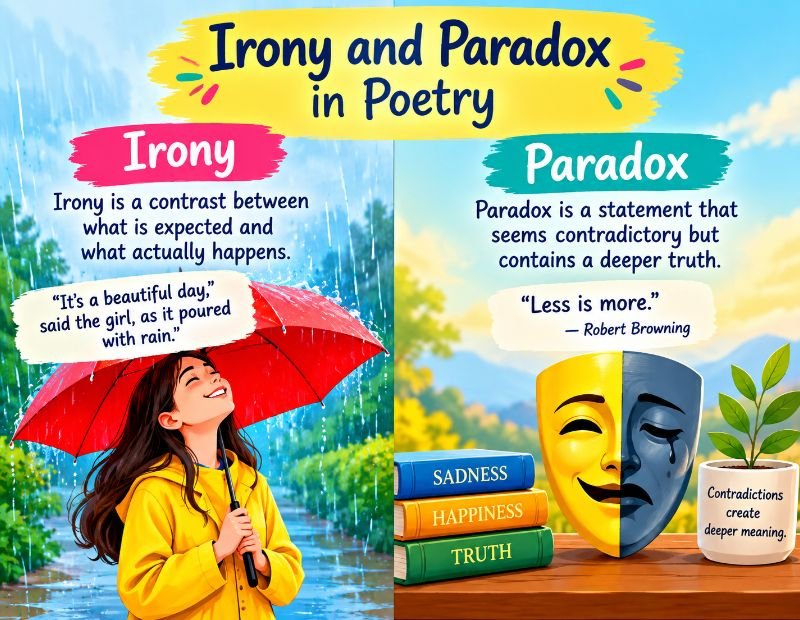
Irony and paradox are often confused, but they work differently. Understanding the distinction can help with both literary analysis and writing.
| Feature | Irony | Paradox |
|---|---|---|
| Definition | A contrast between expectation and reality, or words and meaning | A statement that seems contradictory but reveals a deeper truth |
| Focus | Outcome, tone, or intended meaning | Logical or philosophical contradiction |
| Example type | A rich person feeling deeply unhappy | “Less is more” |
| Purpose | Critique, humor, or emotional impact | Highlighting complex or layered truths |
| Common use | War poetry, satire, social commentary | Philosophical or reflective poetry |
While irony often relies on a paradox to create its effect, not every paradox is ironic, and not every ironic moment involves a true logical contradiction.
Synonyms for Irony in Poetry
Depending on context, several related literary terms are sometimes used alongside or instead of the word irony.
- Sarcasm
- Satire
- Mockery
- Paradox
- Understatement
- Contradiction
- Incongruity
While these terms overlap with irony, each has its own specific meaning. Satire, for example, typically uses irony as one tool among several, including exaggeration and humor, to criticize a broader target like society or politics.
How to Identify Irony When Reading a Poem?
If you’re analyzing a poem for irony, especially for a class assignment or essay, these steps can help.
- Read the poem’s title and opening lines carefully, noting any expectations they set up.
- Watch for tone shifts, especially moments where confidence turns to doubt or celebration turns to loss.
- Look for gaps between statement and outcome, particularly in the poem’s final stanza.
- Consider the speaker’s perspective, and whether the reader is meant to know more than they do.
- Identify the poem’s central contrast, then ask what point the poet seems to be making through that contrast.
Most poems don’t announce their irony directly, so close reading and attention to tone are essential skills for spotting it.
How to Use Irony in Your Own Poetry?
If you’re writing poetry and want to use irony effectively, a few practical techniques can help.
- Set up a clear expectation early in the poem before subverting it later.
- Use a confident or naive speaker whose perspective the reader can see beyond.
- Choose specific, concrete details rather than vague statements, since irony lands harder with precision.
- Avoid over explaining the irony, letting the contrast speak for itself.
- Consider your poem’s structure as a whole, not just individual lines, since structural irony can be just as powerful as a single ironic statement.
The strongest ironic poems tend to trust the reader to notice the contrast rather than stating it outright.
Frequently Asked Questions
What is irony in poetry?
It’s a literary device where there’s a contrast between what’s expected and what actually happens, or between what’s said and what’s truly meant.
What are the three main types of irony in poetry?
The three main types are verbal irony, situational irony, and dramatic irony.
What is the purpose of irony in poetry?
It’s used to add emotional depth, critique ideas or institutions, create humor, and reveal deeper truths beneath the surface.
What is a famous example of situational irony in poetry?
Ozymandias by Percy Bysshe Shelley is a classic example, showing a ruler’s boastful legacy reduced to ruins.
What’s the difference between irony and paradox in poetry?
Irony involves a contrast between expectation and reality, while paradox involves a statement that seems contradictory but reveals a deeper truth.
Can a poem contain more than one type of irony?
Yes, many well known poems combine verbal, situational, and even dramatic irony within the same piece.
Is sarcasm the same as verbal irony?
They’re closely related, but sarcasm is typically more direct and mocking, while verbal irony in poetry tends to be subtler and more layered.
Final Thoughts
Irony in poetry does more than add a clever twist, it shapes how readers feel, think, and interpret meaning long after the poem ends. From the crumbling statue in Ozymandias to the quietly devastating truth behind Richard Cory, irony gives poets a way to say far more than their words literally state. Understanding its types, purpose, and effects doesn’t just help with literary analysis, it also reveals why irony remains one of the most enduring and powerful tools in poetry, across centuries, styles, and voices.