
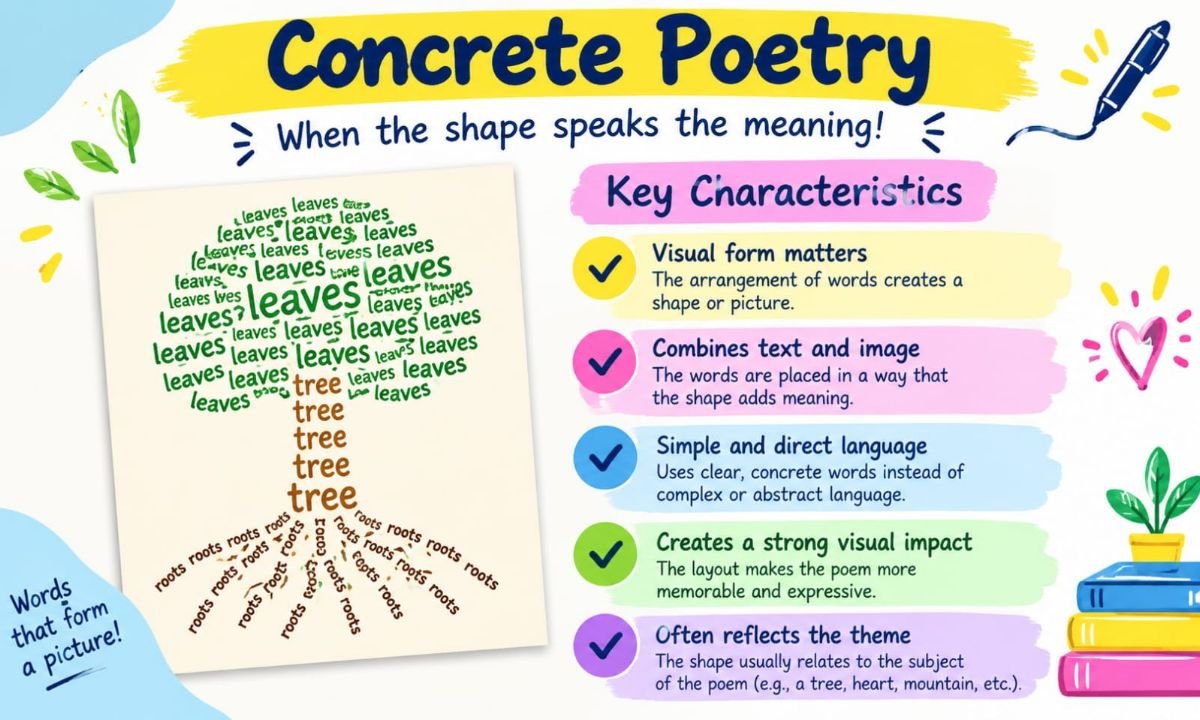
Some poems are meant to be read. Others are meant to be seen. Concrete poetry does both at once.
In this form, the shape of the text on the page carries as much meaning as the words themselves. A poem about rain might fall in slanted streams. A poem about a tree might grow branches. Once you understand the idea, you start spotting it everywhere.
This guide covers the meaning, history, features, types, and famous examples of concrete poetry. It also shows you how to write your own, with ideas for students and kids.
Concrete Poetry Meaning
Concrete poetry is a form where the visual arrangement of letters, words, and space is central to the poem’s meaning. It is also called shape poetry, visual poetry, or patterned poetry.
Wikipedia describes it as an arrangement of linguistic elements in which the typographical effect matters more than the verbal meaning. That is a strong claim, and it explains why these poems feel closer to art than to ordinary verse. Wikipedia
A simple way to remember it: a concrete poem is a poem you can look at, not only read.
The word “concrete” does not mean cement. It means the poem is a real, physical object on the page, not just an abstract idea in language.
Read Also This Blog: Figurative Poetry
Concrete Poetry vs Visual Poetry
The two terms overlap, but they are not identical. Literary theorists treat visual poetry as a development of concrete poetry that moves closer to intermedia, where visual elements dominate over language. Wikipedia
| Feature | Concrete Poetry | Visual Poetry |
|---|---|---|
| Main focus | Words arranged in meaningful shapes | Image, graphics, and design |
| Role of language | Central | Sometimes minimal or absent |
| Typical tools | Typewriter, print, page layout | Digital art, collage, photography |
| Best known era | 1950s and 1960s | 1960s to today |
A Short History of Concrete Poetry
The idea is far older than the name.
Ancient and Religious Roots
Poets of Greek Alexandria in the third century BCE wrote poems to appear on objects such as an ax handle, a statue’s wings, or an egg. Simias of Rhodes is the name most often linked to these early shaped poems. Writer’s Digest
Later, medieval and Renaissance writers made pattern poems, often religious ones. In English, George Herbert wrote “The Altar” and “Easter Wings” in the early 1600s. Their lines form an altar and a pair of wings on the page. Herbert also wrote poems shaped like a cross. Interesting Literature
Lewis Carroll joined in with “The Mouse’s Tale” in Alice’s Adventures in Wonderland. The poem winds down the page like a long tail, a pun on the word “tale.”
The Early Twentieth Century
The approach came back in Guillaume Apollinaire’s Calligrammes (1918), with poems shaped like a necktie, a fountain, and raindrops running down a window. E. E. Cummings also played with spacing and lowercase letters, and some of his short poems work as shaped verse. Wikipedia
The Concrete Poetry Movement
The modern movement began in the 1950s. Two names stand out. The Noigandres group in Brazil (Augusto de Campos, Haroldo de Campos, and Décio Pignatari) and the Swiss Bolivian poet Eugen Gomringer developed the idea at almost the same time.
Gomringer wanted poems that were short, clear, and usable like signs. The Brazilian poets wanted language to work like design. Both groups treated the page as a space to build on.
The movement spread and reached its peak of popularity in the 1960s, and it became less abstract as poets used repeated words to depict recognizable objects and patterns. In Britain, writers such as Ian Hamilton Finlay and Edwin Morgan became leading voices. Academy of American Poets
Characteristics of Concrete Poetry
How do you know a poem is concrete? Look for these traits.
- Visual layout is essential. Take away the shape and the poem loses meaning.
- Words often repeat. Repetition builds lines, textures, and outlines.
- Free verse is common. Most concrete poems are free verse, and rhyme and meter are hard to combine with a fixed visual design. Poem Analysis
- Typography matters. Font size, letter spacing, and line breaks are creative tools.
- White space speaks. Empty areas can suggest silence, distance, or absence.
- Language is often brief. Fewer words make the shape easier to see.
- Meaning is layered. The reader interprets the words and the image together.
The relationship between language and visuals in a concrete poem is mutually reinforcing. That single idea separates a real concrete poem from a poem that has simply been centered or indented. Study.com
Effects of Concrete Poetry
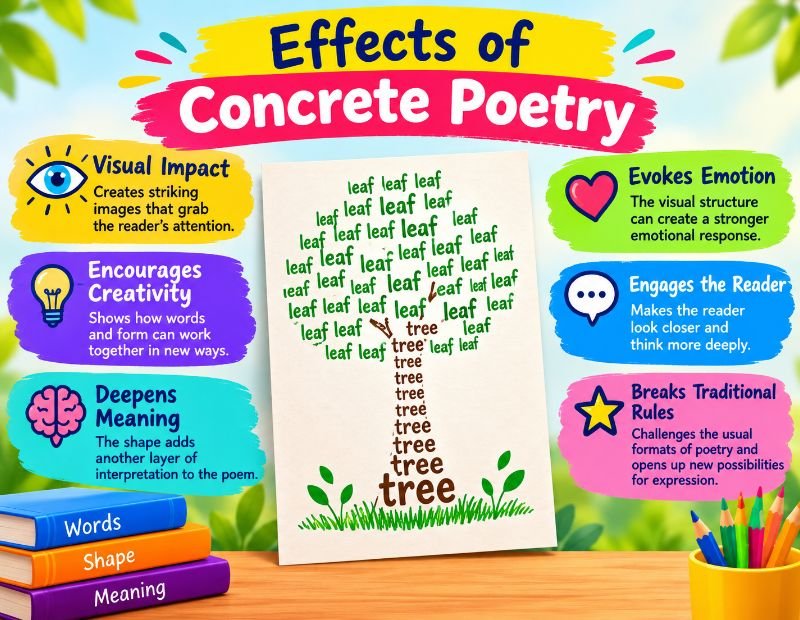
Concrete poems change how we read. Here is what they usually do to an audience.
- They slow the reader down. You stop scanning and start looking.
- They create surprise. The shape often reveals itself late.
- They add emotion through form. A collapsing shape can feel like loss. A spiral can feel like confusion.
- They invite multiple readings. You can read left to right, top to bottom, or follow the outline.
- They make poetry approachable. People who avoid long poems often enjoy a poem that looks like an object.
Researchers have even studied this. A team at the University of Kent ran experiments that tracked eye movements to see how people perceive concrete poems. Poetrybeyondtext
Purpose of Concrete Poetry
Why write in shapes at all? The purpose is not decoration. It is meaning.
- To reinforce the message. A poem about a race can mimic a track. One Writer’s Digest example about an 800 meter race forms a figure eight, matching the two laps runners must complete. Writer’s Digest
- To break poetic tradition. Concrete poets questioned whether poetry must be linear.
- To merge art forms. It sits between writing, graphic design, and sculpture.
- To work across languages. Simple visual words can be understood by readers who do not share a mother tongue. That international appeal helped the movement spread.
- To teach. Teachers use it to explain imagery, structure, and word choice.
Types of Concrete Poetry
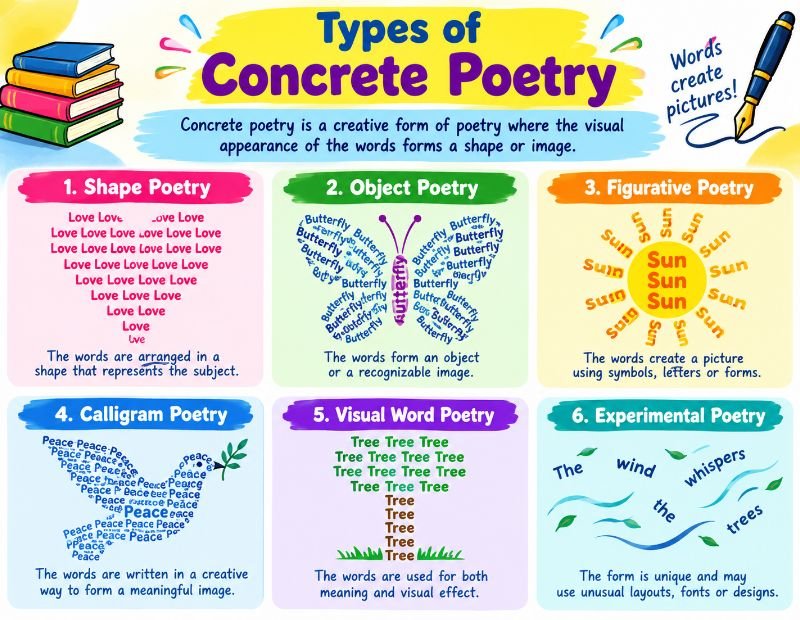
Writers and teachers group concrete poems in slightly different ways. These are the most useful categories.
| Type | How It Works | Example Idea |
|---|---|---|
| Outline (shape) poem | Words follow the silhouette of an object | A poem about a cat shaped like a cat |
| Filled shape poem | Words fill an outlined form | A heart packed with words about love |
| Line poem | Words draw the image themselves | Mary Ellen Solt’s “White Rose” is given as an example of a line type poem. |
| Calligram | Handwriting or lettering forms the image | Apollinaire’s raindrops |
| Typographic poem | Fonts, size, and spacing carry the meaning | A word that shrinks until it vanishes |
| Repetition or pattern poem | One word repeats to create rhythm or a grid | Gomringer’s “silencio” style layouts |
| Kinetic or digital poem | Text moves or changes on screen | Animated poems |
| Combined forms | Some poems print words as an outline in one area and fill another area with more lines. | A tree with a poem inside the trunk |
Concrete Formalist Poetry
Some writers combine concrete layout with strict poetic form, such as a sonnet shaped like an object. One modern sonnet, for instance, is shaped like a potted Christmas tree to reinforce a festive message. This approach keeps rhyme and meter alive while still playing with the page. Fromwhisperstoroars
20+ Examples of Concrete Poetry
Here is a broad list of works and poets that show the range of the form. This table gives context for each so you can search for them and view the originals. I have described them rather than reproducing text.
| # | Poem or Work | Poet | What to Notice |
|---|---|---|---|
| 1 | Wings, Axe, and Egg poems | Simias of Rhodes | Ancient shaped poems, among the earliest known |
| 2 | Syrinx (pan pipes) | Attributed to Theocritus | Lines of varying length form a musical pipe |
| 3 | Carmina figurata | Optatian | Roman patterned verse with hidden designs |
| 4 | De laudibus sanctae crucis | Rabanus Maurus | Medieval poems built around crosses |
| 5 | The Altar | George Herbert | Lines form an altar, matching the religious subject |
| 6 | Easter Wings | George Herbert | Lines widen and narrow like wings in flight |
| 7 | The Mouse’s Tale | Lewis Carroll | Text curls like a tail, a visual pun |
| 8 | Vision and Prayer | Dylan Thomas | Stanzas shaped on the page in patterns |
| 9 | Il pleut (raindrops) | Guillaume Apollinaire | Interesting Literature picks the raindrops poem from Calligrammes as its example. |
| 10 | Necktie and Fountain poems | Apollinaire | Everyday objects turned into text |
| 11 | l(a | E. E. Cummings | A single falling leaf built from letters and parentheses |
| 12 | Silencio | Eugen Gomringer | The word repeats with a gap that represents silence |
| 13 | beba coca cola | Décio Pignatari | Brazilian pop and advertising language turned poem |
| 14 | Luxo | Augusto de Campos | A fold out piece included in Solt’s anthology. |
| 15 | Apfel | Reinhard Döhl | An apple made from the word “apple,” with a single “worm” hidden inside. |
| 16 | White Rose | Mary Ellen Solt | A flower drawn with letters |
| 17 | Forsythia | Mary Ellen Solt | Letters spread like blossoms |
| 18 | Moon Shot | Mary Ellen Solt | Space age imagery in visual form |
| 19 | Swan and Shadow | John Hollander | A swan and its reflection made of type |
| 20 | Little Sparta poem sculptures | Ian Hamilton Finlay | A poem sculpture in Finlay’s garden in the Pentland Hills near Edinburgh. |
| 21 | lighght | Aram Saroyan | A one word poem famous for its odd spelling |
| 22 | Sweethearts | Emmett Williams | Repetition that builds and breaks a single word |
| 23 | Siesta of a Hungarian Snake | Edwin Morgan | Sound and shape working together |
10 Examples of Concrete Poetry to Study First
If you are just starting, focus on these ten. They cover the main ideas.
- Easter Wings by George Herbert
- The Altar by George Herbert
- The Mouse’s Tale by Lewis Carroll
- Il pleut by Guillaume Apollinaire
- l(a by E. E. Cummings
- Silencio by Eugen Gomringer
- Apfel by Reinhard Döhl
- White Rose by Mary Ellen Solt
- Swan and Shadow by John Hollander
- A poem sculpture by Ian Hamilton Finlay
Famous Concrete Poetry
Among these, the best known are Herbert’s shaped hymns, Apollinaire’s Calligrammes, Gomringer’s “Silencio,” and Solt’s flower poems. Together they show how the form moved from religion to modern art.
Ian Hamilton Finlay and Concrete Poetry
Ian Hamilton Finlay (1925 to 2006) was a Scottish poet and artist. He treated poems as objects, carving them into stone, wood, and metal.
His masterpiece is Little Sparta, a garden near Edinburgh filled with inscribed works. TheArtStory calls one poem sculpture there a monument to Finlay’s vision and to the boldest ambitions of the movement. Finlay showed that concrete poetry could live outdoors, in landscapes, and not only on paper. The Art Story
Mary Ellen Solt and the Anthologies
Mary Ellen Solt (1920 to 2007) was an American poet, editor, and professor. She is one of the most important figures in the movement, especially outside Europe and Brazil.
Flowers in Concrete
Her poems were collected in Flowers in Concrete (1966), published through the design program of the Fine Arts Department at Indiana University. Each poem uses the shape and letters of a flower to express its nature. Wikipedia
Concrete Poetry: A World View
In 1968 Solt edited Concrete Poetry: A World View, which she used to collect, translate, and introduce the global movement. Today it remains a standard reference. The book presents over one hundred thirty poems and texts, along with manifestos from figures like Gomringer, the Noigandres group, and Finlay. WikipediaSoccochico
The 1967 and 1968 Anthologies
Three major anthologies appeared close together. These were Stephen Bann’s Concrete Poetry: An International Anthology (1967), Emmett Williams’s An Anthology of Concrete Poetry (1967), and Solt’s A World View (1968). The Art Story
| Anthology | Editor | Year |
|---|---|---|
| Concrete Poetry: An International Anthology | Stephen Bann | 1967 |
| An Anthology of Concrete Poetry | Emmett Williams | 1967 |
| Concrete Poetry: A World View | Mary Ellen Solt | 1968 (book edition 1970) |
Women in Concrete Poetry
The movement is often described through male names, but women shaped it too.
- Mary Ellen Solt in the United States
- Ilse Garnier in France, who worked with Pierre Garnier on Spatialism
- Salette Tavares in Portugal
- Mirella Bentivoglio in Italy, known for visual and verbal experiments and for organizing exhibitions of women artists
Reading their work gives you a fuller view of the form.
How to Write Concrete Poetry?
You do not need to be a designer. You need an idea and a pen, or a keyboard.
- Choose a simple subject. Pick something with a clear silhouette, such as a tree, moon, wave, heart, or bird.
- Sketch the shape. Draw a rough outline on paper first.
- Find your message. Decide what the poem says about the subject, not just what it looks like.
- Draft the words. Keep lines short. Use strong nouns and verbs.
- Fit words to the shape. Sketch the outline first, then draft your poem while focusing on meaning and placement. Fromwhisperstoroars
- Adjust spacing. Use line breaks and spaces to shape edges.
- Test the reading order. Ask a friend how they read it.
- Revise. Cut extra words. Make sure the shape adds meaning.
A Quick Original Example
Here is a simple pattern to try. Write the word “rain” repeatedly, and let each line drift a little further to the right. The words fall like drops. Now add one line that breaks the pattern, such as the word “stop,” placed alone at the bottom. That single change gives the poem a story.
Tips That Make Poems Better
- Use a monospaced font on a computer for cleaner alignment.
- Keep the shape simple. Complex shapes hide the words.
- Avoid filler. Every word should earn its place.
- Let the layout suggest a feeling, not only a picture.
Concrete Poetry Generator and Concrete Poetry Maker
Many websites offer a concrete poetry generator or concrete poetry maker. You type a poem, choose a shape, and the tool arranges your words inside it. These tools are useful for beginners and for classroom use.
They have limits, though. A generator cannot choose meaningful words for you. The best results come when you write the poem first and then use software to place it.
Other maker options:
- Word processors, using text boxes and spacing
- Drawing apps, where you trace the outline and type along it
- Slide software, useful for classroom projects
- Simple code, for animated or kinetic versions
Concrete Poetry Artist: Who Makes It Today?
A concrete poetry artist may be a poet, graphic designer, typographer, or sculptor. Today the form has expanded. Contemporary concrete poetry has grown to include photography, film, and soundscapes. Digital poets also make animated and interactive pieces. Academy of American Poets
Concrete Poetry for Students
Concrete poetry works well in the classroom because it connects writing and art.
Examples of Concrete Poetry for Students
- A poem about the sun, shaped as a circle with rays
- A poem about a pencil, written along a long thin line
- A poem about a mountain, with lines growing shorter toward the peak
- A poem about a clock, with words placed around a circle
Classroom Activity Ideas
- Ask students to pick an object from the room and describe it in five words.
- Have them draw the object’s outline.
- Ask them to fit the five words into the shape, repeating them as needed.
- Let classmates guess the object before reading the words.
This exercise teaches imagery, word choice, and revision in one lesson.
Concrete Poetry for Kids
Kids love shape poems because they feel like drawing. Keep the rules light.
- Start with a simple shape, like a star or ball.
- Use words about the five senses.
- Let children color the finished poem.
- Try alphabet shapes, such as writing “snake” along a wavy line.
Short poems work best. Even a single repeated word can make a fun poem for young writers.
Concrete Poetry in Tagalog
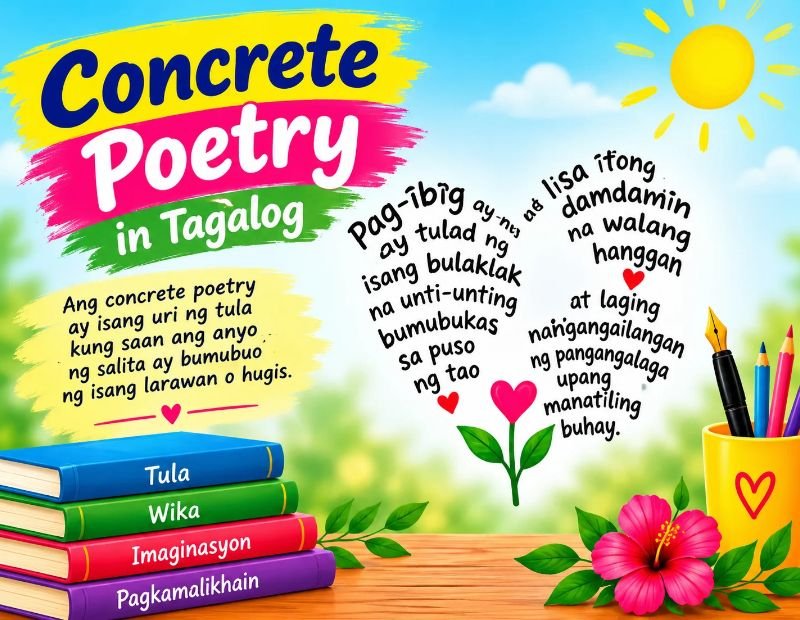
Concrete poetry is not limited to English. Filipino writers and students can build shape poems in Tagalog too. The Tagalog word for shape is “hugis,” which means shape, contour, figure, outline, or silhouette. So a poem shaped like a tree, or “puno,” follows the same steps as any concrete poem. tagalog
Tagalog offers good material for this form. Words for nature, family, and daily life can fill shapes in ways that feel local and personal. Concrete poetry is also listed among the genres in Philippine creative writing lessons, alongside forms like performance poetry.
Concrete Poetry in English Literature
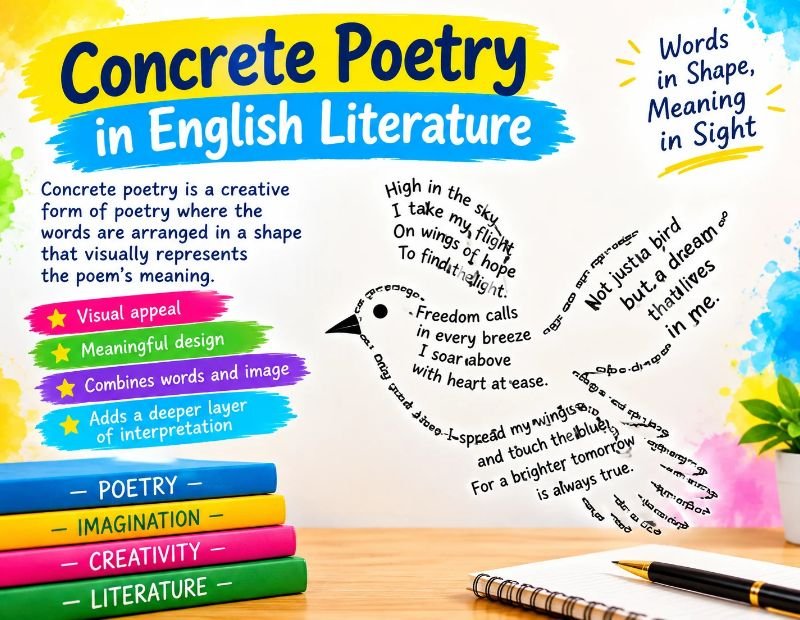
In English literature, the tradition runs from Herbert’s altars and wings, through Carroll’s playful tail, to Cummings’s spacing and the postwar work of Finlay, Morgan, and Hollander. Writer’s Digest notes that the form has detractors who feel structure overweighs the words, but argues that as much thought goes into concrete poetry as any other form. Studying it helps students understand that form and meaning are linked in all poetry. Writer’s Digest
Concrete Poetry: A World View and Global Reach
The title of Solt’s book captures the movement’s spirit. Concrete poetry grew in Brazil, Germany, Switzerland, Austria, France, Britain, the United States, Japan, and beyond. The shared visual language made it easy to translate and exhibit. That is why it is often called the first truly international literary movement.
Concrete Poetry Books to Read
If you want to go deeper, start with these.
- Concrete Poetry: A World View by Mary Ellen Solt (ed.), the standard global survey
- Concrete Poetry: An International Anthology by Stephen Bann (ed.), 1967
- An Anthology of Concrete Poetry by Emmett Williams (ed.), 1967
- Flowers in Concrete by Mary Ellen Solt, 1966
- Types of Shape by John Hollander, 1969
- Experimental, Visual, Concrete: Avant Garde Poetry Since the 1960s, edited by K. D. Jackson, E. Vos, and J. Drucker
Free archives such as UbuWeb also host historic concrete poems and manifestos.
Concrete Poetry Tree: A Simple Model
A tree is the classic starter shape. Here is how it works.
- Trunk: short, repeated words like “roots” or “hold”
- Branches: longer lines that spread outward
- Leaves: single words like “green,” “grow,” and “breathe”
The idea is that the tree’s growth mirrors the poem’s message about patience, family, or change. YourDictionary offers an example of this kind of tree poem, describing trees as having a muted beauty in their branches and sturdy trunks. YourDictionary
Common Mistakes to Avoid
- Choosing a shape that does not match the subject
- Making the shape too complicated to read
- Forgetting the meaning and focusing only on the picture
- Using tiny fonts that hide the words
- Skipping revision
Frequently Asked Questions
What is concrete poetry in simple words?
Concrete poetry is poetry where the shape of the words on the page helps tell the story. You read it and look at it at the same time.
What is another name for concrete poetry?
It is also called shape poetry, visual poetry, or patterned poetry.
Who invented concrete poetry?
No single person did. The modern movement began in the 1950s with Eugen Gomringer and the Brazilian Noigandres group, but shaped poems date back to ancient Greece.
What are the main types of concrete poetry?
The main types are outline poems, filled shape poems, line poems, calligrams, typographic poems, and digital or kinetic poems.
What is the most famous concrete poem?
Many critics point to Apollinaire’s Calligrammes, Herbert’s “Easter Wings,” and Gomringer’s “Silencio” as the best known examples.
Does a concrete poem need to rhyme?
No. Most concrete poems use free verse, and rhyme is optional.
How do you write a concrete poem?
Pick a subject, sketch its outline, write short meaningful lines, and fit them into the shape. Then revise until the shape and the words support each other.
Is concrete poetry good for kids?
Yes. It blends drawing and writing, which makes poetry feel playful and easy.
What is the difference between concrete poetry and acrostic poetry?
An acrostic spells a word with the first letters of each line. A concrete poem uses the whole visual layout to create meaning.
Can I make concrete poetry with a computer?
Yes. Use a word processor, drawing tool, or online concrete poetry generator, but write the words yourself for the best result.
Who are the key women in concrete poetry?
Mary Ellen Solt, Ilse Garnier, Salette Tavares, and Mirella Bentivoglio are important names.
Where can I read concrete poetry online?
UbuWeb and poetry sites such as Poets.org host examples, essays, and historical texts.
Conclusion
Concrete poetry shows that a poem is more than sound and sense. It is also a picture, a structure, and a small piece of design.
From Herbert’s wings to Apollinaire’s raindrops, from Solt’s flowers to Finlay’s garden, the form keeps reinventing itself. It welcomes students, kids, and professional artists alike.
Ready to try? Pick one simple shape today, write five strong words, and let the page do the rest.