
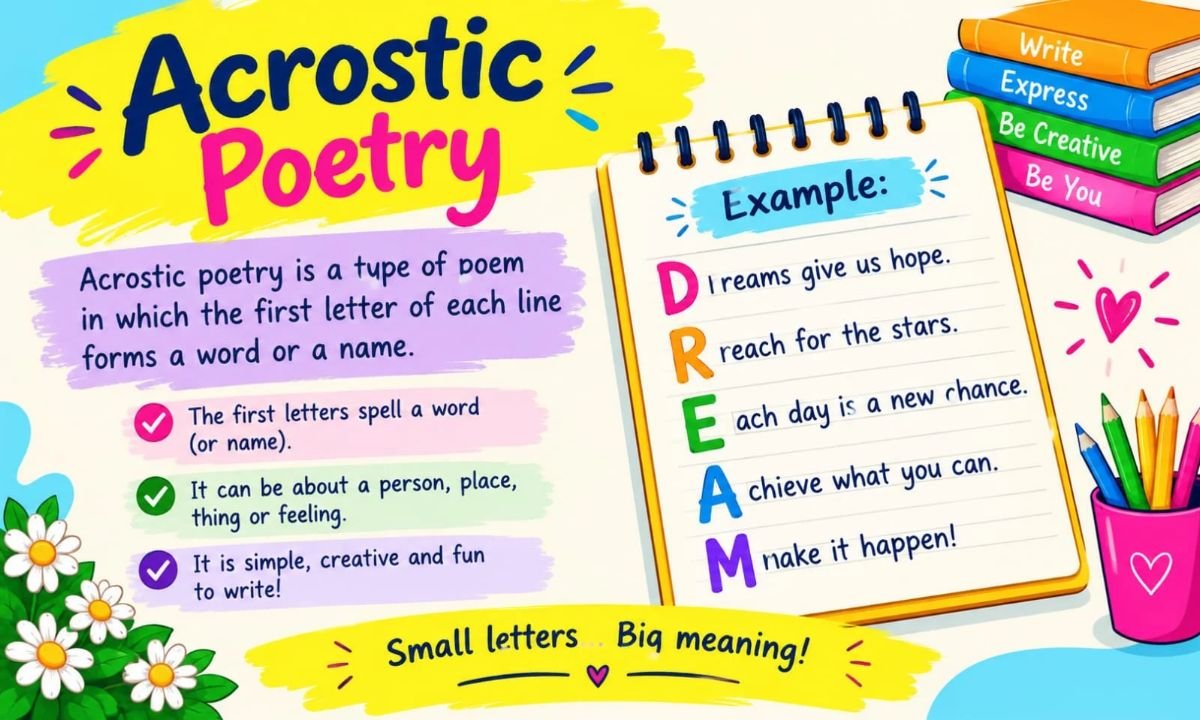
An acrostic poem hides a secret in plain sight. Read the first letter of every line from top to bottom, and a word appears.
That small trick makes acrostic poetry one of the easiest forms to start and one of the most fun to master. Kids use it to write about their names. Students use it to learn vocabulary. Poets use it to hide messages, honor loved ones, and play with form.
This guide covers the meaning of acrostic poetry, its characteristics, types, and elements. You will also find 25+ examples, templates, word ideas, and answers to common questions.
What Is Acrostic Poetry?
Acrostic poetry is a form where certain letters in each line spell out a word, name, or phrase when read vertically. Most often, the hidden word uses the first letter of every line.
The vertical word usually acts as the theme. Each line then describes, praises, or explains that theme. Because the form does not require a set rhyme scheme or meter, it is beginner friendly.
Think of it like an acronym stretched into a poem. Each letter has a job, and each line gives that letter a meaning.
Read Also This Blog: Prose Poetry
How to Recognize Acrostic Poetry?
Use this quick checklist to spot one:
- Read down the left edge. Look at the first letter of each line.
- Check for a word. Do those letters form a name, word, or phrase?
- Look at the theme. The hidden word often matches the subject of the poem.
- Try the other edges. The message may sit at the end of lines or in the middle.
- Notice the capital letters. Poets often capitalize or bold the hidden letters to make them easy to see.
If the vertical letters spell something meaningful, you have found an acrostic.
Characteristics of Acrostic Poetry
- A vertical message. A word or phrase runs down the page.
- Letter based structure. Each line is built around a chosen letter.
- Flexible lines. Lines can be single words, phrases, or full sentences.
- No required rhyme. Rhyme is optional, so the form feels relaxed.
- A strong link to theme. The best acrostics make the hidden word and the lines work together.
- Word play. The form is a type of puzzle, often a little cheeky or clever.
- Short length. Most are brief, because the length depends on the hidden word.
Elements of Acrostic Poetry
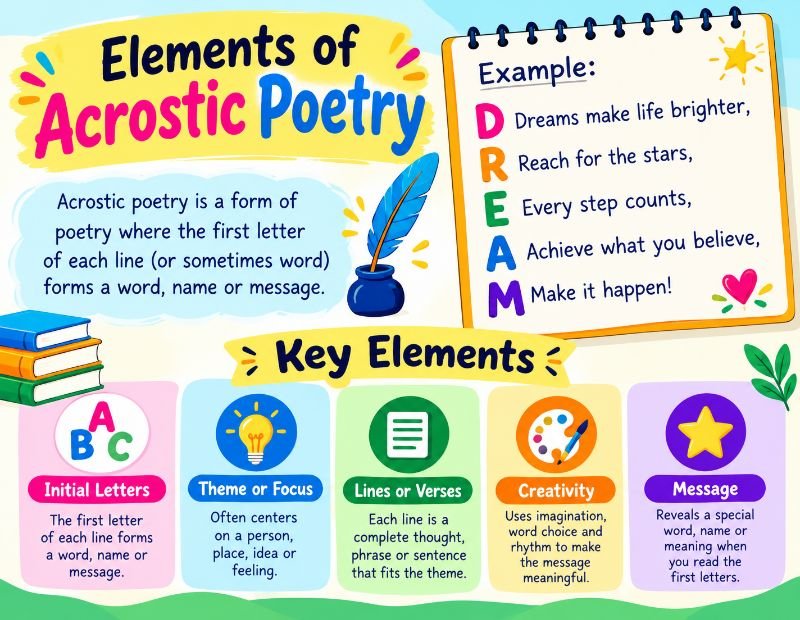
| Element | What It Means | Quick Tip |
|---|---|---|
| Key word | The word or phrase spelled vertically | Choose a word with strong meaning |
| Anchor letters | The letters that start (or end) each line | Capitalize or bold them |
| Lines | Phrases or sentences built on each letter | Keep them clear and vivid |
| Theme | The central idea of the poem | Make every line support it |
| Imagery | Sensory detail that paints a picture | Use sight, sound, and touch |
| Rhythm | The flow from one line to the next | Read it aloud to test |
| Surprise | A twist, joke, or emotional turn | Save the best line for the end |
Purpose of Acrostic Poetry
Why do people write acrostics?
- To honor someone. Name poems are popular for birthdays, weddings, and tributes.
- To teach. Teachers use them to build vocabulary and spelling skills.
- To hide a message. Poets have tucked names and secrets into their lines for centuries.
- To help memory. The structure makes ideas easier to remember.
- To express a complete idea. In ancient Hebrew poetry, the alphabet itself suggested completeness, like “from A to Z.”
- To play. Sometimes the goal is simply the fun of a clever puzzle.
Effects of Acrostic Poetry
- Focus. The key word keeps the poem on topic.
- Delight. Readers enjoy discovering the hidden word.
- Confidence. Beginners feel successful quickly because the structure guides them.
- Memorability. Short, patterned lines stick in the mind.
- Emotional warmth. A name or a word like “love” gives the poem a personal touch.
Types of Acrostic Poetry
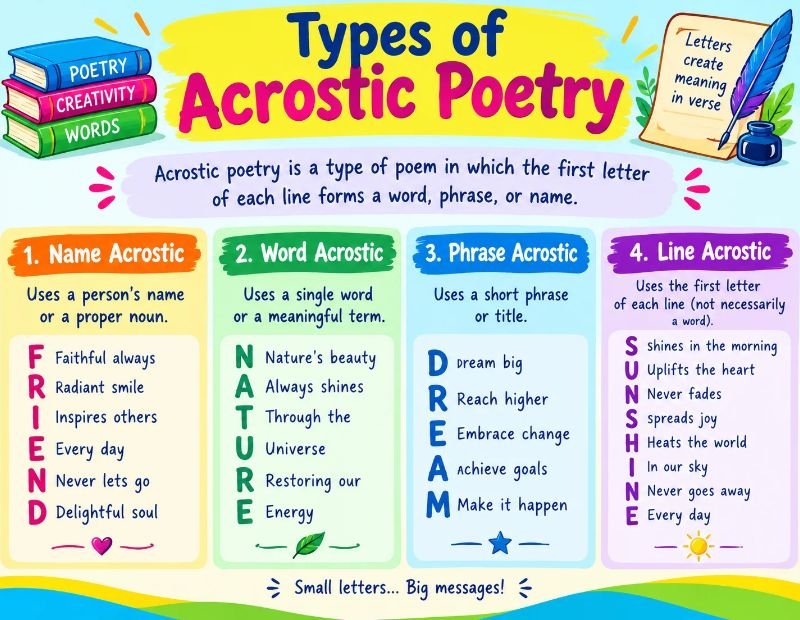
There are several forms, and each changes where the hidden word appears.
| Type | Where the Hidden Word Sits | Difficulty |
|---|---|---|
| Conventional acrostic | First letter of each line | Easy |
| Telestich | Last letter of each line | Medium |
| Mesostich (mesostic) | A word down the middle of the poem | Medium |
| Double acrostic | First and last letters both spell words | Hard |
| Abecedarian | First letters follow the alphabet in order | Medium to hard |
| Golden shovel | Last words of lines spell out another poem | Hard |
Conventional Acrostic
This is the classic form. The first letters of the lines spell the topic, and most examples online use this style.
Telestich
A telestich reverses the idea. The message appears at the ends of the lines.
Mesostich
A mesostich places the word down the middle. The hidden letters fall inside the lines, not at the edges.
Double Acrostic
A double acrostic spells one word with the first letters and another with the last letters. It combines the conventional form with the telestich.
Abecedarian
An abecedarian poem moves through the alphabet. Each line starts with the next letter, from A toward Z. The hardest letters, like J, X, Q, and Z, are the real challenge.
Golden Shovel
In a golden shovel, the last word of each line, read down the page, copies the words of another poem. It is often a tribute to the original poet.
Short Acrostic Poetry
Short acrostics are perfect for beginners. Three or four lines are enough.
Example 1: CAT
Calm eyes in the window,
Always watching the rain,
Tail curled like a question.
Example 2: SUN
Soft gold on the windowsill,
Unhurried clouds drift away,
Now the whole day is warm.
Example 3: HOPE
Hold on a little longer,
Open the window,
Plant the seed anyway,
Expect the morning.
Acrostic Poetry About Love
Love is the most popular acrostic theme. Short words like LOVE, YOU, and HEART work beautifully.
Example 4: LOVE
Laughing at the same old joke,
Over tea gone cold,
Valuing the quiet more than the noise,
Every day, again.
Example 5: YOU
Your laugh is my favorite weather,
Often I forget what I was saying,
Under your light, ordinary rooms glow.
Example 6: HEART
Hands that find mine in the dark,
Eyes that say what words cannot,
Always home when you are near,
Remembering every small kindness,
Together, the whole world slows down.
Tips for love acrostics: Use the name of your partner. Mention a shared memory. Keep the last line warm and simple.
Acrostic Poetry for Kids
Acrostics are a classic classroom activity. Children learn spelling, vocabulary, and creative thinking at the same time.
Example 7: KIND
Keep a door open,
Include the one who is alone,
Notice who needs help,
Do it without being asked.
Example 8: SAM (a name poem)
Super at soccer,
Always sharing snacks,
Making everyone laugh.
Example 9: RAIN
Rooftops drumming,
All the puddles shining,
Inside, we drink warm cocoa,
Never mind the weather.
Kid friendly ideas:
- Write about your own name.
- Describe a favorite animal or food.
- Write a poem about your best friend.
- Use one adjective per letter.
Acrostic Poetry for Students
Older students can use acrostics for deeper tasks. They work well for vocabulary review, character studies, and summaries.
Example 10: STUDY
Set a small goal,
Take a short break,
Underline what matters,
Drink some water,
Yes, try again.
Classroom uses:
- Summarize a chapter using the title as the hidden word.
- Describe a historical figure using their name.
- Define a science term, one line per letter.
- Review vocabulary by building a poem around each new word.
Spring Acrostic Poetry
Spring brings fresh images: rain, buds, birds, and light.
Example 11: SPRING
Soft rain taps the windows,
Puddles hold the sky,
Robins argue in the hedge,
Icy mornings loosen,
New leaves unfold,
Green returns to everything.
Example 12: BLOOM
Buds crack open,
Light stretches longer,
Orchards turn to snow,
One warm wind arrives,
Morning smells like rain.
Christmas Acrostic Poetry
Christmas themes include light, warmth, family, and winter scenes.
Example 13: CHRISTMAS
Candles flicker in the window,
Hot cocoa warms cold hands,
Rooftops wear a coat of snow,
Itchy sweaters, silly songs,
Stockings hang beside the fire,
Twinkling lights on every street,
Mittens drying by the door,
Always room for one more guest,
Starlight over quiet roofs.
Example 14: SNOW
Silence settles on the town,
No footprints yet on the lawn,
Outside, the world is paper white,
Waiting for the first small boots.
Halloween Acrostic Poetry
Halloween poems work best with playful, spooky images and short, punchy lines.
Example 15: HALLOWEEN
Hollow pumpkins grin in the dark,
Armfuls of candy swing from small hands,
Lanterns flicker down the lane,
Leaves skitter like tiny ghosts,
Owls call from the bare oak,
Witches’ hats bob past the gate,
Every porch light waits,
Evening hums with whispers,
Night wraps the street in shadow.
Example 16: BOO
Behind the curtain, something moves,
Only the cat, or so we hope,
Oh, the floorboard creaks again.
Special Acrostic Forms
Try these once you are comfortable with the basics.
Example 17: Telestich spelling SEA
Gulls wheel above the quiet piers
Waves fold themselves onto the shore
A lighthouse hums a slow sonata
Example 18: Mesostich spelling SUN
The muSic of early birds
Warm jUly grass
Long ruNs to the river
Example 19: Double acrostic
Sparrows scatter over rooftops
Under the bridge, the river runs dark
Nothing is louder than a quiet day
Example 20: Abecedarian
Ash drifts above the garden,
Birds return despite the cold,
Candles lean toward the window,
Dusk arrives on quiet feet,
Every shadow learns your name,
Fog erases the far hills.
Famous Acrostic Poetry
Acrostics are very old, and many famous writers have used them. These works are worth reading in full from trusted editions.
| # | Work | Writer | What Makes It Notable |
|---|---|---|---|
| 21 | “A Boat Beneath a Sunny Sky” | Lewis Carroll | Spells the full name of the girl who inspired Alice in Wonderland |
| 22 | “An Acrostic” | Edgar Allan Poe | Spells the name “Elizabeth” with the first letters of the lines |
| 23 | “A Valentine” | Edgar Allan Poe | Hides a name in the poem for a clever reveal |
| 24 | Hymns of Astraea | Sir John Davies | Court poems that spell a royal title |
| 25 | “An A.B.C.” | Geoffrey Chaucer | An alphabetical prayer with stanzas running through the alphabet |
| 26 | “Abecedarian with Sexual Tension” | Emily Corwin | A modern abecedarian with playful, tense lines |
| 27 | “Hummingbird Abecedarian” | Aimee Nezhukumatathil | A nature themed alphabetical poem |
| 28 | “A Poem for S.” | Jessica Greenbaum | A contemporary abecedarian often cited in poetry guides |
| 29 | Psalm 119 | Biblical poet | Twenty two sections, each tied to a Hebrew letter |
| 30 | Lamentations 1 to 4 | Biblical poet | Alphabetic acrostics that structure grief |
Carroll’s piece is a good teaching example. The hidden name is spelled out by the first letters of its lines, which makes it a charming hidden message for a real child.
Acrostic Hebrew Poetry
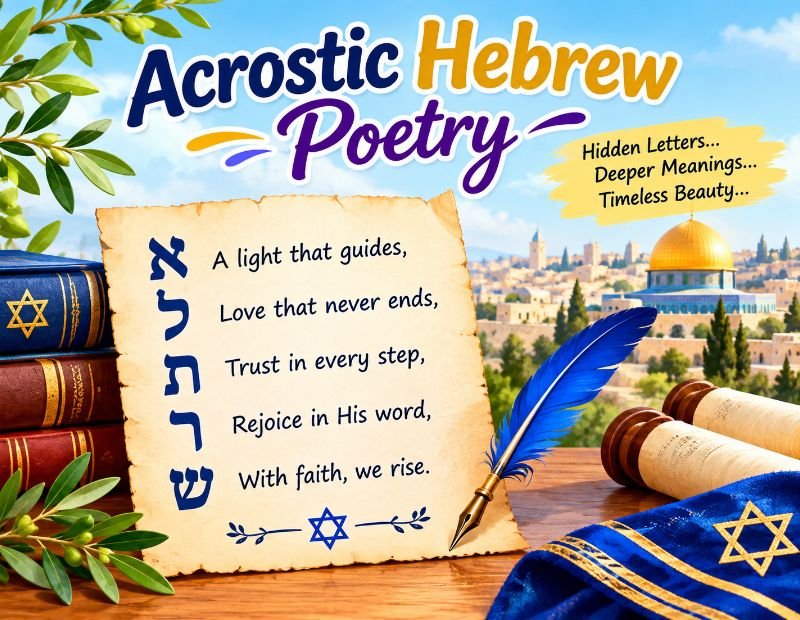
Hebrew acrostics are some of the oldest examples in the world. They are different from English ones. Instead of spelling a name, they run through the Hebrew alphabet in order.
Scholars generally count about fourteen alphabetic acrostic poems in the Old Testament. They appear in Psalms 9 and 10 (treated as one poem), 25, 34, 37, 111, 112, 119, and 145, in Proverbs 31:10 to 31, in Lamentations 1 to 4, and in Nahum 1.
| Text | Pattern |
|---|---|
| Psalm 119 | 22 sections of 8 verses, each section tied to one letter |
| Psalms 111 and 112 | Each half line begins with the next letter |
| Psalms 25, 34, 145 | Each line begins with the next letter |
| Proverbs 31:10 to 31 | 22 verses, one per letter |
| Lamentations 1, 2, 4 | Each verse starts with the next letter |
| Lamentations 3 | Three lines for each letter |
Why did ancient poets use acrostics? Possible reasons include helping memory and signaling completeness. The idea of covering a subject “from A to Z” fits well with praise, wisdom, and even grief. Lamentations uses the form to express a full sense of sorrow over the fall of Jerusalem. Nahum 1, by contrast, is read as disrupting the pattern to show the storm of anger.
A note of caution: some scholars debate whether every case was intended as an acrostic by the original writers. Still, the pattern is a major part of Hebrew literary study.
Acrostic Poem Letters A to Z
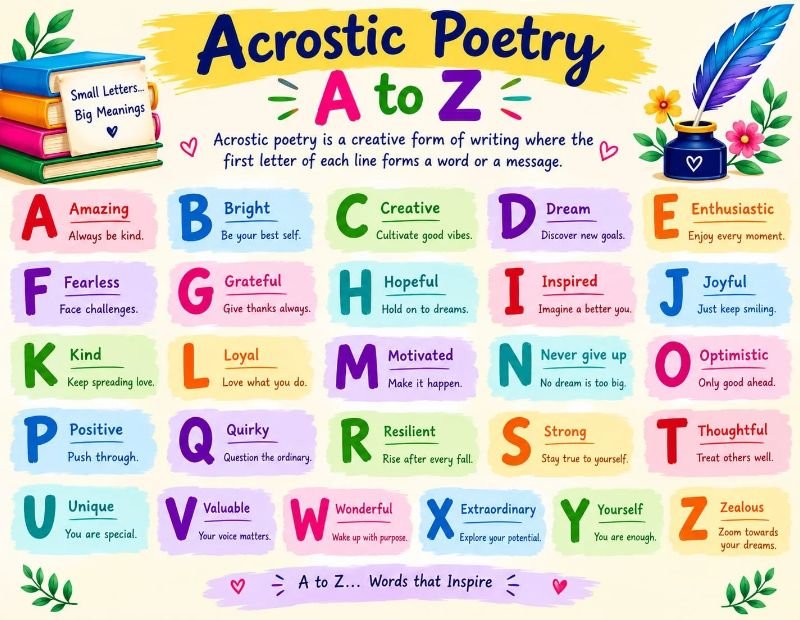
If you are stuck on a letter, a word bank helps. Here is a starter list of easy, expressive words.
| Letters | Word Ideas |
|---|---|
| A, B, C | Amber, Breeze, Candle |
| D, E, F | Dawn, Echo, Feather |
| G, H, I | Glow, Harvest, Ivy |
| J, K, L | Journey, Kite, Lantern |
| M, N, O | Meadow, Nest, Orchard |
| P, Q, R | Petal, Quiet, River |
| S, T, U | Shimmer, Twilight, Umbrella |
| V, W, X | Velvet, Whisper, Xylophone |
| Y, Z | Yearning, Zephyr |
Tough letters: For X, try words like “extra,” “exhale,” or “excited.” For Z, try “zest,” “zero,” or “zigzag.” For Q, try “quiet” or “quick.”
Acrostic Poetry Words: Good Subjects to Spell
Strong keywords make strong poems. Try one from these groups:
- Emotions: LOVE, JOY, HOPE, CALM, PEACE
- Nature: RAIN, OCEAN, FOREST, SUNRISE, STORM
- People: MOTHER, FRIEND, TEACHER, HERO
- Seasons and holidays: SPRING, WINTER, DIWALI, EASTER, HALLOWEEN
- Values: KIND, BRAVE, HONEST, GRATEFUL
- Study topics: HISTORY, ENERGY, LIBERTY, ATOM
Acrostic Poetry Template
Use this fill in the blank template to draft any acrostic.
| Step | Your Draft |
|---|---|
| 1. Hidden word | _______________ |
| 2. Write the letters down the page | ___ |
| 3. Brainstorm 3 words per letter | _______________ |
| 4. Build a line from each letter | _______________ |
| 5. Check that every line supports the theme | Yes / No |
| 6. Read aloud and polish | Done |
Quick template for a name poem:
[Letter 1] ________ (describe a quality)
[Letter 2] ________ (describe a hobby)
[Letter 3] ________ (describe a feeling)
[Letter 4] ________ (describe a wish)
Acrostic Poetry Generator
An acrostic poem generator is an online tool that takes your word and suggests words or lines for each letter. These tools are handy for quick ideas, but they often give generic results.
For a more original poem, build a manual generator:
- Write your hidden word down the page.
- Next to each letter, list five words that start with it.
- Circle the words that fit your theme.
- Combine circled words into short phrases.
- Rewrite until every line sounds natural.
This method keeps the voice yours, which also makes the poem more personal and more human.
How to Write Acrostic Poetry?
- Choose a topic. Pick something you care about or know well.
- Write the word vertically. Put one letter per line.
- Brainstorm. List words, images, and feelings tied to your topic.
- Draft each line. Start every line with its assigned letter.
- Link the lines. Make them flow, or build a small story from top to bottom.
- Add imagery. Replace vague words with concrete ones.
- Read it aloud. Fix awkward lines and uneven rhythm.
- Polish the ending. Make the last line the strongest.
Expert Tips for Better Acrostics
- Do not force a weak word just to hit a letter. Rework the sentence instead.
- Let lines run into each other for a more flowing poem.
- Choose longer words for more space, shorter words for tighter poems.
- Try rhyme once you feel confident.
- Use the hidden word as a surprise, not a spoiler, by making the poem slowly reveal the theme.
Common Mistakes
- Using lines that do not connect to the theme
- Repeating the same sentence pattern for every line
- Filling lines with filler words
- Ignoring rhythm and sound
- Forgetting to proofread the hidden word
Acrostic vs Acronym: What Is the Difference?
People often mix these up.
| Feature | Acrostic | Acronym |
|---|---|---|
| What it is | A poem or text with a hidden word | A word formed from first letters of other words |
| Example | A poem spelling LOVE | NASA, UNESCO |
| Use | Art, memory, play | Shortening long names |
| Reads | Vertically | As a single word |
Acrostics are also used as memory aids. A familiar phrase can help students remember a list by the first letters of each word. That is why teachers love them.
Conclusion
Acrostic poetry proves that structure can spark creativity. A single word on the page becomes a frame for imagery, emotion, and meaning. You can write one for a loved one, for a classroom, for a holiday, or just for fun.
Start small. Pick a short word like HOPE, write it down the page, and let each letter lead you to a line. Then try a telestich or a double acrostic when you want a new challenge. With practice, hidden messages will feel like second nature.
Frequently Asked Questions (FAQs)
What is an acrostic poem in simple words?
It is a poem where the first letters of each line spell a word or phrase when read from top to bottom.
How do you write an acrostic poem?
Write your chosen word vertically, then create a line starting with each letter that describes or relates to the word.
What are the main types of acrostic poetry?
The main types are conventional, telestich, mesostich, double acrostic, abecedarian, and golden shovel.
Does an acrostic poetry have to rhyme?
No. Rhyme is optional, and most acrostics do not follow a set rhyme scheme.
What is a telestich?
A telestich is an acrostic where the last letters of the lines spell out the hidden word.
What is an abecedarian poem?
It is an acrostic where each line starts with the next letter of the alphabet.
What is a double acrostic poetry?
It is a poem where the first letters spell one word and the last letters spell another.
What are good topics for acrostic poetry?
Names, emotions, seasons, holidays, nature, and school subjects all work well.
Are acrostic poetry good for kids?
Yes. They build spelling, vocabulary, and creativity with a simple, guided structure.
Is Psalm 119 an acrostic poem?
Yes. It has twenty two sections, one for each Hebrew letter, with each section’s eight verses starting with the same letter.
Who wrote famous acrostic poetry?
Lewis Carroll, Edgar Allan Poe, and Sir John Davies all wrote well known examples, and many ancient Hebrew poets used the form.
What is the difference between an acrostic poetry and an acronym?
An acrostic poetry with a hidden vertical word, while an acronym is a word formed from the initials of a phrase.
Can I use an acrostic poetry generator?
Yes, for ideas. For a better result, edit the lines so they sound personal and fit your theme.