
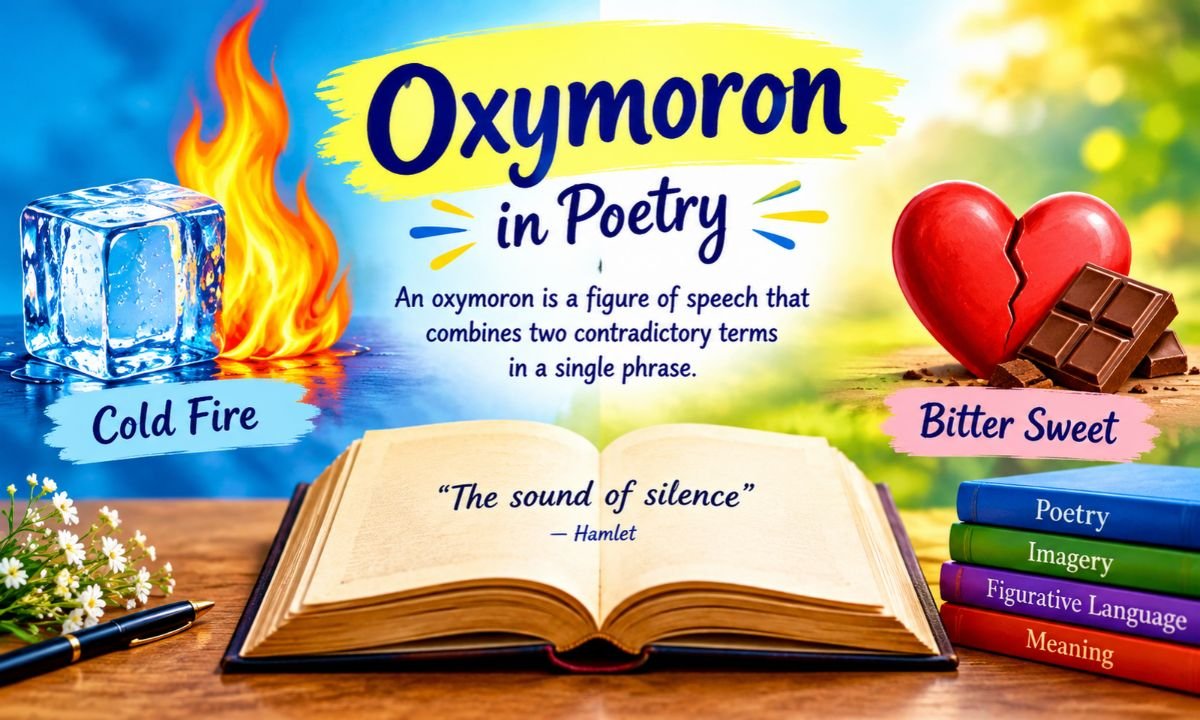
Poetry thrives on contradiction. Some of the most unforgettable lines in literary history don’t make logical sense at first glance yet they capture emotion more precisely than plain language ever could. That’s the magic of the oxymoron in poetry: two opposing words, fused into one phrase, revealing a truth too complicated for ordinary description.
Think of Shakespeare’s Juliet calling Romeo a “beautiful tyrant,” or the timeless line “parting is such sweet sorrow.” These phrases shouldn’t work, sweetness and sorrow don’t belong together, and yet they perfectly describe the ache of saying goodbye to someone you love.
In this guide, you’ll learn exactly what an oxymoron is, why poets rely on it so heavily, the different types you’ll encounter, and more than 20 real examples pulled from some of the most celebrated poems ever written. Whether you’re a student, a teacher, or simply a lover of language, this article will give you a complete, easy-to-understand picture of how oxymorons work in poetry.
Oxymoron In Poetry Meaning
An oxymoron is a figure of speech that combines two contradictory or opposite words to create a new, layered meaning. The term comes from the Greek words oxus (sharp) and moros (dull), literally meaning “sharply dull,” which is itself a fitting oxymoron.
In poetry specifically, an oxymoron isn’t just wordplay. It’s a compression technique. Instead of writing several lines to explain a complicated emotional state like the mixed joy and pain of falling in love: a poet can compress that entire feeling into two words: “sweet sorrow,” “pleasant pain,” or “loving hate.”
A simple way to remember it: an oxymoron pairs words that are technically incompatible, but emotionally or poetically true at the same time. It’s short, usually just two or three words, which separates it from a paradox, a longer statement or sentence that also expresses a contradiction but needs more space to make its point.
| Term | Length | Example |
|---|---|---|
| Oxymoron | 2–3 words | “Deafening silence” |
| Paradox | Full sentence or phrase | “The only constant in life is change.” |
| Antithesis | Balanced contrasting clauses | “Ask not what your country can do for you, ask what you can do for your country.” |
Read Also This Blog: Irony in Poetry
Why Is Oxymoron Used In Poetry?
Poets don’t use oxymorons by accident, they’re a deliberate craft choice. Here’s why this device shows up so often across centuries of verse:
- To express complex emotions in fewer words. Love, grief, and longing rarely feel like one clean emotion. Oxymorons let poets capture that emotional duality instantly.
- To create tension and drama. A contradictory phrase forces the reader to stop and think, building suspense or intensity within a line.
- To highlight irony. When something is described in a way that contradicts itself, it often points to a deeper irony in the situation being described.
- To make language more memorable. Contradictory pairings are naturally striking, which is why so many oxymorons like “bittersweet” or “living dead” have outlived the poems they came from.
- To add rhythm and musicality. Two short, contrasting words often create a pleasing sound pattern that fits neatly into a poetic meter.
Characteristics Of Oxymoron In Poetry
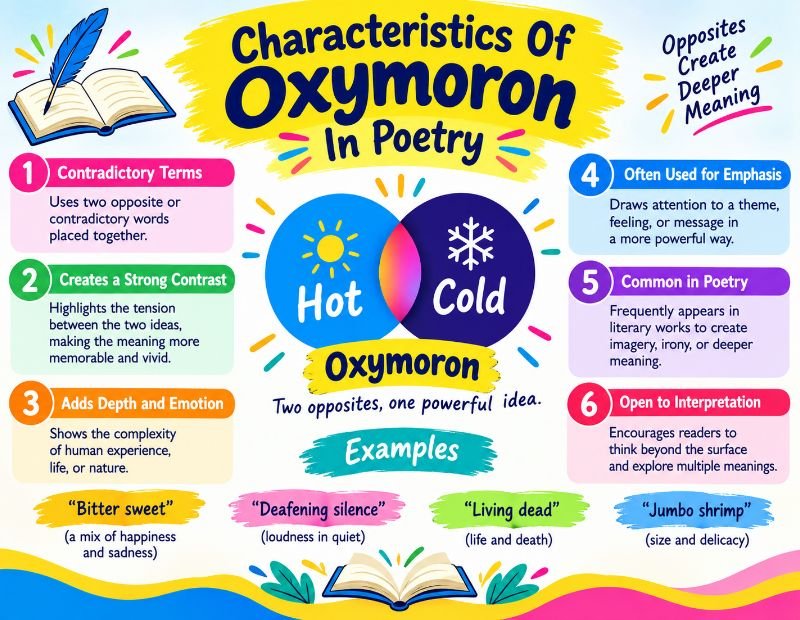
Not every contradictory phrase qualifies as a true poetic oxymoron. Here are the defining characteristics that set it apart:
- Brevity: It’s almost always just two or three words, rarely a full sentence.
- Contradiction: The words involved have opposite or clashing meanings.
- Intentional pairing: The contrast is deliberate, not accidental or a writing error.
- Layered meaning: Despite the contradiction, the phrase creates a new and coherent idea when read together.
- Emotional or thematic weight: It usually appears at emotionally charged moments in a poem: love, death, war, loss, or transformation.
- Compact structure: Most follow an adjective + noun pattern (“sweet sorrow”) or adverb + adjective pattern (“seriously funny”).
Effects Of Oxymoron In Poetry
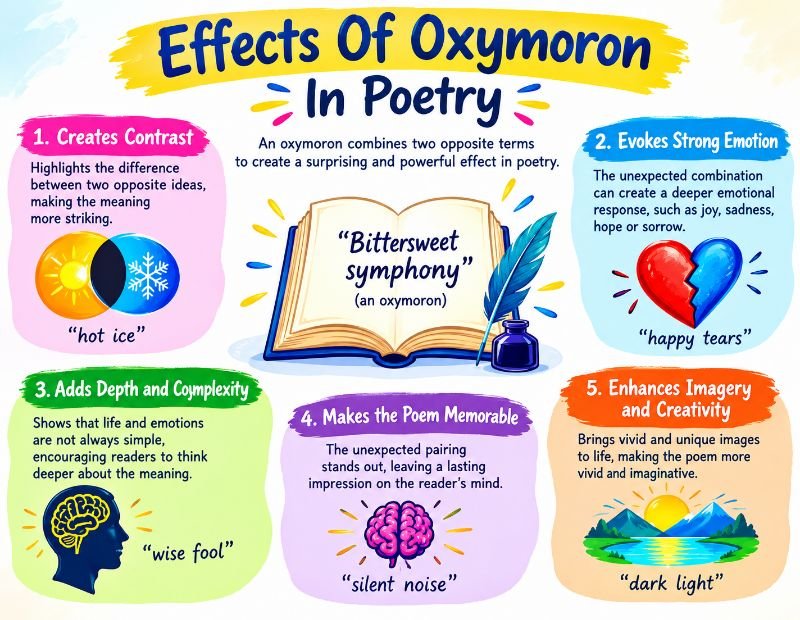
When used skillfully, an oxymoron changes how a reader experiences a poem. Some of the most common effects include:
1. Emotional Complexity
Oxymorons let poets show that feelings are rarely simple. A single phrase like “painful pleasure” can capture heartbreak and desire in the same breath.
2. Surprise and Reflection
Because the words seem to contradict each other, readers naturally pause to make sense of the phrase — which deepens engagement with the poem.
3. Irony and Satire
Contradictory phrasing can expose the absurdity of a situation, which is why oxymorons appear frequently in satirical or socially critical poetry.
4. Vivid Imagery
Pairing opposites like “dark light” or “cold fire” creates a striking mental picture that a single descriptive word could never achieve.
5. Musical and Rhythmic Appeal
The clash of sounds and meanings often adds a punchy rhythm, making the line easier to remember and more pleasant to read aloud.
Purpose Of Oxymoron In Poetry
At its core, the purpose of an oxymoron is to say more with less. Poetry is a condensed art form, and poets are always looking for ways to pack maximum meaning into minimum words. An oxymoron achieves this by:
- Communicating a contradiction that mirrors real, lived emotional experience.
- Adding depth to characters, situations, or themes without lengthy explanation.
- Creating a “hook” that makes a line stand out and stay in the reader’s memory.
- Allowing writers to explore duality life and death, love and hate, joy and sorrow within a single poetic breath.
Types Of Oxymoron In Poetry
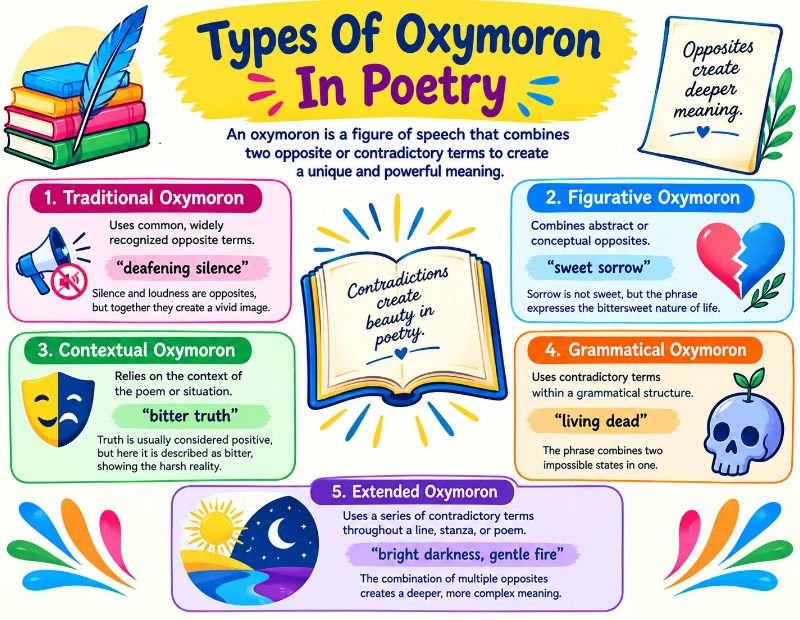
Oxymorons don’t all follow the same grammatical pattern. Understanding the different types can help you spot and use them more effectively.
| Type | Structure | Example |
|---|---|---|
| Adjective, Noun Oxymoron | Adjective + Noun | “Deafening silence,” “living death” |
| Adverb, Adjective Oxymoron | Adverb + Adjective | “Seriously funny,” “awfully good” |
| Noun, Noun Oxymoron | Noun + Noun | “Love-hate,” “friendly fire” |
| Verb, Based Oxymoron | Verb pairing opposite action/meaning | “Act naturally” |
| Compound Oxymoron | Two contradictory ideas fused into one word | “Bittersweet” |
| Phrase Level Oxymoron | Longer phrase with embedded contradiction | “O brawling love! O loving hate!” |
Adjective: Noun Oxymoron
This is the most common type in poetry. A descriptive word directly contradicts the noun it modifies, as in “sweet sorrow” or “cold fire.”
Adverb: Adjective Oxymoron
Here, the adverb intensifies an adjective in a way that shouldn’t logically make sense — like “seriously funny” or “clearly confused.”
Compound Oxymoron
Two opposing ideas are merged into a single word, such as “bittersweet.” These are so widely used that many have become part of everyday vocabulary.
10 Examples Of Oxymoron In Poetry
Here are ten powerful oxymorons frequently found or referenced in poetic works, along with what each one really means:
- “Sweet sorrow”: The bittersweet pain of parting from someone you love.
- “Living death”: A life so devoid of joy it feels like death.
- “Deafening silence”: A silence so intense it feels overwhelming, almost like noise.
- “Cold fire”: Passion or intensity without warmth or comfort.
- “Bright smoke”: Something beautiful yet obscuring or confusing.
- “Feather of lead”: Something that should feel light but carries emotional heaviness.
- “Loving hate”: The tangled coexistence of love and resentment.
- “Painful pleasure”: Joy that comes bundled with suffering.
- “Wise fool”: A character who appears foolish but speaks profound truth.
- “Beautiful tyrant”: Someone whose charm conceals cruelty or control.
Famous Poems With Oxymoron In Poetry
Some of literature’s most quoted lines rely entirely on oxymoronic phrasing. Here’s where you’ll find them:
Romeo and Juliet by William Shakespeare
Shakespeare is often considered the master of poetic oxymorons. In one famous passage, Romeo strings together more than a dozen contradictions in a row, pairing love with hate, lightness with heaviness, and fire with cold to build an entire speech out of nothing but contradiction. Later, Juliet famously says goodbye to Romeo with the line “parting is such sweet sorrow”, a phrase that has become one of the most quoted oxymorons in the English language.
Don Juan by Lord Byron
Byron uses the phrase “melancholy merriment” to describe a joy that is tinged with sadness, a perfect example of how oxymorons can convey emotional nuance in just two words.
Paradise Lost by John Milton
Milton frequently leaned on contradiction to describe the fallen state of his characters, using phrases that blend darkness and light, order and chaos, to reflect spiritual conflict.
Animal Farm Style Political Verse
While technically prose, George Orwell’s famous line “more equal” (from Animal Farm) is often studied alongside poetic oxymorons for how it exposes hypocrisy through contradiction, a technique many political and satirical poets borrow directly.
Modern and Contemporary Poetry
Contemporary poets continue to use oxymorons like “organized chaos,” “silent scream,” and “controlled madness” to describe modern anxieties, relationships, and identity struggles proving this device is just as relevant today as it was in Shakespeare’s time.
Sentence Examples Of Oxymorons
Beyond poetry, oxymorons are common in everyday speech and writing. Here are some simple sentence examples to show how naturally they fit into conversation:
- She gave him a deafening silence after the argument, saying more with her quiet than words ever could.
- The jumbo shrimp appetizer was the highlight of the dinner.
- His act of kindness felt like an open secret everyone in the office knew about.
- It was an original copy of a document nobody had ever seen before.
- The comedian’s performance was seriously funny from start to finish.
- Living alone in that huge house felt like a lonely crowd of memories.
- The soldiers described the mission as organized chaos from beginning to end.
- Her small fortune was enough to change her family’s future.
Oxymoron vs Paradox vs Antithesis: Key Differences
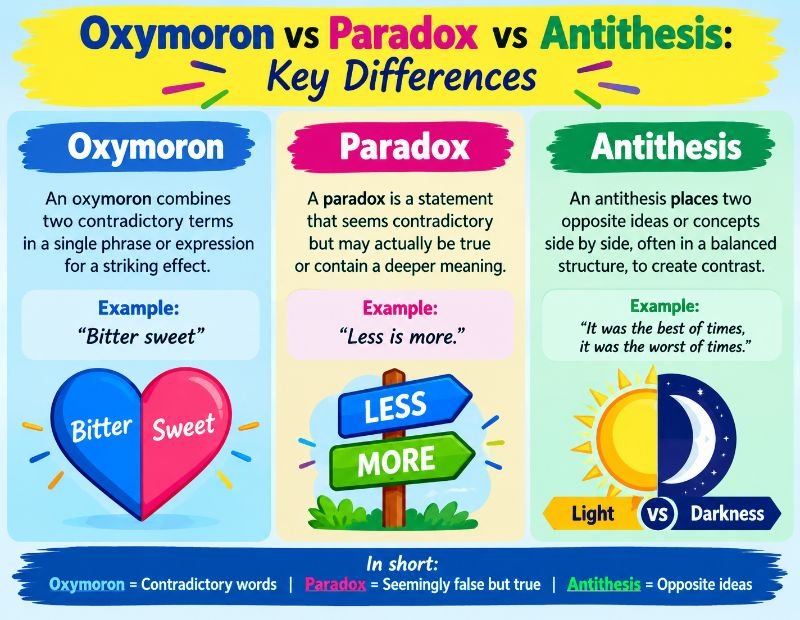
Because these three devices are often confused, here’s a quick side-by-side comparison to keep them straight:
| Device | Definition | Length | Example |
|---|---|---|---|
| Oxymoron | Two contradictory words combined | Short phrase | “Bittersweet” |
| Paradox | A statement that seems contradictory but reveals truth | Sentence or longer | “Less is more.” |
| Antithesis | Two contrasting ideas placed in parallel structure | Balanced clause | “Give me liberty, or give me death.” |
How To Identify An Oxymoron In A Poem?
If you’re analyzing a poem and want to spot an oxymoron, look for these signs:
- Two words placed directly next to each other that seem to clash in meaning.
- A moment of emotional intensity, oxymorons often appear during descriptions of love, death, or internal conflict.
- A phrase that makes you pause because it doesn’t immediately make logical sense.
- A deeper truth beneath the surface, once you think about it, the contradiction actually captures something real.
How To Use Oxymoron In Poetry?
If you want to add oxymoron in poetry , try these steps:
- Start with the emotion you want to express (grief, love, confusion, irony).
- List two words that represent opposite ends of that emotion.
- Pair them together and read the phrase aloud to check the rhythm.
- Place the oxymoron at a high-emotion point in your poem for maximum impact.
- Avoid overusing the device, one or two well-placed oxymorons are more powerful than a dozen scattered throughout.
Conclusion
The oxymoron in poetry is proof that poetry doesn’t always need more words to say more sometimes it needs fewer, sharper ones. By fusing two opposing ideas into a single phrase, poets like Shakespeare, Byron, and countless modern writers have captured emotions that plain language simply can’t reach. From “sweet sorrow” to “deafening silence,” these contradictions remind us that human experience is rarely one-sided it’s layered, complicated, and beautifully contradictory, just like the best poetry itself.
Whether you’re analyzing classic verse for a class assignment or crafting your own poem, understanding how and why oxymorons work will help you read and write with far more depth and precision.
FAQs
What is an oxymoron in poetry?
An oxymoron in poetry is a short phrase that combines two contradictory words to create a new, layered meaning, such as “sweet sorrow” or “deafening silence.”
What is the most famous oxymoron in poetry?
“Parting is such sweet sorrow” from Shakespeare’s Romeo and Juliet is widely considered the most famous oxymoron in poetry.
What’s the difference between an oxymoron in poetry and a paradox?
An oxymoron in poetry is a short phrase of contradictory words, while a paradox is a longer statement or sentence that also expresses a contradiction.
Why do poets use oxymorons?
Poets use oxymoron in poetry to express complex or conflicting emotions, create irony, add drama, and make lines more memorable in fewer words.
Can an oxymoron in poetry be funny?
Yes. Oxymoron in poetry are often used for comic or witty effect, such as “act naturally” or “seriously funny.”
Is “bittersweet” an oxymoron?
Yes, “bittersweet” is a classic compound oxymoron that combines two opposite sensory or emotional qualities into one word.
Are oxymorons only used in poetry?
No. While extremely common in poetry, oxymorons also appear in everyday speech, literature, film, and advertising.