
Read the word “buzz” out loud. You can almost hear a bee circling your ear. That small moment is onomatopoeia at work, and poets have used it for centuries to turn silent words on a page into sound you can feel.
Onomatopoeia in poetry does more than copy noise. It sets mood, builds rhythm, and pulls readers inside a scene. This guide covers the meaning, characteristics, types, effects, and purpose of onomatopoeia. It also includes 20+ examples, five original short poems, and practical tips for writing your own.
Onomatopoeia in Poetry Meaning
Onomatopoeia in poetry is the use of words that imitate the natural sound of what they describe. Words like “hiss,” “clang,” “murmur,” and “thud” sound like the thing they name.
The term comes from two Greek roots. Onoma means “name” and poiein means “to make.” Literally, it means “making a name,” and the name sounds like the thing itself.
In poetry, the device works on two levels. It gives the reader meaning, and it gives the ear a sensory experience at the same time.
Read Also This Blog: Spoken Poetry
Onomatopoeia Pronunciation
Many readers hesitate over this word, so here is the breakdown.
- Phonetic spelling: on-uh-mat-uh-PEE-uh
- IPA: /ˌɒnəˌmætəˈpiːə/
- Syllables: on-o-mat-o-poe-ia (six syllables)
- Stress: the fifth syllable, “PEE”
A quick memory trick is to say “on a mat a pea” and finish with a long “ee” sound. The adjective form is onomatopoeic (on-uh-mat-uh-PEE-ik). You may also see “onomatopoetic.”
Characteristics of Onomatopoeia in Poetry
Onomatopoeic words share a few features. Knowing them makes the device easier to spot and use.
- Sound imitation: the word echoes a real noise, such as a “splash,” a “crackle,” or a “howl.”
- Sensory appeal: it mainly targets hearing, but it can also suggest touch, motion, and texture.
- Vivid imagery: readers form a picture and a sound at once.
- Rhythm and musicality: the sounds create beat, flow, and sometimes rhyme.
- Emotional tone: soft sounds feel gentle, while harsh sounds feel tense or violent.
- Language specific: a dog says “woof” in English but “wan wan” in Japanese, so the same noise is spelled differently across cultures.
- Economy: one short word often replaces a whole descriptive phrase.
Types of Onomatopoeia in Poetry
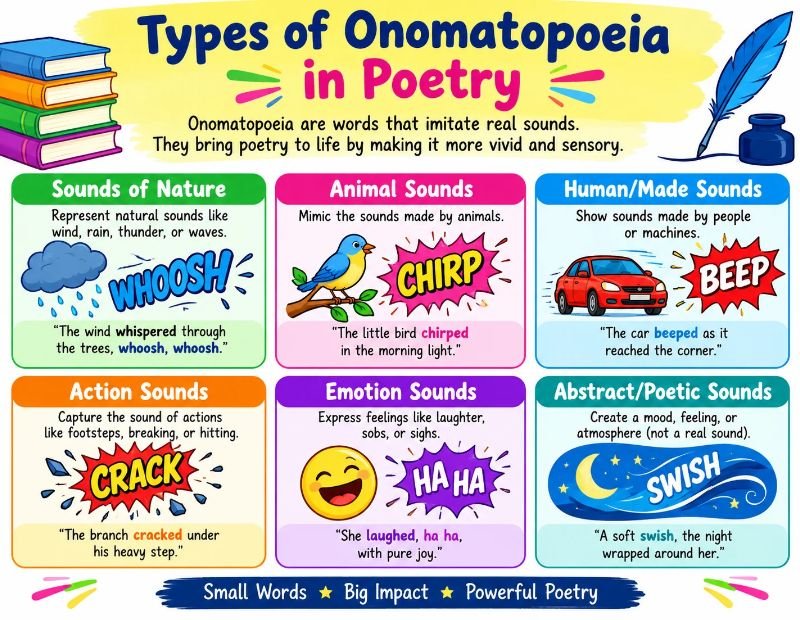
Scholars sort onomatopoeia in several ways. The table below shows the most useful categories for poetry readers.
| Type | How it works | Example |
|---|---|---|
| Direct (imitative) | The word copies a real sound | buzz, boom, sizzle |
| Associative (indirect) | The sound of the word suggests an idea or feeling | slither, glitter, gloom |
| Invented (coined) | The poet creates a brand new sound word | snicker-snack, tintinnabulation |
| Repeated (reduplicated) | A sound word is doubled for rhythm | tick tock, pitter patter |
| Sound pattern (alliterative) | Repeated consonants imitate a noise | the hissing, whispering sea |
Direct Onomatopoeia
This is the classic form. The word is a near copy of the noise. “Crash,” “pop,” “knock,” and “splash” are all direct.
Associative Onomatopoeia
Here the word does not copy a noise exactly. Instead, its sound hints at a quality. “Slimy” feels wet and slippery, and “crunch” feels dry and brittle even before you think about meaning.
Invented Onomatopoeia
Poets sometimes coin new words when ordinary ones fail. Lewis Carroll’s “snicker-snack” is a famous case. The invented word still feels right because it sounds like a quick blade.
Repeated and Alliterative Forms
Doubling a sound (“drip, drip, drip”) mimics repetition in nature. Alliteration, like “the soft sigh of the sea,” spreads a single sound across a line to create atmosphere.
How to Recognize Onomatopoeia in Poetry?
Spotting this device gets easier with practice. Use this simple checklist when you read a poem.
- Read it aloud. Sound devices reveal themselves when spoken.
- Look for sound words. Scan for verbs and nouns that name noises, such as “rustle” or “clatter.”
- Ask the imitation question. Does the word sound like what it means? If yes, it is likely onomatopoeia.
- Check the line rhythm. Choppy sounds often match fast action, and long vowels often match calm or sorrow.
- Notice repetition. Repeated consonants or doubled words often signal a sound effect.
- Match sound to mood. Ask how the noise supports the poem’s feeling.
A helpful test is to swap the word for a plain synonym. If the line loses its energy, the original word was doing sound work. “The door shut” is flat, but “the door slammed” is not.
15 Examples of Onomatopoeia in Poetry
These lines come from classic poems that are now in the public domain. The sound words are the ones that carry the effect.
- Alfred Tennyson, “The Princess”: “The moan of doves in immemorial elms, and murmuring of innumerable bees.” The “m” and “n” sounds hum like insects.
- Edgar Allan Poe, “The Bells”: “tintinnabulation.” The coined word rings like small bells.
- Edgar Allan Poe, “The Raven”: “rapping, rapping at my chamber door.” The repeated “rap” mimics a nervous knock.
- Robert Southey, “The Cataract of Lodore”: “rattling and battling” and “clashing and flashing.” Pairs of rhyming sound words recreate falling water.
- Robert Browning, “Meeting at Night”: the “quick sharp scratch” of a match. The short, hard “k” and “ch” sounds feel like friction.
- Alexander Pope, “An Essay on Criticism”: “The hoarse, rough verse should like the torrent roar.” Pope argues that sound should echo sense, then proves it.
- Samuel Taylor Coleridge, “Kubla Khan”: “ceaseless turmoil seething.” The hissing “s” sounds boil like water.
- Samuel Taylor Coleridge, “The Rime of the Ancient Mariner”: “It cracked and growled, and roared and howled.” Four verbs stack up to imitate groaning ice.
- William Shakespeare, The Tempest (Ariel’s song): “Bow-wow” and “cock-a-diddle-dow.” These are animal sounds turned into verse.
- Alfred Tennyson, “The Brook”: “I chatter, chatter, as I flow.” The repeated word copies a babbling stream.
- Lewis Carroll, “Jabberwocky”: “snicker-snack.” An invented word captures a swift sword stroke.
- Alfred Tennyson, “The Splendour Falls”: “Blow, bugle, blow.” The plosive “b” mimics a horn blast.
- John Keats, “To Autumn”: swallows that “twitter.” A light, quick word fits small birds.
- Edgar Allan Poe, “The Bells”: “clamor and the clangor.” The harsh “cl” cluster rings like loud metal.
- Samuel Taylor Coleridge, “Kubla Khan”: “fast thick pants.” The short breaths copy a heaving earth.
Common Onomatopoeic Words for Poetry
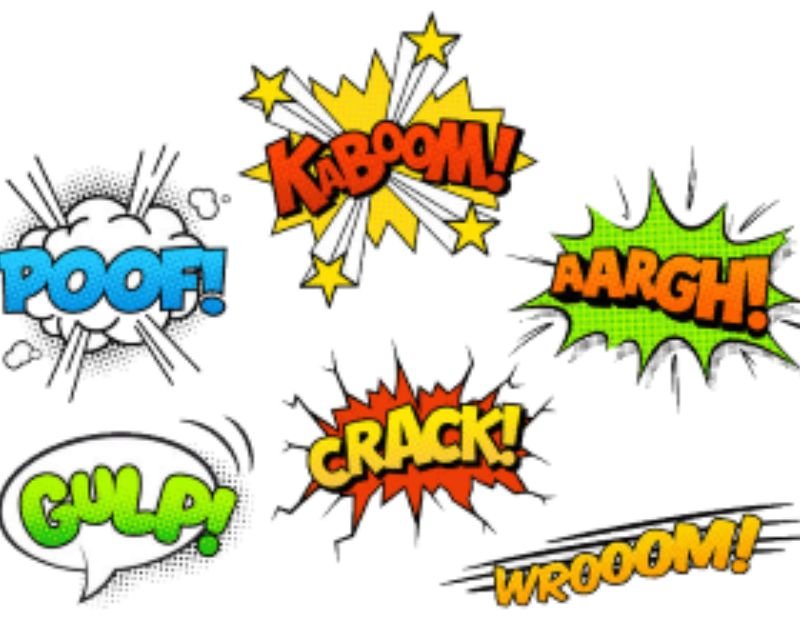
If you need more material, this table sorts useful sound words by source.
| Sound source | Words to use |
|---|---|
| Animals | buzz, hiss, purr, croak, chirp, roar |
| Water | splash, drip, gurgle, trickle, plop |
| Weather | rumble, crack, patter, whoosh, howl |
| Machines | click, beep, whir, clank, hum |
| Human actions | gasp, sigh, mumble, giggle, sneeze |
| Impact | bang, thud, smack, crash, thump |
Onomatopoeia in Sentences
Examples in plain sentences help you see how the device works before you use it in verse.
- The kettle hissed as steam filled the kitchen.
- Rain pattered softly against the window.
- The old gate creaked open in the wind.
- A single drop plopped into the pond.
- Thunder boomed over the sleeping village.
- The crowd murmured as the singer walked on stage.
- Her heels clicked along the empty hallway.
Notice how each verb carries both action and sound. That is why onomatopoeia saves words.
Effects of Onomatopoeia in Poetry
The device changes how a poem is felt as well as how it is understood. Here are its main effects.
- Creates vivid imagery: the reader hears the scene, not just reads it.
- Builds mood and atmosphere: soft “sh” and “s” sounds feel quiet, while hard “k” and “t” sounds feel sharp.
- Adds rhythm and music: sound words create beats that guide the reading pace.
- Increases emotional impact: a “sob” or a “gasp” moves a reader faster than a long description.
- Makes poems memorable: playful sounds stick in the mind and are easy to recite.
- Engages the senses: it can trigger memory, such as the smell and sound of rain.
- Adds humor and energy: words like “splat” or “boing” make verse lively.
Use of Onomatopoeia in Poetry
Poets apply onomatopoeia in practical ways. These are the most common uses.
- Describing nature: wind, rivers, birds, and storms come alive through sound words.
- Showing action: fast scenes use short, hard sounds to speed up the line.
- Setting a scene: a “clanging” street or a “humming” field places the reader instantly.
- Reflecting emotion: “sighing,” “sobbing,” and “whispering” mirror inner states.
- Creating rhyme and flow: sound words often rhyme naturally.
- Writing for children: playful noise makes rhymes fun and easy to learn.
- Supporting performance: spoken word poets use sound words to add energy to a reading.
Purpose of Onomatopoeia in Poetry
The purpose of onomatopoeia is to join sound and sense. A poem is meant to be heard, and this device makes the language itself act out the meaning.
Poets use it to:
- Make abstract ideas physical and concrete.
- Pull the reader inside the moment.
- Strengthen the link between form and content.
- Add musical texture without extra explanation.
Pope summed up this goal long ago when he wrote that the sound must seem an echo to the sense.
Importance of Onomatopoeia in Poetry
Why does this device matter so much? Because it makes language feel alive.
Without sound words, much descriptive writing would feel distant. With them, readers experience the thing described. This is especially valuable in short forms like haiku, where every word must work hard.
Onomatopoeia is also a bridge between ages and skill levels. Children enjoy it instantly, students learn sound analysis through it, and experienced poets use it for subtle effects. It is one of the most accessible literary devices, which makes it a strong starting point for anyone learning to read or write poetry.
How to Write Onomatopoeia Poems?
Writing your own is easier than it looks. Follow these steps.
- Choose a sound-rich topic. Storms, kitchens, markets, farms, and trains all work well.
- List the sounds. Close your eyes and write every noise you can imagine.
- Pick strong sound words. Choose precise words over general ones, such as “clatter” instead of “noise.”
- Match sound to mood. Use soft sounds for calm and harsh sounds for tension.
- Build rhythm. Read each line aloud and adjust until the beat feels right.
- Mix your sounds. Combine animal, mechanical, and natural sounds so the poem does not feel repetitive.
- Use repetition carefully. Doubling a sound can create music, but too much feels forced.
- Add a human touch. Connect the sounds to a feeling, memory, or small story.
- Revise. Cut any sound word that does not earn its place.
5 Short Poems with Onomatopoeia
Here are five original poems you can read, teach, or use as models.
1. Morning Kitchen
The kettle hisses, the toaster pops,
the spoon goes clink in the cup.
Butter sizzles, the tap drip-drips,
and the whole house wakes up.
2. Rainy Window
Pitter, patter, tap, tap, tap,
the rain knocks on the glass.
Gurgle, splash, the gutters sing
as the grey afternoon slides past.
3. Night Barn
A creak, a moo, a rustle of hay,
an owl hoots low and long.
The wind goes whoosh through the sleepy dark
like a soft, forgotten song.
4. The Train
Chug, chug, chug, then clack, clack, clack,
the iron wheels hum along.
A whistle shrieks, the platform shakes,
and the morning rushes on.
5. The Storm
Rumble, crackle, boom, and crash,
the sky tears wide apart.
Then drip, then hush, a quiet drop
falls soft on a calmer heart.
Each poem uses different sound sources and moods, which keeps the effect fresh.
Onomatopoeia in Poetry for Kids
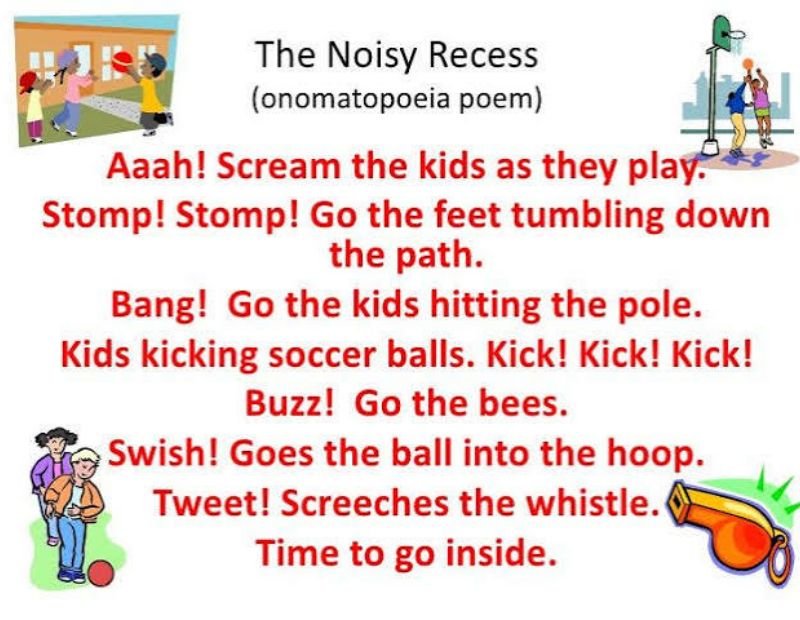
Children love sound words because they are playful and easy to act out. Teachers use them to build vocabulary, reading fluency, and confidence.
Try these ideas with young learners:
- Sound hunt: walk around the classroom or garden and list every noise.
- Animal chorus: have each child perform an animal sound, then turn the sounds into a group poem.
- Action words: act out “stomp,” “tiptoe,” “splash,” and “zoom” while reading.
- Rhyme games: pair sound words that rhyme, such as “buzz” and “fuzz.”
- Comic strips: draw pictures with “POW” and “SPLAT” captions to link sound with image.
A simple kids’ verse might read: “Splish, splash, splosh, the puddle goes, / jump in with your boots and see! / Squelch, squish, squash, the mud replies, / what a messy day for me!”
Onomatopoeia in Poetry for Students
Older students can go beyond simple recognition. At this level, the goal is analysis.
When you study a poem, ask these questions:
- Which words imitate a sound?
- Is the sound direct or associative?
- How does the sound match the poem’s mood?
- Does the rhythm speed up or slow down with the sound words?
- What would be lost if the sound words were replaced?
For exams and essays, use a clear structure. Name the device, quote the example, explain the sound effect, and link it to the poem’s theme. For instance, you might say that Poe’s repeated “bells” imitate ringing and also create a hypnotic rhythm that reflects the poem’s changing emotions.
Students should also compare onomatopoeia with related devices:
| Device | What it does | Quick example |
|---|---|---|
| Onomatopoeia | Words imitate real sounds | hiss, thud |
| Alliteration | Repeats starting consonants | slow, soft snow |
| Assonance | Repeats vowel sounds | the moan of low tones |
| Consonance | Repeats consonants anywhere | blank and thick |
| Phanopoeia | Imitates visual qualities | glitter, shimmer |
Common Mistakes to Avoid
Even a great device can fall flat if overused. Watch out for these problems.
- Overloading lines: too many sound words feel noisy and silly.
- Using clichés: “buzz” for a bee works, but a fresher choice may land better.
- Ignoring meaning: a sound word must still make sense in the sentence.
- Forgetting rhythm: sounds that disrupt the beat distract readers.
- Skipping the read aloud test: a poem that looks good may sound awkward.
Conclusion
Onomatopoeia in poetry turns language into music. It lets readers hear rain, feel a storm, and sense a heartbeat through nothing more than carefully chosen words. From Tennyson’s humming bees to Poe’s ringing bells, poets have always known that sound carries meaning.
Whether you are a student studying a poem, a teacher planning a lesson, or a writer hunting for fresh imagery, this device is worth mastering. Start by reading poems aloud, collect sound words that surprise you, and practice using them with care. The more you listen, the more your poems will speak.
Frequently Asked Questions
What is onomatopoeia in poetry?
It is the use of words that imitate real sounds, like “buzz” or “crash,” to make a poem more vivid and musical.
How do you pronounce onomatopoeia in poetry?
It is pronounced on-uh-mat-uh-PEE-uh, with the stress on the fifth syllable.
What are the types of onomatopoeia in poetry?
The main types of Onomatopoeia in poetry are direct, associative, invented, repeated, and alliterative onomatopoeia.
What is the purpose of onomatopoeia in poetry?
Onomatopoeia in poetry has purpose to match sound with meaning so readers can hear and feel what the poem describes.
How do you identify onomatopoeia in a poem?
Read the poem aloud and look for words that sound like the noise or action they describe.
What are some examples of onomatopoeia in poetry?
Common examples include “tintinnabulation,” “murmuring,” “rapping,” “snicker-snack,” and “chatter.”
Why is onomatopoeia important in poetry?
Onomatopoeia in poetry creates imagery, rhythm, and emotion, and it makes poems more memorable and enjoyable to read.
What are the effects of onomatopoeia in poetry?
Onomatopoeia in poetry builds mood, adds musicality, strengthens imagery, and engages the reader’s senses.
How can kids learn onomatopoeia in poetry?
Kids learn best through sound hunts, animal sounds, action games, and short rhyming poems.
Is onomatopoeia in poetry the same as alliteration?
No. Onomatopoeia in poetry imitates real sounds, while alliteration repeats the same starting consonant sounds.
Can onomatopoeia be used in haiku?
Yes. A single sound word like “plop” or “rustle” can add a lot of life to a short haiku.
Do all languages have onomatopoeia?
Yes, but the words differ. A rooster says “cock-a-doodle-doo” in English and “kukuriku” in several other languages.