
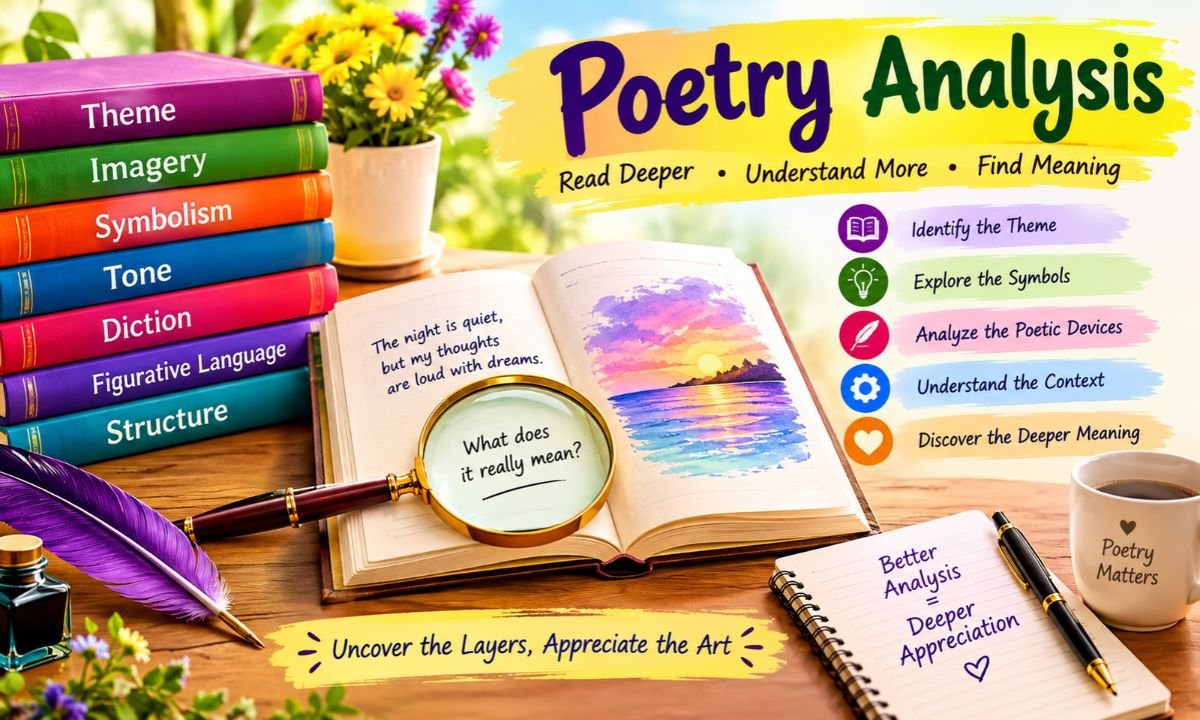
Poetry can feel like a locked room. You read the lines, sense that something important is hiding there, and still can’t find the door. Poetry analysis is the key. It teaches you to slow down, notice the details, and explain how a poem creates its effect.
This guide covers what poetry analysis is, why it matters, and how to do it. It gives you more than 25 techniques, the main elements of a poem, the TP-CASTT method, AP Lit advice, and short studies of Emily Dickinson, Marianne Moore and Hayden Carruth. Whether you are a student, a teacher or a curious reader, you can use it right away.
What is Poetry Analysis?
Poetry analysis is the close study of a poem’s parts to understand its meaning and its effect on the reader. You look at form, structure, language, sound, imagery, speaker, and context, then explain how they work together.
Most good guides agree on one point: you are not hunting for a single hidden answer. You are building an interpretation and backing it with evidence from the text. Two readers can reach different conclusions and both be right, as long as each can point to the words that support their view.
Read Also This Blog: Poetry Project Ideas
Characteristics of Poetry Analysis
Strong poetry analysis shares a few traits:
- Evidence-based: every claim connects to a line, word or sound in the poem.
- Focused on the whole: each detail is tied to the poem’s central idea.
- Attentive to form: line breaks, stanzas and punctuation count as meaning.
- Aware of context: the poet’s era, culture and life can shape the reading.
- Open to layers: a single word may carry two or three meanings.
- Clearly written: the argument is easy to follow, not buried in jargon.
Purpose of Poetry Analysis
Why bother taking a poem apart? There are several good reasons:
- To understand meaning. Analysis moves you past the surface story to the deeper theme.
- To appreciate craft. You notice how a poet’s choices create emotion.
- To build critical thinking. You learn to argue from evidence.
- To improve your own writing. Seeing how others use a technique helps you use it.
- To pass exams. Courses like GCSE, IB and AP Literature reward close reading.
Effects of Poetry Analysis
Regular practice changes how you read. Here is what most readers notice:
- A richer, more emotional response to poems
- A larger vocabulary and sharper attention to word choice
- Better essay writing and stronger thesis statements
- More confidence with difficult or unfamiliar texts
- A habit of reading slowly, which helps with every kind of literature
Elements of Poetry Analysis
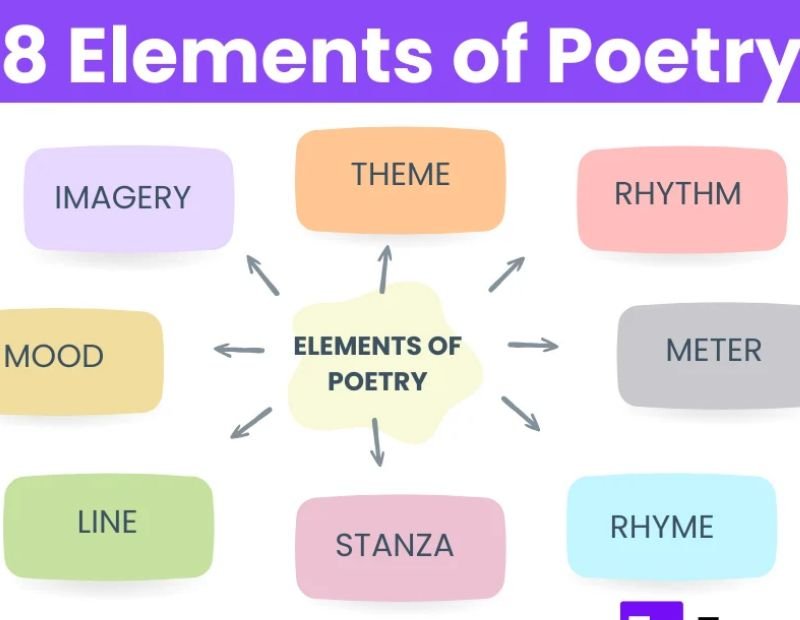
Before you can analyze a poem, you need to know what to look for. These are the core elements.
| Element | What to Ask | Why It Matters |
|---|---|---|
| Speaker | Who is talking? | The speaker is not always the poet |
| Theme | What big idea runs through the poem? | Gives your analysis a destination |
| Tone | What is the speaker’s attitude? | Shapes how lines should be read |
| Mood | What feeling does the reader get? | Shows the poem’s emotional effect |
| Imagery | Which senses are triggered? | Creates vivid pictures and feelings |
| Diction | Which words were chosen, and why? | Word choice carries connotation |
| Form | Is it a sonnet, haiku, free verse? | Form often supports meaning |
| Structure | How are stanzas and lines arranged? | Reveals shifts and emphasis |
| Rhyme and rhythm | What patterns of sound appear? | Adds music and emphasis |
| Context | When and why was it written? | Explains references and stakes |
Speaker and Persona
Never assume the “I” in a poem is the poet. Poets often invent voices. Name the speaker, describe their situation, and ask what they want.
Tone and Mood
Tone belongs to the speaker, and mood belongs to the reader. A poem can have a calm tone and still leave you uneasy. Notice the gap when it exists.
Form and Structure
Count the lines, find the stanzas, and look for repeated patterns. Then ask what happens when the pattern breaks. A broken pattern is usually a clue.
25+ Techniques of Poetry Analysis
Poets use literary and sound devices to shape meaning. You do not need to name every device in an essay. Choose the ones that matter most to the poem’s message.
| # | Technique | Quick Definition |
|---|---|---|
| 1 | Metaphor | A direct comparison without “like” or “as” |
| 2 | Simile | A comparison using “like” or “as” |
| 3 | Personification | Human traits given to non-human things |
| 4 | Imagery | Sensory language that paints a picture |
| 5 | Symbolism | An object or image standing for an idea |
| 6 | Alliteration | Repeated starting consonant sounds |
| 7 | Assonance | Repeated vowel sounds inside words |
| 8 | Consonance | Repeated consonant sounds anywhere in words |
| 9 | Onomatopoeia | Words that imitate sounds |
| 10 | Hyperbole | Deliberate exaggeration |
| 11 | Irony | A gap between expectation and reality |
| 12 | Paradox | A statement that seems contradictory but holds truth |
| 13 | Oxymoron | Two opposite words placed together |
| 14 | Allusion | A reference to another text, person or event |
| 15 | Enjambment | A sentence running over a line break |
| 16 | Caesura | A pause inside a line |
| 17 | End-stopped line | A line that ends with a natural pause |
| 18 | Rhyme scheme | The pattern of end rhymes (ABAB, AABB) |
| 19 | Meter | The pattern of stressed and unstressed syllables |
| 20 | Anaphora | Repetition at the start of lines |
| 21 | Refrain | A repeated line or phrase |
| 22 | Apostrophe | Addressing someone absent or something abstract |
| 23 | Synecdoche | A part standing for the whole |
| 24 | Metonymy | Something named by an associated thing |
| 25 | Juxtaposition | Placing contrasting ideas side by side |
| 26 | Volta | A turn or shift in thought or argument |
| 27 | Connotation | The emotional associations of a word |
| 28 | Understatement | Deliberately downplaying something |
How to Use Techniques Well?
Naming a device earns very little credit by itself. The useful step is explaining its effect. Compare these two sentences:
- Weak: “The poet uses alliteration.”
- Strong: “The repeated soft s sounds slow the line down and create a hushed, secretive mood.”
Always follow the pattern of device, evidence, effect.
How to Write a Poetry Analysis?
Here is a step-by-step method you can follow for any poem.
- Read the poem once without stopping. Let it work on you first.
- Read it aloud. Poems are built for the ear, so listen for rhythm and rhyme.
- Study the title. Does it hint at theme, irony or setting?
- Identify the speaker and situation. Who is talking, to whom, and why?
- Paraphrase line by line. Put each line in plain words to check your understanding.
- Mark the language. Underline striking words, images and devices.
- Examine form and structure. Look at stanzas, rhyme, meter and line breaks.
- Find the shift. Most poems turn somewhere, in tone, image or argument.
- State the theme. Write one sentence about what the poem says about life, love, time or loss.
- Draft a thesis. Combine theme and technique into a single arguable claim.
- Write the essay with evidence. Quote short phrases and explain them.
- Revise. Cut anything that does not support your thesis.
Structure of a Poetry Analysis Essay
A clear structure makes your argument easy to follow.
| Section | What to Include |
|---|---|
| Introduction | Title, poet, brief context, and a thesis statement |
| Body Paragraph 1 | Theme and speaker, supported by quotations |
| Body Paragraph 2 | Imagery and language, with effects explained |
| Body Paragraph 3 | Form, sound and structure, with effects explained |
| Conclusion | Restate the thesis in fresh words and note the poem’s wider significance |
Each body paragraph can follow the PEEL pattern: Point, Evidence, Explanation, Link back to the thesis.
Poetry Analysis with TP-CASTT
TP-CASTT is a classroom favorite because it gives you a clear order to work in. The letters stand for seven steps.
- T (Title): Predict what the poem will be about before reading.
- P (Paraphrase): Restate the poem in plain language.
- C (Connotation): Study the deeper meanings of words, images and devices.
- A (Attitude): Identify the tone of the speaker and the poet.
- S (Shift): Spot where tone, subject or perspective changes.
- T (Title again): Reread the title and see how its meaning has grown.
- T (Theme): State the central idea in a full sentence.
Teachers like this method because it covers the whole poem without skipping steps. Students like it because it gives them something to write down at every stage.
Poetry Analysis for AP Lit
The AP Literature exam usually opens with a poetry prompt, and it rewards clear thinking more than fancy vocabulary. Here is what helps:
- Write a defensible thesis. It should make an interpretive claim, not just describe the poem.
- Choose specific evidence. Short, well-chosen quotations beat long block quotes.
- Explain the effect. Each example should lead to a comment about meaning.
- Track the shift. Graders like to see that you noticed how the poem develops.
- Avoid summary. Retelling the poem earns very little.
- Practice under time. Aim for a short planning stage, then write steadily.
A good habit is to practice with TP-CASTT in the margins first, then turn those notes into paragraphs.
Poetry Analysis Generator
Many people search for a poetry analysis generator. These tools take a poem and return a summary of themes, devices and tone. They can be handy for a quick first look, especially when a poem feels impenetrable.
Use them with care, though. A generator cannot hear your response to the poem, and it may miss irony or cultural context. It can also be wrong. The safest approach is to form your own reading first, then compare it with the tool’s output. Never submit generated text as your own work, because teachers can usually tell.
Emily Dickinson Poetry Analysis
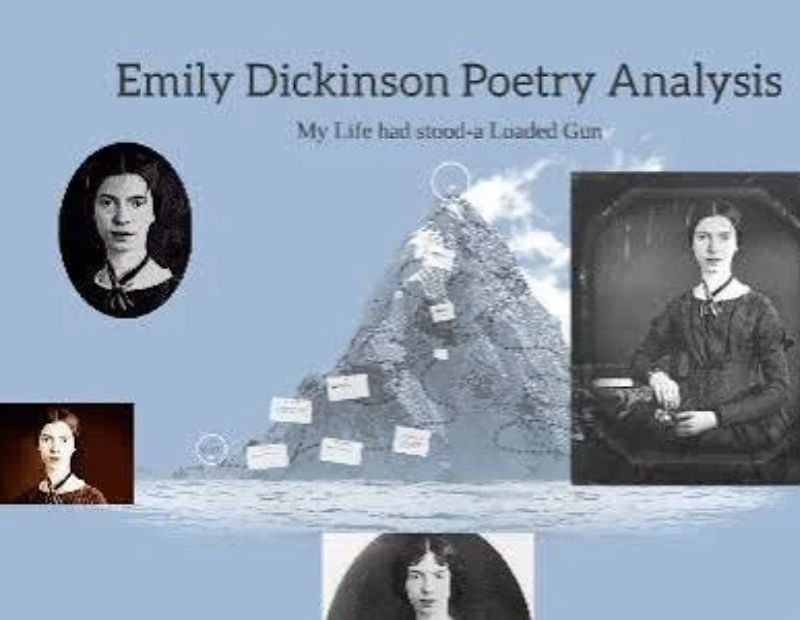
Emily Dickinson (1830 to 1886) wrote short, compressed poems that reward slow reading. Here is what to watch for.
- Dashes and capitalization: Her unusual punctuation creates pauses and stresses certain words.
- Slant rhyme: She often uses near rhymes that feel slightly off, matching her uneasy subjects.
- Common meter: Many poems follow hymn-like patterns, which makes her strange ideas sound deceptively familiar.
- Big themes: Death, immortality, nature, faith, doubt and the self.
Example: “Because I could not stop for Death”
In this poem, Death appears as a polite carriage driver who collects the speaker. The calm tone is the surprise. Death is a gentleman caller, not a monster. As the ride passes children playing, fields of grain and a setting sun, the journey suggests the stages of life. The poem ends by looking at eternity from a distance of centuries, which makes the long view feel strangely peaceful. A good analysis would focus on the personification of Death, the contrast between the gentle tone and the weighty subject, and the shift near the end.
Example: “I’m Nobody! Who are you?”
This short poem plays with public and private identity. The speaker enjoys being unknown and mocks those who crave attention by comparing them to a frog croaking to an admiring bog. Look at the playful tone, the simile and the secretive “we” that invites the reader in.
Marianne Moore Poetry Analysis
Marianne Moore (1887 to 1972) is known for precise observation, odd detail and a love of facts. Her poems often borrow from science, history and everyday objects.
What to analyze in her work:
- Syllabic verse: Instead of strict stress patterns, she often counts syllables in each line.
- Quotation: She weaves in phrases from other sources and credits them in notes.
- Animal and natural subjects: Creatures serve as a way to talk about courage, discipline and honesty.
- Precision: Every word is chosen with a naturalist’s care.
Her best-known short poem, “Poetry,” openly admits a dislike of poetry in its famous opening, then argues that readers should want “imaginary gardens with real toads in them.” The tension is the point. Moore says poetry should be genuine, not showy, and that real things can live inside invented forms. When analyzing it, examine the paradox, the speaker’s honest tone, and how the poem argues for the very thing it seems to reject.
Hayden Carruth Poetry Analysis
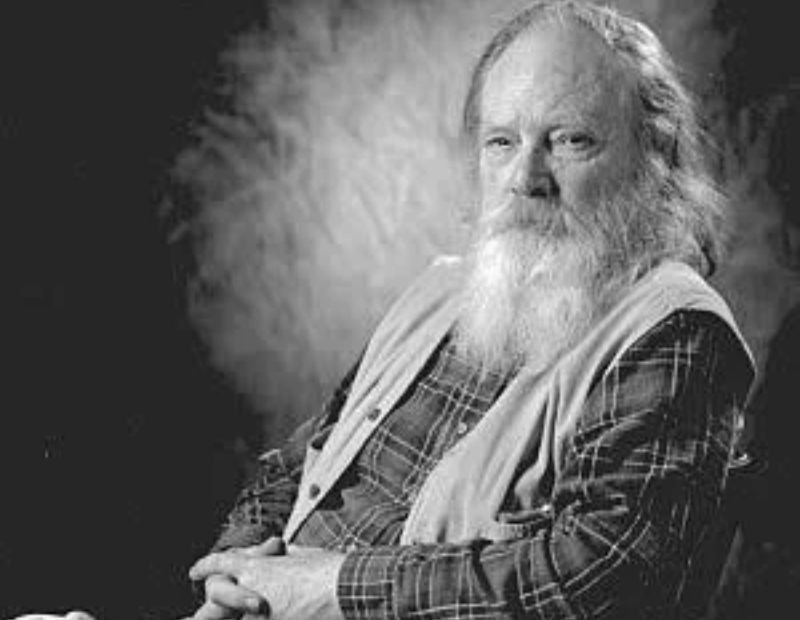
Hayden Carruth (1921 to 2008) was an American poet who spent many years in rural Vermont. His work is direct, emotional and often rooted in working life and the natural world.
What to look for:
- Plain diction: He avoids ornate language and favors honest speech.
- Jazz influence: Rhythm and improvisation echo his love of music, especially in his collection Scrambled Eggs & Whiskey, which won the National Book Award in 1996.
- Social conscience: His poems often question what art can do in a violent or unjust world.
- Personal struggle: Depression and recovery shaped some of his most striking work.
A good starting point is “On Being Asked to Write a Poem Against the War in Vietnam.” It reflects on whether poetry can have any power against war. When you analyze it, ask how the speaker’s tone shows frustration, humility and moral weight at once.
Smile Poetry Analysis
“Smile” is a popular topic, and the exact poem varies, so start by confirming the author and text you are studying. Most poems and songs with this title share a common theme: choosing to smile through pain.
When analyzing any “Smile” poem, ask:
- Is the smile genuine, or a mask?
- Who is the speaker trying to comfort, themselves or someone else?
- Does the tone feel hopeful, weary or both?
- Which images tie the smile to sorrow, such as clouds, tears or hidden hurt?
- Does the poem shift from sadness to resolve?
This approach works for song lyrics too. Treat the words as poetry and apply the same close-reading steps.
Swift Poetry Analysis
“Swift” can point to two very different areas, so here is a quick guide to each.
Jonathan Swift (1667 to 1745): Better known for satire like A Modest Proposal, he also wrote verse that mocks society with sharp wit. When analyzing his poems, focus on irony, exaggeration, couplets and the target of his satire. His poem “A Description of a City Shower” paints urban life with humor and rough detail.
Taylor Swift: Her songs are often studied as contemporary poetry. Analyze storytelling, imagery, bridge shifts and the speaker’s changing emotions. Treat the lyrics as text, with attention to metaphor, repetition and narrative voice.
In both cases, ask what the writer wants you to feel, and which devices build that feeling.
Famous Poetry Analysis: Where to Start?
If you are new to analysis, begin with poems that are short, rich and widely discussed.
| Poem | Poet | Good Focus for Analysis |
|---|---|---|
| “The Road Not Taken” | Robert Frost | Irony, tone and the speaker’s reliability |
| “Ozymandias” | Percy Bysshe Shelley | Irony, imagery and the theme of power |
| “Sonnet 18” | William Shakespeare | Metaphor, volta and the idea of immortality |
| “Daffodils” | William Wordsworth | Nature imagery and memory |
| “The Raven” | Edgar Allan Poe | Sound devices, refrain and mood |
| “Still I Rise” | Maya Angelou | Repetition, defiance and tone |
Analyzing poems you already know makes it easier to see how the method works.
Poetry Analysis Websites
These trusted sites offer poems, guides and study help:
- Poetry Foundation: a large archive with biographies and essays
- Poets.org: from the Academy of American Poets, with glossaries and teaching resources
- LitCharts: clear summaries and device breakdowns
- SparkNotes and Shmoop: helpful for students needing quick guidance
- Purdue OWL: reliable advice on writing about literature
- Genius: annotated lines, useful but best checked against other sources
Use these tools to check your thinking, not to replace it.
Poetry Analysis Books
Reading a good guide will sharpen your skills. These are widely respected:
- How to Read a Poem by Edward Hirsch: warm and passionate, great for general readers
- Sound and Sense by Laurence Perrine: a classic textbook used in many classrooms
- A Poetry Handbook by Mary Oliver: practical advice on sound and craft
- The Ode Less Travelled by Stephen Fry: a friendly guide to meter and form
- Poems, Poets, Poetry by Helen Vendler: an anthology with close-reading support
Poetry Analysis Questions and Answers
Practice questions help you build the habit of looking closer. Try these on any poem.
- Who is the speaker, and what is their situation?
- What is the tone, and does it change?
- Which images stand out, and what feeling do they create?
- How do the line breaks and stanzas affect the pace?
- Where does the poem shift?
- What does the title add after you finish reading?
- What is the central theme in one sentence?
For each question, aim for a short answer backed by a quoted word or phrase.
Expert Tips for Better Poetry Analysis
- Read slowly and more than once. The second and third readings reveal the most.
- Keep a notebook. Jot down questions, reactions and word meanings.
- Look up unfamiliar words. A single unknown term can hide a whole meaning.
- Trust your first reaction, then test it. Check whether the text supports it.
- Avoid forcing symbols. Not every object stands for something deeper.
- Quote small. A few well-chosen words usually serve you better than a full line.
- Compare poems. Seeing two poets handle the same theme sharpens your eye.
- Read about the poet after your first reading. Context helps, but your own response comes first.
- Practice often. Skill grows with repetition, just like learning an instrument.
Common Mistakes to Avoid
- Summarizing the poem instead of analyzing it
- Naming devices without explaining their effect
- Treating the speaker as the poet in every case
- Ignoring form, punctuation and line breaks
- Claiming a single “correct” meaning
- Writing a long paragraph with no clear point
Frequently Asked Questions
What is poetry analysis?
Poetry analysis is the close study of a poem’s language, form, structure and context to understand its meaning and effect.
How do you start poetry analysis?
Read it several times, once aloud, then note the title, speaker, tone and any striking images or patterns.
What is TP-CASTT?
TP-CASTT is a seven-step method: Title, Paraphrase, Connotation, Attitude, Shift, Title again and Theme.
What are the main elements of a poem?
The main elements are speaker, theme, tone, mood, imagery, diction, form, structure, sound and context.
How long should a poetry analysis be?
Most school essays run 500 to 1,000 words, but always follow your assignment instructions.
What is the difference between tone and mood?
Tone is the speaker’s attitude, while mood is the feeling the poem creates in the reader.
How do you write a thesis for a poetry analysis?
Combine the poem’s theme with the techniques that express it, then phrase it as a claim someone could argue with.
Can I use a poetry analysis generator?
Yes, for a first look, but verify its claims and write your own interpretation.
What is the best way to prepare for AP Lit poetry questions?
Practice timed essays, use TP-CASTT for planning, and focus on explaining how devices create meaning.
Is there one correct interpretation of a poem?
No, several readings can be valid if each is supported by evidence from the text.
Why do poets use figurative language?
Figurative language lets poets express complex feelings and ideas through vivid comparisons and images.
What is a volta in poetry?
A volta is a turn in thought or tone, common in sonnets, where the poem changes direction.
Conclusion
Poetry analysis is a skill you build one poem at a time. Start with a careful reading, notice the speaker, language and structure, and always explain how each choice shapes meaning. Use frameworks like TP-CASTT when you feel stuck, and let writers like Dickinson, Moore and Carruth show you how different styles reward different questions.
The more poems you analyze, the faster you will spot patterns and the more you will enjoy what you find. Pick a poem today, read it aloud, and see what it tells you.