
Poetry has a reputation for being serious, quiet and a little scary. Poetry games flip that idea upside down. They turn rhyme, rhythm and imagery into something you can touch, shuffle, race against and laugh about.
This guide covers more than 25 poetry games for kids, students, adults and classrooms. You will find free and online options, board games, surrealist experiments and simple ideas you can start in five minutes with a pen and a sheet of paper.
What Are Poetry Games?
Poetry games are playful activities that use the tools of poetry, such as rhyme, rhythm, word choice and imagery, to help people read, write or perform poems in a fun and low-pressure way.
Some are quick word challenges. Others are team contests, card games or full board games. Some are digital, and some are made from wooden blocks or fridge magnets.
The idea is old. People have played with verse for centuries through riddles, rhyming contests and parlor games. Today, galleries and libraries even stage exhibitions of poetry games. One recent London show at the National Poetry Library brought together interactive games and puzzles that join the worlds of poetry and play.
A poetry game usually has three things:
- A prompt or constraint, such as “use only these ten words.”
- A simple rule, such as a timer, a turn order or a scoring system.
- A creative result, such as a line, a stanza or a whole poem.
Read Also This Blog: Poetry for Neanderthals
Why Poetry Games Work?
Games lower the fear of the blank page. When there is a rule to follow, nobody has to be “good at poetry.” They only have to play.
Here are the main benefits:
- Builds vocabulary. Players hunt for stronger, more precise words.
- Teaches poetic devices. Metaphor, simile, alliteration and onomatopoeia stick faster when they are part of a challenge.
- Boosts confidence. Short, silly poems feel safe to share.
- Encourages teamwork. Many games are collaborative.
- Supports reading and spelling. Rhyme and rhythm train the ear.
- Makes revision easier. Players edit without noticing they are editing.
Teaching resources often point out that poetry games help make poetry approachable for all kinds of learners and can reinforce vocabulary and grammar while making lessons more memorable. twinkl
Elements of Poetry Games
Before you pick a game, it helps to know which poetry element it trains. Use this table to match the game to your goal.
| Poetry Element | What It Means | Game That Practices It |
|---|---|---|
| Rhyme | Words with matching end sounds | Rhyme Chain, Rhyming Dominoes |
| Rhythm and Meter | The beat of a line | Clap the Beat, Poetry Charades |
| Imagery | Words that paint a picture | Paint Chip Poetry, Blackout Poetry |
| Metaphor and Simile | Comparing two things | Metaphor Mash-Up |
| Alliteration | Repeated starting sounds | Tongue Twister Poems |
| Form | Structure such as haiku or acrostic | Acrostic Challenge, Haiku Dice |
| Voice and Tone | The speaker’s attitude | Poetry Slam, Poetry Speed Dating |
| Word Choice | Picking the most exact word | Magnetic Poetry, Word Bank Poems |
Fun Poetry Games to Play Anywhere

These need almost no setup. They work at home, in a car, at a party or in a classroom.
1. Magnetic Poetry
Scatter word magnets on a fridge or whiteboard. Players build lines from only the words in front of them. The limits force surprising choices. You can make your own set by cutting up printed word lists.
2. Book Spine Poetry
Stack books so the titles read like lines of a poem. Take a photo and share it. It is quiet, visual and great for library visits.
3. Paint Chip Poetry
Grab free paint sample cards from a hardware store. The color names are already poetic, with titles like “Dusty Lavender” or “Morning Fog.” Use them as lines or as a spark for a new poem.
4. Found Poetry
Take words from a newspaper, menu, label or old book. Circle the ones you like and arrange them into a poem. You do not add any words of your own. You only choose and order.
5. Poetry for Neanderthals
This is a popular party game in the style of a word-guessing contest. Players must describe a poetic phrase using only one-syllable words. It is loud, funny and a great fit for adult game nights.
6. Rhyme Chain
One player says a word. The next says a word that rhymes. Keep going until someone is stuck. Then start again with a new word. Add a rule that no word can repeat.
7. Acrostic Challenge
Pick a word, write its letters down the page, and build a line from each letter. Names, seasons and feelings all work well. Set a two-minute timer for extra energy.
8. Haiku Dice
Roll dice that carry words, or use word cards. Build a haiku with five, seven and five syllables. Commercial sets exist, but you can write words on blank dice.
9. Sticky Note Poetry
Everyone writes one word or line on a sticky note. Stick them on a wall, then move them around until a poem appears. It is a good group warm-up.
10. Poetry Snowball Fight
Write a line on scrap paper and crumple it into a ball. Throw the snowballs around the room. Each player grabs one, reads it, and adds a line. This is a favorite in lively classrooms.
Poetry Games for Kids
Children learn best when they move, talk and laugh. The best poetry games for kids are short, silly and sound-based.
11. Poetry Charades
Act out a poem or a poetic image without speaking. Others guess the phrase. It teaches kids how words create pictures.
12. Mad Lib Poems
Write a simple poem with blank spaces. Ask players to fill the gaps with nouns, verbs and adjectives. Read the finished poem aloud. The strange results make children giggle, and they also review parts of speech.
13. Sound Hunt
Walk around the house or garden. Write down every sound you hear. Then turn the list into a poem using onomatopoeia, like “buzz,” “crunch” and “splash.”
14. Rhyming Dominoes
Make domino-style cards with a word on each half. Players match a card to a rhyming card. Ready-made kits exist too. One children’s kit led by a former Children’s Laureate includes 500 word cards, rhyming dominoes and a poetry spinner, with games from acrostics to concrete poems. nationaltheatre
15. Poetry Bingo
Make bingo cards filled with poetry terms or example words such as “simile,” “rhyme” and “stanza.” Read short poems aloud. Kids mark the device they hear.
Tip for parents: Keep rounds under ten minutes. Praise creative ideas, not perfect spelling or rhyme.
Poetry Games for Middle School
Students aged 11 to 14 like competition and a little humor. These games build skills without feeling babyish.
- Poetry Speed Dating. Place poems on desks. Students move every two minutes, read a new poem, and jot down a quick reaction. At the end, they pick their “match.”
- Metaphor Mash-Up. Draw two random object cards, such as “bicycle” and “sadness.” Write one metaphor that connects them.
- Word Bank Poems. Give students twenty words. They must use at least twelve in a short poem.
- Poetry Recital Relay. Teams memorize and perform lines in sequence. Judges score voice, pace and expression.
Poetry Games for High School
Older students can handle bigger ideas. Good high school poetry games link creative play to exam skills.
16. Power and Conflict Poetry Games
Students studying the Power and Conflict cluster often struggle to remember quotes and themes. Games help.
- Quote Match-Up. Print short quotes and poem titles on separate cards. Pairs race to match them.
- Theme Sort. Sort poems into themes such as war, nature, identity and power.
- Compare and Connect. Draw two poem cards and give a one-minute oral comparison.
- Technique Auction. Teams “bid” on literary techniques they can find in a poem.
17. Blackout Poetry
Take a page from a book or newspaper. Black out most of the words and leave a poem behind. Add small drawings around the remaining text.
18. Poetry Slam
Students write and perform original poems for a live audience. Judges score on content, delivery and originality. A slam combines performance and friendly competition, and teachers often use it to round off a poetry unit. weareteachers
19. Poetry Scavenger Hunt
Hide lines of a poem around the room or school. Students find the lines and put them in the right order. It works well for sonnets and ballads.
Poetry Games for Adults
Adults often say, “I’m not creative,” yet they love a good challenge. The key is to make the game social and a little daring.
20. Poetry Truth or Dare
This is a fun mix of confession and creativity.
- Truth: Share a line from a poem that changed your life, or explain your most hated poem.
- Dare: Write a limerick about the person on your left. Recite a poem in a dramatic accent. Rap a verse of a nursery rhyme.
Keep the dares kind and the mood light. It works well as a party icebreaker or a book club twist.
21. Consequences
Each person writes a line, folds the paper to hide it, and passes it on. After several rounds, unfold and read the full poem. The results are often hilarious.
22. Poetry Pictionary
Draw the imagery of a poem while others guess the line or title. It shows how strongly poems work as pictures.
23. Poetry Jenga
Write lines or words on the blocks of a Jenga set. When you pull a block, read it aloud and add it to the top. An artist-made version of this idea turns the tower into a growing object poem, where players take turns removing blocks, reading the inscriptions and stacking them. belfastbookfestival
Surrealist Poetry Games
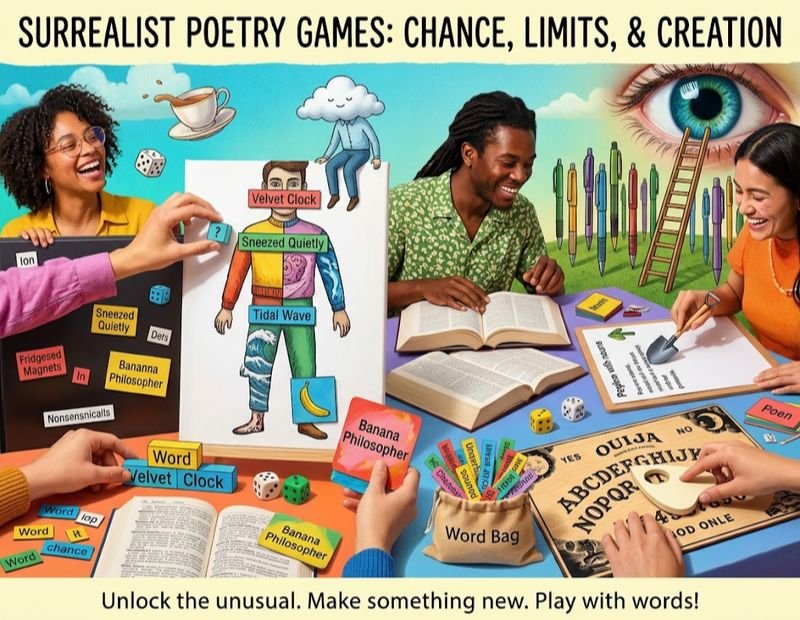
Surrealist and experimental groups loved word games because chance can unlock odd, vivid images. These are some of the best.
24. Exquisite Corpse
Players add a word or phrase to a sentence without seeing what came before. The surprise is the point. A common pattern is adjective, noun, verb, adverb. For example, “The velvet clock sneezed quietly.”
25. Cut-Up Poetry
Cut printed text into strips or single words. Shake them in a bag and pull them out at random. Arrange them into a poem. Edit lightly, but keep the strange leaps.
26. N+7 Method
Take a poem, then replace each noun with the noun seven entries later in a dictionary. The result is a bizarre remix. This comes from the Oulipo group, a literary circle that loved rules and constraints. Their puzzles now appear in books such as the Oulipo puzzle series from small presses, which independent publishers have helped bring back. thebookseller
27. Sound Poetry Ouija
Use a board with phonemes instead of letters. Players move a pointer and build nonsense sounds into performance. A version of this appeared as a playable art piece, built with phonemes for sound poetry games and performances. belfastbookfestival
Classroom Poetry Games
Teachers need games that are quick, low-cost and easy to manage. Here are ideas that work for a whole class.
Pie Corbett Style Poetry Games
Many teachers use the approach popularized by author and literacy expert Pie Corbett. It is built on talk, repetition and imitation. Children first say a poem aloud, learn it with actions, and then change parts of it to make their own.
You can try it like this:
- Pick a short model poem with a strong pattern.
- Say it together with hand movements.
- Swap some key words, such as animals or colors.
- Perform the new version.
Wordwall Poetry Games

Wordwall is a popular tool for turning word lists into interactive activities. Teachers can build:
- Matching games for poets and poems
- Quizzes on poetic devices
- Random wheels for prompts
- Anagram and word search puzzles
It is a strong option when you need a quick, ready-to-play game on a screen. Many templates are free, though you may need an account to save and edit.
Other Classroom Favorites
- Buzz-In Quiz. Teams press a buzzer to name a device in a short poem.
- Rhyme Relay. Teams race to write rhyming pairs on the board.
- Gallery Walk. Students pin up poems, walk around, and leave sticky note feedback.
Poetry Games Online (Free Options)
You do not need to buy anything to play. Search for these types of free online poetry games:
| Type | What You Do | Best For |
|---|---|---|
| Online magnetic poetry | Drag digital word tiles into lines | All ages |
| Poetry quizzes | Answer questions about poets and devices | Students |
| Rhyme generators | Find rhymes for any word | Writers |
| Word match games | Pair quotes with poets | Exam revision |
| Interactive poems | Click or jump to reveal lines | Curious readers |
Some digital projects even let players explore poetry through video game worlds. One poetry platformer, for example, was built from 200 Quebecoise poems with a single reading rule, “jump”. thelondonmagazine
Safety note: Always check an online game’s age rating, ad content and privacy policy before letting children play.
Poetry Board Games and Books
If you prefer physical games, there are many ways to bring poetry to the table.
Poetry Board and Card Games
- Word card sets with hundreds of prompts and tiles
- Rhyming domino sets for early learners
- Letter spinners that choose a starting sound
- Literary trivia games that test knowledge of poets
- Party games like Poetry for Neanderthals
Poetry Games Books
A good book can give you games for years. Look for titles that include:
- Writing prompts and constraints
- Classroom activity plans
- Form guides for haiku, limerick and sonnet
- Experimental games from the Oulipo tradition
Pick a book that matches your player’s age and reading level.
Quick Guide: Best Poetry Game by Age
| Age Group | Best Game Types | Example |
|---|---|---|
| 5 to 8 | Sound and rhyme games | Rhyming Dominoes |
| 9 to 11 | Word banks and simple forms | Acrostic Challenge |
| 12 to 14 | Competitive and creative | Poetry Speed Dating |
| 15 to 18 | Analytical and performance | Quote Match-Up, Poetry Slam |
| Adults | Social and experimental | Truth or Dare, Exquisite Corpse |
How to Run a Great Poetry Game Session
Good games need good setup. Follow these steps.
- Pick one goal. Is it rhyme, imagery or confidence?
- Keep rules short. If you need more than three sentences to explain, simplify.
- Use a timer. Short deadlines reduce overthinking.
- Model first. Show one example before players begin.
- Celebrate bold choices. Silly lines are welcome.
- Share the results. Read poems aloud or display them.
- Reflect briefly. Ask, “Which word surprised you?”
Common Mistakes to Avoid
- Making the game too long
- Correcting spelling during the creative stage
- Forcing every poem to rhyme
- Choosing a game that is too hard for the age group
- Skipping the sharing step
Tips to Make Poetry Games More Inclusive
- Offer both written and spoken options.
- Allow players to work in pairs or small groups.
- Provide word banks for English language learners.
- Use large print or audio support when needed.
- Let players pass without pressure.
Conclusion
Poetry games prove that verse does not have to feel heavy. A handful of magnets, a stack of books or a bag of cut-up words can turn a quiet afternoon into a lively creative session.
Start small. Choose one game from this list, set a timer, and play for ten minutes. You may be surprised by how quickly people relax and start writing. Whether you are a parent, teacher, student or lifelong word lover, there is a poetry game here for you.
Frequently Asked Questions
What are poetry games?
Poetry games are playful activities that use rhyme, rhythm and word play to help people read, write or perform poems. They can be played alone, in pairs or in groups.
What are the best poetry games for kids?
Rhyming dominoes, sound hunts, mad lib poems and poetry bingo are great for children. They are short, silly and focused on sound.
What are good poetry games for adults?
Poetry Truth or Dare, Consequences, Exquisite Corpse and Poetry for Neanderthals work well for adults. They are social and need little preparation.
Are there free poetry games online?
Yes. Look for online magnetic poetry, rhyme generators, quizzes and Wordwall templates. Many are free to play.
What are good poetry games for high school students?
Blackout poetry, quote match-ups, poetry slams and scavenger hunts suit teens. They build analysis skills while staying fun.
How can I use poetry games in the classroom?
Pick one goal, keep the rules short and use a timer. Finish with a sharing session so every student is heard.
What is Poetry for Neanderthals?
It is a party game where players describe poetic phrases using only one-syllable words. Teammates try to guess the phrase.
What are surrealist poetry games?
They use chance and constraints to create strange images. Exquisite Corpse and cut-up poetry are the best known.
Do poetry games help with Power and Conflict revision?
Yes. Matching quotes to poems and sorting poems by theme make key details easier to remember.
What are the elements of poetry games?
Most games rely on rhyme, rhythm, imagery, word choice and form. A clear rule and a creative challenge turn those elements into play.