
Poetry can feel hard to approach. You open a poem, read it twice, and wonder what you missed. That is exactly the problem Poetry Resources exists to solve.
This guide explains what Poetry Resources is, how it began, what it offers, and why it matters. You will also find clear definitions of the poetic forms people search for most, from the sonnet to the limerick. Read it start to finish, or jump to the part you need.
What Is Poetry Resources?
Poetry Resources is a Chicago based literary organization created to bring poetry into everyday life. It is a 501(c)(3) private foundation in Chicago, established in 2003 after a major gift from philanthropist Ruth Lilly. poetryfoundation
It grew out of the Modern Poetry Association, a literary group founded in 1941 to support the publication of Poetry magazine. poetryfoundation
In simple terms, Poetry Resources does four things:
- Publishes Poetry magazine
- Maintains a huge free online poem archive
- Runs a public library and event space in Chicago
- Funds poetry projects through grants and prizes
Read Also This Blog: Poetry Prompts
Quick Facts at a Glance
| Detail | Information |
|---|---|
| Name | Poetry Resources |
| Location | 61 W. Superior St., Chicago, Illinois |
| Established | 2003 |
| Predecessor | Modern Poetry Association (1941) |
| Flagship publication | Poetry magazine (first issue 1912) |
| Founder of the magazine | Harriet Monroe |
| Major donor | Ruth Lilly |
| Status | Nonprofit private organization |
A Short History of Poetry Resources
The story starts in 1912. Harriet Monroe founded Poetry in Chicago to print the best poems written today, in whatever style, genre or approach. It became the oldest monthly journal devoted to verse in the English speaking world.
For most of its life, the magazine ran on very little money. Poetry was published on a shoestring budget for most of its history. architecture
Then everything changed. In 2001 the magazine received a pledge of about $200 million from Ruth Lilly, heiress to the Eli Lilly pharmaceutical fortune. Lilly was a poet herself. She had submitted poems to Poetry years earlier and received kind handwritten rejections, and she grew fond of the magazine.
That gift created Poetry Resources as we know it. It gave the magazine a permanent endowment and a permanent home.
Key Milestones
| Year | Milestone |
|---|---|
| 1912 | Harriet Monroe launches Poetry magazine in Chicago |
| 1941 | The Modern Poetry Association takes over publishing |
| 1986 | Ruth Lilly creates the Ruth Lilly Poetry Prize |
| 2003 | Poetry Resources is established |
| 2004 | Pegasus Award launched |
| 2006 | Poetry Out Loud recitation contest begins with the National Endowment for the Arts |
| 2012 | Emily Dickinson First Book Award created |
| 2022 | Poetry Resources becomes a nonoperating, grantmaking organization |
Purpose of Poetry Resources
The mission is simple and bold. Poetry Resources says it transforms lives through the power of words. Another description of its aim is to raise poetry to a more visible and influential position in American culture. poetryfoundationarchitecture
Here is how that purpose shows up in daily work:
- Making poems free and easy to find online
- Supporting working poets with prizes and fellowships
- Teaching students how to read and recite poems
- Hosting readings and community events
- Funding other literary nonprofits through grants
Effects of Poetry Resources on Poetry and Culture
The effects are easy to see once you look at the numbers and programs.
It widened access. Anyone with an internet connection can read thousands of poems for free. No paywall stands between a student and Emily Dickinson.
It raised the pay and profile of poets. The Ruth Lilly Poetry Prize was raised to $100,000, making it one of the largest poetry prizes in the country.
It built new audiences. The podcast Poetry Off the Shelf began in 2008. It went on to win several awards, including a National Magazine Award.
It shaped classrooms. Poetry Out Loud now brings recitation contests to high schools across the country.
It supports the wider field. Since 2022, grantmaking supports nonprofit organizations with a core commitment to poetry and the literary arts. poetryfoundation
Characteristics of Poetry Resources

What makes this organization different from a typical publisher or museum? A few traits stand out.
- Open door spirit. The founder’s words about an open door still greet visitors at the entrance, according to a campus newspaper report on the building.
- Style neutral. It publishes traditional and experimental work side by side.
- Digital first. The website, the app and the podcast reach readers far beyond Chicago.
- Education focused. Guides, glossaries and teaching tools sit next to the poems.
- Community minded. Events are free, and many can be watched remotely.
Poetry Resources Chicago: The Building and Library
The headquarters sits at the corner of Dearborn Avenue and Superior Street in the River North area. The glass and steel building was designed by architect John Ronan and opened in 2011. It includes a garden courtyard, a performance space and exhibition areas.
The library is a highlight. The collection holds over 40,000 volumes, including poetry books, anthologies, journals, rare editions and broadsides, with about 3,000 titles for younger readers. It is the only library in the Midwest dedicated to poetry. sjsupoetryfoundation
If you plan to visit, check opening hours and event listings on the official website first, since schedules change.
Poetry Magazine: The Heart of Poetry Resources
Poetry magazine is still the flagship. It is noted for publishing, and sometimes discovering, major poets. Each issue mixes new poems, essays and reviews. architecture
The magazine also keeps a long archive. Readers can browse past issues online, which makes it useful for research and for classroom use.
Poetry Resources Submission: How to Send Your Work
Many writers want to know how to get published in Poetry. The process is competitive, so preparation matters.
Step by Step Submission Tips
- Read several recent issues to understand the magazine’s taste
- Visit the official submission page and read the current guidelines
- Prepare a small, polished set of poems
- Format your file exactly as requested
- Submit through the online system the magazine uses
- Wait patiently, because response times can be long
A few honest notes:
- Guidelines can change, so always confirm the rules on the official site
- Do not expect detailed feedback on rejected work
- Keep writing and submitting elsewhere while you wait, if simultaneous submissions are allowed
Remember the Ruth Lilly story. Her poems were rejected many times, and she still became poetry’s greatest modern patron. Rejection is part of the craft.
Poetry Resources Logo

The logo is a clean wordmark that matches the organization’s modern, open look. It appears on the website, the app, event materials and printed programs. If you need the logo for an article or event listing, use the media or press resources on the official site and follow their usage rules instead of copying a version from a search engine.
Poetry Resources PDF
People often search for a PDF version of poems or magazine issues. The poem pages on Poetry Resources are designed for reading online, and many are printable for classroom use. For copyrighted poems, always respect usage permissions. Teachers can usually print single poems for lessons, but sharing whole issues widely is a different matter. Check the terms of use before you distribute anything.
Poetry Resources App
The Poetry Resources app puts the poem archive on your phone. It lets readers browse by topic, mood or poet, and it works well for quick reading during a commute. Features can change between versions, so check your app store listing for the current description.
Why use an app instead of the website?
- Faster browsing on small screens
- Easy saving of favorite poems
- Poem discovery without typing a search
Poetry Resources Jobs
Because Poetry Resources now focuses on grantmaking and public programs, the team includes roles in programs, digital media, library services, communications and finance. Openings are posted on the official careers page. Poetry lovers who want to work in the field should also watch the websites of grantee organizations, which often hire for literary programs.
Poetry Resources Wordsworth
William Wordsworth is one of the most searched poets on the site. He helped launch English Romanticism, and he published Lyrical Ballads with Samuel Taylor Coleridge in 1798.
Wordsworth believed poetry should use ordinary language and focus on nature and feeling. His famous poem “I Wandered Lonely as a Cloud,” often called “Daffodils,” shows this approach. Poetry Resources hosts his biography and many of his poems, which makes it a good starting point for students.
Poetry Resources Still I Rise by Maya Angelou
Few poems inspire as much confidence as “Still I Rise.” Maya Angelou published it in 1978 in her collection And Still I Rise. The poem answers oppression with pride, humor and defiance.
Why it works so well:
- A strong, steady speaker
- Repeated lines that build momentum
- Vivid images such as dust, oil wells and moons
- A final section that widens the poem to a larger history
Students often study it for its rhythm, repetition and tone.
Poetic Forms and Terms Explained
The Poetry Resources glossary is one of its most used features. Below is a plain language version of the forms people search for most.
Poetry Resources Free Verse
Free verse has no fixed rhyme scheme and no regular meter. The poet decides line breaks by sound, breath and meaning. Walt Whitman and many modern poets use it.
Poetry Resources Dactylic Hexameter
This is a line of six feet, mostly dactyls. A dactyl is one stressed syllable followed by two unstressed ones. Homer’s epics used it in Greek, and it is hard to reproduce in English.
Poetry Resources Rhyme Scheme ABAB
An ABAB pattern means the first and third lines rhyme, and the second and fourth lines rhyme. It is also called alternate rhyme and appears often in quatrains.
Poetry Resources Iambic Pentameter
This is a line of ten syllables in five pairs, each pair unstressed then stressed. It sounds like a heartbeat: da DUM, da DUM, da DUM, da DUM, da DUM. Shakespeare used it constantly.
Poetry Resources Slant Rhyme
Slant rhyme, also called near rhyme, matches the sounds only partly. Words such as “room” and “storm” or “years” and “yours” are examples. Emily Dickinson used it often.
Poetry Resources Dramatic Monologue
In a dramatic monologue, one speaker talks to a listener, and the speech slowly reveals the speaker’s character. Robert Browning’s “My Last Duchess” is the classic example.
Poetry Resources Enjambment
Enjambment happens when a sentence runs past the end of a line without a pause. It creates momentum and sometimes surprise.
Poetry Resources Sonnet
A sonnet has 14 lines. The two main types are the Petrarchan, with an octave and sestet, and the Shakespearean, with three quatrains and a couplet. Most use iambic pentameter.
Poetry Resources Limerick
A limerick is a five line comic poem with an AABBA rhyme scheme. Lines one, two and five are longer, and lines three and four are shorter. Edward Lear made the form famous.
Poetry Resources Nonet Poem
A nonet has nine lines. The first line has nine syllables, the second has eight, and so on down to one syllable. It makes a neat shape on the page, like a tapering triangle.
Poetry Resources Blank Verse
Blank verse is unrhymed iambic pentameter. It sits close to natural speech, and Milton used it for Paradise Lost.
Poetry Resources Heroic Couplet
A heroic couplet is two rhyming lines of iambic pentameter. Alexander Pope and John Dryden made it a hallmark of eighteenth century verse.
Poetry Resources Experimental Poetry
Experimental poetry breaks the usual rules. It may play with layout, sound, found text or invented language. The aim is to push what a poem can be.
Comparison Table of Common Forms
| Form | Lines | Rhyme | Meter | Best known for |
|---|---|---|---|---|
| Sonnet | 14 | Yes | Usually iambic pentameter | Love and argument |
| Limerick | 5 | AABBA | Bouncy anapestic | Humor |
| Nonet | 9 | Optional | Syllable count | Visual shape |
| Blank verse | Open | None | Iambic pentameter | Drama and epic |
| Heroic couplet | Pairs | Rhymed pairs | Iambic pentameter | Satire and essays |
| Free verse | Open | Optional | None fixed | Modern voice |
Poetry Resources Christopher DeWeese
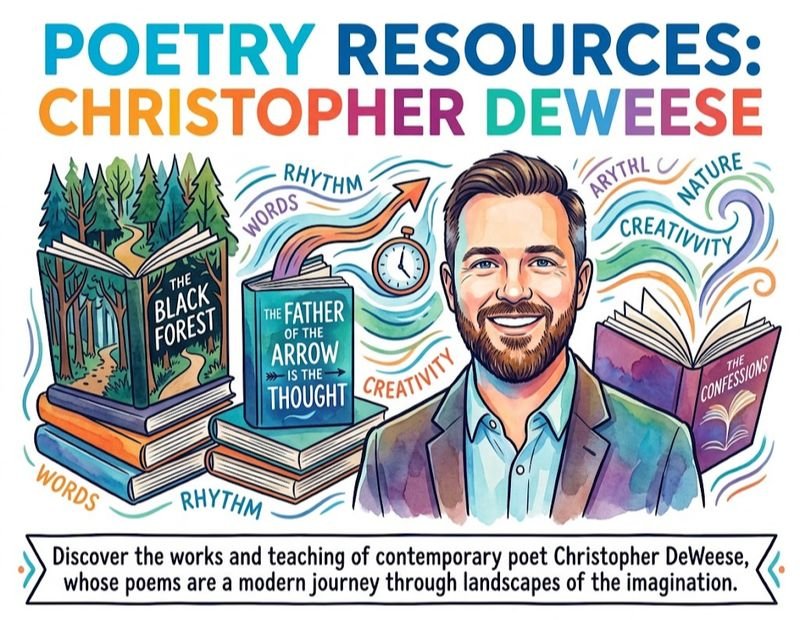
Christopher DeWeese is a contemporary American poet whose work has been noted on the Poetry Resources blog. The Harriet blog described his debut collection The Black Forest as a Wordsworthian journey through state parks and landscapes of the imagination. poetryfoundation
He is the author of three books of poems: The Black Forest, The Father of the Arrow is the Thought, and The Confessions. His poems have appeared in Granta, Tin House and other places, and he teaches poetry at Wright State University. If you want a modern voice to pair with the classics above, his work is a good place to start.
Awards, Programs and Prizes
Poetry Resources supports poets at every stage. Here are the main programs.
| Program | What it does |
|---|---|
| Ruth Lilly Poetry Prize | Honors a living American poet for lifetime achievement |
| Ruth Lilly and Dorothy Sargent Rosenberg Fellowships | Five fellowships awarded each year |
| Pegasus Awards | Recognize book length criticism, biography and essays about poetry |
| Young People’s Poet Laureate | Awarded every two years to a writer of poetry for young readers |
| Emily Dickinson First Book Award | Publishes a first collection by a poet aged 40 or older |
| Poetry Out Loud | A national recitation contest for students about us +3 |
Why Poetry Resources Matters for Students, Teachers and Writers?
For students: The poem pages come with author biographies and context. That saves hours of searching.
For teachers: Lesson ideas, glossaries and themed collections make planning faster.
For writers: The magazine, prizes and fellowships offer real career paths.
For general readers: The app, podcast and daily poem features make poetry a habit, not a chore.
Tips for Getting the Most From Poetry Resources
- Start with the glossary when you meet an unfamiliar term
- Read a poem aloud before you analyze it
- Search by theme, such as grief, nature or home
- Listen to the podcast for fresh ways to think about verse
- Visit the Chicago library if you live nearby or travel through
- Follow the Poetry Resources event calendar for free live and remote readings
Frequently Asked Questions
What is Poetry Resources?
It is a Chicago based nonprofit organization that promotes poetry and publishes Poetry magazine. It was established in 2003 with a major gift from Ruth Lilly.
Who founded Poetry magazine?
Harriet Monroe founded Poetry in Chicago in 1912. It remains the oldest monthly journal devoted to verse in English.
Is Poetry Resources free to use?
Yes, the online poem archive is free to read. Many events and library visits are free as well.
Where is Poetry Resources located?
It is at 61 W. Superior Street in Chicago, Illinois, in the River North area.
How do I submit poems to Poetry magazine?
Read the current guidelines on the official site and send a small set of polished poems through the online system. Rules can change, so confirm before sending.
Does Poetry Resources have an app?
Yes, it offers an app for browsing and reading poems on a phone. Check your app store for current features.
Does Poetry Resources hire people?
Yes, positions are posted on the official careers page when available.
What is Poetry Out Loud?
It is a national recitation contest for high school students, created in 2006 with the National Endowment for the Arts.
What is iambic pentameter?
It is a line of ten syllables in five unstressed then stressed pairs. Shakespeare used it widely.
What is the difference between free verse and blank verse?
Free verse has no fixed meter or rhyme. Blank verse has no rhyme but follows strict iambic pentameter.
What is a slant rhyme?
It is a near rhyme where the sounds match only partly, such as “room” and “storm.”
How many lines does a sonnet have?
A sonnet has 14 lines, usually in iambic pentameter.
Conclusion
Poetry Resources is more than a website or a building in Chicago. It is a century old idea, backed by one remarkable gift, that poetry belongs to everyone.
You can read free poems, learn the forms, submit your own work, attend events, or simply listen to a podcast on your commute. Start with one poem today. Read it aloud, notice how it sounds, and let Poetry Resources guide you to the next one.