
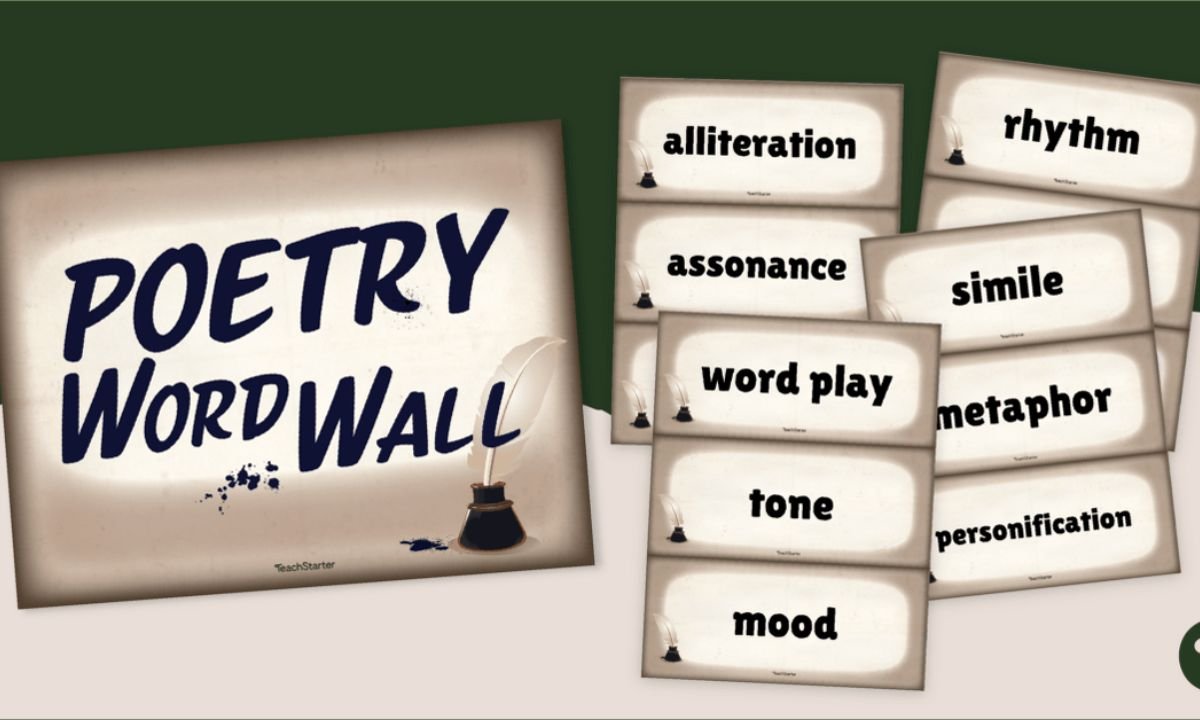
Poetry can feel like a locked door when you do not know the vocabulary behind it. The moment you learn a handful of poetry terms, that door swings open. Suddenly a stanza is not just a block of text, a metaphor is not just a fancy sentence, and meter starts to make sense as a rhythm you can actually hear.
This guide is built for beginners, students preparing for GCSE or AP Lit exams, and anyone who wants a simple poetry terms glossary they can return to again and again. You will find basic poetry terms, technical poetry terms, poetry structure terms, and common poetry terms explained in plain English, with examples that make each definition click.
What Are Poetry Terms?
Poetry terms are the specific words used to describe the structure, sound, and meaning inside a poem. They help readers, writers, and students talk about poetry using a shared language.
Think of poetry terms as tools in a toolbox. A poet uses rhyme, rhythm, imagery, and figurative language the same way a builder uses a hammer and a level. Once you know what each tool does, you can spot it in any poem and understand why the poet chose it.
Read Also This Blog: Sufi Poetry in Urdu
Why Learning Poetry Terminology Matters?
Understanding poetry terms is not just for English majors. It helps in real, practical ways:
- It makes poetry analysis easier during GCSE and AP Lit exams 📘
- It improves your own writing, whether you write poems, lyrics, or captions 🖊️
- It helps you appreciate why a poem feels a certain way, not just what it says 💬
- It builds confidence when discussing literature in class or in a poetry terms Quizlet study session 🎯
- It gives you a shared vocabulary for poetry terms word search puzzles, crossword puzzles, and classroom quizzes 🧩
Basic Poetry Terms Every Beginner Should Know
Before diving into the full glossary, it helps to understand the three broad categories that most poetry terms fall into: structure, sound, and figurative language. Almost every technical poetry term you will ever come across fits into one of these three buckets.
Poetry Structure Terms
Structure terms describe how a poem is physically built, from lines to stanzas to entire forms.
| Term | Meaning | Example |
| Stanza | A group of lines forming a unit, similar to a paragraph in prose | A sonnet often uses stanzas of four lines called quatrains |
| Line | A single row of words in a poem | “The woods are lovely, dark and deep” is one line |
| Verse | Another word for a single metrical line, or poetry in general | “Free verse” refers to poetry without a fixed pattern |
| Couplet | Two consecutive lines that usually rhyme | “Shall I compare thee to a summer’s day / Thou art more lovely and more temperate” |
| Quatrain | A four line stanza | Most nursery rhymes use quatrains |
| Stanza break | The space between stanzas | Signals a shift in idea, tone, or time |
| Enjambment | When a sentence or phrase continues past the end of a line without a pause | Creates momentum and surprise |
| End stopped line | A line that ends with natural punctuation, like a period or comma | Gives the reader a clear pause |
| Refrain | A line or group of lines repeated at intervals throughout a poem | Common in songs and ballads |
Sound and Rhythm Terms in Poetry

Sound based poetry terms explain how a poem creates music through repetition, stress, and rhyme.
| Term | Meaning | Example |
| Rhyme | Matching end sounds in two or more lines | “Cat” and “hat” |
| Rhyme scheme | The pattern of rhymes in a poem, marked with letters like ABAB | Helps identify a poem’s form |
| Meter | The rhythmic pattern of stressed and unstressed syllables | Iambic pentameter is the most famous example |
| Iambic pentameter | A line with five pairs of unstressed and stressed syllables | Common in Shakespeare’s sonnets |
| Alliteration | Repetition of consonant sounds at the start of nearby words | “Peter Piper picked a peck” |
| Assonance | Repetition of vowel sounds within nearby words | “The rain in Spain” |
| Consonance | Repetition of consonant sounds anywhere in nearby words, not just at the start | “Pitter patter” |
| Onomatopoeia | A word that imitates the sound it describes | “Buzz,” “clang,” “hiss” |
| Caesura | A pause or break in the middle of a line | Often marked by punctuation |
Figurative Language and Literary Devices in Poetry
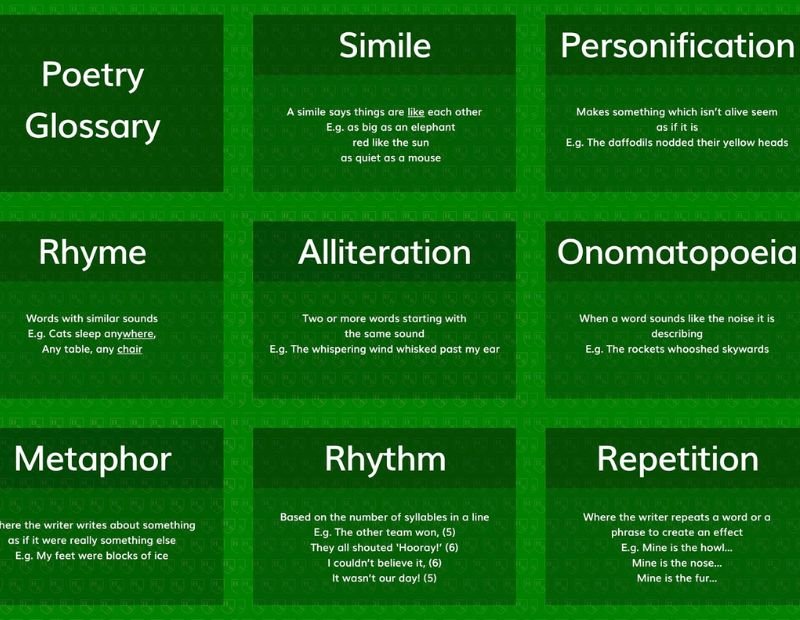
Figurative language terms describe the creative comparisons and images poets use to add deeper meaning.
| Term | Meaning | Example |
| Metaphor | A direct comparison between two unlike things without using “like” or “as” | “Time is a thief” |
| Simile | A comparison using “like” or “as” | “Brave as a lion” |
| Personification | Giving human qualities to non human things | “The wind whispered through the trees” |
| Imagery | Descriptive language that appeals to the five senses | Helps readers see, hear, or feel a scene |
| Symbolism | Using an object or idea to represent something beyond its literal meaning | A dove often symbolizes peace |
| Hyperbole | Deliberate exaggeration for emphasis | “I have told you a million times” |
| Allusion | A brief reference to a person, place, event, or other work | Referencing a Greek myth in a modern poem |
| Apostrophe | Directly addressing someone or something absent or non human | “O Death, be not proud” |
| Irony | A contrast between what is expected and what actually happens | Adds tension or humor to a poem |
Common Poetry Terms Used in AP Lit and GCSE Exams
If you are studying for AP Lit or GCSE English literature, examiners expect you to use precise poetry terminology when analyzing a poem. These are some of the most frequently tested literary poetry terms:
- Tone: the poet’s attitude toward the subject 🎭
- Mood: the emotional atmosphere the reader feels 🌙
- Diction: the poet’s specific word choice ✍️
- Theme: the central message or idea of the poem 💡
- Speaker: the voice narrating the poem, not always the poet 🗣️
- Volta: the turn or shift in argument, often found in sonnets 🔄
- Ambiguity: language that can be interpreted in more than one way ❓
- Juxtaposition: placing two contrasting ideas or images side by side ⚖️
- Connotation: the implied or emotional meaning of a word 💭
- Denotation: the literal dictionary meaning of a word 📖
Examiners reward students who can identify a device and then explain its effect on the reader. Naming a technique is only half the answer; the stronger half is explaining why the poet used it.
Full Poetry Terms Glossary: List of Poetry Terms A to Z
Here is a quick reference list of poetry terms and their meanings. Use this as a poetry terms word search companion, a crossword puzzle helper, or a simple study sheet.
- Ballad: a narrative poem, often set to music, telling a story in short stanzas 🎵
- Blank verse: unrhymed poetry written in a steady meter, usually iambic pentameter 📜
- Cinquain: a five line poem, often with a set syllable pattern 5️⃣
- Elegy: a poem that mourns or reflects on a death or loss 🕊️
- Epic: a long narrative poem about heroic deeds and adventures 🏹
- Free verse: poetry without a fixed rhyme scheme or meter 🌊
- Haiku: a three line Japanese poem, traditionally 5, 7, 5 syllables 🍃
- Limerick: a humorous five line poem with an AABBA rhyme scheme 😄
- Lyric poem: a short poem expressing personal emotion or thought 💗
- Narrative poem: a poem that tells a story with characters and plot 📖
- Ode: a poem written in praise or celebration of a person or thing 🌟
- Sonnet: a fourteen line poem, often about love, following a strict rhyme scheme ❤️
- Villanelle: a nineteen line poem with two repeating rhymes and two refrains 🔁
- Anaphora: repetition of a word or phrase at the start of successive lines 🔂
- Antithesis: placing opposite ideas together for contrast ↔️
- Diction: a poet’s deliberate choice of words 🗒️
- Enjambment: continuing a sentence beyond the line break without a pause ➡️
- Foot: the basic unit of meter, made of stressed and unstressed syllables 🎶
- Free association: linking ideas or images loosely by feeling rather than logic 🌀
- Hyperbole: exaggerated language used for emphasis, not to be taken literally 📈
- Imagery: vivid, sensory description in a poem 🖼️
- Metaphor: an implied comparison between two different things 🌉
- Meter: the rhythmic structure of stressed and unstressed syllables 🥁
- Mood: the emotional atmosphere created for the reader 🌫️
- Onomatopoeia: words that sound like the noise they describe 🔊
- Persona: the character or voice adopted by the poet for a poem 🎭
- Personification: giving human traits to objects, animals, or ideas 🌳
- Prosody: the study of rhythm, stress, and sound patterns in poetry 🎼
- Quatrain: a four line stanza, one of the most common stanza forms 4️⃣
- Refrain: a repeated line or set of lines throughout a poem 🔄
- Rhyme scheme: the pattern in which end rhymes occur 🔤
- Simile: a comparison using “like” or “as” 🌤️
- Stanza: a grouped set of lines forming a section of a poem 📑
- Symbolism: using objects or images to represent larger ideas 🕯️
- Syntax: the arrangement of words and phrases in a line 🧵
- Tone: the poet’s attitude toward the subject or audience 🎙️
- Verse: a single line of poetry, or poetry in general ✒️
- Volta: the turning point in argument or emotion within a poem 🔀
- Alliteration: repeated consonant sounds at the beginning of nearby words 🔤
- Assonance: repeated vowel sounds within nearby words 🎵
- Consonance: repeated consonant sounds anywhere within nearby words 🔡
- Caesura: a pause or break within a line of poetry ⏸️
- Enjambed line: a line that flows into the next without punctuation ➡️
- Iamb: a metrical foot with one unstressed then one stressed syllable ⬆️
- Trochee: a metrical foot with one stressed then one unstressed syllable ⬇️
- Anapest: a metrical foot with two unstressed syllables followed by a stressed one 🎯
- Dactyl: a metrical foot with one stressed syllable followed by two unstressed ones 🎲
- Spondee: a metrical foot made of two stressed syllables in a row 💥
- Litotes: understatement used for emphasis, often using a double negative ➖
- Oxymoron: two contradictory words placed together, like “deafening silence” ⚡
- Paradox: a statement that seems contradictory but reveals a deeper truth 🌀
- Pun: a play on words that uses multiple meanings for humor or effect 😏
- Allusion: an indirect reference to another work, person, or event 📚
- Apostrophe: addressing an absent or non human subject directly 📣
- Epigraph: a short quotation placed at the beginning of a poem 📝
- Motif: a recurring image, idea, or symbol throughout a poem 🔁
- Point of view: the perspective from which the poem is told 👁️
- Rhetorical question: a question asked for effect, not to get an answer ❓
- Repetition: repeating words or phrases for emphasis or rhythm 🔂
- Understatement: presenting something as less significant than it is 🔽
- Denotation: the literal, dictionary definition of a word 📕
- Connotation: the emotional or cultural association attached to a word 💭
Poetry Terms in English vs Technical Poetry Terms
Some poetry terms are used casually in everyday reading, while others are highly technical and appear mostly in academic study. The table below breaks down the difference.
| Category | Examples | Where You Will See Them |
| Everyday poetry terms | Rhyme, stanza, verse, mood, tone | General reading, GCSE lessons |
| Technical poetry terms | Iamb, trochee, caesura, volta, prosody | AP Lit exams, university literature courses |
| Structural poetry terms | Quatrain, couplet, sonnet, villanelle | Poetry writing and form analysis |
| Sound based poetry terms | Alliteration, assonance, consonance, meter | Reading poems aloud, performance poetry |
How to Use Poetry Terms When Analyzing a Poem?
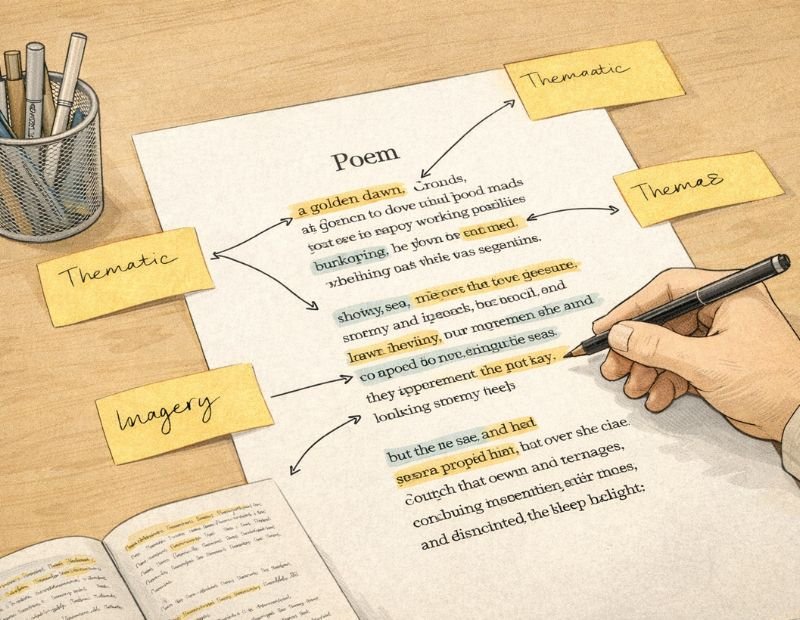
Knowing definitions is only the first step. The real skill is applying poetry terms to actual analysis. Follow these steps:
- Read the poem twice, once silently and once aloud, to catch sound patterns like alliteration and rhyme.
- Identify the structure first. Count the stanzas and lines, and check for a recognizable form like a sonnet or haiku.
- Look for figurative language, including metaphors, similes, and imagery, and underline them as you find them.
- Note the tone and mood, and ask how word choice creates that feeling.
- Connect each device back to the poem’s theme by asking, what effect does this technique have on the reader.
- Use precise poetry terminology in your written response instead of vague words like “technique” or “thing.”
Poetry Terms Quizlet and Study Tips
Many students search for a poetry terms Quizlet set to memorize definitions quickly before an exam. If you want to build your own study set instead of relying on someone else’s, try this simple approach:
- Group terms by category, such as structure, sound, and figurative language, instead of learning them alphabetically 📂
- Pair each term with a short, memorable example rather than just the definition 🧠
- Test yourself by finding examples of each device in a new poem you have never studied before 🔍
- Turn your glossary into flashcards for spaced repetition practice 🗂️
- Practice with a poetry terms crossword puzzle or word search to reinforce spelling and recall 🧩
Frequently Asked Questions
What is the simplest definition of a poetry term?
A poetry term is a specific word used to describe a technique, structure, or sound device found in a poem.
What are the most basic poetry terms for beginners?
Stanza, line, rhyme, meter, and metaphor are the most essential starting points for any beginner.
What is the difference between rhyme and rhythm?
Rhyme is matching end sounds between lines, while rhythm is the pattern of stressed and unstressed syllables.
What poetry terms are commonly tested in GCSE exams?
GCSE exams often test tone, imagery, structure, rhyme scheme, and figurative language like metaphor and simile.
What poetry terms are commonly tested in AP Lit?
AP Lit frequently tests volta, diction, syntax, tone, and more technical devices like caesura and enjambment.
How many poetry terms should a beginner learn first?
Start with around 15 to 20 core terms covering structure, sound, and figurative language before moving to advanced vocabulary.
Is a stanza the same as a paragraph?
A stanza functions like a paragraph in prose, grouping related lines together, but it follows poetic rather than grammatical rules.
What is the easiest way to memorize poetry terms?
Group terms by category and pair each one with a short example, then test yourself using flashcards or quizzes regularly.
Conclusion
Poetry terms are not meant to make poetry harder to understand. They exist to make it easier to talk about what a poem is doing and why it moves us. Once you know the difference between a metaphor and a simile, or a stanza and a verse, poems stop feeling mysterious and start feeling like something you can actually read closely.
Keep this glossary nearby as you study for GCSE or AP Lit, build your own poetry terms Quizlet set, or simply read poetry for pleasure. The more you practice spotting these terms in real poems, the more naturally they will become part of how you read, write, and think about language.