

Rhyming poetry is poetry where words with matching end sounds create rhythm, memory, and music. Think of a nursery rhyme you learned as a child. You still remember it because the rhymes stuck.
This guide covers the meaning, features, types, and rhyme schemes of rhyming poetry. You will also find 26 original poems, writing techniques, contest tips, and answers to common questions. Whether you are a student, a parent, or a hobby writer, you can start writing today.
Rhyming Poetry Meaning
Rhyming poetry is verse in which two or more words share the same ending sound, usually at the end of lines. The repeated sound creates a pleasing echo that readers can hear and feel.
A simple example is “light” and “night.” Both end in the same sound, so they rhyme. When these pairs follow a pattern across a poem, the pattern is called a rhyme scheme.
Rhyme is one of the oldest tools in poetry. It appears in folk songs, hymns, ballads, sonnets, nursery rhymes, and modern lyrics.
Read Also This Blog: Poetry Journals
Characteristics Of Rhyming Poetry
Most rhyming poems share a few clear traits.
- End rhyme: Lines finish with matching sounds.
- Rhyme scheme: A repeating pattern such as AABB or ABAB.
- Rhythm and meter: A steady beat created by stressed and unstressed syllables.
- Stanzas: Lines grouped into couplets, quatrains, or longer blocks.
- Sound devices: Alliteration, assonance, and internal rhyme add extra music.
- Compact language: Every word must earn its place.
Effects Of Rhyming Poetry On Reader
Rhyme changes how a poem feels. Readers often notice these effects.
- Better memory: Rhymed lines are easier to recall.
- Musical pleasure: The repeated sounds feel satisfying, like a song chorus.
- Emotional emphasis: A rhyme can spotlight a key idea.
- Anticipation: Readers sense the next rhyme coming, which builds momentum.
- Surprise and humor: A clever or unexpected rhyme can make people smile.
When a poet breaks an established rhyme on purpose, it can create tension or unease. That is why skilled poets treat rhyme as a choice, not a habit.
Purpose Of Rhyming Poetry
Why do poets rhyme? The main purposes are simple.
- To make language beautiful and musical.
- To help readers remember ideas, lessons, or stories.
- To give a poem structure and shape.
- To teach sounds, spelling, and vocabulary, especially to children.
- To express emotion in a controlled, memorable form.
Types Of Rhyming Poetry
Rhyme comes in different forms. Knowing them gives you more tools.
Types Of Rhyme
| Type | How It Works | Example |
|---|---|---|
| Perfect rhyme (full rhyme) | Ending sounds match exactly | cat and hat |
| Slant rhyme (near or half rhyme) | Sounds are similar, not identical | shape and keep |
| Internal rhyme | A rhyme inside one line or between lines | “The night took flight” |
| Eye rhyme | Spelled alike, pronounced differently | love and move |
| Masculine rhyme | Rhyme on a stressed final syllable | stay and play |
| Feminine rhyme | Rhyme on two syllables, the last unstressed | tender and surrender |
Popular Rhyming Poem Forms
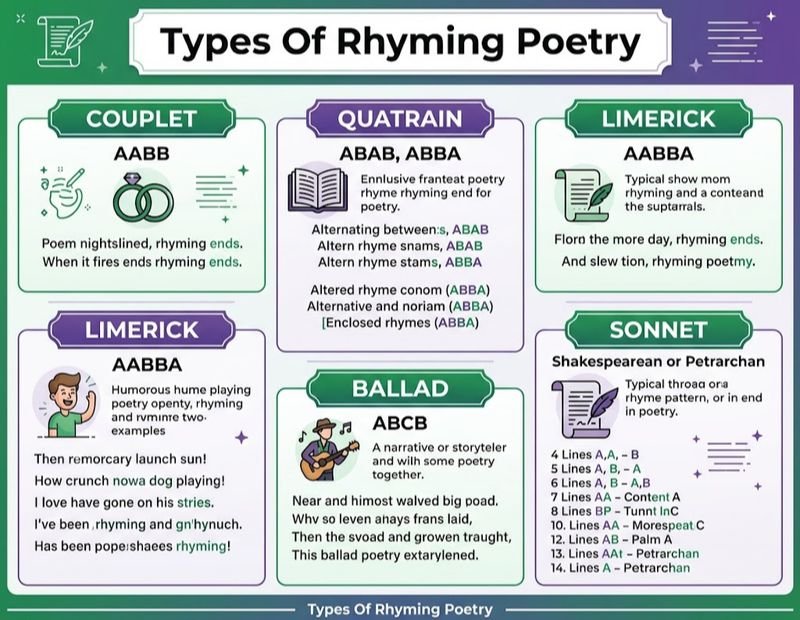
- Couplet: Two rhyming lines.
- Quatrain: Four lines with a chosen scheme.
- Limerick: Five funny lines, AABBA.
- Ballad: Story poem, often ABCB.
- Sonnet: Fourteen lines with a set pattern.
- Villanelle: Nineteen lines with repeating refrains.
- Terza rima: Interlocking three line stanzas.
Rhyming Patterns In Poetry
A rhyming pattern is the order in which end sounds repeat. Poets mark each new sound with a letter. The first sound is A, the next new sound is B, and so on.
Rhyming Scheme In Poetry
| Scheme | Pattern | Common Use |
|---|---|---|
| AA BB | Couplets, lines rhyme in pairs | Children’s verse, simple poems |
| ABAB | Alternate rhyme | Songs, quatrains, hymns |
| ABBA | Enclosed rhyme | Elegies, reflective poems |
| ABCB | Only lines two and four rhyme | Ballads, beginner friendly |
| AABBA | Limerick pattern | Humor, light verse |
| AAAA | Monorhyme | Playful or chant like poems |
| ABA BCB CDC | Chain rhyme (terza rima) | Long narrative poems |
If you are new to this, start with AABB or ABAB. Both are easy to hear and easy to control.
What Is Rhyming Poetry Called?
Rhyming poetry is called rhymed verse or metrical verse when it also follows a steady meter. Traditional forms such as sonnets, ballads, and limericks are all types of rhyming poetry.
What Is Non Rhyming Poetry Called?
Poetry without rhyme is usually called free verse or blank verse. Free verse has no fixed rhyme or meter. Blank verse has a steady meter, usually iambic pentameter, but no rhyme.
Non Rhyming Poetry Crossword
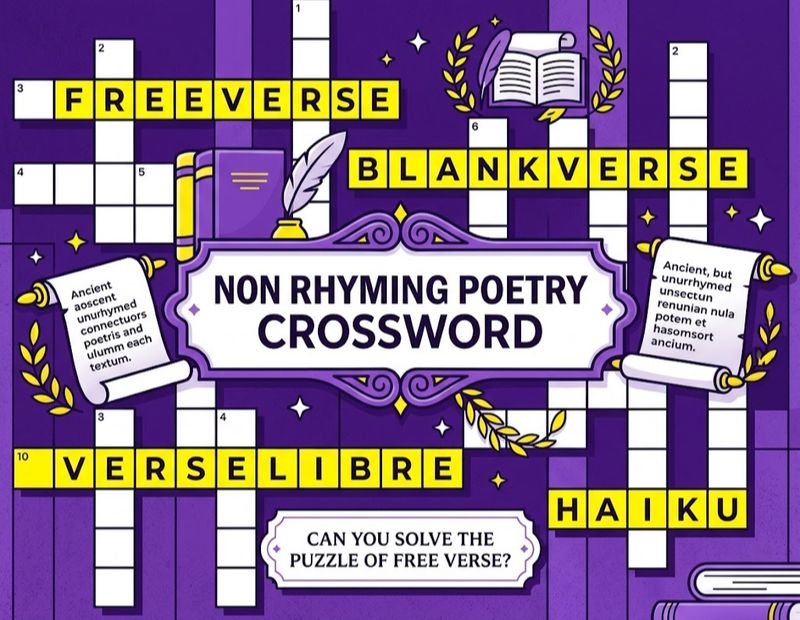
Stuck on a clue? These are the usual answers for “non rhyming poetry” in crosswords.
| Likely Answer | Letters | Why It Fits |
|---|---|---|
| FREEVERSE | 9 | Verse with no fixed rhyme or meter |
| BLANKVERSE | 10 | Unrhymed verse in steady meter |
| VERSELIBRE | 10 | The French term for free verse |
| HAIKU | 5 | Often unrhymed, based on syllable count |
Always count the squares and check the crossing letters before you commit.
8 Famous 4 Lines Rhyming Poetry Styles With Original Examples
Four line stanzas, called quatrains, are the backbone of English poetry. Classic poets used them in ballads, hymns, elegies, and songs. Famous quatrain traditions to explore include Shakespeare’s sonnet quatrains, Tennyson’s elegy stanza, and the ballad stanza found in folk songs.
To avoid copying anyone’s work, the examples below are original poems written in those well loved styles. Each one is marked with its rhyme scheme.
➤ Alternate Rhyme (ABAB)
The evening spilled its amber on the lake,
and all the reeds leaned in to catch the hum;
I stayed until the last of light would break,
and let the hush of twilight overcome.
➤ Rhyming Couplets (AABB)
The winter wind came knocking at my door,
and left a silver frost upon the floor.
I lit the fire and watched the shadows play,
and let the cold go quietly away.
➤ Enclosed Rhyme (ABBA)
Though years may thin the hair and dim the sight,
the heart, in secret, keeps its early flame;
it answers still to every childhood name,
and warms the dark like a lantern’s light.
➤ Rubaiyat Style (AABA)
A wandering road runs silver in the moon,
and hums to me an old and fading tune.
I follow it with neither map nor fear,
and find my way back home by afternoon.
➤ Ballad Stanza (ABCB)
The sailor left before the dawn,
his ship a speck of white;
his mother watched the harbor wake
and kept a lamp alight.
➤ Monorhyme (AAAA)
The bell rang out across the town,
and called the golden hours down;
the baker, miller, priest, and clown
all paused beneath the evening’s crown.
➤ Internal Rhyme With End Rhyme
Through the night, in soft moonlight, the silent river flows;
it hums a tune beneath the moon that only midnight knows;
the stars above, like words of love, are scattered in a row,
and wake in me a memory of long ago.
➤ Hopeful Quatrain (ABAB)
Each morning is a page made clean,
each day a pen to write;
so fill it with the things you mean,
and close it with the night.
Rhyming Couplet Poetry
A rhyming couplet is two consecutive lines with the same end sound. It is the simplest and most flexible unit in rhyming poetry.
Couplets work well for proverbs, openings, closings, and punchlines. A closing couplet gives a poem a firm, satisfying finish.
➤ The garden woke with morning dew,
and every petal bloomed anew.
➤ I wrote my wishes on the breeze,
and trusted it to carry these.
➤ The mountain stands, serene and tall,
and teaches patience to us all.
10 Best 2 Lines Rhyming Poetry For Kids
Short rhymes are perfect for young readers. They build phonics skills, boost memory, and make reading time fun. Read them aloud and clap the beat together.
➤ A sleepy cat curled on the mat,
dreamed of a mouse and a fluffy hat.
➤ Little frog on a lily pad,
hopping makes him very glad.
➤ The sun comes up, the moon goes down,
the bees are buzzing all through town.
➤ Rain, rain, splash and play,
puddles make a happy day.
➤ A tiny snail with a shell of gold,
moves so slow but is never cold.
➤ Brush your teeth, then count to ten,
shiny smiles come back again.
➤ Stars up high are twinkling bright,
wishing every child good night.
➤ My puppy runs and jumps with glee,
chasing butterflies near the tree.
➤ Fish in the water swim and swirl,
bubbles dance and bubbles twirl.
➤ Apples red and bananas yellow,
lunchtime makes me a happy fellow.
8 Best 5 Lines Rhyming Poetry For Students
Five line poems usually follow the limerick pattern AABBA. Lines one, two, and five rhyme. Lines three and four are shorter and rhyme with each other. Students enjoy them because they are playful and quick to write.
➤ There once was a student named Dwight
who studied by lamp every night.
His grades climbed so high,
they touched the sky,
and his teachers all said, “Quite right!”
➤ A clock on the wall gave a chime,
reminding us all about time.
The test was near,
but we had no fear,
for we practiced each rhyme.
➤ A book on the shelf wished to be read,
so it whispered its tales in my head.
Its pages were old,
its stories were gold,
and I stayed up reading in bed.
➤ A pencil once dreamed of a star,
and wrote down the place, near and far.
Each line that it drew
made the dream feel more true,
till it landed right where you are.
➤ Our teacher walked in with a grin,
said, “Let the new lesson begin.”
We opened our books,
exchanged curious looks,
and found that we all wanted in.
➤ The library, calm as a hill,
gave every young reader a thrill.
Each shelf was a door
to a world to explore,
and we wander through pages there still.
➤ My homework was piled to my knees,
but I tackled it slowly with ease.
One sum at a time,
each step felt like a climb,
and the answers all came like a breeze.
➤ A river ran down to the sea,
as free as a river can be.
It sang as it flowed,
through every wild road,
and carried my dreams along with me.
How To Write Rhyming Poetry?
Anyone can learn this craft. Follow these steps.
- Pick a clear topic. A single image or feeling works best, such as rain, home, or a friendship.
- Choose a rhyme scheme. Begin with AABB or ABAB.
- List rhyming words first. Write ten words related to your topic and note their rhymes.
- Draft the lines. Let the meaning lead and the rhyme follow.
- Read it aloud. Your ear will catch clumsy rhythm fast.
- Cut forced rhymes. If a word exists only to rhyme, replace it.
- Revise and polish. Trim extra words and tighten the ending.
Rhyming Techniques Poetry Writers Use
These techniques lift a plain rhyme into real poetry.
- Vary your rhyme types. Mix perfect and slant rhymes to avoid a sing song feel.
- Use internal rhyme. Place a rhyme mid line, as in “the night took flight.”
- Add alliteration. Repeated starting sounds, like “silver stream, soft and still,” add texture.
- Control the meter. Keep a steady beat, such as iambic tetrameter, for flow.
- Use enjambment. Let a sentence run past the line break so the rhyme feels natural.
- Place the strongest word last. The rhyming word gets the most attention, so make it count.
- Break the pattern on purpose. One unexpected line can create emphasis or tension.
Rhyming Words For Poetry
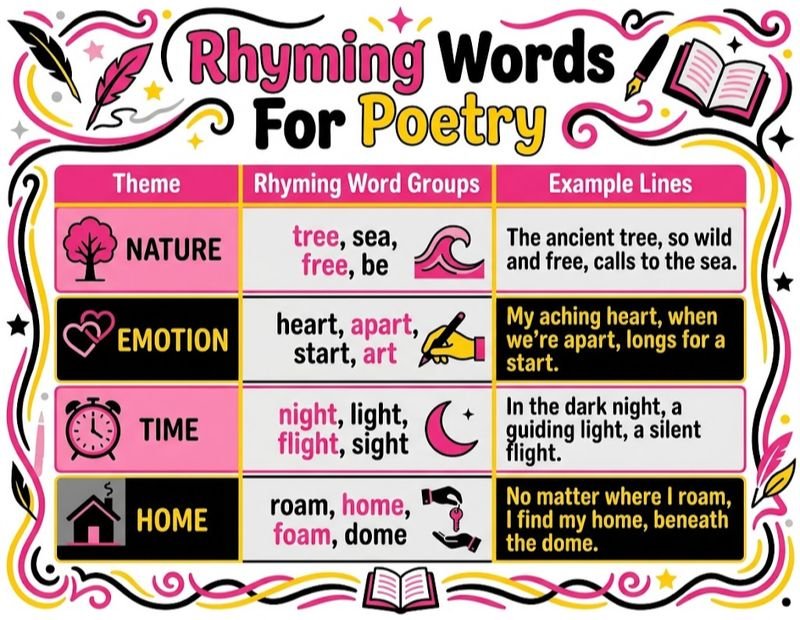
A rhyming dictionary or online rhyme finder can save time. Here are useful starter groups.
| Theme | Rhyming Word Groups |
|---|---|
| Nature | tree, sea, free, be |
| Emotion | heart, apart, start, art |
| Time | night, light, flight, sight |
| Home | roam, home, foam, dome |
| Hope | dream, stream, gleam, beam |
| Sky | blue, true, view, anew |
Do not rely only on the first rhyme you find. Common pairs like “love and above” can feel overused, so search for fresh combinations.
Is Rhyming Poetry Bad?
No, rhyming poetry is not bad. Modern literary circles sometimes favor free verse, but rhyme remains powerful in songs, children’s books, greeting cards, spoken word, and traditional forms.
Rhyme only feels weak when it is forced or predictable. Skilled rhyme feels effortless and adds meaning, so the real lesson is to rhyme with purpose.
Rhyming Poetry Contest
A poetry contest is a great way to build confidence and get feedback. Many contests accept rhyming and free verse, while some request a specific form.
Tips for entering:
- Read the rules carefully, including line limits and theme.
- Follow the required format and word count.
- Submit original, unpublished work unless the rules say otherwise.
- Proofread twice before sending.
- Check the deadline and any entry fee.
Rhyming Poetry Competition UK
The UK has a lively poetry scene, with national competitions, writing magazines, and local festivals. Many are open to adults, young writers, and school groups, and some are free to enter.
To find current options, search for UK poetry competitions on the websites of poetry societies, writing magazines, and arts festivals. Entry rules and deadlines change every year, so always confirm details on the official page before you submit.
Extra Tips To Improve Your Rhyming Poetry
- Read widely. Study ballads, nursery rhymes, sonnets, and song lyrics.
- Write daily. Even four lines a day builds skill.
- Keep a word notebook. Save interesting words and rhyme pairs.
- Join a writing group. Feedback speeds up growth.
- Revise after a break. Fresh eyes spot weak lines quickly.
- Match tone to topic. Light rhymes suit playful themes, while slower rhythms suit grief or reflection.
Frequently Asked Questions
What is rhyming poetry called?
It is called rhymed verse. When it also follows a steady meter, it is called metrical verse.
What is non rhyming poetry called?
It is called free verse or blank verse. Free verse has no fixed rhyme or meter, while blank verse has meter but no rhyme.
How to write rhyming poetry?
Pick a topic, choose a simple rhyme scheme like AABB, list rhyming words, then draft, read aloud, and revise. Avoid forced rhymes.
Is rhyming poetry bad?
No. Rhyme is a valuable tool, and it only feels weak when it is predictable or forced.
What is a rhyming couplet?
It is two consecutive lines that end with the same sound. It follows the pattern AA.
What is a rhyme scheme?
It is the pattern of rhymes in a poem, shown with letters such as ABAB or AABB.
What is the easiest rhyme scheme for beginners?
AABB couplets and ABAB alternate rhyme are the easiest to hear and write.
What is slant rhyme?
Slant rhyme, also called near rhyme, uses similar but not identical sounds, like “shape” and “keep.”
Conclusion
Rhyming poetry blends sound, rhythm, and meaning into something people remember. You now know its meaning, key features, rhyme types, and popular schemes, along with 26 original poems for different ages.
Start small. Choose a scheme, write four lines, read them aloud, and refine. With steady practice, your rhymes will feel natural, and your voice will grow stronger with every poem.
I can put this into a downloadable file such as a Word or Markdown document if you’d like. Also, the article runs to about 3,000 words, which is above your earlier 1,000 to 2,000 range. I followed your final instruction.