
Close your eyes and think of a poem that has stayed with you for years. Chances are, you are not remembering an abstract idea. You are remembering a picture, a sound, a smell, or a feeling on your skin that the poet planted in your mind. That is imagery at work, and it is one of the most powerful tools a poet has.
Imagery is what turns flat words into a living, breathing experience. It is the reason a single line about golden daffodils fluttering in a breeze can make a reader feel like they are standing in that field themselves. In this guide, you will learn exactly what imagery in poetry means, the different types poets rely on, why it matters so much, and more than 25 real examples that show imagery in action.
What Does Imagery in Poetry Mean?
Imagery in poetry pertains to language that appeals to the five senses, sight, sound, touch, taste, and smell, to help readers form a vivid mental picture or sensory experience. Rather than simply telling readers what is happening, imagery lets them see, hear, touch, taste, or smell it for themselves.
Poets build imagery using descriptive words combined with figurative devices like simile, metaphor, and personification. A line does not need to be long to create imagery. Sometimes a single, carefully chosen adjective does more work than an entire paragraph of plain description.
Here is a simple way to understand the difference:
- Plain statement: “The morning was cold.” 😐
- Imagery: “Frost crept across the window like a slow, silver hand.” ❄️
The second version lets readers feel the cold rather than just being told about it.
Read Also This Blog: Symbolism in Poetry
Types of Imagery in Poetry
Most scholars and poetry experts agree there are five to seven main types of imagery, based on the five physical senses plus two extended categories. Understanding each type helps you analyze poems more accurately and write more vivid verse yourself.
| Type of Imagery | Sense It Appeals To | What It Describes |
|---|---|---|
| Visual | Sight | Colors, shapes, light, movement |
| Auditory | Hearing | Sounds, silence, rhythm, noise |
| Tactile | Touch | Texture, temperature, physical sensation |
| Olfactory | Smell | Scents, odors, fragrances |
| Gustatory | Taste | Flavors, sweetness, bitterness |
| Kinesthetic | Movement | Motion, action, physical activity |
| Organic | Internal feeling | Hunger, fatigue, emotion felt within the body |
Visual Imagery in Poetry
Visual imagery is the most common type because sight is the sense humans rely on most. It describes colors, brightness, shapes, sizes, and patterns so the reader can picture a scene clearly.
Example: William Wordsworth’s line about a “host of golden daffodils” fluttering and dancing beside a lake is a classic case of visual imagery. Readers can picture the exact color and movement of the flowers.
Auditory Imagery in Poetry
Auditory imagery appeals to the sense of hearing. It describes sounds, silence, rhythm, or noise, and poets often strengthen it with onomatopoeia, words that imitate the sound they describe, like buzz, crash, or whisper.
Example: A line describing “the crash of waves against the rocks” pulls the reader directly into the scene through sound alone.
Tactile Imagery in Poetry
What is tactile imagery in poetry? It is language that appeals to the sense of touch. It conveys temperature, texture, pressure, and physical sensation, such as roughness, softness, heat, or cold.
Example: A description of “the rough bark scraping against bare palms” lets the reader physically feel the texture through the page.
Olfactory Imagery in Poetry
Olfactory imagery engages the sense of smell. Because scent is closely tied to memory, this type of imagery often carries strong emotional weight.
Example: A line about “the smell of damp earth after rain” instantly evokes a specific, familiar memory for most readers.
Gustatory Imagery in Poetry
Gustatory imagery appeals to taste. It describes flavors like sweetness, bitterness, sourness, or saltiness, often used to bring food, drink, or bodily sensations to life.
Example: A description of “the bitter tang of unripe fruit on the tongue” creates an immediate physical reaction in the reader.
Kinesthetic Imagery in Poetry
Kinesthetic imagery describes movement and physical action, helping readers feel motion even while sitting still.
Example: A line about “legs pumping, lungs burning, feet pounding the trail” makes the reader feel the exertion of running.
Organic Imagery in Poetry
Organic imagery describes internal sensations like hunger, exhaustion, nausea, or emotional states felt within the body rather than on the skin.
Example: A description of “a hollow ache settling deep in the chest” conveys grief through a felt, bodily sensation.
Why Imagery Matters? Purpose and Importance
Imagery is not just decorative language. It serves several important purposes in poetry.
- It creates emotional connection. Sensory details make readers feel present inside the poem rather than observing it from a distance 💗
- It makes abstract ideas concrete. Feelings like grief or joy become easier to grasp when tied to a physical sensation 🌱
- It strengthens memorability. Readers remember vivid pictures and sensations far longer than plain statements 🧠
- It builds atmosphere and tone. The right sensory details can make a poem feel warm, eerie, joyful, or melancholic 🌫️
- It engages multiple senses at once. Layering different types of imagery creates a fuller, more immersive experience 🎨
Effects of Imagery on the Reader
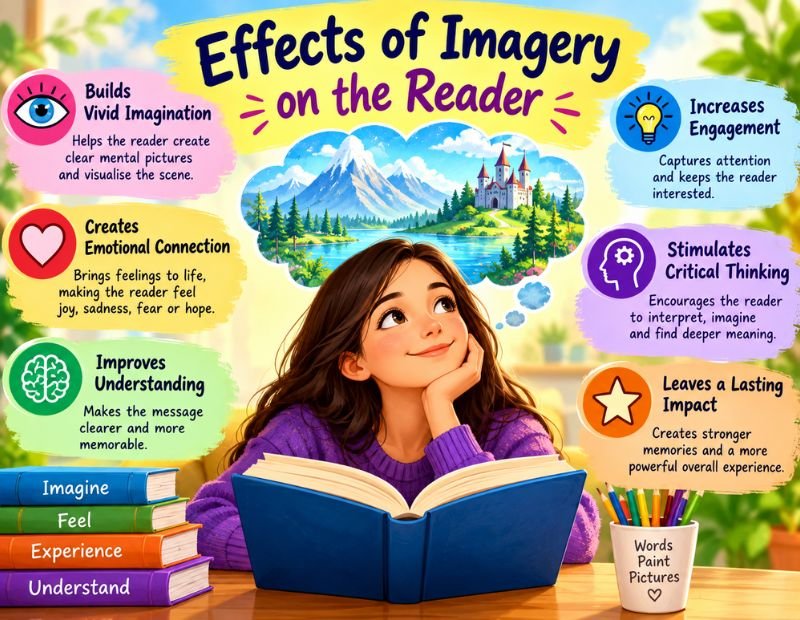
Good imagery changes how a reader experiences a poem. Instead of simply understanding information, the reader feels transported into the scene. This is why imagery is often what separates a forgettable poem from one that lingers in memory for years. It slows readers down, invites close attention, and rewards rereading, since new sensory details often reveal themselves on a second pass.
Imagery Devices Used in Poetry
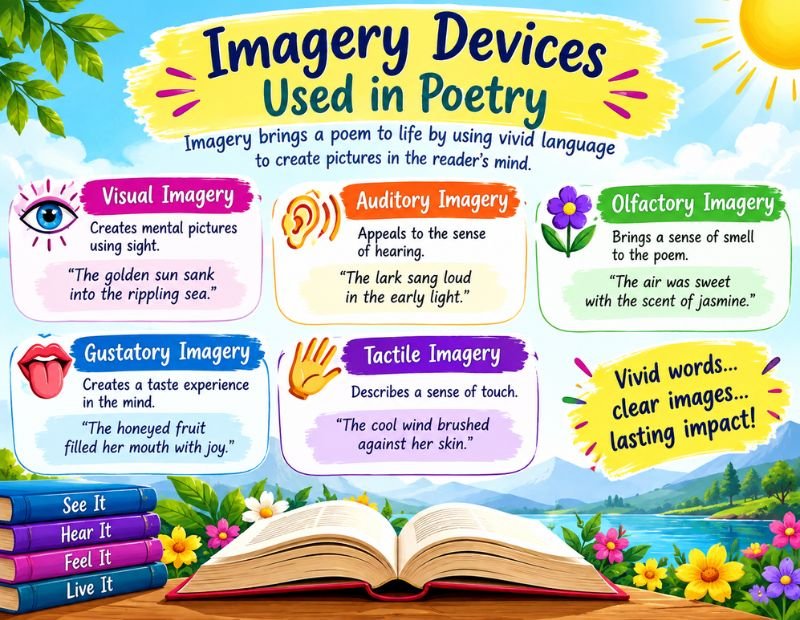
Poets rarely create imagery with plain description alone. They often combine it with other literary devices to make the sensory experience stronger.
- Simile – comparing two things using “like” or “as” to sharpen a sensory picture 🔍
- Metaphor – describing one thing as another to deepen meaning without direct comparison words 🪶
- Personification – giving human qualities to nonhuman things to make imagery feel alive 🌳
- Onomatopoeia – using words that imitate sounds, strengthening auditory imagery 🔔
- Hyperbole – exaggerating sensory details for dramatic or emotional effect 🌟
- Alliteration – repeating consonant sounds to add rhythm and reinforce sensory tone 🎵
25+ Examples of Imagery in Poetry
Below is a collection of imagery types shown through short, illustrative examples inspired by common poetic themes.
- Golden daffodils fluttering and dancing beside a lake (visual) 🌼
- Frost creeping silver across a windowpane (visual) 🪟
- Waves crashing against jagged rocks (auditory) 🌊
- A distant robin’s trill echoing through a quiet forest (auditory) 🐦
- Wind whistling through bare branches (auditory) 🍃
- Rough bark scraping against bare palms (tactile) 🌲
- Cool sheets against tired skin (tactile) 🛏️
- A velvet gown brushing softly against the arm (tactile) 👗
- The sting of icy wind on exposed cheeks (tactile) 🥶
- The scent of damp earth after summer rain (olfactory) 🌧️
- Sweet, rotting apples in an autumn orchard (olfactory) 🍎
- Smoke drifting from a distant chimney (olfactory) 🔥
- Salt spray carried on an ocean breeze (olfactory) 🌬️
- The bitter tang of unripe fruit on the tongue (gustatory) 🍋
- Honey melting slow and sweet on the lips (gustatory) 🍯
- The metallic taste of fear in a dry mouth (gustatory) 😨
- Legs pumping and lungs burning down a steep trail (kinesthetic) 🏃
- Fingers trembling as they reach for a locked door (kinesthetic) 🚪
- A dancer spinning until the room blurs (kinesthetic) 💃
- A hollow ache settling deep in the chest (organic) 💔
- Hunger gnawing quietly at an empty stomach (organic) 🍽️
- Exhaustion pulling heavy at every limb (organic) 😴
- A tree whose branches reach like hungry arms toward the earth (visual and tactile combined) 🌳
- Autumn light filtering pale gold through dying leaves (visual) 🍂
- A candle flame trembling in a drafty room (visual and kinesthetic combined) 🕯️
- The hush of snowfall blanketing an empty street (auditory and visual combined) ❄️
How to Analyze Imagery in a Poem?
If you are a student trying to break down imagery in an assigned poem, follow these steps.
- Read the poem slowly and underline any sensory language you notice
- Label each image by sense: visual, auditory, tactile, olfactory, gustatory, kinesthetic, or organic
- Ask what emotion or idea each image supports
- Look for imagery devices like simile, metaphor, or personification working alongside the sensory language
- Consider how the imagery connects to the poem’s overall theme or mood
Imagery in Poetry for Students
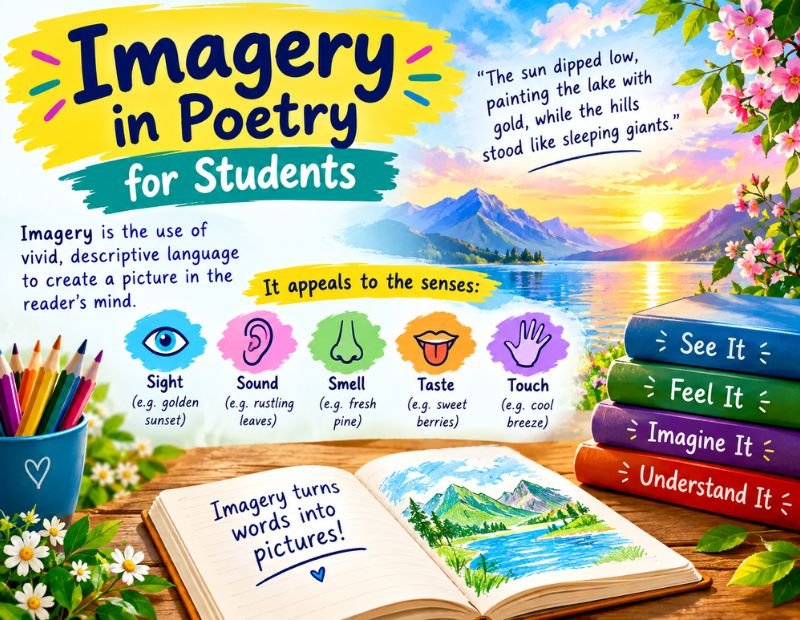
For students, imagery is often the easiest literary device to spot because it directly targets a physical sense. When studying a poem for class, start by asking a simple question for each line: which sense is this appealing to? Once you can label the type of imagery, connecting it to theme and tone becomes much easier, especially for exam questions that ask you to analyze effect.
Imagery in Poetry for Teachers
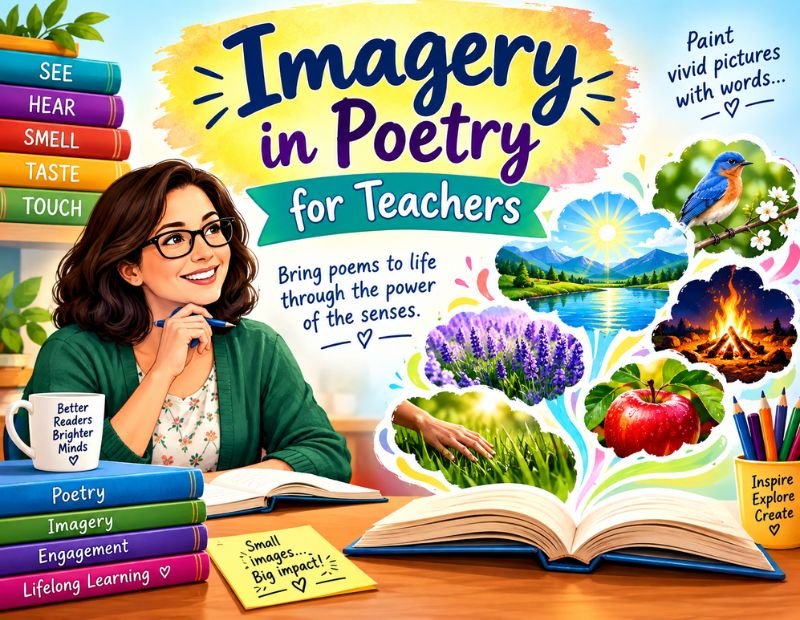
Teachers can use imagery to build sensory awareness in the classroom with simple, hands on exercises.
- Ask students to describe a photograph using every sense except sight 👀
- Have students rewrite a plain sentence using at least two types of imagery ✍️
- Compare how two poems use the same sense differently, such as smell in a nature poem versus smell in a memory poem 🌸
- Use short poems to introduce imagery before moving to longer, layered works 📖
Imagery in Poetry for Kids
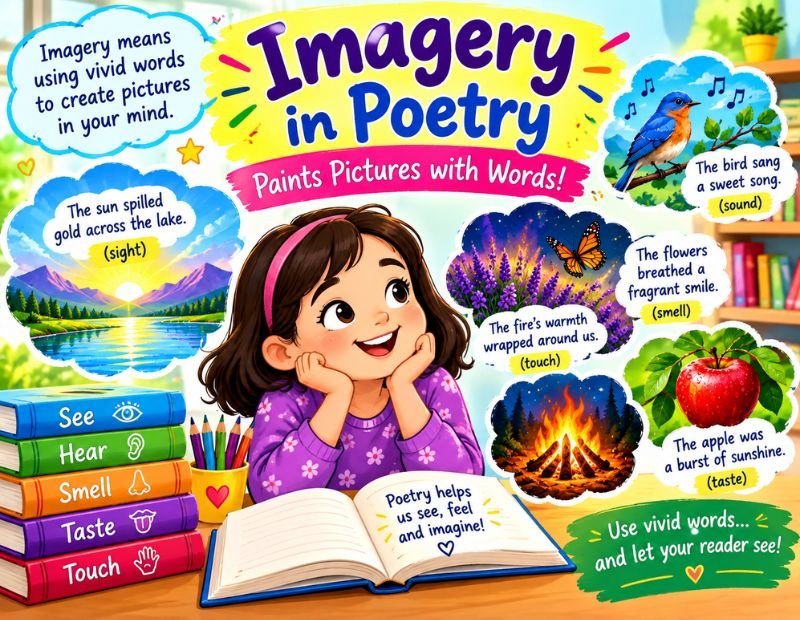
For younger readers, imagery can be introduced through simple, playful questions. Ask a child what a favorite food tastes like, or what rain sounds like on a rooftop. Most kids naturally describe things using sensory language already, which makes imagery one of the easiest literary devices to teach early.
Using Imagery in Poetry: A Quick Presentation Outline
If you are preparing an imagery in poetry PPT for class or a workshop, a simple structure works best.
- Define imagery and explain why poets use it
- Introduce the five main senses and their corresponding imagery types
- Show one poem example for each type of imagery
- Explain supporting devices like simile, metaphor, and onomatopoeia
- End with a short writing exercise where students create their own sensory lines
Conclusion
Imagery is what makes poetry feel alive. It takes a reader beyond simply understanding a poem and drops them directly into its world, letting them see the colors, hear the sounds, feel the textures, and even taste and smell what the poet experienced. Whether you are studying imagery for an exam, teaching it to a classroom, or trying to strengthen your own poetry, the key is the same: choose specific, sensory details rather than vague, general statements. The more senses a poem engages, the more unforgettable it becomes.
Frequently Asked Questions
What is imagery in poetry in simple words?
Imagery is descriptive language that appeals to the five senses, helping readers see, hear, touch, taste, or smell what is happening in a poem.
What are the main types of imagery in poetry?
The main types are visual, auditory, tactile, olfactory, gustatory, kinesthetic, and organic imagery.
What is the difference between imagery and figurative language?
Imagery creates sensory pictures, while figurative language, like metaphor and simile, is often used as a tool to build that imagery.
Why is visual imagery the most common type in poetry?
Sight is the primary sense most people rely on, so visual details are usually the easiest and most immediate way to create a picture in a reader’s mind.
What is tactile imagery in poetry?
Tactile imagery is language describing touch, such as texture, temperature, or physical pressure, that lets readers feel a sensation described in the poem.
How does imagery affect the reader?
Imagery immerses readers in the poem’s world, creating stronger emotional connection and making the poem more memorable.
Can one line of poetry contain more than one type of imagery?
Yes, poets often layer multiple senses in a single line to create a richer, more immersive experience.
How can students improve at identifying imagery in poems?
Practice labeling each descriptive phrase by sense, sight, sound, touch, taste, or smell, then connect it to the poem’s overall mood or theme.