
Poetry is one of the oldest forms of human expression, yet it still feels new every time someone writes an honest line. From ancient chants passed down around fires to modern verses shared on social media, poetry has always found a way to capture emotion, memory, and meaning in a way plain prose cannot.
This complete guide walks through what poetry actually is, where it came from, why it affects the brain the way it does, and how you can write it yourself. You will also find the major types, structural elements, sound devices like anaphora and assonance, and a look at poetry traditions across English, Urdu, and Hindi, along with famous poets like Mary Oliver and Billy Collins.
What Is Poetry?
Poetry is a form of literary art that uses carefully chosen and arranged language to create emotional, sensory, and intellectual effects. Unlike prose, poetry pays close attention to sound, rhythm, imagery, and compression, often saying more with fewer words than any other form of writing.
Poetry differs from ordinary writing in a few key ways:
- Economy, since a short poem can carry the emotional weight of an entire story 📝
- Sound, because poems are built to be heard, not just read silently 🎵
- Compression, packing complex feelings into a handful of concentrated images 💭
- Form, following specific patterns like stanzas, meter, or line breaks 📐
Poets across history have defined poetry differently. Some call it heightened emotion recalled in calm reflection, while others simply say you know poetry when it makes you feel something you cannot fully explain.
Read Also This Blog: Couplet in Poetry
History of Poetry
It did not begin on a page. It began as sound, chanted or sung long before written language existed. Early oral poetry helped communities remember history, pass down laws, and honor ancestors, since rhythm and repetition made long stories easier to memorize.
Key stages include:
- Oral and epic traditions, such as ancient praise poems and long narrative epics recited by memory 🎙️
- Classical poetry from Greek and Roman writers, who formalized meter and verse structure 🏛️
- Medieval and religious poetry, often tied to hymns, prayers, and moral instruction ⛪
- The Romantic era, which shifted focus toward personal emotion and nature 🌿
- Modern and contemporary poetry, which broke away from strict rhyme and meter in favor of free verse and experimentation 🖊️
Even today, oral poetry traditions remain alive and powerful, particularly in cultures where praise poetry and spoken word performance are still central to public life.
How It Affects the Mind of Readers?
Poetry does not just entertain, it actually changes how the brain processes language and emotion. Because poems rely on rhythm, imagery, and unexpected word choices, they activate areas of the brain linked to both memory and feeling at the same time.
Reading or hearing it can:
- Slow down thinking, encouraging reflection instead of quick reaction 🧠
- Trigger emotional responses through sound patterns like rhyme and repetition ❤️
- Improve memory retention, since rhythmic language is easier to recall than plain prose 📚
- Build empathy by placing readers directly inside another person’s perspective 🤝
- Provide comfort during grief, heartbreak, or major life transitions 🕊️
This is part of why sad and love poetry remain some of the most searched and shared categories online. People often find that a poem expresses a feeling they could not put into words themselves.
How to Write the Best One?
Writing strong poetry is less about following strict rules and more about paying close attention to language, feeling, and rhythm. Beginners often assume it as must rhyme, but plenty of powerful poems use free verse instead.
Here is a simple step by step approach for new poets:
- Start with a real feeling or image, not an abstract idea 🌱
- Choose precise words instead of vague or generic ones 🎯
- Read your draft out loud to check its rhythm and flow 🔊
- Use line breaks intentionally, since where a line ends changes meaning and pace ✂️
- Cut unnecessary words, since poetry rewards compression over length ✍️
- Revise multiple times, since first drafts rarely reveal a poem’s best version 🔁
Types
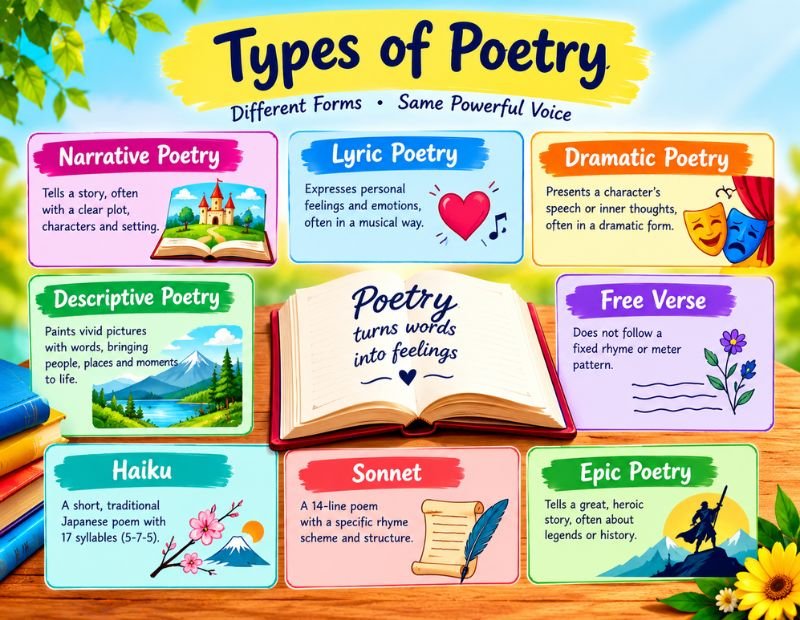
There are many recognized types of poetry, each shaped by its own structure, purpose, and tone.
| Type | Description |
|---|---|
| Lyric poetry | Expresses personal emotion, often musical and introspective |
| Narrative poetry | Tells a story with characters, setting, and plot |
| Epic poetry | A long narrative poem celebrating heroic deeds and grand events |
| Sonnet | A fourteen line poem with a fixed rhyme scheme, often about love |
| Haiku | A short three line Japanese form following a 5 7 5 syllable pattern |
| Ode | A formal poem praising a person, object, or idea |
| Elegy | A reflective poem mourning someone’s death |
| Free verse | Poetry without a fixed rhyme scheme or meter |
| Ballad | A rhythmic, often musical poem that tells a story, traditionally sung |
Structure
Structure refers to how a poem is physically organized on the page, including line length, stanza size, and overall pattern. Structure is different from form, since form refers to a poem’s recognized type, like a sonnet or haiku, while structure describes how the words and lines are actually arranged.
Common structural elements include:
- Stanza, a grouped set of lines functioning like a paragraph in prose 📄
- Meter, the rhythmic pattern created by stressed and unstressed syllables 🥁
- Rhyme scheme, the pattern of end rhymes across lines, often labeled with letters like ABAB 🔤
- Verse, a single metrical line within a poem 📏
- Refrain, a repeated line or phrase that returns throughout the poem 🔄
Elements
While structure focuses on organization, the elements of poetry cover the deeper building blocks that give a poem its meaning and texture.
| Element | Function |
|---|---|
| Imagery | Creates vivid mental pictures using sensory language |
| Diction | Reflects word choice and level of formality |
| Tone | Conveys the poet’s attitude toward the subject |
| Theme | Represents the poem’s central idea or message |
| Symbolism | Uses objects or images to represent larger concepts |
| Rhythm | Creates a musical, patterned flow when read aloud |
Devices
Poetic devices are techniques poets use to shape sound, emphasis, and meaning. Many of the most searched poetry terms fall into this category, especially devices tied to repetition and sound.
Repetition
Repetition means intentionally reusing a word, phrase, or line for emphasis. It reinforces emotion, builds rhythm, and helps a key idea stick in the reader’s memory.
Anaphora
Anaphora is a specific type of repetition where the same word or phrase begins several consecutive lines. It is often used to build intensity, as seen in poems that repeat phrases like “in every” or “whereas” at the start of successive lines to hammer home a central idea.
Enjambment
Enjambment happens when a sentence or thought continues past the end of a line without a pause, running into the next line or stanza. This creates momentum, surprise, or a double meaning, and it is the opposite of an end stopped line, where a thought finishes cleanly at the line’s end.
Assonance
Assonance is the repetition of vowel sounds in nearby words, such as the long “ee” sound in “deep green sea.” It is sometimes called internal rhyme, and it helps control a poem’s pace, since longer vowel sounds slow a line down while shorter ones speed it up.
Consonance
Consonance is the repetition of consonant sounds within or at the end of nearby words, such as the repeated “t” sounds in “pitter patter.” Unlike alliteration, consonance does not need to occur at the beginning of a word, which makes it a more flexible and subtle sound device.
Poetry Across Languages and Cultures
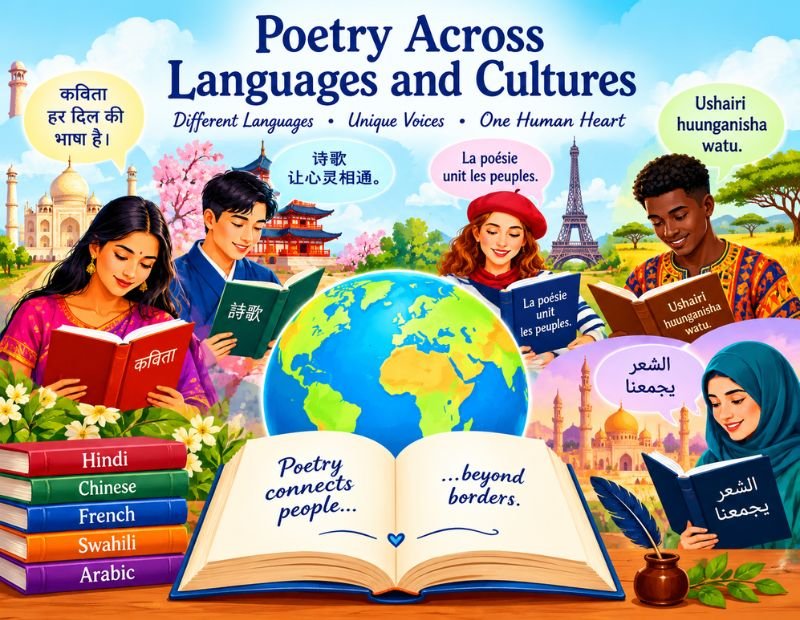
Urdu Poetry
Urdu poetry is known for its rich tradition of ghazals and nazms, often exploring themes of love, longing, and spirituality through carefully balanced couplets and metaphor heavy language.
خاموش رات میں چاند سے باتیں کرتے ہیں
دل کے ارمانوں کو لفظوں میں ڈھالتے ہیں
جو خواب آنکھوں نے دیکھے تھے کبھی
انہیں امید کے رنگوں سے سجاتے ہیں
Khamosh raat mein chaand se baatein karte hain
Dil ke armaanon ko lafzon mein dhaalte hain
Jo khwaab aankhon ne dekhe thay kabhi
Unhein umeed ke rangon se sajaate hain
بارش کی بوندوں میں خوشبو سی بات ہے
تنہائی میں بھی تیری یادوں کا ساتھ ہے
دل نے جو چاہا وہ خواب بن گیا
محبت میں ہر لمحہ خاص بات ہے
Barish ki boondon mein khushboo si baat hai
Tanhai mein bhi teri yaadon ka saath hai
Dil ne jo chaha woh khwaab ban gaya
Mohabbat mein har lamha khaas baat hai
English Poetry
English poetry spans centuries, from Shakespearean sonnets to modern free verse, and remains one of the most studied and widely translated poetic traditions in the world.
The morning whispers through the trees,
A golden breeze moves softly by,
The world awakens with the sun,
And hope begins across the sky.
I carry dreams within my heart,
Like stars that brighten darkest nights,
Though distant roads may test my soul,
I walk ahead toward brighter lights.
The river sings beneath the moon,
While silver clouds drift through the night,
The flowers dance beside the breeze,
And nature glows in peaceful light.
Life writes its stories day by day,
With joy and sorrow intertwined,
Each step becomes a treasured verse,
Each moment leaves its mark behind.
Hindi Poetry
Hindi poetry blends classical forms with modern free verse, frequently drawing on themes of nature, devotion, social change, and personal emotion, with deep roots in oral recitation.
रात चाहे कितनी गहरी हो,
सुबह की किरण ज़रूर आएगी,
जो दिल उम्मीद से चलता है,
उसकी राह फिर मुस्कुराएगी।
Raat chahe kitni gehri ho,
Subah ki kiran zaroor aayegi,
Jo dil ummeed se chalta hai,
Uski raah phir muskuraayegi.
तेरी मुस्कान में सुकून सा है,
तेरी बातों में प्यार बसा है,
तू पास रहे तो दिल खिलता है,
तेरे बिना सब कुछ अधूरा सा है।
Teri muskaan mein sukoon sa hai,
Teri baaton mein pyaar basa hai,
Tu paas rahe to dil khilta hai,
Tere bina sab kuch adhoora sa hai.
चलते रहो चाहे राह कठिन हो,
हर मोड़ पर एक सीख मिलेगी,
गिरकर फिर जो उठना सीखो,
ज़िंदगी खुद खूबसूरत लगेगी।
Chalte raho chahe raah kathin ho,
Har mod par ek seekh milegi,
Girkar phir jo uthna seekho,
Zindagi khud khoobsurat lagegi.
हवा में फूलों की खुशबू है,
आसमान में रंग बिखरे हैं,
पेड़ों पर चिड़ियों के गीत हैं,
प्रकृति के पल कितने सुनहरे हैं।
Hawa mein phoolon ki khushboo hai,
Aasmaan mein rang bikhre hain,
Pedon par chidiyon ke geet hain,
Prakriti ke pal kitne sunahare hain.
Poetry in South Africa
South African poetry carries a strong oral and performance tradition, rooted in praise poetry known as izibongo, historically performed by imbongi, or praise poets, at important cultural and political events. Modern South African poetry blends this oral heritage with spoken word, slam poetry, and written verse, often addressing themes of identity, history, and social justice.
Ubuntu bethu, siyaphila ndawonye,
Izandla zethu zakha uthando,
Ilanga likhanya phezu kwethu,
Sihamba ngobunye nangokuthula.
Iintaba zimi phantsi kwesibhakabhaka,
Umoya uthwala ivumba leentyatyambo,
Ilanga litshona phezu komhlaba,
Intliziyo yam ifumana uxolo.
Lerato la ka le khanya joalo ka letsatsi,
Le futhumatsa pelo ya ka ka bonolo,
Ha o le teng, lefatshe le a bososela,
Re tsamaya mmoho tseleng ya bophelo.
Onder die son van Afrika,
Berge staan stil teen die hemel,
Die wind sing deur die veld,
En my hart vind vrede hier.
Python
It is worth clarifying that “poetry python” does not refer to literary poetry at all. Poetry is also the name of a popular Python programming tool used for dependency management and packaging, helping developers organize project files through a single configuration file instead of juggling multiple setup files. This is an entirely separate meaning from literary poetry, and search intent for this term usually relates to coding rather than creative writing.
Famous Poets and Their Styles
Mary Oliver Whimsical Philosophy
Mary Oliver was an American poet celebrated for her plain, accessible language and deep communion with the natural world. Her poetry, including the Pulitzer Prize winning collection American Primitive, often erases the line between speaker and nature, inviting readers into quiet, meditative observation of animals, seasons, and solitude. Oliver believed poetry should not be overly fancy, and her work remains widely loved for its clarity and emotional honesty.
Poetry by Billy Collins
Billy Collins, a former United States Poet Laureate, is known for conversational, witty poetry that finds depth in everyday moments. His accessible style, often blending humor with quiet reflection, helped introduce countless readers to poetry who might otherwise have found the form intimidating.
Emotion and Theme
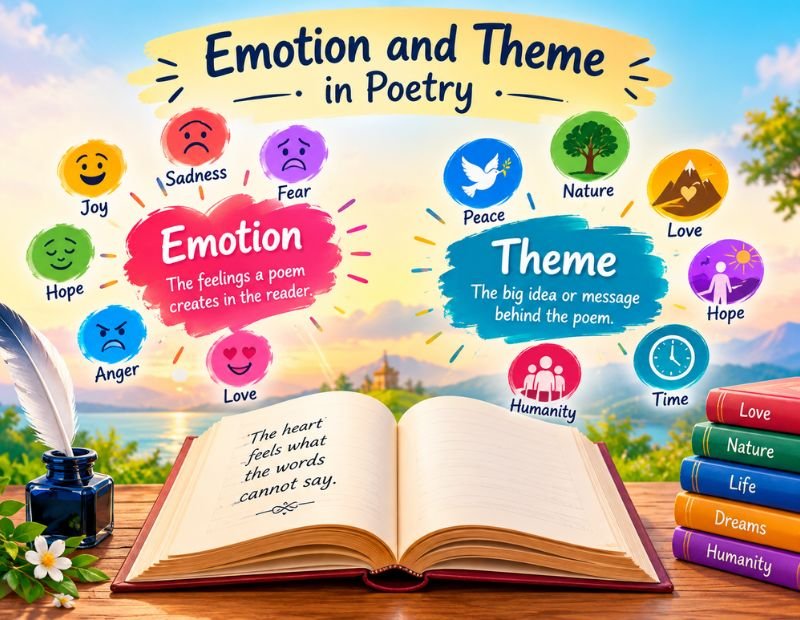
Romantic Poetry
Romantic poetry emphasizes intense emotion, nature, and individual imagination, drawing from the Romantic literary movement that celebrated awe, solitude, and the sublime power of the natural world.
Beneath the moon, your eyes softly shine,
Your gentle hand forever rests in mine,
With every heartbeat, my dreams come true,
And every beautiful moment leads to you.
Your smile brings sunlight to my heart,
Your love makes every darkness depart,
In your embrace, the world feels new,
My sweetest dream begins with you.
Through quiet nights and skies of blue,
My heart keeps whispering only you,
No matter where the seasons roam,
Your loving heart will be my home.
Your voice is music, soft and sweet,
Your presence makes my world complete,
Each tender glance becomes a song,
With you, my heart knows where it belongs.
Sad Poetry
Sad poetry gives language to grief, loss, and heartbreak, often helping readers process emotions they struggle to express in everyday conversation.
The moon still shines, but nights feel cold,
Your memories linger, stories untold,
I search for you in every silent place,
Yet find only shadows where I saw your face.
Rain falls softly upon my window pane,
Each drop whispers the echo of my pain,
I smile outside while my heart falls apart,
For losing you left silence in my heart.
The empty road remembers every tear,
The words we shared still sound so near,
Time moves on, but sorrow stays,
Like a fading light on lonely days.
I held your dreams close to my heart,
Never believing we would drift apart,
Now every sunset brings your name,
And every lonely night feels just the same.
Love Poetry
Love poetry captures romantic longing, devotion, and intimacy, remaining one of the most timeless and widely written poetic themes across every culture and language.
Among the roses, I would choose your name,
Among the stars, your light would shine the same,
My heart has found its sweetest place to be,
In every moment shared with you and me.
Your hand in mine feels warmer than the sun,
With you beside me, every day is one,
A thousand moments bloom when you are near,
And love grows deeper with each passing year.
When moonlight dances softly on the sea,
I close my eyes and feel you close to me,
No distance can diminish what we share,
For love still finds you everywhere.
Your smile awakens stars within my heart,
Your gentle words make lonely hours depart,
In every dream, your loving light I see,
And every heartbeat whispers you to me.
Happy Poetry
Happy poetry celebrates joy, gratitude, and light hearted moments, offering an uplifting contrast to poetry centered on sorrow or longing.
A Heart Full of Light
Morning smiles across the sky,
Golden dreams are floating by,
Joy awakens in my heart,
A beautiful day is set to start.
Dance of Happiness
Let every moment bloom with cheer,
Let laughter make the heart feel near,
With every step, the world feels bright,
And happiness fills the day with light.
Simple Joy
A gentle breeze, a sunny day,
A peaceful heart along the way,
Small moments shine like stars above,
Life feels beautiful, filled with love.
Endless Smile
The flowers dance beneath the sun,
The clouds drift softly, one by one,
My heart is free, my spirit sings,
Happiness gives my soul its wings.
Frequently Asked Questions
What is poetry in simple words?
Poetry is writing that uses rhythm, sound, and carefully chosen words to express emotion and ideas more powerfully than ordinary prose.
What are the main elements ?
The main elements include imagery, diction, tone, theme, symbolism, and rhythm, all working together to shape meaning.
What is the difference between rhyme and rhythm?
Rhyme refers to matching sounds at the end of words, while rhythm refers to the pattern of stressed and unstressed syllables across a line.
What is enjambment used for?
Enjambment carries a sentence across line breaks without pausing, creating momentum, surprise, or added emphasis on the following line.
Is free verse still considered real poetry?
Yes, free verse is a fully recognized poetic form that skips fixed rhyme and meter while still using rhythm, imagery, and line breaks intentionally.
What makes Mary Oliver’s poetry unique?
Her poetry blends plain, accessible language with deep observation of nature, often dissolving the boundary between the speaker and the natural world.
Why is Billy Collins considered accessible?
His conversational tone, humor, and focus on everyday moments make his poetry easy to understand without sacrificing emotional depth.
Conclusion
Poetry is far more than rhyming lines on a page. It is a living tradition that stretches from ancient oral chants to modern spoken word stages, carrying emotion, memory, and meaning across every culture and language. Understanding its structure, devices, and major voices, from anaphora and enjambment to poets like Mary Oliver and Billy Collins, gives readers and writers alike a richer appreciation for why poetry continues to move people the way it does.
Whether you are drawn to sad poetry, love poetry, epic poetry, or the quiet accessibility of contemporary free verse, poetry remains one of the most powerful ways humans have found to say the unsayable.